What is Constitutional Morality? [UPSC Notes]
Constitutional morality is adherence to constitutional values and spirit. Understand the meaning, examples, and direct relevance for UPSC Prelims and Mains.
Dec, 2025
•4 min read
Constitutional morality is not a natural sentiment. It has to be cultivated. We must realise that our people have yet to learn it. Democracy in India is only a top dressing on an Indian soil which is essentially undemocratic. - Dr B.R. Ambedkar
These words convey that constitutional morality is learned, not inherited. In India’s diversity, it binds citizens and institutions to rise above divisions and uphold constitutional values. Constitutional morality is a highly relevant topic for UPSC Prelims and GS Paper II of Mains. Let us understand constitutional morality in India.
What is Constitutional Morality?
Constitutional morality means respecting the Constitution’s values, procedures, and limitations while exercising power, so that every action remains within the spirit of the Constitution.
- It guides how institutions like Parliament, Government, Judiciary and Civil Services should behave in a fair, non-arbitrary and accountable manner.
- It demands loyalty to principles such as justice, liberty, equality, fraternity, rule of law, and dignity of the individual.
- It prefers constitutional values over social prejudices, majoritarian pressure or narrow political interests.
- It is not automatic; it has to be consciously cultivated through education, institutions and civic culture.
- It is backwards-looking in that it preserves the constitutional vision, and forward-looking in that it guides society towards justice, equality, and dignity.
- The idea was clearly explained in Naz Foundation v. Government of NCT of Delhi (2009), where the court said that constitutional values are more important than public opinion or social morality.
Also read: Judicial Review in India: Meaning, Scope & Provisions [UPSC]
Key Pillars of Constitutional Morality
Constitutional morality stands on certain core pillars that keep democracy healthy and prevent the misuse of power.
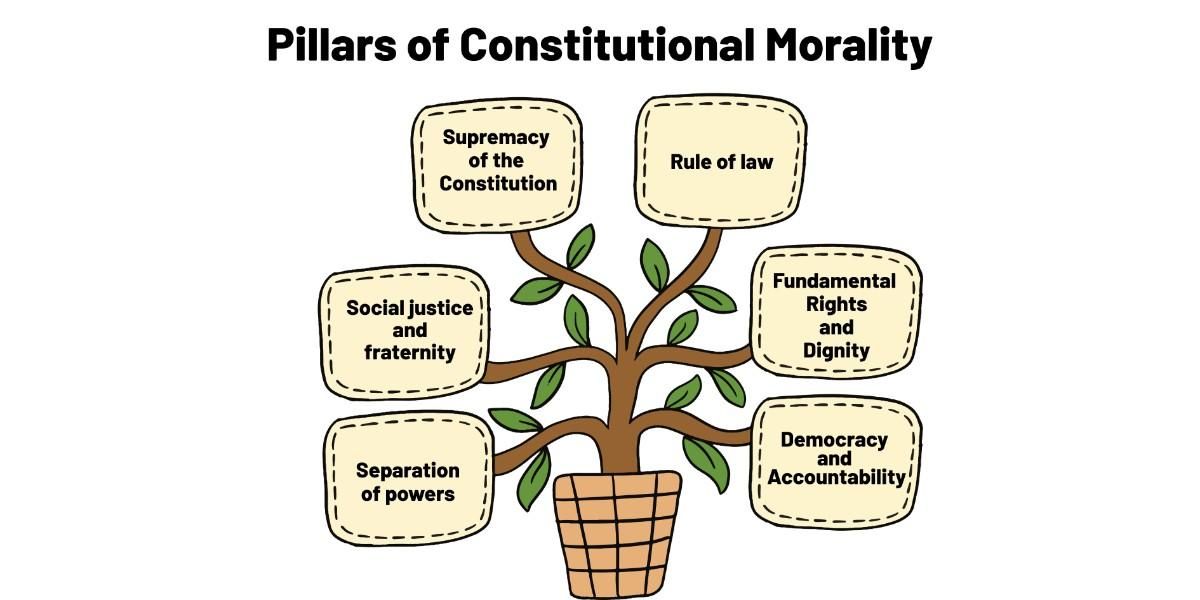
- Supremacy of the Constitution: All organs of the State must act within the boundaries of the Constitution; any law or action violating it can be struck down by courts.
- Rule of Law: All persons, including those in authority, are equally subject to law; arbitrary or personal rule is not allowed.
- Fundamental Rights and Dignity: Respecting and protecting fundamental rights in Part III (e.g., equality, freedoms, life and personal liberty, anti-discrimination, protection of minorities) is central to moral governance.
- Democracy and Accountability: Free and fair elections, responsible government, and accountability of the executive to the legislature and people.
- Separation of Powers: The legislature, executive, and judiciary must respect each other’s roles while preventing concentration of power.
- Social Justice and Fraternity: Special concern for historically disadvantaged groups and promotion of unity with respect for diversity.
Also read: Communalism in India: Meaning, Evolution and Its Impact | UPSC Polity
Constitutional Provisions that Uphold Constitutional Morality
Many provisions of the Constitution collectively uphold constitutional morality by limiting power and protecting rights.
- Preamble of the Indian Constitution: It gives the value framework of constitutional morality. Declares India to be a sovereign, socialist, secular, democratic republic and secures justice, liberty, equality and fraternity.
- Fundamental Rights (Articles 12–35): Protect equality, freedoms, religious rights, and remedies, ensuring the State cannot act in a discriminatory, arbitrary or oppressive manner.
- Directive Principles of State Policy (Articles 36–51): Guide the State towards social, economic and political justice, human dignity, and welfare of the people.
- Fundamental Duties (Article 51A): Remind citizens to respect the Constitution, national symbols, and promote harmony and equality.
- Judicial Review (Articles 32 and 226): Empower the Supreme Court and High Courts to enforce rights and strike down unconstitutional laws and actions, preserving constitutional morality against majoritarian excess.
- Independent Institutions: Provisions for UPSC, Election Commission, CAG, Finance Commission, and other constitutional bodies help ensure fairness, integrity and continuity of constitutional values in governance.
Also read: Indian Judiciary UPSC Notes: History, Structure of Courts and Functions
Important Supreme Court Judgments
Constitutional morality has been explicitly discussed in several important judgments of the Supreme Court of India.
- Kesavananda Bharati Case(1973): Introduced the basic structure doctrine, using constitutional morality to stop Parliament from destroying core constitutional values through amendments.
- Naz Foundation v. Government of NCT of Delhi (2009): Held that constitutional morality is superior to public morality, and struck down Section 377 insofar as it criminalised consensual private acts.
- Navtej Singh Johar v. Union of India (2018): The Court decriminalised consensual same-sex relations, ruling that constitutional morality overrides social morality, and individual dignity and equality cannot be denied by majority views.
- Government of NCT of Delhi v. Union of India (2018, 2023): The Court held that constitutional morality demands federalism, democratic accountability, and responsible governance, and limits arbitrary interference by the Centre.
- Indian Young Lawyers Association v. State of Kerala (Sabarimala, 2018): The Court ruled that excluding women violated equality and dignity, and that constitutional morality must prevail over religious customs.
- Manoj Narula v. Union of India (2014): The Court said that public office holders must follow higher moral standards in line with constitutional values, especially in ministerial appointments.
The Court uses constitutional morality to expand rights, protect vulnerable groups, and prevent abuse of power.
Also read: President of India UPSC Notes: Elections, Veto Power & Impeachment Process
Significance of Constitutional Morality
The significance of constitutional morality lies in upholding the spirit of the Constitution- liberty, equality, and fraternity, above social customs and political interests..
- It ensures that power is exercised with restraint, fairness and transparency, preventing authoritarianism and arbitrariness.
- It supports the protection of minorities and vulnerable groups when electoral or social majorities may be intolerant or oppressive.
- It guides institutions like civil services, courts, Parliament and regulatory bodies to uphold integrity, impartiality and service orientation.
- It helps courts interpret the Constitution as a transformative document, expanding the reach of rights such as dignity, privacy, equality, and freedom.
- It nurtures a culture where citizens and officials feel morally bound to the Constitution, not just legally compelled.
UPSC Prelims MCQ on Constitutional Morality
QUESTION 1
The term "Constitutional Morality" was emphasized by whom during Constituent Assembly debates?
Criticisms of Constitutional Morality
Although constitutional morality protects against majoritarianism, it is often criticised for being vague and for allowing judges to override democratic decisions based on personal interpretations.
- Judicial Overreach: Critics say constitutional morality gives judges too much power, risking the court becoming a “super-legislature” guided by personal views.
- Separation of Powers: It may undermine parliamentary authority by allowing courts to overrule legislative decisions on moral grounds.
- Subjectivity: The concept is vague and open to interpretation, leading to inconsistent and unpredictable judgments.
- Social Change from the Top: Court-imposed values may block natural social evolution and lack democratic acceptance.
- Scope for Misuse: An activist judiciary could use constitutional morality for political or arbitrary interference.
- Unclear Balancing: The doctrine gives no clear method to resolve conflicts between rights, such as equality vs. religious freedom.
UPSC Mains Previous year Practice Question
‘Constitutional Morality’ is rooted in the Constitution itself and is founded on its essential facets. Explain the doctrine of ‘Constitutional Morality’ with the help of relevant judicial decisions. (2021)
Evaluate Your Answer Now!Way Forward
Strengthening constitutional morality needs a combined effort from institutions, leaders and citizens.
- Train officials in constitutional values, ethics, and citizen-focused governance (e.g., Mission Karmayogi).
- Promote awareness of rights, duties, and constitutional values through education and public campaigns.
- Avoid hate speech and policies that violate equality, dignity, and the rule of law.
- Apply constitutional morality with clarity, consistency, and respect for the separation of powers.
- Ensure bodies like UPSC, Election Commission, and CAG remain impartial, fair, and merit-based.
Start Your UPSC Journey Smarter with SuperKalam
Crack UPSC with AI-powered guidance, personalised feedback, PYQs, Instant Mains answer Evaluation and expert-curated notes, all in one platform.
Join SuperKalam today and take your preparation to the next level!