Vedic Age (1500 BC - 600 BCE) – UPSC Ancient History
The Vedic Age (1500–600 BCE) marks the foundation of Indian society, polity, economy and Vedism. Get comprehensive & detailed Vedic Period UPSC notes for Prelims and GS Paper I Mains.
Feb, 2026
•12 min read
The Vedic Age (1500 BCE – 600 BCE) is a core topic in UPSC Ancient Indian History. The Vedic period covers the transition from pastoral to agrarian society, the rise of political institutions, and the foundations of Vedism.
These Vedic Age UPSC notes will help you understand key features of the early and later Vedic age for Prelims and Mains (GS Paper I).
What is Veda?
The word Veda comes from the Sanskrit root “vid”, meaning “to know.” In simple terms, the Vedas are the oldest sacred texts of India and the foundational scriptures of Hinduism. They form the core of Vedism, the early religious tradition of the Vedic Age.
Composed in Sanskrit between 1500 BCE and 600 BCE, the Vedas were initially transmitted orally before being written down. They contain hymns, prayers, rituals, philosophical ideas, and social concepts that shaped early Indian society.
There are four Vedas:
- Rigveda – Collection of hymns dedicated to various gods; the oldest Veda.
- Samaveda – Melodies and chants used in rituals.
- Yajurveda – Ritual formulas and sacrificial procedures.
- Atharvaveda – Hymns, spells, and everyday prayers.
Rigveda
The Rigveda is the earliest and most important Veda, serving as the primary source for reconstructing the Early Vedic Age.
- Contains 1028 hymns (Suktas) divided into 10 Mandalas.
- Composed by various priestly families (Rishi lineages).
- Written in praise of natural forces personified as deities.
- Reflects a pastoral and tribal society.
- Mentions political institutions like Sabha, Samiti, and Vidatha.
- Evidence of cattle wealth and limited agriculture.
- Early reference to the Varna system, though not rigid.
Important Deities:
- Indra – God of rain and war (most prominent).
- Agni – Fire god and intermediary between gods and humans.
- Varuna – Guardian of cosmic order (Rta).
- Soma – Associated with a ritual drink.
Samaveda
The Samaveda is primarily a liturgical text, focusing on musical recitation of hymns.
- Consists largely of verses borrowed from the Rigveda.
- Arranged for melodic chanting during sacrifices.
- Used by the Udgatri priest.
Cultural Importance:
- Laid the foundation of Indian classical music traditions.
- Marks increasing importance of ritual formalism.
- Reflects the shift from simple prayer-based worship to structured sacrificial rituals.
- Indicates the growing power and specialisation of priests in Later Vedic society.
Yajurveda
The Yajurveda provides detailed instructions for performing sacrifices (Yajnas), making it a practical guide for priests.
- Prose mantras and ritual formulas.
- Detailed procedures for major royal sacrifices.
- Mentions elaborate rituals like Rajasuya (royal consecration) and Ashvamedha (horse sacrifice).
- Reflects the rise of monarchical authority and territorial kingdoms.
Divisions:
- Shukla (White) Yajurveda – Clear separation of mantras and commentary.
- Krishna (Black) Yajurveda – Mantras and explanations mixed together.
Atharvaveda
The Atharvaveda differs significantly from the other three Vedas.
- Contains hymns, spells, charms, and incantations.
- Deals with health, diseases, household rituals, marriage, and social customs.
- Includes both spiritual and practical concerns.
Social Significance:
- Reflects beliefs in magic, spirits, and healing practices.
- Provides insight into the life of common people, not just priests and kings.
- Shows the development of more complex social structures.
About the Vedic Period
Based on literary, social, and cultural developments, this period is broadly divided into two stages. The classification is mainly derived from the composition of Vedic texts and the changes reflected in them.
1. Early Vedic Period (1500 BCE – 1000 BCE)
This phase is named after the composition of the Rigveda, the oldest Vedic text.
- Society was largely pastoral and tribal.
- Political organisation was simple, based on clans and tribes.
- Institutions like Sabha and Samiti functioned as assemblies.
- The Varna system existed, but was flexible and not rigid.
- Religion centred around nature worship and simple rituals.
This period reflects an early stage of socio-political development with limited agriculture and no large territorial kingdoms.
2. Later Vedic Period (1000 BCE – 600 BCE)
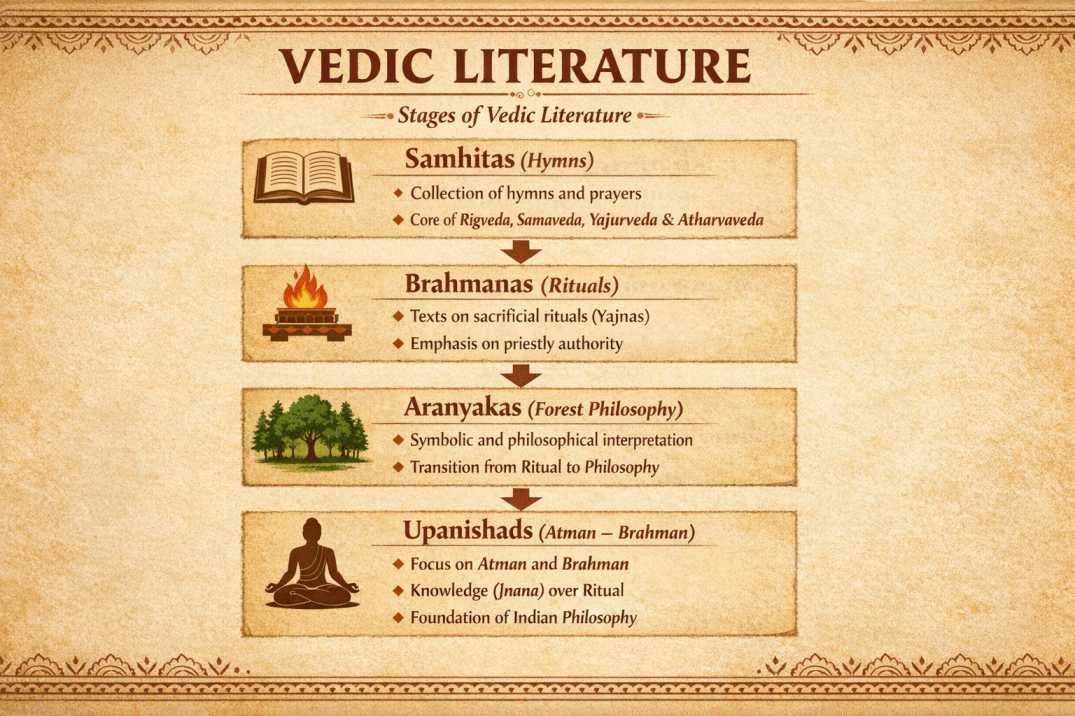
The Later Vedic Period corresponds to the time when texts like the Yajurveda, Samaveda, Atharvaveda, Brahmanas, and Upanishads were composed.
- Transition from pastoral to agrarian economy.
- Rise of territorial kingdoms and a stronger monarchy.
- Increasing complexity in rituals and dominance of priests.
- The Varna system became rigid and hereditary.
- Emergence of social inequalities and new religious ideas.
This stage marks significant political expansion, social stratification, and cultural evolution, laying the foundation for the rise of the Mahajanapadas.
Important Sources of the Vedic Period
The history of the Vedic Period is reconstructed primarily through literary texts and archaeological discoveries. While literary sources reveal the ideological, social, and political framework, archaeological evidence helps us understand settlement patterns and material culture.
| Early Vedic Period (1500 BCE – 1000 BCE) | Later Vedic Period (1000 BCE – 600 BCE) |
|---|---|
| Primary Literary Source: The Rigveda is the earliest and most important source. | Literary Expansion: Later portions of the Rigveda along with Samaveda, Yajurveda, and Atharvaveda Samhitas. |
| Textual Core: Rigvedic Samhita consists of 10 Mandalas; Mandalas II–VII are the oldest and specifically belong to the Early Vedic phase. | Later Additions: Mandalas I, VIII, IX, and X of the Rigveda are considered later compositions, especially the 10th Mandala. |
| Nature of Content: Hymns dedicated to nature deities; reflects pastoral economy, tribal polity, and simple social organization. | Nature of Content: Emphasis on elaborate rituals, sacrificial ceremonies, social stratification, and emerging philosophical ideas. |
| Archaeological Evidence: Post-Harappan/Chalcolithic settlements excavated in Punjab, Uttar Pradesh, and northern Rajasthan, particularly along the Indus and Ghaggar rivers. | Archaeological Evidence: Findings from Western U.P., Haryana, and Rajasthan showing agricultural expansion and permanent settlements. |
| Material Culture: Limited metal use; the term “ayas” appears in the Rigveda but likely referred to copper/metal in general. | Material Culture: Clear archaeological evidence of iron technology, which supported agricultural growth and territorial expansion. |
UPSC Prelims MCQs on Vedic Period
QUESTION 1
Consider the following statements:
- There are no parables in Upanishads.
- Upanishads were composed earlier than the Puranas.
Which of the statements given above is/are correct?
QUESTION 2
The religion of early Vedic Aryans was primarily of -
Geography of the Vedic Age
The geography of the Vedic Period played a decisive role in shaping its economy, polity, and cultural evolution. Over time, the Vedic people gradually expanded from the north-western region of the Indian subcontinent.
1. Geography of the Early Vedic Period
The region was known as Sapta Sindhu (Land of Seven Rivers). Located mainly in present-day Punjab, Haryana, and north-western Rajasthan. Important rivers mentioned in the Rigveda include:
- Indus (Sindhu)
- Vitasta (Jhelum)
- Asikni (Chenab)
- Vipasha (Beas)
- Shutudri (Sutlej)
- Parushni (Ravi)
- Saraswati
Society was largely pastoral, and settlements were concentrated near riverbanks. The Indus River system formed the core geographical area. This phase reflects a semi-nomadic lifestyle with limited agricultural expansion.
2. Geography of the Later Vedic Period
Expansion eastward from Punjab to the Western Ganga-Yamuna Doab. Regions such as Kuru-Panchala, Kosala, and Videha gained prominence. Forest clearing and agricultural expansion became prominent due to the use of iron tools. There was a shift from tribal settlements to territorial kingdoms.
This geographical expansion laid the foundation for the rise of large states (Mahajanapadas) in the 6th century BCE.
Must cover: What is Indus Valley Civilization? The History, Location, and Artifacts
Political Life of the Vedic Period
The political structure of the Vedic Period evolved significantly from the Early to the Later phase. Let's understand!
| Early Vedic Period | Later Vedic Period |
|---|---|
| Social Unit: The basic unit was Jana (tribe). Society was organized along tribal lines. | Territorial Shift: The concept of Janapada emerged, marking settled territorial states. The term Rashtra appears for the first time. |
| Chief/King (Rajan): Head of the Jana. His primary duty was to protect the tribe and cattle from enemies. | Territorial King: The Rajan became the protector of a defined territory rather than just a tribe. |
| Nature of Kingship: Not strictly hereditary. The king was often chosen with the involvement of tribal assemblies. | Hereditary Monarchy: Kingship became hereditary. Elaborate rituals like Rajasuya and Vajapeya strengthened royal authority. |
Administrative Bodies: Tribal assemblies such as Sabha, Samiti, Vidatha, Gana, and Parishad assisted the Rajan.
| Decline of Popular Assemblies: The Sabha gained prominence over the Samiti. Royal authority became stronger, reducing the importance of collective decision-making. |
| Taxation: People voluntarily offered Bali (tribute) on special occasions. It was not a regular tax. | Regular Revenue System: Bali, Bhaga, and Shulka gradually became regular taxes and compulsory tributes. |
| Army: The Sena was a temporary tribal militia composed of able-bodied men during wartime. | Standing Army: A rudimentary permanent army began to emerge, maintained through taxes. |
| Status of Brahmins: Priests (Purohita) performed yajnas and received gifts from the Rajan. Their influence was significant but limited. | Rise of Brahmanical Power: As royal power expanded, the importance of Brahmanas increased. Elaborate rituals enhanced their authority, and their status became highly exalted. |
Also see: The Mauryan Empire: UPSC Notes for India’s First Great Empire
Socio-Religious Life of the Vedic Period
The socio-religious structure of the Vedic Period underwent a gradual but significant transformation from the Early to the Later phase.
| Early Vedic Period | Later Vedic Period |
|---|---|
| Family Structure: The basic unit was the family, which formed part of a larger group called Vis (clan). Several clans together formed a Jana (tribe), the largest social unit. | Family Structure: The family remained the basic unit, but it evolved into a joint family system, often comprising three or four generations. |
| Varna System: No rigid caste system existed. Social divisions were flexible and largely occupation-based. | Varna System: Society became divided into four Varnas – Brahmanas, Kshatriyas, Vaishyas, and Shudras. The system became hereditary and rigid. |
| Status of Women: Women enjoyed relatively high status. They were educated, could participate in assemblies, and choose their partners. Women sages like Apala, Ghosa, Lopamudra are mentioned. | Status of Women: Women were excluded from political assemblies, considered subordinate, and child marriages became more common. |
| Varna-Ashrama Concept: No structured Varna-Ashrama system. | Varna-Ashrama Concept: Three Ashramas:
Later Sanyasa was added. Together with Varna, it evolved into Varna-Ashrama Dharma. |
| Marriage: Monogamy was common, though chiefs sometimes practised polygamy. | Marriage: Polygamy existed, especially among elites, but monogamy remained the preferred norm. |
| Gotra System: Not prevalent. | Gotra System: Gotra system developed; marriage within the same gotra was prohibited. |
| Tribal Conflicts: Frequent inter-tribal conflicts for cattle and pasture lands (e.g., Battle of Ten Kings in the Rigveda). | Tribal Conflicts: Conflicts increasingly centred around territorial control and land acquisition. |
| Social Mobility: Occupation not strictly based on birth; society was flexible. | Social Mobility: Occupation became birth-based; social mobility declined significantly. |
Also read: Bhakti Movement in India Notes for UPSC
Economic Life of the Vedic Period
The economic structure of the Vedic Period reflects a gradual transition from a pastoral economy in the Early Vedic phase to a more settled agrarian economy in the Later Vedic phase.
The hymns of the Rigveda provide extensive evidence of the central role of cattle in economic life, especially during the Early Vedic period.
- Cattle were the backbone of the economy and symbolised wealth and prosperity.
- The word “gau” (cow) formed the root of several economic and social terms.
- A wealthy person owning many cattle was called “gomat.”
- The king was known as “gopati” (protector of cows).
- Wars and conflicts were referred to as gavishti, gavesana, gavyat, etc., indicating battles for cattle.
- “Godhuli” (cow-dust time) was used as a measure of time.
- A daughter was called duhitri (one who milks cows).
- Kinship groups were termed gotra.
This terminology highlights how deeply cattle were embedded in the economic and social vocabulary of the time.
| Early Vedic Period | Later Vedic Period |
|---|---|
| Occupational Pattern: Dominated by pastoralism; cattle rearing was the chief occupation. | Occupational Pattern: Shift toward a settled agrarian economy with agriculture as the primary occupation. |
| Agriculture: Limited importance. Only Yava (barley) is clearly mentioned. Shifting cultivation was practised. | Agriculture: Expanded significantly. Crops included rice (Vrihi, Tandula, Sali), wheat, pulses, lentils, millet, sugarcane, etc. Evidence of double cropping. |
| Domestication: Cattle, sheep, goats, and horses were raised for milk, meat, and hides. | Domestication: Buffalo domesticated for agricultural use. Indra was symbolically referred to as the “Lord of the Plough.” |
| Taxation: Voluntary contribution called Bali given to the chief; no specific tax-collecting officer. | Taxation: Bali, Bhaga, and Shulka became regular taxes. Officials like Bhagalugha were appointed for tax collection. |
| Technology: No iron technology; familiarity with copper. | Technology: Introduction of iron tools (socketed axes, iron ploughshares, hoes) increased agricultural productivity. |
| Medium of Exchange: Cows were the primary unit of exchange. Priests were paid in cows, horses, and gold ornaments. | Medium of Exchange: Use of gold ornaments and coins such as Niskha in transactions. |
UPSC Mains PYQ on Vedic Period
What are the main features of Vedic society and religion? Do you think some of the features are still prevailing in Indian society? (UPSC Mains 2023) (15 marks, 250 words)
Evaluate your Answer in 60 SecondsConclusion
The Vedic Age explains the roots of Indian society, polity, economy, and Vedism. These Vedic Age UPSC notes will help you tackle both factual Prelims questions and analytical Mains answers with confidence.
Supercharge your UPSC prep with SuperKalam, your personal mentor for instant doubt clearing, smart study plans, PYQs practice, and Instant Mains Evaluation.
Start your UPSC Preparation 2026/2027 with SuperKalam
SuperKalam is your personal mentor for UPSC preparation, guiding you at every step of the exam journey. Practice, revise, and evaluate– all in one place.
Download the App Now