Loss and Damage Fund (LDF) | UNFCCC - UPSC Notes
Loss and Damage Fund (LDF) is a climate finance mechanism under the UNFCCC to support vulnerable countries facing climate impacts. Learn its meaning, governance, funding, and criticisms for UPSC Prelims & Mains.
Mar, 2026
•7 min read
The Loss and Damage Fund (LDF) under the United Nations Framework Convention on Climate Change helps vulnerable countries cope with climate-related disasters and irreversible impacts. This topic is important for UPSC Prelims & Mains GS Paper III (Environment & Ecology).
These UPSC notes on the Loss and Damage Fund explain its origin, purpose, and importance for global climate justice and developing nations.
What is Loss and Damage Fund (LDF)?
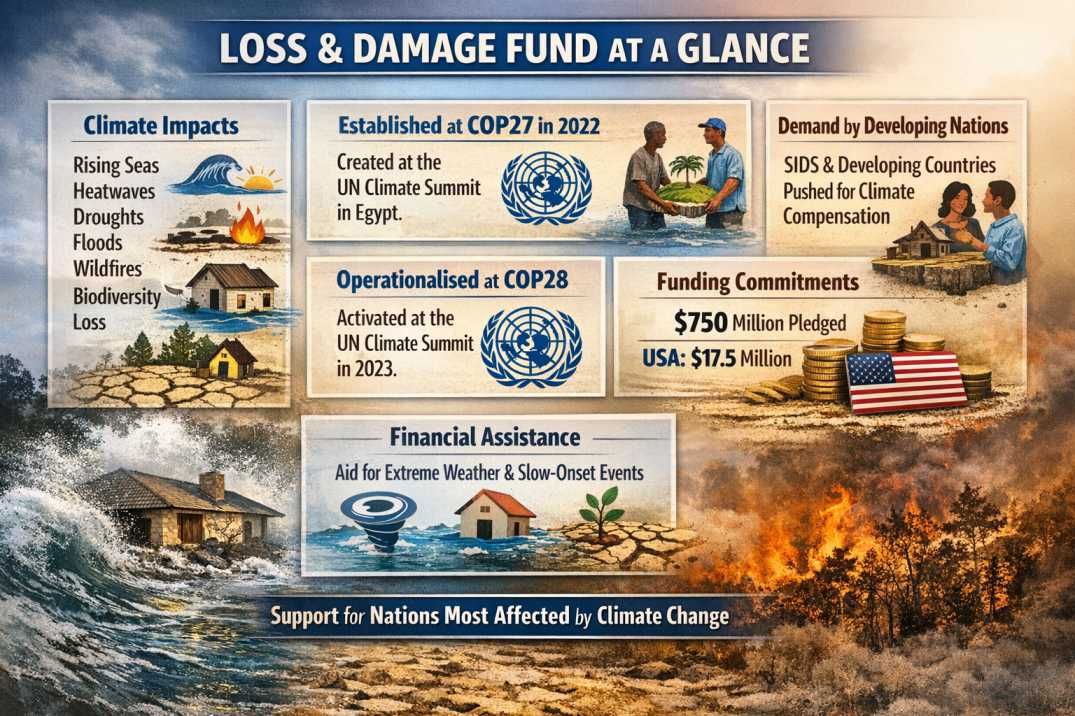
The Loss and Damage Fund (LDF) is a financial mechanism created to support vulnerable countries facing the unavoidable impacts of climate change. Loss and damage refer to the negative consequences caused by climate change, such as rising sea levels, prolonged heatwaves, desertification, ocean acidification, extreme weather events, bushfires, crop failures, and biodiversity loss.
Established under the United Nations Framework Convention on Climate Change (UNFCCC), the fund aims to provide financial assistance to countries suffering both economic and non-economic losses due to climate-related disasters.
- Establishment: The Loss and Damage Fund was created at the UNFCCC COP27 held in Egypt in 2022.
- Demand by Developing Nations: Developing countries, especially Small Island Developing States (SIDS), have long demanded such a fund, arguing they face the worst climate impacts despite contributing very little to global emissions.
- Operationalisation: At the COP28, member countries agreed to operationalise the Loss and Damage Fund, allowing financial assistance to begin.
- Funding Commitments: Around $750 million has been pledged so far by different countries, with the United States contributing about $17.5 million and being among the first to transfer its committed amount.
- Coverage of Climate Impacts: The fund addresses losses from extreme weather events (cyclones, floods, droughts) as well as slow-onset processes like sea-level rise and desertification.
Must read: Paris Agreement 2015 on Climate Change | UPSC Environment & Ecology Notes
Types of Loss and Damage
1. Economic Loss and Damage: Economic loss and damage refers to climate impacts that can be quantified in monetary terms, as they involve direct financial costs for repair, recovery, or replacement. Examples include:
- Damage to buildings and infrastructure due to floods, cyclones, or storms
- Loss of income from disrupted businesses and livelihoods
- Destruction of crops and agricultural land affecting farmers’ earnings
- Damage to roads, ports, and energy infrastructure
2. Non-Economic Loss and Damage: Non-economic loss and damage refers to impacts that cannot be easily measured in financial terms but significantly affect people’s lives, culture, and well-being. Examples include:
- Loss of cultural heritage and traditional knowledge
- Displacement from ancestral or traditional lands
- Psychological trauma and mental health impacts after disasters
- Loss of biodiversity and ecosystems
- Breakdown of community cohesion and social networks
Must cover: UN Framework Convention on Climate Change (UNFCCC): UPSC Notes
Governance of the Loss and Damage Fund (LDF)
The Loss and Damage Fund (LDF) is managed through a structured governance system to ensure the transparent and equitable distribution of financial support to vulnerable countries.
The Fund is overseen by a Governing Board, which is responsible for the overall management and strategic direction of the LDF.
Key responsibilities of the Governing Board include:
- Allocation of Resources: Deciding how the Fund’s financial resources are distributed among eligible developing countries.
- Policy and Operational Guidelines: Developing rules, procedures, and eligibility criteria for accessing the fund.
- Prioritisation of Vulnerable Countries: Ensuring that least developed countries (LDCs) and Small Island Developing States (SIDS) receive priority support.
- Monitoring and Accountability: Overseeing the implementation and use of funds to ensure transparency and effective climate response.
Role of the World Bank
The World Bank currently serves as the interim trustee of the Loss and Damage Fund for an initial four-year period. Its responsibilities include:
- Hosting and managing the financial resources of the fund
- Ensuring proper financial administration and reporting
- Supporting the operationalisation of the fund until a permanent institutional arrangement is finalised
Access Mechanisms Being Developed
To ensure that vulnerable countries can quickly and easily access financial support, the Governing Board is developing several mechanisms, including:
- Direct Access: Allowing eligible countries to receive financial assistance without complex intermediary procedures directly.
- Small Grants Window: Providing smaller funding packages for local communities and small-scale climate recovery projects.
- Rapid Disbursement Options: Ensuring quick release of funds after climate disasters, enabling faster relief and recovery efforts.
Must read: COP 30 2025: UNFCCC Climate Summit in Belem, Brazil
Criticism of the Loss and Damage Fund (LDF)
Although the Loss and Damage Fund (LDF) is seen as a major step toward climate justice, it has faced several criticisms regarding its funding, governance, and implementation.
1. Insufficient Funding Commitments
One of the biggest criticisms is the very limited financial pledges compared to the scale of climate damage faced by developing countries.
- Around $750 million has been pledged so far, which is considered extremely small compared to the hundreds of billions of dollars in annual climate-related losses.
- For example, countries like Pakistan suffered massive economic losses during the 2022 floods, estimated at over $30 billion, far exceeding the total funds currently pledged.
2. Lack of Mandatory Contributions
The fund relies mainly on voluntary contributions from developed countries, rather than mandatory financial commitments.
- This raises concerns about uncertain and unpredictable funding flows.
- Many developing countries argue that major historical emitters should have legally binding obligations to contribute.
3. Concerns over World Bank Control
The decision to host the fund temporarily at the World Bank has also been criticised.
- Developing countries fear that bureaucratic procedures and conditionalities could slow the disbursement of funds.
- Some critics argue that institutions dominated by developed countries may limit the decision-making power of vulnerable nations.
4. Limited Coverage of Climate Impacts
Another criticism is that the fund may not fully address all types of climate-related loss and damage, especially non-economic losses.
- For example, loss of cultural heritage, displacement of indigenous communities, or extinction of species cannot easily be compensated through financial aid.
5. Slow Operationalisation
Despite being established at the COP27 and operationalised at the COP28, the fund is still in the early stages of implementation.
- Many vulnerable countries argue that delays in access mechanisms and fund distribution could limit their effectiveness during urgent climate disasters.
UPSC Prelims PYQs
QUESTION 1
“Climate Action Tracker” which tracks the emission reduction pledges of different countries is a:
QUESTION 2
The term ‘Intended Nationally Determined Contribution’ is sometimes seen in the news in the context of:
QUESTION 3
"Momentum for Change: Climate Neutral Now" is an initiative launched by
Conclusion
The Loss and Damage Fund (LDF) marks an important step in acknowledging the climate challenges faced by vulnerable nations under the UNFCCC. However, its long-term success will depend on adequate funding, faster access mechanisms, and stronger global cooperation.
Moving forward, developed countries must increase financial commitments and ensure transparent governance so that the fund can support nations most affected by climate change and strengthen global climate justice.
Start your UPSC Preparation 2026/2027 with SuperKalam
SuperKalam is your personal mentor for UPSC preparation, guiding you at every step of the exam journey. Practice, revise, and evaluate– all in one place.
Install Now