What is Money Bill? (Article 110) - UPSC Polity Notes
A Money Bill is a special bill related to taxes, government spending, and public funds. Get complete Money Bill UPSC Notes, Article 110, procedure, challenges, powers and more.
May, 2026
•8 min read
The Money Bill under Article 110 of the Indian Constitution is one of the most important topics in UPSC Polity. A Money Bill deals with matters related to taxation, government expenditure, borrowing, and the Consolidated Fund of India, making it a key part of the parliamentary financial system.
Questions on Money Bills are frequently asked in UPSC Prelims, while in Mains, the topic becomes important from the perspective of Parliament, constitutional provisions, and Centre–State relations.
In these UPSC Polity Notes, we will understand the meaning, features, procedure, and powers of the Lok Sabha and Rajya Sabha, and important constitutional provisions related to the Money Bill.
What is a Money Bill?
A Money Bill is a special type of bill defined under Article 110 of the Indian Constitution that deals exclusively with financial matters of the Government of India.
It mainly relates to issues such as:
- Imposition or abolition of taxes,
- Government borrowing
- Custody and withdrawal of money from the Consolidated Fund of India
- Expenditure from government funds.
A bill is considered a Money Bill only when it contains provisions strictly related to matters mentioned in Article 110. Important examples include taxation, public expenditure, government receipts, and financial obligations of the Union Government.
Money Bill can be introduced only in the Lok Sabha and only with the prior recommendation of the President. The Rajya Sabha has limited powers in its passage, which makes the Lok Sabha more powerful in financial matters.
Must read: National Income: Components & Accounting Measures - UPSC Notes
Key Features of a Money Bill
The Money Bill is a special category of legislation under Article 110 of the Indian Constitution. It follows a unique procedure in Parliament and gives greater authority to the Lok Sabha in financial matters. Here are its key features:
1. Defined Under Article 110
A Money Bill is clearly defined under Article 110 of the Constitution. It includes only those matters that are directly related to taxation, government expenditure, borrowing of money, custody of government funds, and related financial matters.
2. Can Be Introduced Only in the Lok Sabha
A Money Bill can be introduced only in the Lok Sabha. This reflects the financial supremacy of the directly elected House of Parliament.
3. Prior Recommendation of the President is Mandatory
Before introducing a Money Bill, the President’s recommendation is compulsory. Without the President’s approval, such a bill cannot be introduced in Parliament.
4. Speaker Decides Whether a Bill is a Money Bill
The Speaker of the Lok Sabha has the final authority to decide whether a bill qualifies as a Money Bill or not. The Speaker’s certification is considered final.
5. Limited Role of the Rajya Sabha
The Rajya Sabha cannot reject or amend a Money Bill. It can only make recommendations and must return the bill to the Lok Sabha within 14 days.
6. Lok Sabha Can Accept or Reject Recommendations
The Lok Sabha is free to accept or reject the suggestions made by the Rajya Sabha. Even if the Rajya Sabha does not return the bill within 14 days, the bill is considered passed.
7. No Joint Sitting in Case of Deadlock
Unlike ordinary bills, there is no provision for a joint sitting of Parliament in the case of a Money Bill because the Rajya Sabha has only a limited role.
8. No Reconsideration by the President
After a Money Bill is passed by Parliament, the President can either give assent or withhold assent, but cannot return it for reconsideration.
Matters Covered Under a Money Bill (Article 110)
Under Article 110 of the Indian Constitution, a bill is treated as a Money Bill only when it contains provisions exclusively related to specific financial matters of the Union Government. If the bill includes subjects beyond these provisions, it cannot be classified as a Money Bill.
A bill is considered a Money Bill if it deals with any of the following matters:
- Taxation Matters: The imposition, abolition, remission, alteration, or regulation of any tax by the Government of India.
- Government Borrowing: Regulation of borrowing of money by the Government of India or giving guarantees on behalf of the government.
- Consolidated Fund and Contingency Fund: Custody, operation, payment into, or withdrawal of money from the Consolidated Fund of India or the Contingency Fund of India.
- Appropriation of Government Funds: Withdrawal or appropriation of money from the Consolidated Fund of India for government expenditure.
- Charged Expenditure: Declaring any expenditure as expenditure charged on the Consolidated Fund of India or increasing such expenditure.
- Receipt and Custody of Public Money: Receipt, custody, issue, or audit of money related to the Consolidated Fund of India or the Public Account of India.
- Incidental Financial Matters: Any matter directly connected or incidental to the financial provisions mentioned above.
Important Note: For a bill to qualify as a Money Bill, it must contain only the matters mentioned in Article 110. Even the inclusion of unrelated provisions may prevent it from being classified as a Money Bill.
Also cover: All Important Articles of Indian Constitution for UPSC
Procedure for the Passage of a Money Bill
The Constitution of India provides a special procedure for the passage of a Money Bill under Article 109 and Article 110. Since Money Bills deal with the government's financial matters, the Lok Sabha has greater powers than the Rajya Sabha in this process.
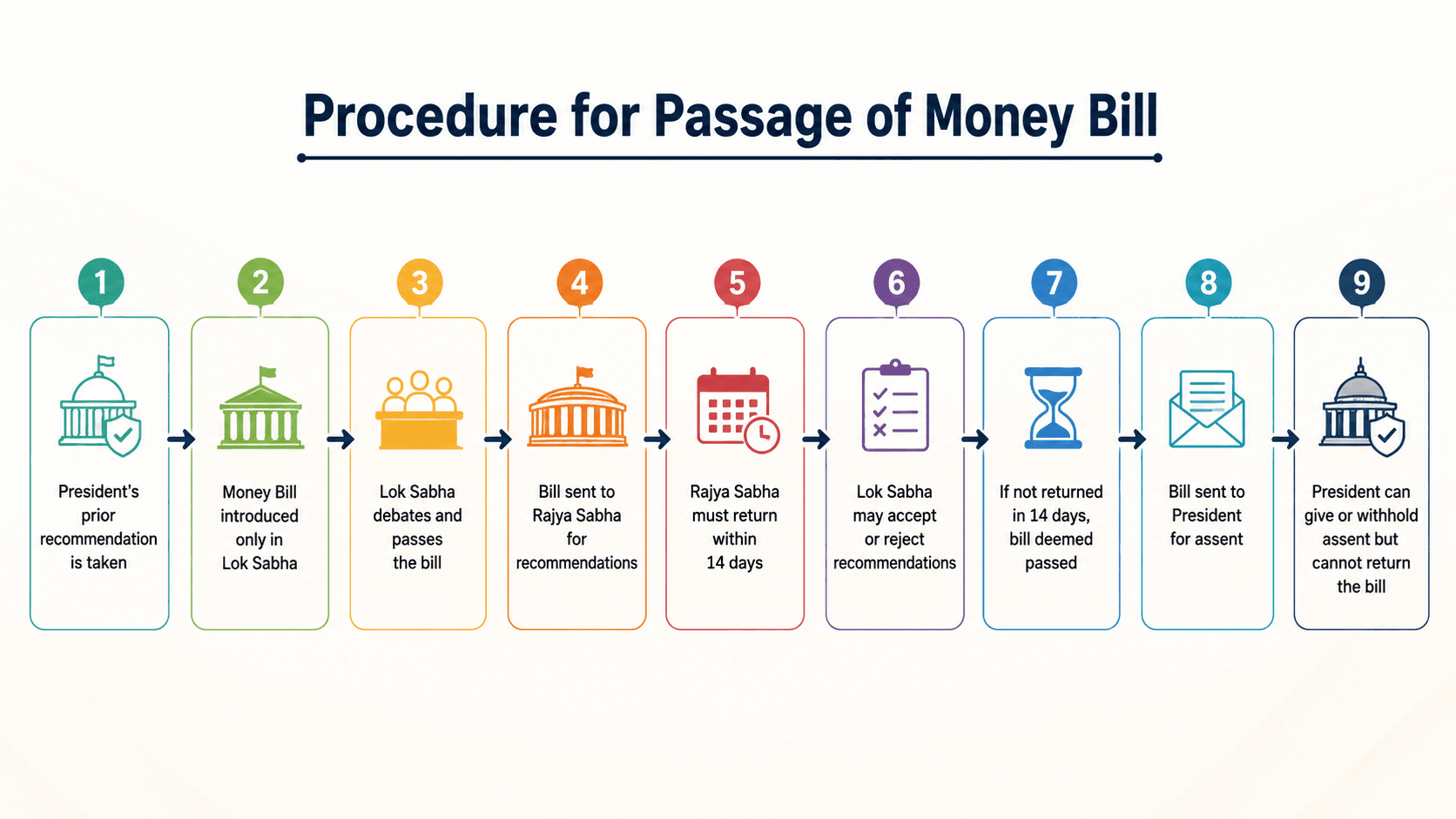
Below is the complete procedure for the passage of a Money Bill in Parliament:
Step 1: Prior Recommendation of the President
Before a Money Bill is introduced in Parliament, the recommendation of the President is mandatory. Without the President’s approval, the bill cannot be introduced.
Step 2: Introduction Only in the Lok Sabha
A Money Bill can be introduced only in the Lok Sabha. It cannot originate in the Rajya Sabha. Such bills are always introduced by a minister, which means they are government bills.
Step 3: Passage in the Lok Sabha
The Lok Sabha discusses, debates, and votes on the Money Bill. Since the Lok Sabha represents the people directly, it has the primary authority over financial legislation.
Once passed by the Lok Sabha, the bill is sent to the Rajya Sabha for its recommendations.
Step 4: Limited Role of the Rajya Sabha
The Rajya Sabha has limited powers regarding a Money Bill. It:
- Cannot reject the bill
- Cannot amend the bill
- Can only suggest recommendations
The Rajya Sabha must return the bill to the Lok Sabha within 14 days, with or without recommendations.
Step 5: Decision of the Lok Sabha on Recommendations
After receiving the bill back from the Rajya Sabha, the Lok Sabha may:
- Accept the recommendations of the Rajya Sabha, either fully or partially, or
- Reject all recommendations
If the Lok Sabha accepts any recommendation, the bill is passed in the modified form.
If it rejects the recommendations, the bill is deemed passed in its original form as approved by the Lok Sabha.
Step 6: If the Rajya Sabha Does Not Return the Bill
If the Rajya Sabha does not return the Money Bill within 14 days, the bill is automatically deemed to have been passed by both Houses in the form originally passed by the Lok Sabha.
This clearly shows the Lok Sabha's financial supremacy in Parliament.
Step 7: President’s Assent
After being passed by Parliament, the Money Bill is sent to the President for assent.
The President may:
- Give assent, or
- Withhold assent
However, unlike ordinary bills, the President cannot return a Money Bill for reconsideration. Generally, assent is given because the bill was introduced earlier with the President’s prior recommendation.
Also see: Sessions of Parliament: Provisions & Types (UPSC Notes)
UPSC Prelims PYQs on Money Bill
QUESTION 1
What will follow if a Money Bill is substantially amended by the Rajya Sabha?
QUESTION 2
With reference to Finance Bill and Money Bill in the Indian Parliament consider the following statements:
- When the Lok Sabha transmits Finance Bill to the Rajya Sabha, it can amend or reject the Bill.
- When the Lok Sabha transmits Money Bill to the Rajya Sabha, it cannot amend or reject the Bill, it can only make recommendations.
- In the case of disagreement between the Lok Sabha and the Rajya Sabha, there is no joint sitting for Money Bill, but a joint sitting becomes necessary for Finance Bill.
How many of the above statements are correct?
QUESTION 3
A deadlock between the Lok Sabha and the Rajya Sabha calls for a joint sitting of the Parliament during the passage of:
- Ordinary Legislation
- Money Bill
- Constitution Amendment Bill
Select the correct answer using the codes given below:
QUESTION 4
Regarding Money Bill, which of the following statements is not correct?
QUESTION 5
Which of the following statements are correct in respect of a Money Bill in the Parliament?
- Article 109 mentions special procedure in respect of Money Bills.
- A Money Bill shall not be introduced in the Council of States.
- The Rajya Sabha can either approve the Bill or suggest changes but cannot reject it.
- Amendments to a Money Bill suggested by the Rajya Sabha have to be accepted by the Lok Sabha.
Select the answer using the code given below :
QUESTION 6
Consider the following statements:
- The Rajya Sabha has no power either to reject or to amend a Money Bill.
- The Rajya Sabha cannot vote on the Demands for Grants.
- The Rajya Sabha cannot discuss the Annual Financial Statement.
Which of the statements given above is/are correct?
UPSC Mains Practice Question on Money Bill
“The Money Bill provision under Article 110 was introduced to ensure smooth financial governance, but its misuse can weaken the spirit of bicameralism.” Discuss the constitutional provisions related to Money Bills in India. Also, examine the controversies associated with their classification. (250 words, 15 marks)
Evaluate your Answer in 60 SecondsThe Way Forward
The Money Bill is an important part of India’s parliamentary and financial system, designed to ensure the smooth functioning of government finances. However, controversies surrounding its misuse and the limited role of the Rajya Sabha have raised important constitutional questions.
Going forward, a balanced approach is needed to protect both financial efficiency and democratic accountability.
- Clear Interpretation of Article 110: The scope of a Money Bill should be interpreted strictly to prevent misuse of constitutional provisions.
- Strengthening Parliamentary Debate: Greater discussion and scrutiny in Parliament can improve transparency in financial legislation.
- Protecting the Role of the Rajya Sabha: The spirit of bicameralism should be maintained by ensuring that the Rajya Sabha is not unnecessarily bypassed.
- Judicial Safeguards and Constitutional Balance: Judicial review can help maintain constitutional checks and prevent the arbitrary classification of bills.
- Promoting Cooperative Democracy: Financial legislation should balance speedy governance with democratic consultation and institutional accountability.
You might also like: UPSC Prelims Polity PYQs with Explanations
Crack UPSC Smarter with SuperKalam
SuperKalam is your personal mentor for UPSC preparation, guiding you at every step of the exam journey. Practice, revise, and evaluate– all in one place.
Download Now