Separation of Powers in India [UPSC Notes]
The separation of powers divides government into three branches: the Legislature, the Executive, and the Judiciary. Learn about its evolution, provisions, and landmark judgments for UPSC.
Dec, 2025
•5 min read
"There is no liberty if the powers of judging are not separated from the legislative and executive."- Montesquieu
The separation of powers is a core principle of democratic governance in India. It prevents the concentration of authority and safeguards citizens’ rights. Unlike the U.S., India does not explicitly state this doctrine in its Constitution. It is implicitly embedded through constitutional provisions and judicial interpretations.
This topic is crucial for the UPSC Prelims and Mains, particularly in questions related to constitutional law, judicial independence, and governance.
What is the Separation of Powers?
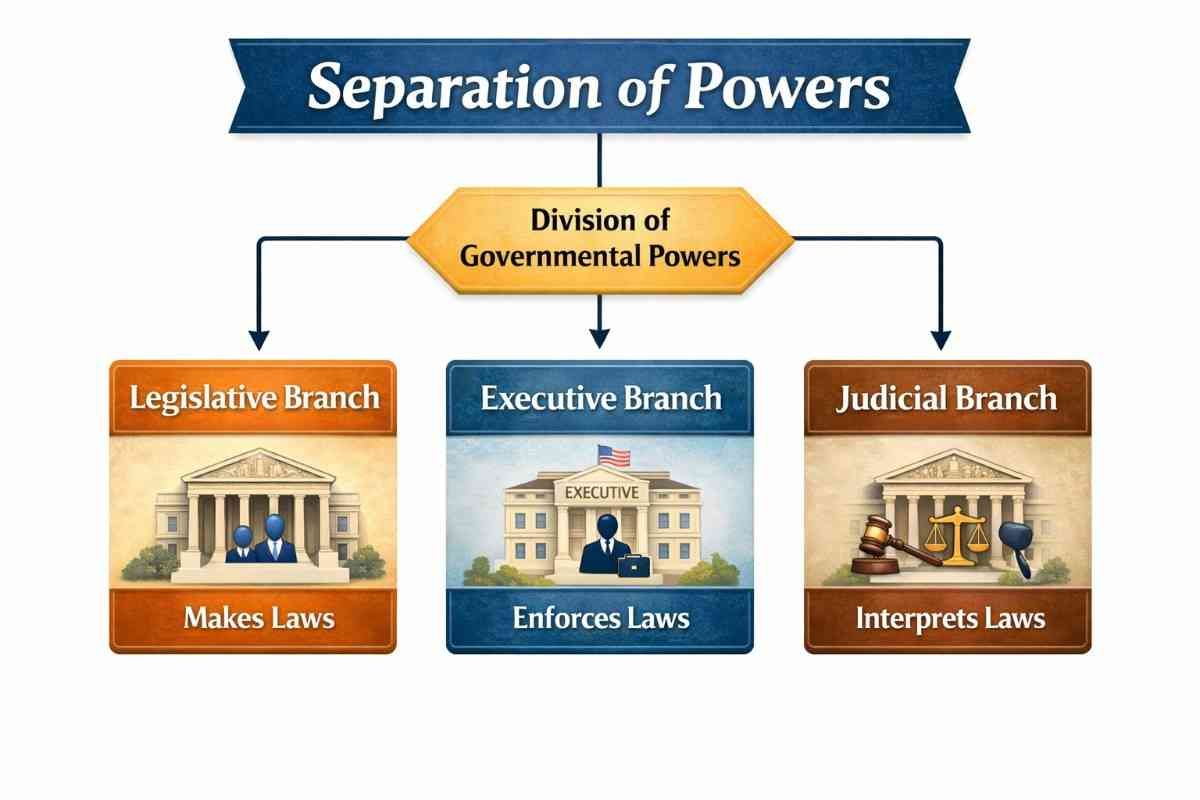
The separation of powers divides government authority into three independent branches: legislative, executive, and judiciary, to prevent any one from dominating and ensure checks and balances.
This doctrine, popularised by Montesquieu, ensures each branch performs distinct functions: the legislature makes laws, the executive enforces them, and the judiciary interprets them. It promotes liberty by preventing power concentration in a single entity.
- The principle is not explicitly mentioned as such in the Constitution, but it is embedded through various articles and provisions.
- Unlike the United States, the Indian Constitution does not follow an absolutely rigid separation of powers.
- One organ should not interfere in the functioning of another organ, except where the Constitution specifically allows it.
- The Constitution clearly demarcates the functions, powers, and jurisdictions of each organ.
- Although powers are separated, mechanisms exist for one organ to check the excesses of another, preventing tyranny.
Objectives of Separation of Powers
The doctrine of separation of powers wasn't created just as a theoretical concept; it was designed with very practical goals in mind.
- Prevention of Power Concentration: By dividing power among three organs, no single authority can become all-powerful, which is essential for democracy.
- Protection of Individual Rights: The Judiciary can safeguard rights against legislative or executive overreach.
- Accountability and Rule of Law: Each organ is accountable to the Constitution and to the people. The Legislature is accountable to voters, the Executive to Parliament, and the Judiciary operates under constitutional constraints.
- Efficient Governance: The separation allows each organ to focus on its core function, legislating, executing, and adjudicating, without spreading itself too thin.
- Judicial Independence: Article 50 ensures that the Judiciary remains independent from executive interference, allowing for fair and impartial justice delivery.
- Prevention of Arbitrary Power: By requiring multiple organs to work within their respective spheres and checking each other, arbitrary power is minimised.
Also read: Judicial Review in India: Meaning, Scope & Provisions [UPSC]
Types of Separation of Powers
The doctrine of separation of powers is applied differently across countries depending on their constitutional framework and system of government. Broadly, it can be classified into two main types:
1. Strict Separation of Powers
This model ensures a clear and rigid division of functions among the three organs of government.
- Clear Functional Division: The Legislature makes laws, the Executive implements them, and the Judiciary interprets laws.
- No Overlap of Personnel: One organ does not interfere with the functioning of the others.
- Strong Independence: Each organ operates independently within its own sphere.
- Limited Checks: Checks and balances exist, but do not allow direct control over functions.
Example: The United States of America, where the President is not a member of the Legislature.
2. Partial Separation of Powers
This model allows functional overlap to ensure coordination and accountability.
- Overlap of Functions: Some organs perform the roles of others (e.g., the Executive involved in law-making).
- Checks and Balances: Each organ checks the others to prevent misuse of power.
- Parliamentary System: The Executive is drawn from the Legislature and remains accountable to it.
- Flexible Functioning: Encourages cooperation rather than strict separation.
Example: India and the United Kingdom, where separation exists in principle, not in a rigid form.
Also read: Indian Judiciary UPSC Notes: History, Structure of Courts and Functions
Origin and Evolution of the Separation of Powers
The idea of separating government powers developed over time from ancient times to modern India. This concept evolved to prevent tyranny and protect liberty.
1. Ancient Beginnings:
- The Greek philosopher Aristotle (384-322 BCE) was among the first to observe that governments had different functions.
- However, Aristotle didn't develop a full theory of separation; he just observed these distinctions.
2. John Locke's Contribution (1632-1704)
- In his work Second Treatise of Civil Government, Locke argued that power must be divided to prevent tyranny.
- He distinguished between legislative power (making laws), executive power (enforcing laws), and what he called "federative power" (handling foreign relations).
3. Montesquieu's "Spirit of Laws"
- In his famous book The Spirit of Laws, Montesquieu vigorously advocated for a "strict or total separation" of powers.
- He argued that the legislative, executive, and judicial powers must be in completely separate hands with no overlap in personnel.
4. Evolution in India's Constitutional Context
- Dr B.R. Ambedkar, the chief architect of India's Constitution, believed that a complete separation like in the U.S. was not suitable for India.
- He felt such rigid separation could hinder the effective functioning of the legislature and make governance difficult.
- So, India adopted the "modern approach" with some overlap but strong checks and balances.
- The Indian model was designed to accommodate India's parliamentary form of government, where the executive is accountable to the legislature.
Provisions for the Separation of Powers in India
The Indian Constitution establishes the separation of powers through various provisions that define the structure, powers, and relationships of the three organs.
Powers and Functions of the Legislature
- Lawmaking: Article 79 vests legislative power in Parliament (Lok Sabha and Rajya Sabha). Parliament is supreme in creating laws within the constitutional framework.
- Budget Control: The Legislature controls the finances of the State through the Budget and appropriation process (Article 265). No money can be spent without parliamentary approval.
- Constitutional Amendments: The Legislature can amend the Constitution under Article 368, though this power has limits (Basic Structure Doctrine).
- Oversight of Executive: The Council of Ministers is answerable to Parliament (Article 75). The Legislature can question ministers, demand explanations, and even pass votes of no-confidence.
- Impeachment and Removal: The Legislature has the power to impeach the President, judges of the Supreme Court, and High Courts for violation of the Constitution.
Powers and Functions of the Executive
- Implementation of Laws: Articles 53-78 vest executive power in the President, though practically exercised through the Prime Minister and Council of Ministers.
- Delegated Legislation: The Executive can frame rules, regulations, and subordinate laws within the framework laid down by the Legislature. However, this cannot go beyond legislative intent.
- Appointments: The Executive appoints judges, though in consultation with the Chief Justice of India (collegium system). The President also appoints other officials and diplomats.
- Emergency Powers: The President has powers to declare emergencies (Articles 352, 356, 360), though these are limited and subject to parliamentary approval.
- Ordinances: The President can issue Ordinances when Parliament is not in session (Article 123), but these must be approved by Parliament within six weeks of its reconvening.
Powers and Functions of the Judiciary
- Judicial Review: Articles 32, 136, 141, and 142 give the Judiciary the power to review laws and government actions to see if they conform to the Constitution. If not, they can be struck down.
- Constitutional Interpretation: The Judiciary interprets the Constitution and gives advisory opinions (Article 143) on constitutional matters if the President asks.
- Protection of Rights: The Judiciary enforces fundamental rights and other constitutional protections through various writs and remedies.
- Appointment of Judges: While the Executive nominates judges, the Judiciary, through the Collegium system, effectively influences judicial appointments, ensuring judicial independence (Articles 124, 217).
- Supervision of Lower Courts: Higher courts supervise and review the decisions of lower courts to ensure justice and adherence to the law.
Checks Between Judiciary and Legislature
- The Judiciary can declare laws unconstitutional (Judicial Review), acting as a check on legislative power.
- The Legislature can amend laws if struck down by the Judiciary, maintaining legislative authority.
- Judges cannot be discussed in the Legislature, protecting judicial independence (Article 211).
- The Judiciary advises on constitutional matters when asked by the President (Article 143).
Checks Between the Legislature and the Executive
- The Executive implements laws passed by the Legislature and is bound by them.
- The Legislature controls finances through the Budget, limiting executive spending.
- The Council of Ministers is answerable to Parliament and can be removed through a vote of no-confidence.
- The Executive can issue Ordinances when Parliament is not in session, but these require parliamentary approval.
Checks Between Executive and Judiciary
- The Executive appoints judges, though in consultation with the Chief Justice, and cannot arbitrarily remove them.
- The Judiciary can review executive actions and declare them unconstitutional or invalid.
- The President can pardon or reprieve convictions (Article 72), showing executive involvement in justice delivery.
- The Executive cannot interfere in judicial functioning or court proceedings.
Also read: Constitutionalism in India | UPSC Polity Concepts
Landmark Judgments on Separation of Powers
Courts not only apply laws but also interpret them. Through important Supreme Court judgments, the meaning of the separation of powers in India has been clearly explained.
1. Kesavananda Bharati (1973) case
- This was a 13-judge bench case that discussed the limits of Parliament's power to amend the Constitution.
- The 24th Amendment had given Parliament unlimited power to amend any part of the Constitution.
Key Contribution to Separation of Powers:
- The Court identified "Separation of Powers" as a core feature of the Constitution's basic structure that cannot be amended or destroyed.
- The other basic structure features identified were: Supremacy of the Constitution, a democratic form of government, secular nature, federal character, and dignity of individuals.
2. S.P. Gupta v. President of India (1981)
- Lawyer S.P. Gupta challenged the way the President was appointing judges to the Supreme Court and High Courts.
- The President and Union Government argued that judicial appointments were an exclusive executive function and courts had no business reviewing them.
- The majority (5:2) held that judicial appointments are subject to judicial review.
- This led to the creation of the Collegium System, where senior judges have significant input in judicial appointments.
Key Contribution to Separation of Powers:
- The judgment established that complete separation of powers is neither possible nor desirable in a parliamentary democracy.
- However, each organ must respect the constitutional role and independence of the others.
3. Rai Sahib Ram Jawaya Kapur v. State of Punjab (1955)
- The State of Punjab decided to nationalise the printing and publication of school textbooks.
- Private publishers challenged this, arguing the Executive had no power to do this without a law made by the Legislature.
- The Supreme Court held that the government's action was within its executive powers.
- The Court recognised that the Executive can engage in business activities if it's for public welfare.
- However, the Court also established that the Executive's powers are derived from and limited by the Constitution.
Key Contribution to Separation of Powers:
- This case established that the Executive cannot arbitrarily use its powers to infringe on citizens' rights just because those rights are not explicitly protected by legislation.
- The Executive must act within constitutional limits, and if an action significantly affects citizens' fundamental rights, legislative backing becomes important.
- It shows that separation of powers includes the idea that the Executive cannot do whatever it wants under the guise of "welfare" or "public policy."
4. Minerva Mills Ltd. v. Union of India (1980)
- The 42nd Amendment (1976) had added new clauses to the Constitution that tried to give Parliament absolute power and remove judicial review.
- Minerva Mills challenged these amendments, arguing they violated the basic structure of the Constitution.
Key Contributions to Separation of Powers:
- The Court added "Judicial Review" to the list of features that are part of the basic structure and cannot be amended away.
- The limited amending power of Parliament is also part of the basic structure.
- The Court struck down clauses that would have given Parliament unlimited power to amend the Constitution without judicial review.
5. Indra Sawhney v. Union of India (1992) - "Mandal Commission Case"
- The Government implemented the Mandal Commission's recommendations for 27% reservation for Other Backwards Classes (OBCs).
- Indra Sawhney and others challenged this, arguing it violated the principle of equality.
Key Contributions to Separation of Powers:
- The Supreme Court reviewed and limited the Executive's power to implement reservation policy.
- The Court held that the Executive cannot implement policies that violate constitutional rights, even if they claim it's for public welfare.
- The Court set a 50% limit on total reservations, meaning that the Executive cannot exceed this even if it wants to.
- It introduced the concept of the Creamy Layer, excluding wealthier members of backward classes from reservations.
UPSC Prelims MCQ on Separation of Powers
QUESTION 1
Consider the following statements about Separation of Powers:
- The doctrine of separation of power is a part of the basic structure of the Indian Constitution.
- Separation of Power is nowhere mentioned in the Indian Constitution.
Which of the above statements is/are correct?
UPSC Mains Previous year Practice Question
Judicial legislation is antithetical to the doctrine of separation of powers as envisaged in the Indian Constitution. In this context, justify the filing of a large number of public interest petitions praying for issuing guidelines to executive authorities. (2020)
Evaluate Your Answer Now!Way Forward
All three organs must work with restraint and transparency. Here are five key steps to strengthen the separation of powers.
- Publish criteria for judicial appointments, executive decisions, and legislative processes to prevent arbitrary power.
- Courts should enforce rights, not make policy.
- Parliament must enact laws promptly to prevent governance gaps that invite judicial intervention.
- Consult broadly before amending constitutional provisions on the separation of powers.
Democracy thrives when organs show restraint and respect constitutional boundaries.
Toppers trust discipline, and SuperKalam makes it easy with daily goals, instant mains answer evaluation & unlimited NCERT & MCQ practice.
Join now!
Crack UPSC with your Personal AI Mentor
An AI-powered ecosystem to learn, practice, and evaluate with discipline
Download the SuperKalam App Now