What is Rule of Law? UPSC Notes for Polity
Rule of Law means everyone, including the government, is bound by just laws. Learn about the principles of the Rule of Law, Dicey’s doctrine, constitutional provisions, and exceptions. Read now!
Dec, 2025
•7 min read
The Rule of Law is one of the most fundamental principles of India’s constitutional democracy. It means that no one is above the law, not the government, not public officials, not even the agencies meant to enforce it.
This concept helps you connect topics like constitutionalism, equality before law, separation of powers, judicial review, and governance ethics. Let’s study this topic in detail!
Understanding the Rule of Law Meaning
The Rule of Law is a core principle of democratic governance to ensure that laws guide the functioning of the State.
- It is an ideal of political morality, meaning the government must function according to legal principles, not personal discretion.
- It acts as a foundation of a democratic society, ensuring citizens are protected from the arbitrary use of power.
- The term “Rule of Law” is not defined in the Indian Constitution.
- The Supreme Court has recognised it as a Basic Structure of the Constitution, making it central to good governance and beyond the scope of amendment.
- An independent and impartial judiciary is essential for preserving and enforcing the Rule of Law.
Universal Principles of the Rule of Law
Across the world, the Rule of Law is built upon four universally accepted pillars.

- Just Laws: Laws must be fair, reasonable, and protect rights.
- Open Government: Governance processes must be transparent and participatory.
- Accessible & Impartial Justice: Courts must be independent, unbiased, and available to all.
- Accountability: Every public authority, including the government, is answerable to the law.
Evolution of the Idea of Rule of Law
The meaning of the Rule of Law has grown through centuries of political thought.
- Aristotle argued that “law should govern”, not individuals.
- Sir John Fortescue linked good governance with just laws.
- John Locke emphasised natural rights and limitations on State power.
- Niccolò Machiavelli and Montesquieu contributed to the ideas of separation of powers and checks on authority.
- A.V. Dicey (the most influential modern contributor) described the Rule of Law as the complete supremacy of law over arbitrary power.
- F.A. Hayek and John Rawls further developed the idea in the context of liberty, justice, and modern governance.
Must cover: DPSP UPSC Complete Notes: Articles, Classification, Features & Criticism
Dicey’s Rule of Law
A.V. Dicey, a British jurist, played the most influential role in shaping the modern meaning of the Rule of Law. According to him, the Rule of Law represents the complete dominance of law over arbitrary or discretionary power exercised by the government.
Dicey considered the Rule of Law to be the bedrock of the British Legal System, and his doctrine later influenced the constitutions of both the United States and India.
Dicey’s Three Principles of the Rule of Law
Dicey explained the Rule of Law through three core principles, each forming a pillar of democratic governance:
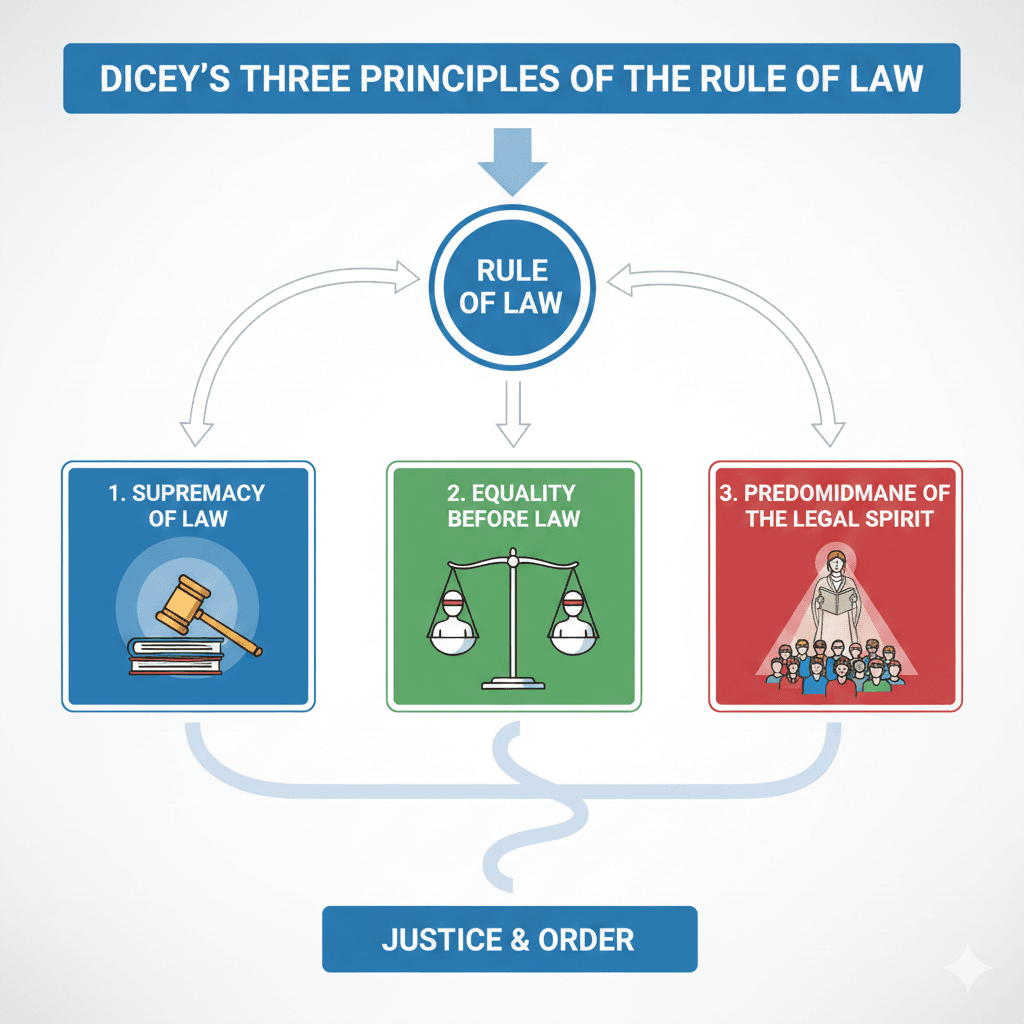
1. Supremacy of Law
This principle means that:
- No person can be punished, detained, or harmed unless they violate a law that is already established.
- Government authorities cannot act arbitrarily; every action must have legal backing.
2. Equality Before Law
Dicey’s second principle highlights that:
- All individuals, regardless of status, rank, or office, are equal under the law.
- This includes government officials, political leaders, and public authorities.
3. Predominance of the Legal Spirit
This is one of the most important but often misunderstood elements. Dicey argued that:
- The rights and liberties of citizens do not exist because they are listed in a written Constitution.
- Instead, they emerge from court decisions where judges protect individual rights through their rulings.
- Therefore, an independent judiciary and strong judicial reasoning are essential for the Rule of Law to survive.
Also read: Fundamental Duties (Article 51A) in the Indian Constitution | UPSC Polity Notes
UPSC Prelims PYQ on Rule of Law Meaning
QUESTION 1
Which of the following are regarded as the main features of the "Rule of Law"?
- Limitation of powers
- Equality before law
- People's responsibility to the Government
- Liberty and civil rights
Select the correct answer using the code given below :
A. 1 and 3 only
B. 2 and 4 only
C. 1, 2 and 4 only
D. 1, 2, 3 and 4
Rule of Law in the Indian Constitution
The Rule of Law is not explicitly defined in the Indian Constitution, yet it forms the core of constitutional governance. All three organs of the government—the Legislature, the Executive, and the Judiciary—are bound to function within the limits of law and cannot act arbitrarily.
Below, we will understand how the Rule of Law operates within the Indian constitutional framework:
1. Judicial Review
Judicial review empowers the courts to ensure that no law or executive action violates the Constitution, thereby upholding the Rule of Law.
- The Supreme Court struck down Section 66A of the IT Act (Shreya Singhal case) for violating fundamental rights.
- The 9-Judge bench in the Puttaswamy (2017) case declared privacy a fundamental right, checking arbitrary State surveillance.
- High Courts routinely quash illegal detentions through Article 226 writ jurisdiction.
2. Supremacy of the Constitution
Any law passed by the Union or State legislature must be consistent with the Constitution. If a law is inconsistent, it becomes void under Article 13(2).
- Farm laws were challenged on the grounds of legislative competence.
- Various State laws on reservations have been struck down for violating basic rights.
3. Preamble
The Preamble embeds the core values that guide the Rule of Law:
- Justice (social, economic, political)
- Liberty (thought, expression, belief, faith, worship)
- Equality (of status and opportunity)
- Fraternity (assuring dignity and national unity)
The Supreme Court in the Kesavananda Bharati (1973) case referred to the Preamble to emphasise that arbitrary power has no place in a constitutional democracy.
4. Article 14
Article 14 directly reflects Dicey’s concept of the Rule of Law.
- Equality Before Law: Everyone is equal in the eyes of the law.
- Equal Protection of Laws: Similar people should be treated similarly; reasonable classifications are allowed.
- The Sabarimala judgment held discriminatory practices unconstitutional.
- Striking down of Section 377 (Navtej Johar case) for violating dignity and equality.
5. Article 21
Article 21 ensures that life and liberty cannot be taken away except by “procedure established by law”—a core idea of the Rule of Law.
- The Maneka Gandhi (1978) judgment expanded Article 21’s meaning and held that any procedure must be fair, just, and reasonable.
- Custodial violence cases are examined under Article 21 for violating dignity.
6. Article 20
This Article provides:
- No ex post facto laws
- No double jeopardy
- No self-incrimination
A person cannot be punished for an act that was not a crime when committed. It protects citizens from unfair and retrospective legal actions.
7. Independent Judiciary & Separation of Powers
Even though not explicitly stated, the Constitution ensures a separation of functions, which prevents the concentration of power.
- Courts strike down executive overreach (e.g., misuse of preventive detention).
- Parliament cannot interfere in judicial decision-making.
8. Due Process in Administrative Actions
Through various judgments, the Supreme Court has mandated fairness in administrative decisions.
- Cancellation of 2G spectrum licenses due to arbitrary allocation procedures.
- Government actions must follow natural justice (notice + hearing).
Must read: Important Articles in the Indian Constitution Related to UPSC Functions and Powers
UPSC Prelims PYQ on Rule of Law
QUESTION 1
Which one of the following statements best reflects the chief purpose of the 'Constitution' of a country?
Exceptions to the Rule of Law in India
While the Indian Constitution strongly upholds the Rule of Law, it also permits certain exceptions to ensure smooth governance, maintain constitutional balance, and respect international obligations.
1. Discretionary Powers of the President & Governor
- Pardoning Powers (Articles 72 & 161): They can pardon, commute, remit, or suspend sentences.
- Legislative Discretion (Article 85): The President may prorogue or dissolve the Lok Sabha.
- Reservation of Bills (Article 200): The Governor can reserve state bills for the President.
- Report under Article 356: The Governor may recommend President’s Rule.
2. Constitutional Immunities
- The President and Governors are not answerable to courts for acts done in their official capacity.
- No criminal proceedings can be initiated against them while in office.
- Civil cases can be filed only after giving a 2-month notice.
3. Executive Discretion
- Police have the power to arrest without a warrant for cognisable offences.
- Public officials (e.g., municipal authorities, administrative officers) enjoy certain immunities to perform duties efficiently.
4. Judicial Discretion
- Criminal courts have wide discretion in awarding sentences, considering the circumstances of each case.
5. Diplomatic Immunities
- Under international law, foreign diplomats, visiting heads of state, and officials are immune from local jurisdiction for their official acts.
Rule of Law IndexThe Rule of Law Index is released annually by the World Justice Project (WJP). It measures how effectively countries uphold the principles of the Rule of Law. The Index evaluates countries on eight major pillars:
As per the 2024 Rule of Law Index report, India ranked 79th out of 142 countries Comparison with Neighbouring Countries Regionally, India stands 3rd among South Asian countries
The top-performing countries are Denmark, Norway, Finland, Sweden, and Germany. |
UPSC Prelims PYQ on Rule of Law Index
QUESTION 1
"Rule of Law Index" is released by which of the following?
Rule of Law vs Rule by Law
The concepts of Rule of Law and Rule by Law may sound similar, but they represent very different systems of governance. Let’s understand the difference!
| Rule of Law | Rule by Law |
|---|---|
| Law governs everyone, including the government. | Law is used by the government to control people. |
| To protect rights, ensure justice, and limit power. | To legitimise the government’s actions, even if unjust. |
| Democratic, accountable, transparent. | Authoritarian or arbitrary governance. |
| Everyone is equal before the law; no special privileges. | The government may create unequal or discriminatory laws. |
| Strong checks (judiciary, constitutional limits). | Weak or no checks; power is concentrated in the State. |
| Fairness, justice, impartiality. | Control, compliance, authority. |
The Way Ahead
The rule of law should be respected so that the basic structure of our democracy is maintained and further strengthened.”— Lal Bahadur Shastri
Moving forward, India must work toward a system where the law protects citizens, limits power, and ensures justice for all. Strengthening the Rule of Law requires:
- Independent and empowered institutions
- Transparent and accountable governance
- People-centric laws
- Efficient and accessible justice delivery
- Zero tolerance for corruption
- Active citizen participation in democratic processes
A strong commitment to these principles will ensure that India continues to grow as a just, democratic, and inclusive nation, firmly rooted in the true spirit of the Rule of Law.
Crack UPSC Smarter with SuperKalam
Your Personal AI Mentor that teaches, instantly evaluates Handwritten Answers & builds Daily Discipline
Download the App Now