Quantum Computing: Meaning, Principles & Applications - UPSC Notes
Quantum computing is an advanced technology using qubits and quantum mechanics to solve complex problems faster. Learn its meaning, principles, applications, advantages, limitations, and India’s initiatives for UPSC.
Feb, 2026
•8 min read
Quantum Computing is an emerging technology that uses principles of quantum mechanics to process information far beyond classical computers. The topic is highly relevant for GS Paper III (Science & Technology) and also important for Prelims and Current Affairs preparation.
Let's learn about Quantum Computing!
What is Quantum Computing?
Quantum Computing is an advanced form of computing that uses the laws of quantum mechanics to process and store information in qubits, enabling it to solve certain complex problems much faster than classical computers.
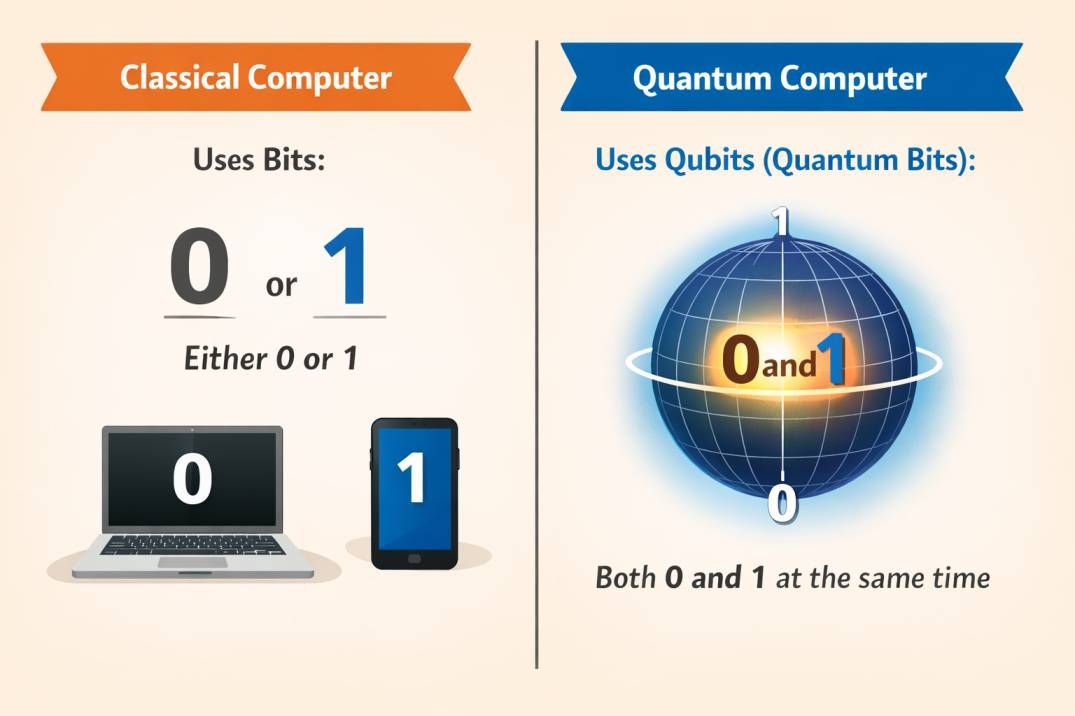
A classical computer (like your laptop or phone) uses bits, which can be either:
- 0 or
- 1
But a quantum computer uses qubits (quantum bits). A qubit can be:
- 0
- 1
Both 0 and 1 at the same time (this is called superposition). Because of this property, quantum computers can process many possibilities at once, making them much more powerful for certain complex problems.
Example: Suppose you have to find the correct password from millions of combinations:
- A classical computer tries combinations one by one.
- A quantum computer can evaluate many combinations at once.
This is why quantum computing is considered revolutionary in areas like cryptography, artificial intelligence, space research, and drug discovery.
Key Principles of Quantum Computing
In physics, quantum computing is based on the smallest possible discrete units of physical properties, known as quantum states. At the microscopic level (atoms and subatomic particles), energy, charge, and spin exist in fixed packets called quanta.
Quantum computing is built on the fundamental laws of quantum mechanics, which govern the behaviour of matter and energy at the atomic and sub-atomic level.
1. Quantum Superposition
The fundamental principle behind quantum computing is quantum superposition.
In classical computers:
- A bit can exist in only one state — 0 or 1.
In quantum computers:
- A qubit can exist in a superposition of 0 and 1 simultaneously.
This does not mean it is partly 0 and partly 1 in a simple sense. It means the qubit exists in a combination of probability states until it is measured.
Because of superposition, if you have n qubits, they can represent 2ⁿ possible states at the same time. This gives quantum computers massive parallel processing capability.
2. Quantum Entanglement
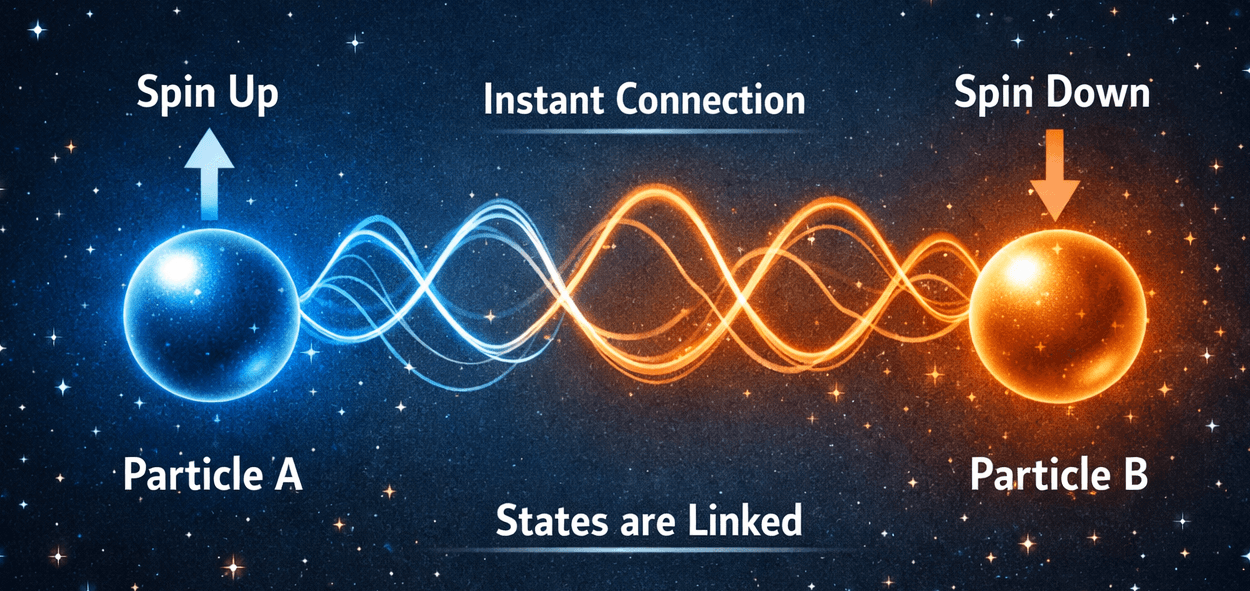
Quantum entanglement occurs when two or more quantum particles interact physically in such a way that their quantum states become linked.
- In this state, the quantum state of each particle cannot be described independently.
- Measuring one particle instantaneously affects the others, even when large distances separate them.
- This leads to correlations that are stronger than any classical system can produce.
- The great scientist Albert Einstein referred to this principle as "spooky action at a distance."
Why this matters:
- Enables ultra-secure quantum communication.
- Forms the backbone of quantum networking and cryptography.
- Increases coordination between qubits in computation.
3. Quantum Interference
Quantum particles behave not only like particles but also like waves. Because of this wave-like nature, different probability states can interfere with each other. This interference can be:
- Constructive Interference → strengthens correct computational outcomes.
- Destructive Interference → cancels incorrect outcomes.
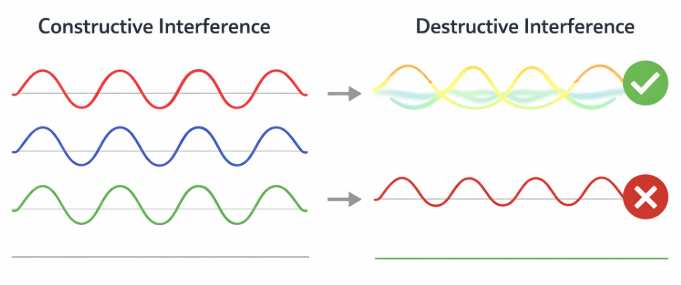
Quantum algorithms are carefully designed to use this interference pattern to increase the probability of arriving at the correct solution.
In simple terms, Superposition explores many possibilities. Interference filters out the wrong ones.
4. Quantum Tunnelling
Quantum tunnelling refers to the ability of particles to pass through energy barriers even when, according to classical physics, they do not have enough energy to cross them.
In classical physics:
- If energy is less than the barrier → crossing is impossible.
In quantum physics:
- There is always a probability that the particle can “tunnel” through.
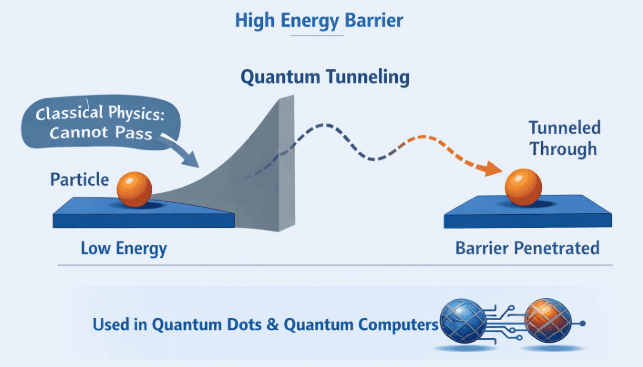
This principle is critical for:
- Certain quantum computing hardware, like quantum dots.
- Quantum annealing methods are used for optimisation problems.
- Semiconductor technologies.
Quantum tunnelling explains both advanced computing hardware and important natural phenomena like nuclear fusion in stars.
Advantages & Applications of Quantum Computing
Quantum computing offers transformational advantages. Its impact is expected across science, finance, defence, healthcare, and climate research.
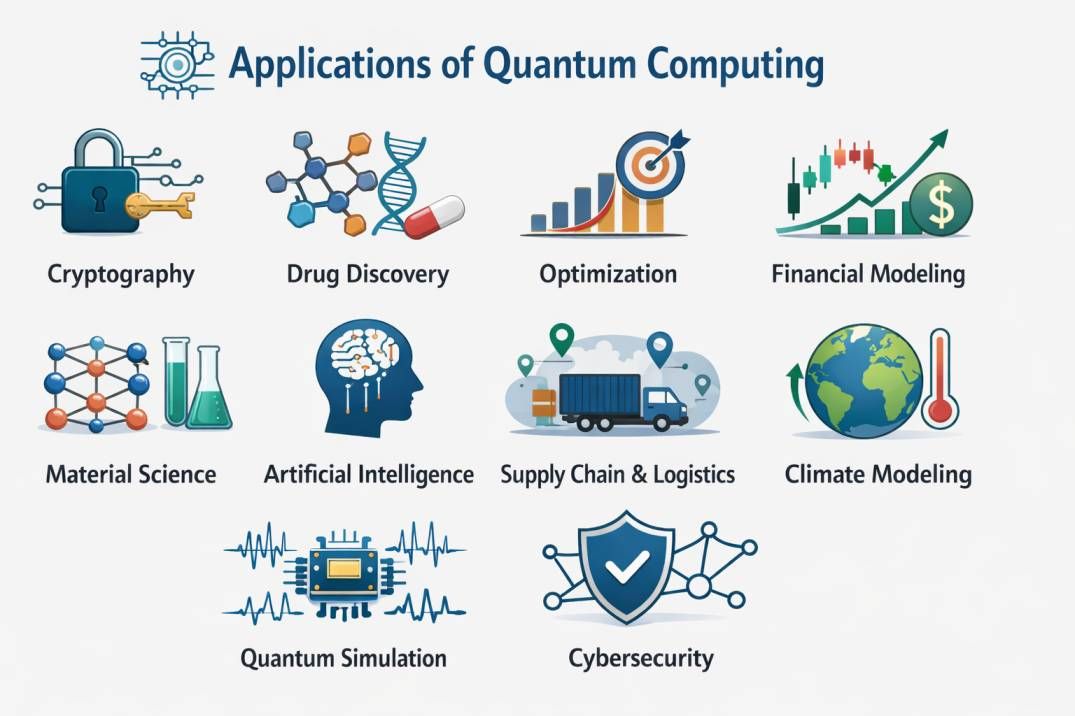
1. Speed in Search & Optimisation
Quantum computers significantly improve search efficiency using Grover’s Algorithm, which provides a quadratic speedup over classical systems.
A database of 4 entries:
- Classical computer → 4 checks
- Quantum computer → 1 check
With larger datasets, the speed advantage becomes massive.
Applications:
- Real-time financial market analysis
- Healthcare data processing
- Defence and intelligence data search
- Logistics and supply-chain optimisation
2. Accurate Chemical & Molecular Simulation
Classical computers struggle to simulate quantum-level molecular behaviour. Quantum computers can naturally simulate these systems.
50–100 qubits can model:
- Complex enzyme mechanisms
- Chemical reactions
- Molecular structures
Applications:
- Designing better fertilizers
- Developing advanced polymers
- Improving biomass energy production
- Creating efficient catalysts
3. Boost to Artificial Intelligence
Quantum computing enhances machine learning by processing multiple data states simultaneously. Quantum neural networks have shown improved performance in fraud detection (e.g., 63% vs 50% in experimental comparisons).
Applications:
- Fraud detection in banking
- Cybersecurity threat analysis
- Big data analytics
- Smart automation systems
4. Advanced Financial Modelling
Financial markets involve complex interdependent variables. Quantum computing can analyse them simultaneously. Capabilities:
- Portfolio optimisation
- Risk assessment
- Price modelling
- Economic forecasting
5. Secure Communication & Strategic Advantage
Quantum computing has a dual impact on cybersecurity:
- Risk: Existing public-key cryptography may become vulnerable.
- Opportunity: Quantum Key Distribution (QKD) enables highly secure communication channels.
Applications:
- Military communication
- Secure online banking
- Protection of sensitive government data
6. Healthcare & Drug Discovery Revolution
Quantum systems can model biological processes more accurately than classical computers. Applications:
- Protein folding simulation
- Gene sequencing analysis
- Disease pathway modelling
- Personalized medicine
- Faster drug discovery
7. Climate Change & Environmental Modelling
Quantum computing can handle extremely large climate datasets. Applications:
- High-resolution regional climate modelling
- Improved weather prediction
- Disaster forecasting
- Climate policy simulation
UPSC Prelims PYQs on Quantum Computing
QUESTION 1
Which one of the following is the context in which the term "qubit" is mentioned?
QUESTION 2
Consider the following statements:
I. It is expected that Majorana 1 chip will enable quantum computing. II. Majorana 1 chip has been introduced by Amazon Web Services (AWS). III. Deep learning is a subset of machine learning.
Which of the statements given above are correct?
Limitations of Quantum Computing
Although quantum computing is one of the most promising emerging technologies, it still faces serious technical and practical challenges.
1. Hardware Fragility
Quantum computers require extremely controlled environments to function properly. For example, Google’s 72-qubit quantum processor operates at temperatures close to absolute zero.
- It must be kept inside vacuum chambers.
- Requires vibration dampening and magnetic shielding.
- Even minor disturbances like heat, electromagnetic waves, or vibrations can disturb qubits.
➡ This makes quantum hardware highly fragile, expensive, and complex to maintain.
2. Decoherence (Short Stability Time)
Qubits lose their quantum properties very quickly, known as decoherence. Researchers at IBM reported that a 27-qubit system had a coherence time of only 47 microseconds. This time is too short for stable, large-scale error correction. Because quantum states collapse quickly:
- Computations must be performed extremely fast.
- Errors become very common.
➡ Decoherence remains one of the biggest obstacles to practical quantum computing.
3. Lack of Standardisation
Unlike classical computing, quantum computing lacks universal standards. No common standards exist for quantum programming languages or software tools. Even hardware benchmarking methods are debated.
- IBM and Microsoft have disagreed over how fidelity benchmarks should be defined across different hardware technologies (superconducting, ion trap, photonics).
➡ This lack of standardisation slows global collaboration and commercial development.
4. Qubit Scalability Problem
Current quantum systems operate with a limited number of qubits. Intel developed a 49-qubit superconducting chip named Pushan, which represents a significant milestone.
- However, achieving quantum advantage in areas like machine learning or chemical simulation may require millions of stable qubits.
- There is still no clear roadmap to scale from tens of qubits to millions.
➡ Scaling qubits while maintaining stability and low error rates remains a major technical challenge.
Initiatives to Promote Quantum Computing in India
India has recognised quantum computing as a strategic technology of the future and launched multiple initiatives to develop research capabilities, build infrastructure, and foster industry–academia linkage.
1. National Quantum Mission (NQM)
The Government of India approved the National Quantum Mission with a budget of around ₹6,003.65 crore (2023–31). The vision is to accelerate research, innovation, and industrial development in quantum technologies, including computing, communication, sensing, metrology, and materials. It aims to make India a global leader in quantum technology by supporting long-term R&D, industrial adoption, and ecosystem building.
Under NQM:
- Quantum computers with 50–1000 qubits are targeted to be developed.
- Satellite and ground-based secure quantum communication networks are planned.
- Advanced quantum sensors, atomic clocks, and quantum materials will be developed.
- The mission supports national goals like Digital India, Skill India, Start-up India, and Make in India.
2. Thematic Hubs and Research Ecosystem
Four National Quantum Mission Thematic Hubs (T-Hubs) have been established to focus on specialised areas:
- Quantum Computing – at institutes like the Indian Institute of Science (IISc), Bengaluru.
- Quantum Communication – led by IIT Madras and partners.
- Quantum Sensing & Metrology – at IIT Bombay.
- Quantum Materials & Devices – at IIT Delhi.
These hubs promote research, innovation and collaboration among academia, startups, and industry.
3. Quantum Start-up Support
Under the National Quantum Mission, innovative startups working on quantum hardware, software, and components are being selected for funding and mentorship.
Companies such as QPiAI India are developing superconducting quantum systems, cryogenic components, and other quantum technologies, demonstrating the growth of an indigenous ecosystem.
4. Quantum Skilling & Awareness Programmes
The mission and related initiatives encourage quantum education and talent development through:
- Competitions, workshops, and awareness events (e.g., Quantum Quest).
- Quantum curriculum in universities and specialised training programs.
Partnerships with tech companies for skilling millions of professionals in quantum computing and related fields.
5. State-Level Quantum City & Valley Projects
Several state governments are also promoting quantum ecosystems:
- Amaravati Quantum Valley in Andhra Pradesh is planned as a dedicated quantum technology hub with partnerships (e.g., IBM, TCS) and a quantum reference facility to support research, startups, and advanced projects.
- Quantum City at Hesarghatta, Bengaluru aims to build labs, incubators, and infrastructure for industrial and academic quantum research.
- Tamil Nadu’s iTNT Hub partnered with a German quantum firm to provide hands-on access to real quantum hardware for students and startups.
6. International Collaboration
India participates in global partnerships like the Quantum Entanglement Exchange Programme, connecting students and researchers with international quantum labs and institutions.
Challenges in the Development of Quantum Computing in India
Despite a strong policy push and the launch of the National Quantum Mission, India faces several structural and technological challenges in developing a globally competitive quantum ecosystem.
- Limited Advanced Infrastructure: High-end fabrication facilities, cryogenic systems, and precision labs are still limited in India.
- Dependence on Imported Components: Critical hardware components like superconducting chips, dilution refrigerators, and photonic devices are largely imported.
- Shortage of Skilled Manpower: Quantum computing requires interdisciplinary expertise (physics, mathematics, computer science, engineering), but trained specialists are limited.
- Funding & Long Gestation Period: Quantum research demands sustained long-term investment with uncertain short-term returns.
- Scalability Issues: Moving from small qubit systems to large, fault-tolerant quantum computers remains a major technical hurdle.
- Weak Industry-Academia Linkages: Limited collaboration between research institutions and private industry slows commercialisation.
- Cybersecurity Risks: Quantum advancement may disrupt existing encryption systems, requiring parallel development of post-quantum cryptography.
- Global Competition: Countries like the US and China are far ahead in hardware development and patents, creating intense strategic competition.
UPSC Mains Practice Question on Quantum Computing
Critically analyse the opportunities and risks associated with quantum computing. How should India prepare for the quantum era? (250 words. 15 marks)
Evaluate your Answer in 60 SecondsWay Forward
To harness the full potential of Quantum Computing, India must adopt a strategic, long-term, and mission-driven approach.
- Strengthen Indigenous Hardware Development: Invest in domestic fabrication facilities, cryogenic systems, and semiconductor ecosystems to reduce import dependence.
- Build a Skilled Quantum Workforce: Introduce quantum computing courses in universities and expand interdisciplinary research in physics, mathematics, and computer science.
- Promote Industry–Academia Collaboration: Encourage startups, private firms, and research institutions to jointly develop scalable quantum solutions.
- Develop Post-Quantum Cryptography: Prepare for future cybersecurity threats by upgrading encryption standards.
- Enhance Global Partnerships: Collaborate with leading quantum nations for knowledge exchange and technology transfer.
A focused roadmap can position India as a global leader in quantum technologies.
Start your UPSC Preparation 2027 with SuperKalam
SuperKalam is your personal mentor for UPSC preparation, guiding you at every step of the exam journey. Practice, revise, and evaluate– all in one place.
Download Now