Partition of Bengal 1905 - UPSC Modern History Notes
Partition of Bengal 1905 UPSC Notes: Understand causes, Swadeshi Movement, boycott, annulment, and major nationalist events crucial for UPSC Prelims and Mains. Click now!
Jul, 2026
•7 min read
The Partition of Bengal (1905) marked a major turning point in India’s freedom struggle. The then Viceroy of India, Lord Curzon, announced the partition by dividing Bengal in the name of administrative convenience, but Indians strongly opposed it as a deliberate British “Divide and Rule” policy.
The decision sparked widespread protests, strengthened nationalist feelings, and gave rise to the Swadeshi and Boycott Movements across the country. It also encouraged the use of indigenous goods and brought students, women, and common people into the national movement.
For UPSC, this topic holds high importance in both Prelims (Modern Indian History) and Mains (GS Paper I). Let's study this topic in detail!
Background of the Partition of Bengal
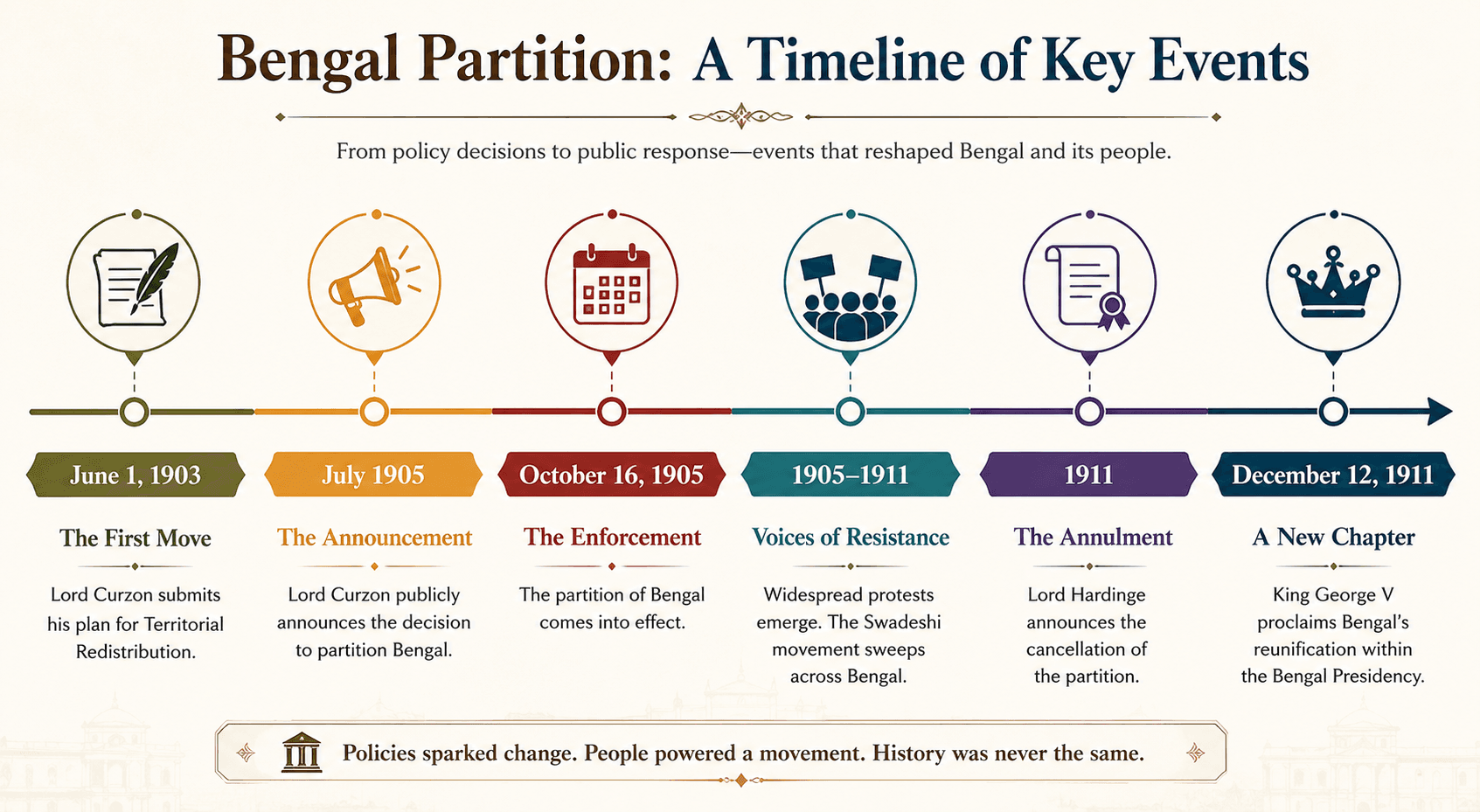
The Partition of Bengal was one of the most controversial decisions taken by the British government in India. Lord Curzon announced the partition on 16 October 1905 during his tenure as the Viceroy of India. The decision triggered strong political opposition and became a major turning point in the Indian freedom struggle.
Bengal Before Partition
Before 1905, Bengal was the largest and most important province of British India. It included:
- Present-day West Bengal
- Bihar
- Odisha
- Parts of Assam
Bengal held immense political, economic, and intellectual importance because:
- Calcutta (now Kolkata) was the capital of British India.
- Bengal was the centre of education, journalism, literature, and political awareness.
- The region produced many early nationalist leaders, reformers, and intellectuals.
- Nationalist activities against British rule were rapidly increasing in Bengal.
Because of this growing political consciousness, Bengal became the heart of the Indian nationalist movement during the late 19th and early 20th centuries.
Why Did the British Partition Bengal?
The British government justified the partition on administrative grounds. According to the British:
- Bengal had a population of nearly 80 million people.
- The province covered a very large geographical area.
- Managing administration, law and order, and revenue collection had become difficult.
- Efficient governance required the creation of smaller provinces.
Curzon argued that partitioning Bengal would improve administration and bring better governance to the eastern regions, which the British claimed had long remained neglected.
Although the British presented the decision as an administrative necessity, Indian leaders believed that the real objective was political. By the beginning of the 20th century, Bengal had emerged as the strongest centre of anti-British nationalism. The British feared the growing unity and political awareness among Indians.
The partition aimed to:
- Break the unity of the Bengali population
- Weaken the nationalist movement in Bengal
- Create divisions between Hindus and Muslims
- Reduce the influence of educated Bengali leaders and intellectuals
The British deliberately separated the Hindu-majority western areas from the Muslim-majority eastern regions. Indian nationalists viewed this as a clear example of the British “Divide and Rule” policy.
Lord Curzon believed that dividing Bengal would weaken the organised political opposition against British rule.
Division of Bengal Under the Partition
The Partition of Bengal divided the province into two separate administrative units.
1. Western Bengal
This province included:
- Western Bengal
- Bihar
- Odisha
Features:
- Hindu-majority population
- Calcutta remained an important political centre
- Included many educated Bengali nationalists
2. Eastern Bengal and Assam
This new province included:
- Dacca
- Chittagong
- Rajshahi
- Malda
- Hill Tippera (Tripura region)
- Assam
Features:
- Muslim-majority population
- Dacca (now Dhaka) became the capital
- The British tried to gain support from sections of the Muslim elite in eastern Bengal
Also see: Vedic Age (1500 BC - 600 BCE) – UPSC Ancient History
Reaction of the Indian People Against the Partition of Bengal
The Partition of Bengal in 1905 sparked intense opposition across Bengal and other parts of India. Indians did not accept the British claim that the partition aimed to improve administration. Instead, they viewed it as a deliberate attempt to divide Hindus and Muslims and weaken the growing nationalist movement in Bengal.
The anti-partition agitation soon became the first large-scale mass movement against British rule in modern India.
Massive Public Protests
People from all sections of society actively participated in the protests against the partition.
- Large public meetings and processions were organised across Bengal.
- Protesters shouted nationalist slogans such as “Vande Mataram.”
- On 16 October 1905, the day the partition came into effect, Indians observed the day as a day of mourning.
- People took dips in the Ganga and tied Rakhi to symbolise Hindu-Muslim unity.
- Shops and markets remained closed during demonstrations.
The movement quickly spread from Bengal to other regions like Maharashtra, Punjab, and Madras.
Role of Nationalist Leaders
Several prominent leaders strongly opposed the partition and inspired people to join the movement.
- Surendranath Banerjee became one of the leading voices against the partition and organised mass meetings across Bengal.
- Bal Gangadhar Tilak supported the boycott movement and encouraged aggressive nationalism.
- Bipin Chandra Pal played a major role in spreading the Swadeshi Movement through speeches and writings.
- Lala Lajpat Rai extended support to the movement from Punjab.
- Aurobindo Ghosh inspired revolutionary nationalism through his writings and political activities.
Together, these leaders transformed the anti-partition movement into a strong nationalist campaign.
Participation of Different Sections of Society
One of the most remarkable features of the movement was the participation of ordinary people.
- Students boycotted schools and colleges run by the British government.
- Lawyers and teachers joined protest meetings and campaigns.
- Women participated in rallies, picketing, and the promotion of Swadeshi goods.
- Traders and businessmen supported the boycott of foreign products.
- Workers and common citizens actively attended demonstrations.
This broad participation gave the Indian freedom struggle a true mass character for the first time.
Also read: Quit India Movement 1942 UPSC Notes
Rise of the Swadeshi and Boycott Movements
The opposition to the Partition of Bengal gave birth to the Swadeshi and Boycott Movements, which became major weapons against British rule. The word Swadeshi means “of one’s own country.” The movement encouraged Indians to reject foreign goods and promote Indian-made products and industries.
The boycott movement became one of the strongest forms of protest against British policies.
- Indians refused to buy British-made goods, especially foreign cloth.
- Public bonfires of imported clothes were organised in many places.
- Shops selling foreign products were picketed.
- People began using handwoven Indian cloth and locally made goods.
The boycott movement directly affected British economic interests and increased nationalist consciousness among Indians.
Promotion of Swadeshi Industries
The movement encouraged economic self-reliance and support for indigenous industries. Major initiatives include:
- Indians promoted local textile mills, handicrafts, and small-scale industries.
- National banks, insurance companies, and enterprises were established.
- People preferred Indian-made soaps, matches, sugar, and other daily-use items.
- Traditional crafts and village industries received new encouragement.
Must read: Revolt of 1857 UPSC: Why It Happened, How it Spread, What It Left Behind
National Education Movement
The movement also focused on creating an education system free from British control.
- Students boycotted government educational institutions.
- National schools and colleges were established across Bengal.
- Institutions like the National Council of Education were founded to promote Indian education.
- Teachers encouraged patriotic values and nationalist thinking among students.
This movement helped spread political awareness among the younger generation.
Cultural and National Awakening
The Swadeshi Movement also inspired cultural nationalism.
- Patriotic songs, poems, and literature became popular.
- Rabindranath Tagore inspired people through songs and public campaigns promoting unity.
- The slogan “Vande Mataram” became a symbol of nationalism.
- Public festivals and cultural programmes spread patriotic feelings among the masses.
The movement created a sense of unity, self-confidence, and national pride among Indians.
Annulment of the Partition of Bengal (1911)
The strong and continuous opposition to the Partition of Bengal eventually forced the British government to withdraw its decision. The movement gained nationwide support and became one of the most powerful anti-British agitations of the early 20th century.
The British government realised that the partition had intensified nationalist sentiments instead of weakening them. The growing unity among Indians and the increasing political unrest compelled the British to reconsider their policy.
Finally, in 1911, the British government officially annulled the Partition of Bengal, marking a major victory for Indian nationalism.
Delhi Durbar of 1911
The annulment of the partition was announced during the Delhi Durbar held in 1911 in the presence of George V.
The announcement aimed to reduce public anger and restore political stability in India. However, the British also introduced new administrative changes to maintain their control over the country.
Reunification of Bengal
- The British government officially cancelled the Partition of Bengal.
- Eastern Bengal and Western Bengal were reunited into a single province once again.
- This decision ended the controversial division created in 1905 by Lord Curzon.
Creation of New Provinces
To reorganise administration after the annulment:
- Bihar and Odisha were separated from Bengal and formed into a new province in 1912.
- Assam was made a separate administrative unit once again.
- These changes reduced the size of Bengal while avoiding the communal division created by the earlier partition.
Transfer of the Capital from Calcutta to Delhi
One of the most significant decisions taken in 1911 was the shifting of the capital of British India from Calcutta to Delhi. The British shifted the capital because:
- Calcutta had become the centre of nationalist politics and anti-British activities.
- The British wanted to reduce Bengal’s political influence.
- Delhi was considered geographically more central for administration.
- The shift also carried symbolic importance because Delhi had historical links with earlier Indian empires, especially the Mughals.
By moving the capital, the British hoped to weaken the growing nationalist movement in Bengal and strengthen administrative control over India.
Also see: Charter Act of 1813 (UPSC Notes)
UPSC Prelims PYQs on Partition of Bengal
QUESTION 1
The Partition of Bengal made by Lord Curzon in 1905 lasted until -
QUESTION 2
The ‘Swadeshi’ and ‘Boycott’ adopted as methods of struggle for the first time during the -
QUESTION 3
Consider the following statements : Statement-I: 7th August is declared as the National Handloom Day. Statement-II: It was in 1905 that the Swadeshi Movement was launched on the same day.
Which one of the following is correct in respect of the above statements?
UPSC Mains Previous Year Question (GS Paper I)
Evaluate the policies of Lord Curzon and their long-term implications on the national movements. (150 words, 10 marks)
Evaluate your Answer within 60 SecondsConclusion
The Partition of Bengal (1905) became a major turning point in the Indian freedom struggle and exposed the British “Divide and Rule” policy. The anti-partition protests, the Swadeshi Movement, and the Boycott Movement strengthened Indian nationalism and encouraged mass participation against colonial rule.
For UPSC Prelims and Mains, the Partition of Bengal remains highly important to understand the rise of nationalist movements, British policies in India, and the growth of organised resistance during the Indian National Movement.
Crack UPSC Smarter with SuperKalam
SuperKalam is your personal mentor for UPSC preparation, guiding you at every step of the exam journey. Practice, revise, and evaluate– all in one place.
Download the SuperKalam App Now