Basic Structure Doctrine UPSC Notes: Meaning, Significance & Key Cases
Basic Structure Doctrine for UPSC explained: definition, origin, landmark cases, Article 368, importance & criticisms. Read now to boost your UPSC Polity score.
Dec, 2025
•4 min read
The Indian Constitution was originally designed to be flexible, allowing Parliament to amend it to meet the changing needs of society. However, this flexibility led to a power struggle: Could Parliament change everything, including Fundamental Rights? This conflict gave birth to the Basic Structure Doctrine.
The Basic Structure Doctrine is a key topic for UPSC Prelims (important judgments, evolution, key cases) and GS Paper II of Mains (separation of powers, judicial review, constitutional amendments). Let's study this topic in detail.
What is the Basic Structure Doctrine?
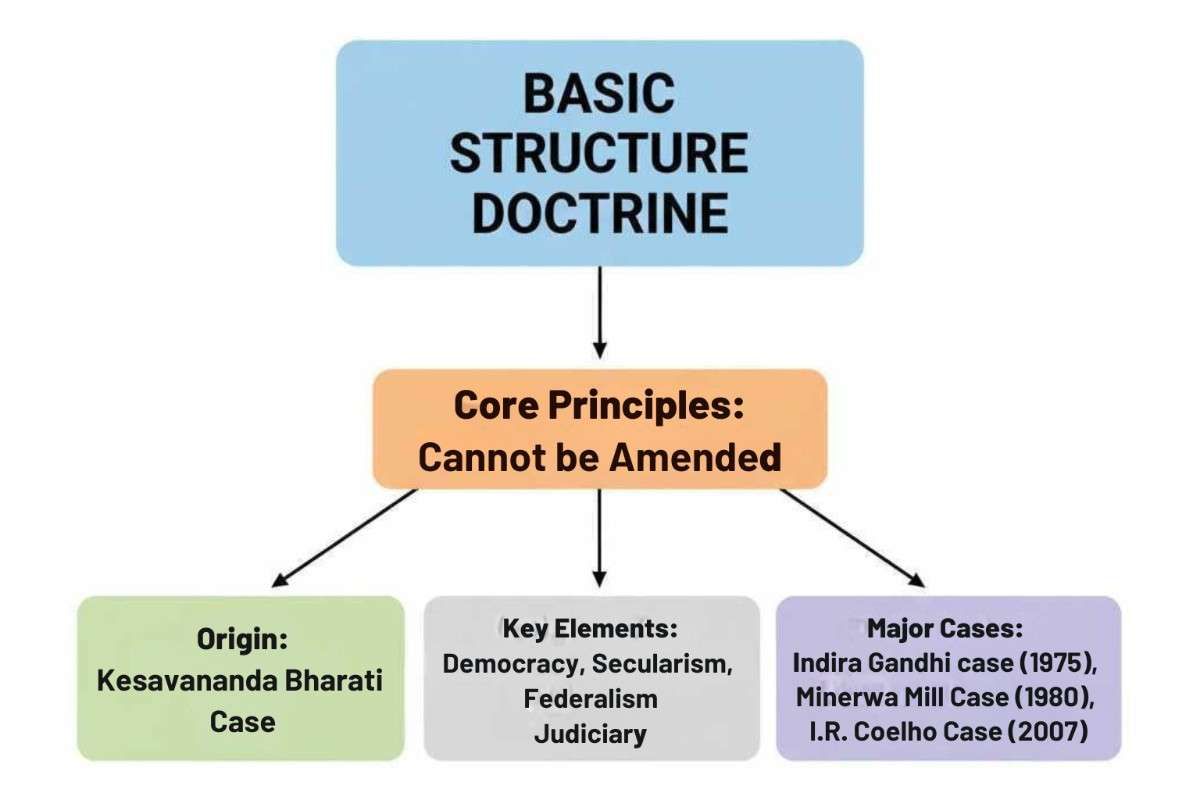
The Basic Structure Doctrine is a judicial principle which states that the Parliament has the power to amend the Constitution, but it cannot alter, damage, or destroy its core identity or "basic features."
- The doctrine is NOT written in the Constitution itself, but was created by the Indian judiciary through court judgments.
- It was formally established in the landmark case Kesavananda Bharati v. State of Kerala on April 24, 1973.
- A 13-judge Constitutional Bench heard the case, one of the largest in Indian judicial history.
- The doctrine acts as a check on Parliament's amending power under Article 368 of the Constitution.
- It ensures that core constitutional principles cannot be altered to serve temporary political interests.
- It applies to constitutional amendments enacted after April 24, 1973, as clarified in the Waman Rao case (1981).
Also read: Anti-Defection Law in India
Important Elements of the Basic Structure
The Supreme Court has not provided a single, exhaustive list of what is called the basic structure. However, through various judgments, particularly the Kesavananda Bharati case and subsequent decisions, certain key elements have been recognised as part of the basic structure.
- Supremacy of the Constitution: The Constitution is the supreme law of the land. No law made by Parliament or any executive action can override or contradict it.
- Republican and Democratic Forms of Government: India must remain a republic (headed by an elected President) and maintain democratic governance where power ultimately rests with the people.
- Secular Character: The state shall have no official religion. All religions shall be treated equally, and religious freedom is guaranteed to all citizens.
- Federal Structure: Power is divided between the central government and state governments. This balance between the centre and states cannot be destroyed.
- Separation of Powers: The three organs of government (the Legislature, the Executive, and the Judiciary) must remain independent and hold checks and balances on each other.
- Judicial Review: The power of courts to examine whether laws and government actions comply with the Constitution is itself a basic feature and cannot be removed.
- Fundamental Rights: Certain basic rights like equality (Article 14), freedom (Article 19), and the right to life (Article 21) cannot be abolished.
- Harmony Between Fundamental Rights and Directive Principles: A balance must be maintained between individual rights and state welfare objectives.
- Rule of Law: All persons, including the government, are subject to the law. No one is above the law.
- Golden Triangle: Articles 14, 19, and 21 together form what is called the "golden triangle" of fundamental rights and are collectively viewed as a basic feature protecting equality, freedom, and dignity.
- Limited Amending Power of Parliament: The very fact that Parliament's power to amend is limited (and not absolute) is itself a basic feature of the Constitution.
Also read: Fundamental Duties (Article 51A) in the Indian Constitution | UPSC Polity Notes
Evolution of the Doctrine of Basic Structure
The journey of this doctrine is a tug-of-war between the Parliament (which wanted unlimited power to amend) and the Judiciary (which wanted to protect rights).
1. Shankari Prasad Singh Deo v. Union of India (1951) Case
- The Supreme Court held that Parliament has absolute power to amend any part of the Constitution, including Fundamental Rights.
2. Sajjan Singh v. State of Rajasthan (1965) Case
- The Court agreed with the earlier view, but some judges began questioning whether "basic features" could be changed.
3. Golak Nath v. State of Punjab (1967) Case
- The Supreme Court reversed its stance. It ruled that Fundamental Rights are "sacrosanct" and Parliament cannot take them away. This led to a conflict between the Parliament and the Judiciary.
4. Kesavananda Bharati v. State of Kerala (April 24, 1973):
- Kesavananda Bharati was the chief of Edneer Mutt in Kasaragod, Kerala. The government's land reform laws threatened his religious institution's property.
- He challenged the 29th Amendment, which placed the Kerala Land Reforms Act into the Ninth Schedule.
The Court overruled the Golaknath judgment. - It said Parliament can amend Fundamental Rights but cannot touch the "Basic Structure" of the Constitution.
5. Indira Nehru Gandhi v. Raj Narain (1975)
- The 39th Amendment tried to keep the election of the PM and Speaker outside the court's jurisdiction.
- The SC struck this down, stating that "Free and Fair Elections" and "Rule of Law" are basic features.
6. Minerva Mills Ltd. v. Union of India (July 31, 1980)
- Parliament tried to give unlimited amending power to itself (42nd Amendment).
- The SC struck this down, ruling that "Judicial Review" and the "harmony between Fundamental Rights and DPSP" are basic structures.
- The Court reinforced the basic structure doctrine and ADDED two new features:
(i) Judicial Review: The power of courts to review laws is a basic feature.
(ii) Balance Between FR and DPSP: Neither can completely override the other.
7. Waman Rao Case (1981)
- The Supreme Court clarified that the basic structure doctrine would apply only to constitutional amendments enacted after the Kesavananda Bharati judgment date of April 24, 1973.
8. S.R. Bommai v. Union of India (1994) Case
- Applied basic structure doctrine to Article 356 (President's Rule).
- Established that federalism and the rights of states are part of the basic structure.
- The Court held that the President cannot arbitrarily impose President's Rule on states.
9. I.R. Coelho Case (Jan 11, 2007)
- Also known as the "9th Schedule Case."
- The SC ruled that any law placed in the 9th Schedule after April 24, 1973, is open to judicial review if it violates the Basic Structure..
Also read: Constitutionalism in India | UPSC Polity Concepts
Significance of the Basic Structure Doctrine
The doctrine plays a very important role in protecting India’s democracy. It helps keep our Constitution strong and has become a key idea in Indian legal thinking.
- It prevents the Parliament from becoming authoritarian or turning India into a dictatorship.
- It acts as a shield for the Fundamental Rights of citizens.
- It ensures the Constitution can change with time (amendments allowed) but does not lose its soul (basic features protected).
- It ensures the courts remain independent to interpret the law without political pressure.
- Prevents the Constitution from being rewritten to justify illegal or arbitrary government action.
- Protects the federal character by preventing the centre from completely subordinating state governments.
UPSC Prelims PYQ on Basic Structure Doctrine
QUESTION 1
Consider the following statements:
- The Constitution of India defines its 'basic structure' in terms of federalism, secularism, fundamental rights and democracy.
- The Constitution of India provides for 'judicial review' to safeguard the citizens' liberties and to preserve the ideals on which the Constitution is based.
Which of the statements given above is/are correct?
Criticism of the Basic Structure Doctrine
Despite its significance, the doctrine has faced criticism from various quarters, particularly regarding its legitimacy and potential for judicial overreach.
- The doctrine is not explicitly mentioned in the Constitution, raising questions about its legitimacy and making it vulnerable to accusations of judicial legislation.
- The absence of a precise, exhaustive list of basic structure elements creates uncertainty and leaves constitutional amendments vulnerable to subjective judicial interpretation.
- It transforms the judiciary into a "third chamber of Parliament," allowing unelected judges to override the will of the people's representatives.
- The doctrine violates the constitutional scheme of separation of powers by giving the judiciary supremacy over Parliament's amending power.
- The doctrine means that even an overwhelming democratic majority cannot change basic features, potentially freezing injustices into the Constitution.
UPSC Mains Previous Year Question
Starting from inventing the ‘basic structure’ doctrine, the judiciary has played a highly proactive role in ensuring that India develops into a thriving democracy. In light of the statement, evaluate the role played by judicial activism in achieving the ideals of democracy. (2014)
Evaluate Your Answer Now!Conclusion
The Basic Structure Doctrine is the "North Star" of Indian democracy. While it has drawn criticism for being vague, it has successfully saved the Indian Constitution from being destroyed by political majorities. For a civil servant, understanding this doctrine is essential, as it represents the fine balance between the power of the people (Parliament) and the protection of the people (Constitution).
Achieve your UPSC dream with SuperKalam, your personal AI mentor providing instant Mains answer evaluation, PYQ practice, and unlimited Subject-wise MCQs.
Start learning smarter today!