International North-South Transport Corridor (INSTC) - UPSC Notes
The International North-South Transport Corridor (INSTC) is a 7,200 km multimodal trade route linking India with Iran, Russia, and Europe. Read now about the map route, significance & features for UPSC.
Mar, 2026
•7 min read
The International North-South Transport Corridor (INSTC) is a strategic multimodal trade route connecting India with Central Asia, Russia, and Europe through sea, rail, and road networks. For UPSC aspirants, understanding the INSTC’s route, member countries, economic significance, and geopolitical importance for India is essential for UPSC Prelims and Mains (GS Paper II).
Let's study this topic in detail!
About the International North-South Transport Corridor (INSTC)
The International North-South Transport Corridor (INSTC) is a 7,200 km-long multimodal transport network designed to connect India with Central Asia, Russia, and Europe through a combination of sea, rail, and road routes. The corridor aims to reduce transit time, lower transportation costs, and enhance trade connectivity between South Asia and Eurasia.
The project was initiated in the year 2000 through an agreement signed by India, Iran, and Russia, and later expanded to include several other Eurasian countries. Over time, the INSTC has emerged as an important strategic trade corridor, offering an alternative to traditional maritime routes such as the Suez Canal.
Key Features of INSTC
- Multimodal Connectivity: The corridor integrates ship, rail, and road networks to transport goods efficiently across regions.
- Reduced Transit Time: It can reduce cargo transport time between India and Russia from about 40–45 days to nearly 20–25 days.
- Lower Transportation Cost: Freight costs may decrease by around 30%, making trade more economical.
- Strategic Trade Route: It provides an alternative route bypassing traditional European maritime pathways, improving supply chain resilience.
- Growing Membership: The corridor currently involves over 10 participating countries, including Azerbaijan, Armenia, Kazakhstan, and Belarus.
Also read: Chabahar Port in Iran: UPSC Notes
Route of the INSTC
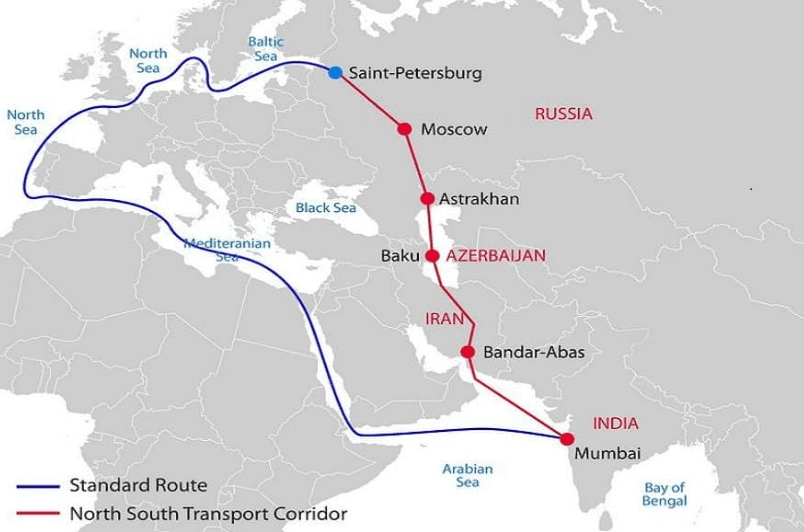
The International North–South Transport Corridor begins in Mumbai, India, one of India’s major ports, from where cargo is transported by sea to Bandar Abbas in Iran, located on the Persian Gulf.
From Bandar Abbas, goods move overland by road and rail across Iran to the Caspian Sea port of Bandar-e-Anzali. This port serves as a key transit point linking the Persian Gulf region with the Caspian Sea.
Cargo is then shipped across the Caspian Sea to Astrakhan in Russia, an important Russian port located near the Volga River delta. From Astrakhan, the freight continues via the Russian rail network to major cities such as Moscow and finally Saint Petersburg, which acts as a gateway to Northern and Western Europe.
Thus, the INSTC links the Indian Ocean, the Persian Gulf, the Caspian region, and Northern Europe.
Route Flow: Mumbai → Bandar Abbas → Bandar-e-Anzali → Caspian Sea → Astrakhan → Moscow → St. Petersburg.
Must cover: Strait of Hormuz Crisis, Impact, Geography & Map - UPSC
Significance of the INSTC
Conceived even before China’s Belt and Road Initiative, the INSTC offers an alternative route for regional connectivity while reducing transportation costs and transit time for trade between India and Eurasian markets.
1. Faster and Cheaper Trade Connectivity
- The corridor significantly reduces the distance, time, and cost of transporting goods between India, Russia, and European markets.
- Compared to traditional routes via the Suez Canal, INSTC can cut transit time by nearly half and reduce freight costs by around 30%.
2. Alternative to China-led Connectivity Projects
- Since the INSTC was conceptualised before the Belt and Road Initiative, it provides an independent connectivity framework for Eurasian countries.
- It strengthens India’s strategic presence in Eurasia and offers countries an alternative trade route beyond China-centric infrastructure networks.
3. Improved Access to Central Asian Markets
- The corridor enhances India’s connectivity with landlocked Central Asian countries, enabling smoother movement of goods, energy resources, and raw materials.
- It strengthens economic engagement with countries such as Kazakhstan, Uzbekistan, and Turkmenistan.
4. Synergy with the Ashgabat Agreement
- The INSTC complements the Ashgabat Agreement, a multimodal transport and transit corridor signed by India, Oman, Iran, Turkmenistan, Uzbekistan, and Kazakhstan.
- This agreement aims to facilitate the transportation of goods between Central Asia and the Persian Gulf, strengthening regional trade connectivity.
5. Strengthening India’s Strategic and Economic Influence
- By improving connectivity with Eurasian regions, the INSTC helps expand India’s trade networks, energy cooperation, and geopolitical engagement.
- It also supports India’s broader vision of diversifying global supply chains and strengthening regional integration.
Also read: India-Middle East Relations: History, Trade, and Strategic Ties
UPSC Prelims PYQ on INSTC
QUESTION 1
India is one of the founding members of the International North-South Transport Corridor (INSTC), a multimodal transportation corridor, which will connect
Conclusion
The International North–South Transport Corridor (INSTC) has the potential to transform India’s trade connectivity with Central Asia, Russia, and Europe by reducing transit time and costs. To fully realise its benefits, India must accelerate infrastructure development, strengthen cooperation, and ensure multimodal logistics across the corridor. A faster operationalisation of the INSTC will boost regional trade and also enhance India’s strategic presence in the Eurasian region and diversify global supply chains.
Must cover this current affairs topic here: U.S.- Israel Joint Missile Strike on Iran 2026
Start your UPSC Preparation 2026/2027 with SuperKalam
SuperKalam is your personal mentor for UPSC preparation, guiding you at every step of the exam journey. Practice, revise, and evaluate– all in one place.
Download the SuperKalam App Now