Strait of Hormuz Crisis, Impact, Geography & Map - UPSC
Strait of Hormuz explained for UPSC: map, geography, recent crisis, and impact on India’s energy security. Essential for GS Paper II & III, Prelims mapping and current affairs.
Mar, 2026
•7 min read
The Strait of Hormuz is one of the most strategically important maritime chokepoints in the world. It connects the Persian Gulf with the Gulf of Oman and the Arabian Sea.
Recently, tensions involving Iran, the United States, and Israel have brought the Strait of Hormuz into global focus. Military strikes, retaliatory threats, and naval tensions in the region have disrupted shipping activity and raised fears of a possible closure of this vital energy corridor.
The Strait of Hormuz is a crucial topic in the UPSC syllabus for GS Paper I (World Geography) and GS Paper III (International Relations). Questions related to global chokepoints, oil trade routes, and West Asian geopolitics frequently appear in UPSC Prelims and Mains.
Strait of Hormuz Location
- The Strait of Hormuz is a narrow maritime passage located between Iran and Oman.
- It lies between Iran in the north and Oman’s Musandam Peninsula in the south.
- It connects the Persian Gulf to the Gulf of Oman and the Arabian Sea.
- At its narrowest point, the strait is only about 33 km wide.
The shipping lanes for large tankers are extremely narrow, around 3 km wide in each direction. Due to its narrow width and heavy traffic, the strait is highly vulnerable to geopolitical disruptions.
Strait of Hormuz Map UPSC
For UPSC Prelims, it is important to identify the location of the Strait of Hormuz on the world map.
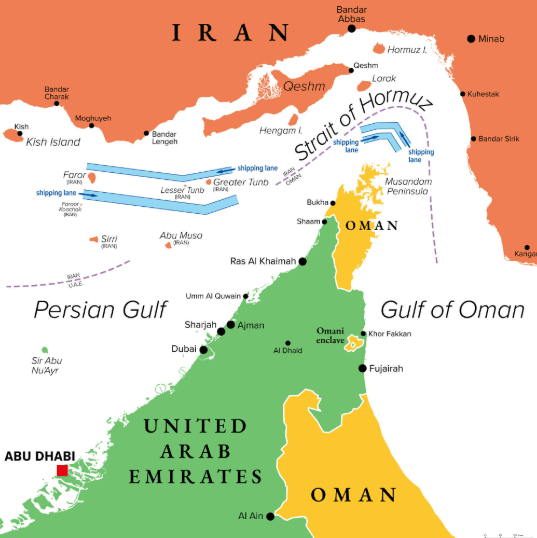
Countries around the Strait
- Iran
- Oman
- United Arab Emirates
Water Bodies Connected
- Persian Gulf
- Gulf of Oman
- Arabian Sea
Major Gulf Oil Exporters Using This Route
- Saudi Arabia
- Iraq
- Kuwait
- Qatar
- United Arab Emirates
- Iran
Most oil exported from these countries passes through the Strait of Hormuz before reaching global markets.
Must cover: Iran-Israel War 2026: Map Locations & Bordering Nations
UPSC Prelims PYQ on Strategic Straits
QUESTION 1
Between India and East Asia, the navigation-time and distance can be greatly reduced by which of the following?
- Deepening the Malacca Straits between Malaysia and Indonesia.
- Opening a new canal across the Kra isthmus between the Gulf of Siam and Andaman sea.
Which of the statements given above is/are correct?
Strategic Importance of the Strait of Hormuz
The Strait of Hormuz holds immense economic, strategic, and geopolitical importance.
1. Global Oil Transit Hub: About 20 million barrels of oil per day pass through the strait, accounting for nearly 20% of global oil consumption. This makes it one of the most critical energy corridors in the world.
2. Major LNG Shipping Route: Apart from crude oil, the strait is also vital for Liquefied Natural Gas (LNG) exports, especially from Qatar, one of the largest LNG exporters globally. Approximately one-fifth of global LNG trade passes through this route.
3. Lifeline for Asian Economies: Around 80% of the oil transported through the strait is destined for Asian markets, including:
- India
- China
- Japan
- South Korea
Therefore, any disruption affects the energy security of major Asian economies.
4. Strategic Military Significance: The region surrounding the strait is heavily militarised. Key factors include:
- Presence of Iranian Revolutionary Guard naval forces
- US naval deployments in the Persian Gulf
- Strategic islands such as Hormuz, Qeshm, and Abu Musa
Control over this chokepoint gives significant strategic leverage in global geopolitics.
Recent Strait of Hormuz Crisis 2026
The Strait of Hormuz has recently become the centre of global geopolitical tensions due to escalating conflict involving Iran, the United States, and Israel.
Key Events in the Iran-Israel 2026 Crisis
- Joint military strikes by the United States and Israel on Iran triggered retaliatory threats from Iran.
- Iran warned commercial ships against passing through the strait and launched missile and drone attacks in the region.
- Tanker traffic in the strait reportedly fell by nearly 90% during the escalation.
- Over 150 ships waited outside the strait due to security risks.
Global Impact
- Oil prices surged sharply as markets feared supply disruptions.
- Shipping costs increased due to war-risk insurance and rerouting of vessels.
- Global energy markets faced uncertainty due to potential supply shortages.
The crisis highlights how a single chokepoint can disrupt the entire global energy system.
Impact of Strait of Hormuz Disruption on India
Since India depends heavily on energy imports from the Gulf region, instability in this strategic chokepoint directly affects our country.
1. Impact on Crude Oil Imports
India imports nearly 85% of its crude oil requirement, and a significant share of this oil comes from Gulf countries such as Saudi Arabia, Iraq, Kuwait, and the United Arab Emirates.
Most of these oil shipments pass through the Strait of Hormuz before reaching Indian ports. If tensions or conflict disrupt shipping in this region, India may face delays in oil supplies and increased import costs.
2. Disruption of LNG and LPG Supplies
The Strait of Hormuz is also a critical route for Liquefied Natural Gas (LNG) and Liquefied Petroleum Gas (LPG) shipments to India.
India imports a large portion of its LNG from Qatar and LPG from Gulf countries, both of which are transported through this maritime corridor. Any blockage or security threat in the strait could disrupt these supplies and affect energy availability for industries, power generation, and households.
3. Rise in Global Oil Prices
Even the possibility of disruption in the Strait of Hormuz can trigger sharp increases in global crude oil prices. For a large oil-importing country like India, higher oil prices significantly increase the energy import bill.
This puts pressure on government finances and increases the cost of fuel across the country.
4. Impact on Inflation and the Economy
Higher crude oil prices lead to increased costs of transportation, manufacturing, and electricity. This can result in rising inflation and increased prices of essential goods and services.
A prolonged disruption may also widen India’s current account deficit, weaken the rupee, and slow economic growth.
5. Strategic and Security Concerns
The Strait of Hormuz is crucial not only for India’s energy supply but also for its maritime trade and strategic interests in West Asia. Instability in the region may require greater naval presence and diplomatic engagement to safeguard shipping routes and ensure uninterrupted trade.
Therefore, maintaining stability in the Strait of Hormuz remains critical for India’s energy security, economic stability, and geopolitical interests.
Also read: India-Middle East Relations: History, Trade, and Strategic Ties
Conclusion
The Strait of Hormuz remains one of the most critical maritime chokepoints in the world. It plays a decisive role in global energy trade, geopolitical stability, and economic security.
For UPSC aspirants, understanding the geography, map location, and strategic importance is essential for both Prelims mapping questions and Mains answers.
Also see: Most Important Maps for UPSC Preparation: Prelims and Mains
Start your UPSC Preparation 2026/2027 with SuperKalam
SuperKalam is your personal mentor for UPSC preparation, guiding you at every step of the exam journey. Practice, revise, and evaluate– all in one place.
Install Now