World Earth Day 2026: Our Power, Our Planet - UPSC
World Earth Day 2026 (22 April): Understand the theme “Our Power, Our Planet,” its significance, history, India’s initiatives, and key environmental actions. Get complete UPSC notes.
Apr, 2026
•6 min read
“Why is everyone suddenly posting about the planet Earth today?” the teenage girl asked casually.
“It’s not sudden, we’ve been talking about it for years. Maybe people are finally starting to listen,” the environmentalist replied.
“But honestly, what difference does it make? It’s too big a problem.”
“It is big, but that doesn’t mean you’re powerless.”
The girl looked up, a bit curious now. “Powerless? I mean, I’m just one person.”
“That’s where you’re wrong. Every choice you make—what you buy, what you waste, what you support—it all adds up. Change doesn’t come from one big action. It comes from millions of small ones.”
She thought for a moment. “So, you’re saying it starts with people like us?”
“Exactly, that’s the whole idea—our power shapes our planet.”
This conversation captures the essence of World Earth Day 2026 and its theme “Our Power, Our Planet.” It highlights a crucial shift from seeing environmental protection as someone else’s responsibility to recognising the role of individual and collective action.
For UPSC aspirants, this day connects directly to key topics such as climate change, sustainable development, environmental ethics, and global environmental governance, making it relevant for both Prelims & Mains.
World Earth Day 2026
World Earth Day is observed every year on 22 April to promote environmental protection and sustainable living. It began in 1970 and has now become the world’s largest civic movement, with over one billion people participating across more than 190 countries. The day highlights the urgent need to protect our planet and reminds us that everyone has a role to play. Here is why the day is significant:
- It brings attention to major issues like climate change, pollution, biodiversity loss, and overuse of natural resources.
- It reminds people that small steps, such as saving water, reducing plastic use, and conserving energy.
- It unites individuals, governments, and organisations to work together for environmental protection.
- Earth Day has helped push governments to make stronger environmental laws and take action.
- It highlights the need to balance development with environmental protection for future generations.
- It stresses the need to reduce pollution, cut carbon emissions, and shift towards clean energy.
- It reminds us to conserve forests, ecosystems, and biodiversity.
- It motivates young people to take part in environmental protection and become responsible citizens.
- It supports eco-friendly technologies and sustainable ways of living.
World Earth Day 2026 Theme
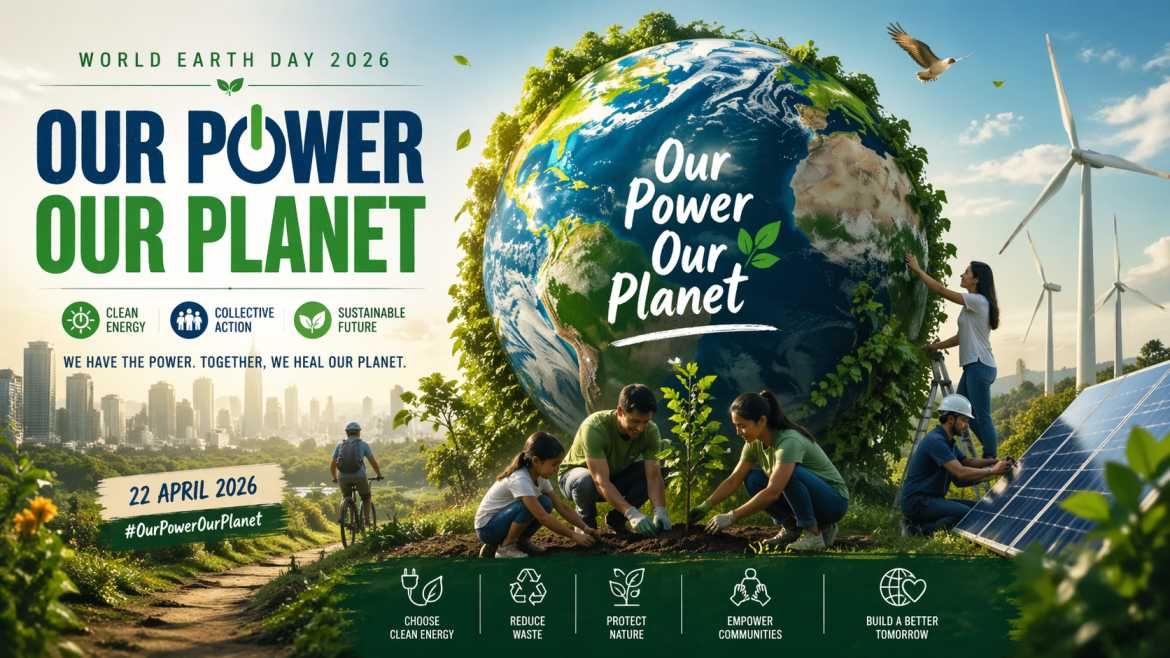
The theme for World Earth Day 2026 is “Our Power, Our Planet”. It focuses on the idea that protecting the Earth is a shared responsibility. It highlights that real change comes from the combined efforts of individuals, governments, and communities.
Present-Day Relevance of the 2026 Theme
- Climate Change is Visible Now: Rising heatwaves, frequent floods, and extreme weather events show that environmental problems are directly impacting our daily lives.
- Growth of Clean Energy: India is rapidly expanding solar power and promoting renewable energy, showing how policy and public support can drive change.
- Plastic Reduction Efforts: Many cities are banning single-use plastics, proving that local actions and public participation can reduce pollution.
- People-Led Movements: Activists like Greta Thunberg show how individual voices can influence global climate discussions.
Also read: Climate Change UPSC Notes: Meaning, Types, Causes & Key Initiatives
Historical Roots of World Earth Day
World Earth Day has evolved from a national environmental protest into a powerful global movement for sustainability and climate action. What began in 1970 in the United States is now observed worldwide, reflecting growing awareness about environmental protection and the need for collective responsibility.
- Origin of the Movement: Earth Day was initiated by Gaylord Nelson after the devastating Santa Barbara oil spill, which released millions of gallons of crude oil. The disaster exposed the scale of environmental damage and pushed for stronger public awareness and policy action.
- First Earth Day (1970): Organised by Denis Hayes, the first Earth Day on April 22, 1970, saw millions of Americans participate in rallies and campaigns, marking one of the largest civic movements in history.
- Impact on Environmental Policies: The movement led to major policy changes in the United States, including the establishment of the United States Environmental Protection Agency and landmark legislation like the Clean Air Act and Clean Water Act.
- Global Expansion (1990): By 1990, Earth Day had transformed into a global event, with around 200 million people across 141 countries participating. This marked the beginning of worldwide environmental awareness and cooperation.
- Link with Global Climate Action: The importance of Earth Day in global governance was reinforced in 2016 when 175 world leaders signed the Paris Agreement on this day, highlighting its symbolic and practical role in climate action.
Today, World Earth Day stands as a reminder of how public awareness, civic participation, and policy action can come together to address environmental challenges at both national and global levels.
Must see: COP 30 2025: UNFCCC Climate Summit in Belem, Brazil
India’s Commitment to Protect the Earth
“The Earth does not belong to us; we belong to the Earth.” — Mahatma Gandhi
India’s approach to environmental protection reflects the philosophy of balancing development with sustainability. In recent years, the country has moved from intent to action, positioning itself as a key player in global climate efforts.
At the global level, India’s Panchamrit commitments announced at COP26 highlight this shift. These include achieving net-zero emissions by 2070, meeting 50% of energy requirements from renewable sources by 2030, and significantly reducing carbon intensity. These targets show India’s commitment to aligning economic growth with climate responsibility.
Key Initiatives and Actions
- National Action Plan on Climate Change (NAPCC): A comprehensive framework with missions on solar energy, energy efficiency, sustainable agriculture, and water conservation to tackle climate change in an integrated way.
- International Solar Alliance (ISA): Led by India and France, the International Solar Alliance aims to mobilise large-scale solar investments and promote clean energy adoption globally.
- Expansion of Renewable Energy: India is one of the fastest-growing renewable energy markets, especially in solar and wind power, reducing dependence on fossil fuels.
- FAME Scheme (Electric Mobility): The Faster Adoption and Manufacturing of Electric Vehicles (FAME) initiative promotes electric vehicles, helping reduce air pollution and fuel dependency.
- Green India Mission: Focuses on increasing forest cover and enhancing carbon sinks to fight climate change and protect biodiversity.
- Project Tiger: A major conservation programme that has helped increase tiger populations while preserving forest ecosystems.
- National Clean Air Programme (NCAP): Aims to reduce air pollution levels in major cities through better monitoring and policy measures.
- LiFE Movement (Lifestyle for Environment): Promoted by India at the global stage, this initiative encourages simple, sustainable lifestyle choices like reducing waste, reusing resources, and saving energy.
- Swachh Bharat Mission: Focuses on cleanliness, sanitation, and waste management, improving both public health and environmental conditions.
Major Activities and Initiatives on World Earth Day 2026
World Earth Day 2026 is marked by a range of activities that spread awareness and encourage action at all levels.
- A special lecture titled “Exploring Antarctica: A Journey to the White Continent” by Amitava Sen Gupta highlights polar science, climate systems, and Antarctic research.
- Student-focused quizzes and competitions are organised to test knowledge on biodiversity, climate science, and sustainability.
- Awareness drives such as seminars, exhibitions, and science outreach programmes help educate people on environmental challenges.
- Plantation drives and cleanliness campaigns promote community participation in protecting the environment.
- Digital campaigns and social media initiatives encourage wider public engagement, especially among youth.
- Government and institutions launch policy discussions and workshops to strengthen environmental governance and sustainable practices.
Final Words
Not a distant cry, the Earth speaks today,
In silent forests and skies turning grey.
It asks for care, not someday, but now,
The future depends on each small vow.
World Earth Day 2026 is all about responsibility. The duty to protect this planet does not lie somewhere far away; it lies in our choices, our actions, and our intent. We don’t need perfect solutions. We need consistent effort. Because when millions act, change becomes unstoppable.
The time to act is not tomorrow. It is now.
Start your UPSC Preparation 2026/2027 with SuperKalam
SuperKalam is your personal mentor for UPSC preparation, guiding you at every step of the exam journey. Practice, revise, and evaluate– all in one place.
Install Now