About West Asia: Countries & Map - UPSC
Get complete notes on West Asia with mapping for UPSC (Prelims & Mains). Study the geographical features, seas, strategic straits and challenges of West Asian crises.
Apr, 2026
•6 min read
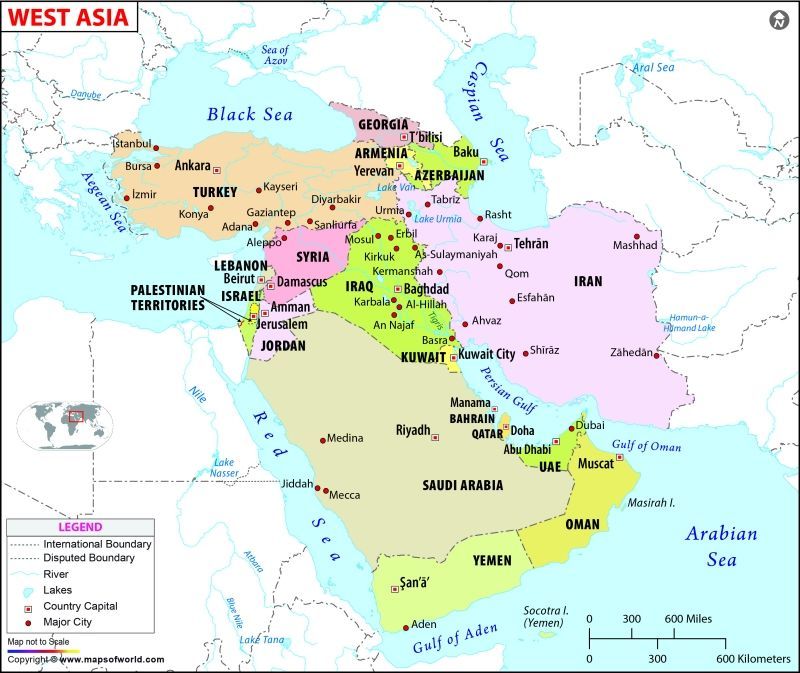
West Asia is a geopolitically crucial region that connects Asia, Africa, and Europe, making it a strategic hub for global trade, energy security, and international relations. The West Asia countries map includes nations such as Saudi Arabia, Iran, Iraq, Israel, and Turkey. The region is rich in oil and natural gas reserves, making it central to global energy politics, while its ongoing conflicts and strategic alliances shape world affairs.
For UPSC, understanding West Asia countries and the map, key locations, and their relevance to India’s foreign policy is essential for both Prelims and GS Paper II in Mains.
West Asia
West Asia is a geographical region located at the westernmost part of the Asian continent, forming a crucial junction between Asia, Africa, and Europe. The term is often preferred over “Middle East” as it is more neutral and geographically precise.
The region broadly includes countries such as Saudi Arabia, Iran, Iraq, Israel, United Arab Emirates, Qatar, Oman, Kuwait, Jordan, Syria, Lebanon, Turkey, and Yemen.
Also see: India-Middle East Relations: History, Trade, and Strategic Ties
Geographical Features of West Asia
West Asia’s geography plays a decisive role in shaping its economic and strategic importance.
1. Surrounded by Important Seas and Gulf
The region is bounded by major water bodies, each connected to specific bordering countries:
- Mediterranean Sea: It connects West Asia to Europe and North Africa, making it historically significant for trade and cultural exchange.
- Red Sea: Lies between the Arabian Peninsula and Africa. In West Asia, it borders Saudi Arabia and Yemen. It is a vital route linking the Indian Ocean to the Mediterranean Sea.
- Arabian Sea: Forms the southeastern boundary of West Asia, touching Oman and Yemen. It connects the region directly with South Asia, including India.
- Persian Gulf: A highly strategic water body bordered by Iran, Iraq, Kuwait, Saudi Arabia, Bahrain, Qatar, and the United Arab Emirates. It is globally important due to its vast oil reserves and shipping routes.
2. Strategic Maritime Chokepoints
West Asia hosts some of the world’s most critical chokepoints:
- Strait of Hormuz: Located between Iran and Oman, it connects the Persian Gulf with the Arabian Sea. A large share of the global oil trade passes through this narrow passage.
- Suez Canal: Located in Egypt, it connects the Mediterranean Sea with the Red Sea, significantly reducing travel distance between Europe and Asia. It is one of the busiest and most strategic waterways in the world.
3. Dominance of Desert Landscapes
A major part of West Asia is covered by arid and semi-arid regions.
- The Arabian Desert, spanning across Saudi Arabia and neighbouring countries, is one of the largest deserts in the world.
- Other desert regions include the Syrian Desert and parts of the Iranian Plateau.
- These harsh climatic conditions influence settlement patterns, agriculture, and water availability.
4. Rich in Energy Resources
West Asia holds some of the largest reserves of petroleum and natural gas globally, especially around the Persian Gulf region.
- Countries like Saudi Arabia, Iran, Iraq, and Kuwait are major producers.
- This makes the region central to global energy security and a key area of interest in international politics.
Also read: Iran-Israel War 2026: Map Locations & Bordering Nations
Challenges and Crises in West Asia
West Asia remains one of the most sensitive and conflict-prone regions in the world. Its crises are deeply rooted in history and continue to evolve into modern geopolitical tensions.
1. Historical Roots of Instability
- Colonial Legacy: After World War I, boundaries were drawn by colonial powers without considering ethnic and cultural identities, leading to long-term disputes.
- Arab–Israel Conflict: Since the creation of Israel in 1948, tensions with neighbouring Arab countries over Palestine have remained unresolved.
- Sectarian Divide: The Sunni–Shia divide shapes regional politics, with rivalry between Saudi Arabia (Sunni-majority) and Iran (Shia-majority).
- External Interference: Involvement of powers like the USA and Russia has intensified conflicts and prolonged instability.
2. Ongoing Conflicts and Proxy Wars
- Countries like Syria, Yemen, and Iraq have witnessed prolonged wars and internal instability.
- Regional powers support opposing sides, turning conflicts into proxy wars.
- The rise of extremist groups and political instability has further weakened governance in many states.
3. Iran–Israel Conflict
The rivalry between Iran and Israel has intensified in recent years.
- It involves issues like nuclear ambitions, regional influence, and security concerns.
- Direct and indirect attacks, cyber warfare, and involvement of allies have increased tensions.
- The conflict risks expanding into a wider regional war, affecting multiple countries in West Asia.
4. Oil Crisis and Energy Insecurity
West Asia holds a major share of the world’s oil and gas reserves, especially around the Persian Gulf. Any conflict in the region disrupts global energy supply.
- The Strait of Hormuz is particularly critical, as a significant portion of global oil trade passes through it.
- During heightened tensions, fears of blockage or attacks lead to sharp increases in global oil prices.
- This creates inflation, trade imbalances, and economic uncertainty worldwide.
5. Impact on India and the World
India depends heavily on oil imports from West Asia.
- Rising oil prices affect:
- Fuel costs and inflation
- Fiscal stability
- Economic growth
Safety of the Indian diaspora in Gulf countries becomes a concern. Global trade routes and supply chains are also disrupted.
UPSC Prelims PYQs Based on West Asia Mapping
QUESTION 1
The Mediterranean Sea is a border of which of the following countries?
- Jordan
- Iraq
- Lebanon
- Syria
Select the correct answer using the code given below:
QUESTION 2
Consider the following pairs:
| Sea Bordering | Country |
|---|---|
| 1. Adriatic Sea | Albania |
| 2. Black Sea | Croatia |
| 3. Caspian Sea | Kazakhstan |
| 4. Mediterranean Sea | Morocco |
| 5. Red Sea | Syria |
Which of the pairs given above are correctly matched?
QUESTION 3
Which of the following is not a member of ‘Gulf Cooperation Council’?
QUESTION 4
Consider the following pairs:
| River | Flows into |
|---|---|
| 1. Mekong | Andaman Sea |
| 2. Thames | Irish Sea |
| 3. Volga | Caspian Sea |
| 4. Zambezi | Indian Ocean |
Which of the pairs given above is/are correctly matched?
UPSC Mains Practice Question (GS Paper II)
Discuss how geopolitical tensions in West Asia can influence global supply chains and economic stability. (150 words, 10 marks)
Evaluate your Answer in 60 SecondsWay Forward: Addressing Challenges in West Asia
A stable and peaceful West Asia is essential not only for the region but also for global economic and strategic balance. The solutions require coordinated efforts at the regional and international levels.
1. Promote Dialogue and Diplomacy
- Encourage sustained diplomatic engagement between rival countries like Iran and Israel.
- Revive multilateral platforms and peace talks to reduce tensions.
- Focus on confidence-building measures instead of military escalation.
2. Resolve Long-Standing Conflicts
- A balanced and peaceful resolution of the Israel–Palestine issue is crucial for regional stability.
- Political settlements in conflict zones like Syria and Yemen should be prioritised through negotiations.
- Strengthening the role of the United Nations in conflict resolution.
3. Ensure Energy Security and Stability
- Protect key maritime routes like the Strait of Hormuz from disruptions.
- Countries should diversify energy sources and reduce overdependence on West Asian oil.
- Promote strategic petroleum reserves and renewable energy transitions globally.
4. Reduce External Interference
- Limit the excessive involvement of global powers that often intensify conflicts.
- Encourage regional ownership of peace processes and solutions.
5. Strengthen Regional Cooperation
- Promote economic cooperation among West Asian countries to build mutual dependence and reduce conflict.
- Develop regional organisations and frameworks for security and trade collaboration.
6. India’s Constructive Role
- India can follow a balanced and neutral approach in the region.
- Strengthen ties with all major countries like Saudi Arabia, Iran, and Israel.
- Ensure energy security, protect the Indian diaspora, and promote peace through diplomacy.
7. Focus on Long-Term Stability
- Invest in development, education, and employment generation in conflict-prone areas.
- Address root causes like poverty, unemployment, and political instability.
- Promote inclusive governance and reduce sectarian divisions.
Also see: Most Important Maps for UPSC Preparation: Prelims and Mains
Start your UPSC Preparation 2026/2027 with SuperKalam
SuperKalam is your personal mentor for UPSC preparation, guiding you at every step of the exam journey. Practice, revise, and evaluate– all in one place.
Download Now