President of India UPSC Notes: Elections, Veto Power & Impeachment Process
Complete notes on the President of India for UPSC prep: Election process, qualifications, executive powers, veto rights, impeachment, and discretionary powers for UPSC Prelims and Mains. Click Now!
Dec, 2025
•4 min read
“In attaining our ideals, our means should be as pure as the end.”- Dr Rajendra Prasad
The President of India holds the highest constitutional office, serving as the ceremonial head of the country and a key member of the Union Executive. The President plays a vital role in ensuring constitutional stability, especially during times of political or national crises.
The President of India is a highly important topic for UPSC Prelims (Articles, election process, powers, key facts) and GS Paper II of Mains (constitutional provisions, role in parliamentary democracy, discretionary powers).
About the President of India
The President of India is the constitutional head of the Union, as outlined in Part V of the Constitution (Articles 52–62). According to Article 52, India shall have a President who functions as:
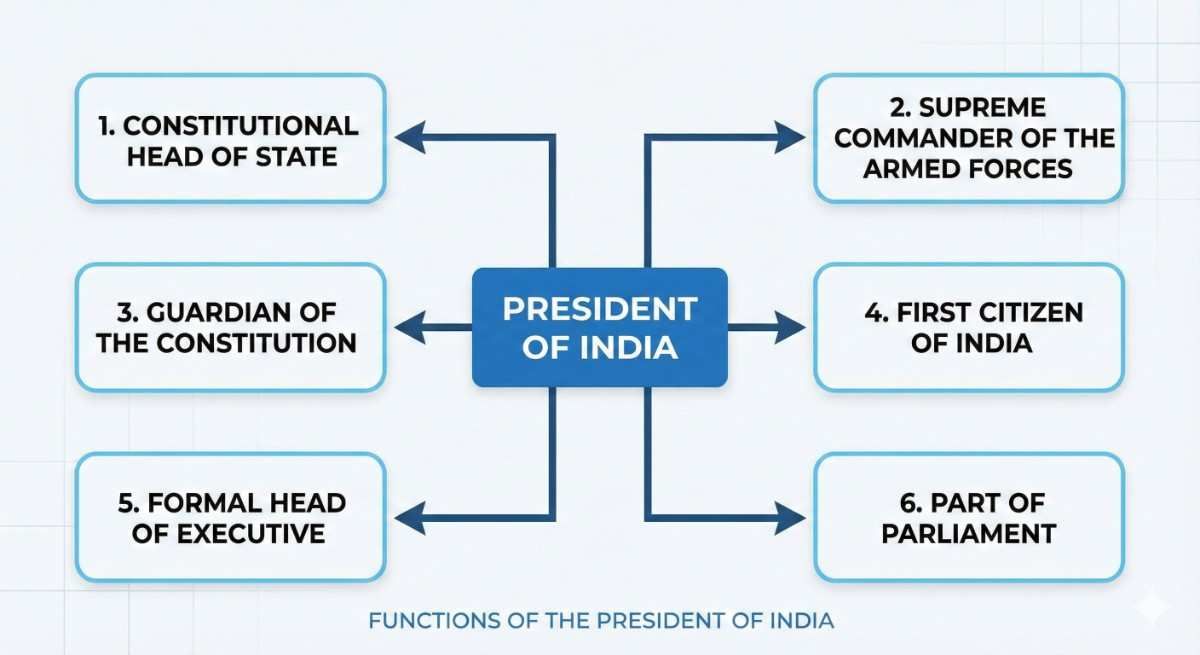
- Constitutional Head of State: The President represents the state in domestic and international matters.
- Supreme Commander of the Armed Forces: All armed forces are under the President's supreme command, although they are regulated by law.
- Guardian of the Constitution: The President takes an oath to preserve, protect, and defend the Constitution and the law.
- First Citizen of India: The President ranks first in the Order of Precedence of India.
- Formal Head of Executive: All executive actions are taken in the President's name, though exercised through the Council of Ministers.
- Part of Parliament: The President is an integral component of Parliament alongside the Lok Sabha and Rajya Sabha.
- Current President of India: The present President is Smt. Droupadi Murmu, the 15th President of India, has been in office since 25 July 2022.
Also read: Fundamental Duties (Article 51A) in the Indian Constitution | UPSC Polity Notes
Election of the President of India
The President is indirectly elected by an Electoral College using proportional representation by means of the single transferable vote (STV) and secret ballot, to reflect the federal character of India.
1. Electoral College Composition (Article 54):
- Elected members of the Lok Sabha.
- Elected members of the Rajya Sabha.
- Elected members of the Legislative Assemblies of all States.
- Elected members of the Legislative Assemblies of NCT of Delhi and UT of Puducherry (by a later constitutional change).
- Nominated members are not part of the Electoral College.
2. Manner of Election (Article 55):
- System of proportional representation by means of single transferable vote (STV).
- Voting is by secret ballot, conducted by the Election Commission of India (ECI) under Article 324 and the Presidential and Vice-Presidential Elections Act, 1952.
3. Value of Votes:
- The value of an MLA's vote is calculated using the formula:
Value = (State Population based on 1971 Census) ÷ (Total elected MLAs × 1000)
- The value of an MP's vote = Total value of all MLAs' votes ÷ Total elected MPs
As per the 84th Constitutional Amendment, the 1971 Census population figures are used for calculating vote values until 2026.
4. Winning the Election
A candidate must secure more than 50% of the total valid votes polled to win. The quota formula is: Quota = (Total valid votes ÷ 2) + 1
Also read: Constitutionalism in India | UPSC Polity Concepts
Constitutional Provisions Relating to the President's Office
The Constitution provides provisions about the President mainly in Part V (The Union) and also in certain other Parts (e.g., pardoning power, emergency provisions, immunities).
Articles 52–62 (Part V, Chapter I):
- Article 52 – There shall be a President of India.
- Article 53 – Executive power of the Union vested in the President.
- Article 54 – Election of President (Electoral College).
- Article 55 – Manner of election of President.
- Article 56 – Term of office of President (5 years, conditions for earlier end).
- Article 57 – Eligibility for re‑election.
- Article 58 – Qualifications for election as President.
- Article 59 – Conditions of the President’s office.
- Article 60 – Oath or affirmation by President.
- Article 61 – Procedure for impeachment of the President.
- Article 62 – Time of holding election to fill vacancy, and term of person elected to fill a casual vacancy.
Supporting Provisions in Other Parts:
- Article 65 – Vice-President to act as President or discharge functions during vacancy/absence.
- Articles 74–75 – Council of Ministers to aid and advise the President, PM and CoM provisions.
- Articles 72, 143 – Pardoning power; advisory jurisdiction of the Supreme Court.
- Articles 85, 86, 87, 111, 123 – Summoning, prorogation, address to Parliament, assent to Bills, Ordinance-making.
- Articles 352, 356, 360 – Emergency provisions (National, State, Financial Emergency).
- Article 361 – Immunities of President and Governors.
Also read: Article 32 of the Indian Constitution: Right to Constitutional Remedies | UPSC Notes
Qualifications of the President of India (Article 58)
The Constitution sets minimum eligibility conditions so that only a person with basic political maturity and legal fitness can become President.
- Must be a citizen of India.
- Must be 35 years of age.
- Must be qualified for election as a member of the Lok Sabha (House of the People).
- Must not hold any office of profit under:
- Government of India,
- Government of any State,
- Any local or other authority under the control of these governments.
Also read: Anti-Defection Law in India
Oath or Affirmation by the President (Article 60)
Article 60 requires that every President and every person acting as President must, before entering office, make and subscribe an oath or affirmation in the presence of:
- The Chief Justice of India, or
- In his absence, the senior-most Judge of the Supreme Court is available.
Content of the Oath:
- To faithfully execute the office of President (or discharge functions as Acting President).
- To preserve, protect and defend the Constitution and the law.
- To devote oneself to the service and well‑being of the people of India.
This oath also explains why the President is sometimes described as “Guardian of the Constitution”.
Also read: Basic Structure Doctrine UPSC Notes: Meaning, Significance & Key Cases
Functions and Powers of the President of India
The President of India exercises wide-ranging powers that can be classified into several categories.
1. Executive Powers (Article 53)
- All executive actions of the Government of India are taken in the President's name.
- Appoints the Prime Minister and other Ministers on the PM's advice (Article 75).
- Appoints key officials such as the Attorney General of India, the Comptroller and Auditor General (CAG),
- Governors of States, Judges of the Supreme Court and High Courts, Chief Election Commissioner, and Chairman of UPSC.
- The Supreme Commander of the Armed Forces appoints Chiefs of Army, Navy, and Air Force.
- Makes rules for the convenient transaction of Government business (Article 77).
2. Legislative Powers
- Summons and prorogues both Houses of Parliament (Article 85).
- Can dissolve the Lok Sabha.
- Addresses Parliament at the commencement of the first session after each general election.
- Can nominate members to Parliament:
- 12 members to the Rajya Sabha (having expertise in literature, science, art, and social service).
- 2 Anglo-Indian members to the Lok Sabha (discontinued after 104th Amendment).
- Prior recommendation required for introducing Money Bills (Article 117).
- Assent to Bills – No bill becomes law without the President's assent (Article 111).
- Can promulgate Ordinances when Parliament is not in session (Article 123).
3. Veto Powers
The President has three types of veto over bills passed by Parliament:
| Veto Type | Description |
|---|---|
| Absolute Veto | The President withholds assent; the bill is rejected outright. |
| Suspensive Veto | The President returns the bill for reconsideration (except Money Bills); if repassed, assent is mandatory. |
| Pocket Veto | The President takes no action; keeps the bill pending indefinitely (no time limit specified). |
Note: The President cannot return a Money Bill or Constitutional Amendment Bill for reconsideration.
4. Financial Powers
- Money Bills can be introduced in the Lok Sabha only with the President's prior recommendation (Article 110).
- Causes the Annual Budget to be laid before Parliament (Article 112).
- Contingency Fund of India is at the President's disposal for urgent unforeseen expenditure (Article 267).
- Constitutes a Finance Commission every five years (Article 280).
- No money can be withdrawn from the Consolidated Fund of India except on the President's recommendation.
5. Judicial Powers
- Appoints Chief Justice of India and judges of the Supreme Court and High Courts (Articles 124 & 217).
- Can seek advice from the Supreme Court on constitutional or legal matters (Article 143).
- Pardoning powers under Article 72:
- Pardon – Completely erases conviction and sentence.
- Commutation – Substituting one form of punishment with a lighter one.
- Remission – Reducing the period of the sentence without changing its character.
- Respite – Awarding a lesser sentence due to special circumstances.
- Reprieve – Temporary stay of sentence execution.
6. Diplomatic Powers
- All treaties and agreements with foreign countries are concluded in the President's name.
- Appoints ambassadors and high commissioners to foreign countries.
7. Military Powers
- Supreme Commander of the Defence Forces (Article 53(2)).
- Appoints the Chiefs of the Army, Navy, and Air Force.
- Has the power to declare war or conclude peace (subject to Parliament's approval).
8. Emergency Powers
The President can declare three types of emergencies:
| Emergency Type | Constitutional Provision | Ground |
|---|---|---|
| National Emergency | Article 352 | War, external aggression, or armed rebellion. |
| State Emergency (President's Rule) | Article 356 | Failure of constitutional machinery in a State. |
| Financial Emergency | Article 360 | Threat to the financial stability of India. |
Also read: Armed Forces Special Powers Act 1958 (AFSPA): UPSC Notes
Conditions of the President's Office
Article 59 lays down the conditions governing the President's office to ensure independence and impartiality.
- The President shall not be a member of either House of Parliament or any State Legislature.
- If elected as President while being a member, the seat is deemed vacated from the date of assuming office.
- The President shall not hold any other office of profit.
- The President is entitled to the use of the official residence (Rashtrapati Bhavan) without payment of rent.
- Emoluments and allowances cannot be diminished during the President's term of office.
Also read: Armed Forces Special Powers Act 1958 (AFSPA): UPSC Notes
Immunities Available to the President of India
Article 361 provides special protection to the President during the term of office.
- The President is not answerable to any court for the exercise and performance of official powers and duties.
- No criminal proceedings can be instituted or continued against the President during the term of office.
- No process for arrest or imprisonment can be issued against the President while they are in office.
- Civil proceedings relating to personal acts can be instituted only after giving two months' prior notice in writing.
UPSC Prelims PYQ on President of India
QUESTION 1
Consider the following statements:
- If the election of the President of India is declared void by the Supreme Court of India, all acts done by him/her in the performance of duties of his/her office of President before the date of decision become invalid.
- Elections for the post of the President of India can be postponed on the ground that some Legislative Assemblies have been dissolved and elections are yet to take place.
- When a Bill is presented to the President of India, the Constitution prescribes time limits within which he/she has to declare his/her assent.
Which of the statements given above is/are correct?
Impeachment Process of the President of India
Article 61 outlines the procedure for impeaching the President for "violation of the Constitution", and this is a quasi-judicial process.
Grounds for Impeachment
- The President can be impeached only for "violation of the Constitution" – no other ground is specified.
Impeachment Procedure
1. Initiation of Charges
- Impeachment can be initiated by either House of Parliament (Lok Sabha or Rajya Sabha).
- A resolution containing the charge must be moved.
- The resolution must be signed by at least 1/4th of the total members of the House.
- A 14-day prior written notice must be given.
2. Passing the Resolution
- The resolution must be passed by a 2/3rd majority of the total membership of the House.
3. Investigation by the Other House
- After the resolution is passed, the other House investigates the charge.
- The President has the right to appear and be represented during the investigation.
4. Final Decision
- If the investigating House passes a resolution by 2/3rd majority sustaining the charges, the President stands removed from office from the date of passing the resolution.
Key Points:
- Nominated members of Parliament can participate in the impeachment proceedings (unlike in the election process).
- No President has been impeached in India so far.
- The process ensures due process and the President's right to fair representation.
Also read: E-Governance in India: Meaning, Objectives, Pillars, Models and Major Government Policies
Vacancy in the President's Office
Article 62 ensures that the office of the President is never left vacant for an extended period. A vacancy in the
- President's office can occur due to:
- Expiration of the term (5 years)
- Death in office
- Resignation (addressed to the Vice-President)
- Removal by impeachment
- Any other cause
Filling the Vacancy
1. Normal Expiration of Term
- Election to fill the vacancy must be completed before the expiration of the term. Article 62(1).
- The outgoing President continues to hold office until the successor enters office. Article 56(1)(c).
2. Death, Resignation, or Removal
- The election must be held as soon as possible and within 6 months of the vacancy. Article 62(2)
- The newly elected President serves a full term of five years from the date of assuming office.
Role of Vice-President (Article 65)
- During a vacancy, the Vice-President acts as President.
- If both the President and Vice-President positions are vacant, the Chief Justice of India acts as President.
- The Vice-President enjoys all powers, immunities, and emoluments of the President while acting.
Also read: DPSP UPSC Complete Notes: Articles, Classification, Features & Criticism
Discretionary Powers of the President of India
The President of India possesses limited discretionary powers, areas where presidential judgment is not bound by ministerial advice.
- Appointment of Prime Minister (No Clear Majority): When no party or coalition has a clear majority in the Lok Sabha, the President uses discretion in inviting the leader most likely to form a stable government.
- Dismissal of the Council of Ministers: If the Council of Ministers loses the Lok Sabha's confidence, the President decides whether to dissolve the Lok Sabha or invite another leader to form a government.
- Suspensive Veto: The President can return a bill (except Money Bills) for reconsideration.
- Pocket Veto: The Constitution specifies no time limit; the President can keep a bill pending indefinitely.
- Seeking Information from the Prime Minister: Under Article 78, the President can seek information from the Prime Minister regarding the administration of Union affairs.
- Summoning Parliament: While usually done on the government’s advice, the President formally summons, prorogues or dissolves Parliament under Article 85.
Limitations on Discretion:
- As per Article 74(1), the President must act on the aid and advice of the Council of Ministers.
- The President can return advice for reconsideration once, but must accept it if the Council reaffirms the advice.
UPSC Mains Previous Year Question
Critically examine the procedures through which the Presidents of India and France are elected. (2022)
Evaluate Your Answer Now!Conclusion
The President of India is the highest constitutional authority and a symbol of national unity. He ensures that laws are fair, governance stays balanced, and the country remains stable. The role of the President firmly supports the smooth and constitutional functioning of India’s democracy.
Start Your UPSC Journey Smarter with SuperKalam
Crack UPSC with AI-powered guidance, personalised feedback, PYQs, NCERT MCQs and expert-curated notes, all in one platform.
Join SuperKalam today and take your preparation to the next level!