Indian Judiciary UPSC Notes: History, Structure of Courts and Functions
Indian Judicial System UPSC Notes: learn about the structure, functions, landmark judgments, challenges, and reforms. Simplified notes, key articles, and exam-focused points for UPSC prelims and mains preparation.
Dec, 2025
•4 min read
However good a constitution may be, if those who are implementing it are not good, it will prove to be bad. However bad a constitution may be, if those implementing it are good, it will prove to be good.- Dr B.R. Ambedkar
The Indian Judicial System is the guardian of the Constitution and protector of fundamental rights. It is an important topic for UPSC Prelims (structure, key articles, appointment process, landmark judgments) and GS Paper II of Mains (functions, judicial review, basic structure doctrine, challenges, and reforms).
Let’s study the Indian Judiciary in detail!
About the Indian Judiciary System
The Indian judicial system, also known as "Bharatiya Nyayapalika," is a unified system of courts that interprets and implements the laws of the Republic of India. It is a single, integrated judiciary that operates across three tiers: the Supreme Court, High Courts, and Subordinate Courts.
- The Supreme Court of India was established on January 26, 1950, marking the formal inception of India's judicial system.
- It is based on the rule of law and the separation of powers – courts administer justice impartially in accordance with the Constitution.
- Articles 124-147 (Supreme Court), Articles 214-237 (High Courts), and various state laws govern lower courts.
- The judiciary functions independently of the executive and legislative branches, with its own administrative and financial structure.
- As per the Supreme Court Number of Judges Amendment Act, 2019, there is a Chief Justice of India (CJI) plus 33 other judges (total strength of 34 judges).
- There are 25 High Courts across India, covering all states and union territories.
- Both the Supreme Court (Art. 32) and High Courts (Art. 226) can issue writs to protect the rights of citizens.
Also read: President of India UPSC Notes: Elections, Veto Power & Impeachment Process
Historical Background of the Judiciary in India
The Indian judiciary has grown over centuries, shaped by ancient laws, British rule, and the Constitution. Its history helps us understand how it works today.
Ancient Period
- The Vedas and Upanishads provided the earliest legal frameworks in Indian civilisation.
- The Manusmriti, believed to have been written between 200 BCE and 200 CE, laid down detailed legal principles and judicial procedures.
- Kautilya's Arthashatra (4th century BCE) outlined administrative and judicial systems under the Mauryan Empire.
- Chakravartins (kings) acted as supreme judges, dispensing justice with the help of a council of ministers.
Medieval Period (12th - 18th Century)
- The Mughal emperors maintained a sophisticated judicial system with courts at multiple levels.
- Islamic law (Sharia) and Hindu personal law coexisted under Mughal rule.
- Traditional dispute resolution systems like Panchayats (village councils) handled local matters.
Colonial Period (1757 - 1947)
- The Regulating Act of 1773 led to the establishment of the Supreme Court of Judicature at Calcutta.
- Warren Hastings restructured the judicial system by setting up Diwani Adalats for civil cases and Faujdari Adalats for criminal matters.
- The Indian High Courts Act of 1861 was a landmark legislation that established high courts in Calcutta, Bombay, and Madras.
- The Government of India Act, 1919, introduced key judicial reforms by separating the judiciary from the executive, establishing diarchy, and granting limited self-governance to provinces.
Independence Period and Modern Era (1947 - Present)
- The Sapru Committee Report (1945) recommended the establishment of a Federal Court of India and the independence of the judiciary.
- The Supreme Court of India first sat on January 26, 1950, with the Chief Justice (H.J. Kania as the first Chief Justice) and other judges.
- Since 1950, the judiciary has evolved in interpreting the Constitution through four key phases:
- Phase 1 (1950-1967): Foundation and narrow interpretation of rights.
- Phase 2 (1967-1975): Expansion of fundamental rights (Golaknath case onwards).
- Phase 3 (1975-1980): Limitation during emergency but later assertion (ADM Jabalpur case).
- Phase 4 (1980-Present): Judicial activism, PIL, and expansive interpretation of fundamental rights.
The Three Judges Cases and the Collegium System
- First Judges Case (1981): Said judges cannot be transferred without consent, strengthening judicial independence.
- Second Judges Case (1993): Created the collegium system, giving senior judges the main role in appointing judges.
- Third Judges Case (1998): Expanded the collegium to five members and clarified the appointment process for Supreme Court and High Court judges.
Indian Judiciary Structure: The Three-Tier Hierarchy
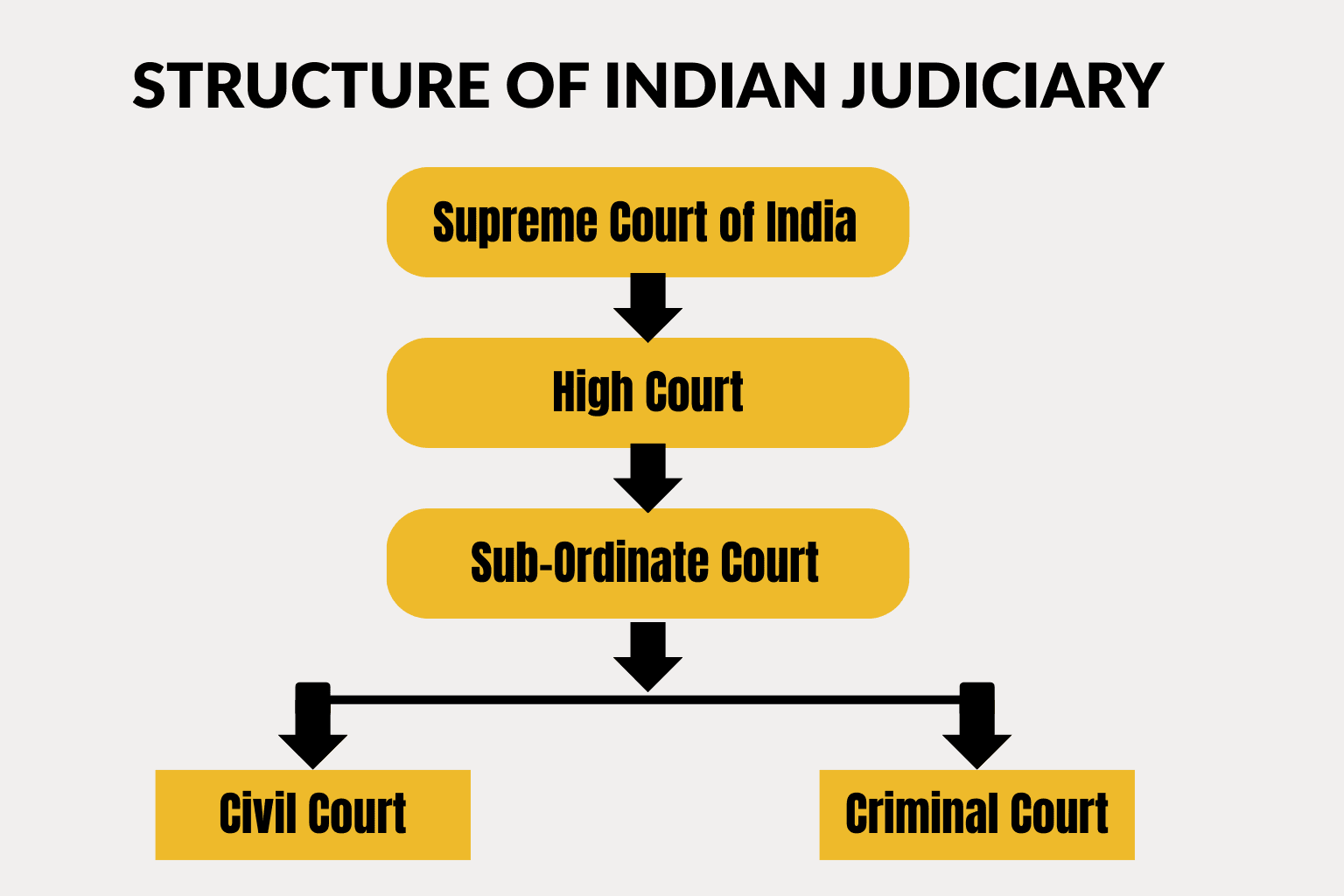
The Indian judiciary has a three-tier structure where each level has its own powers, and lower courts work under higher courts. This helps resolve disputes efficiently and uniformly. The main levels are:
Tier 1: The Supreme Court of India (Apex Court)
- It was established on January 26, 1950.
- The headquarters is situated in New Delhi.
Composition and Structure
- Chief Justice of India (CJI) and 33 other judges (a total of 34 judges).
- Sits primarily on Division Benches (2-3 judges) and Constitutional Benches (5 or more judges).
- Proceedings are conducted exclusively in English.
Jurisdiction and Powers of SC
1. Original Jurisdiction:
- Cases involving disputes between the Union and the States
- Cases involving disputes between two or more States
- Cases for the enforcement of fundamental rights under Article 32
- Election disputes and cases involving the President/Vice-President
2. Appellate Jurisdiction:
- Hears appeals against High Court judgments in civil, criminal, and constitutional matters
- Acts as the final court of appeal for all cases
- Reviews its own judgments in cases involving substantial questions of law
3. Writ Jurisdiction (Articles 32, 226):
- Issues writs (Habeas Corpus, Mandamus, Prohibition, Certiorari, Quo Warranto) for the enforcement of fundamental rights.
- Can intervene through Public Interest Litigation (PIL).
4. Advisory Jurisdiction:
- The President can refer questions of law to the Supreme Court for an advisory opinion.
- These opinions are not binding but carry significant weight.
5. Special Powers
- Judicial Review: Can declare laws and executive actions unconstitutional.
- Contempt of Court: Can punish individuals for contempt.
- Power to Issue Directions: Can issue directions to enforce rights and prevent misuse of power.
Tier 2: High Courts (State Level)
Number and Jurisdiction
- 25 High Courts across India.
- Each High Court has jurisdiction over one or more States/Union Territories.
- Established under Articles 214-232 of the Constitution.
Composition
- Chief Justice and numerous Judges (varies by court).
- Some High Courts have benches (satellite courts) in other cities.
List of High Courts and Their Jurisdictions
| S.No. | High Court | Principal Seat | Jurisdictions |
|---|---|---|---|
| 1. | Allahabad High Court | Allahabad | Uttar Pradesh |
| 2. | Andhra Pradesh High Court | Amaravati | Andhra Pradesh |
| 3. | Bombay High Court | Mumbai | Maharashtra, Goa, Dadra & Nagar Haveli, Daman & Diu |
| 4. | Calcutta High Court | Kolkata | West Bengal, Andaman & Nicobar Islands |
| 5. | Chhattisgarh High Court | Bilaspur | Chhattisgarh |
| 6. | Delhi High Court | New Delhi | Delhi |
| 7. | Gauhati High Court | Guwahati | Assam, Nagaland, Mizoram, Arunachal Pradesh |
| 8. | Gujarat High Court | Ahmedabad | Gujarat |
| 9. | Himachal Pradesh High Court | Shimla | Himachal Pradesh |
| 10. | Jammu & Kashmir and Ladakh High Court | Srinagar/Jammu | Jammu & Kashmir, Ladakh |
| 11. | Jharkhand High Court | Ranchi | Jharkhand |
| 12. | Karnataka High Court | Bengaluru | Karnataka |
| 13. | Kerala High Court | Kochi | Kerala, Lakshadweep |
| 14. | Madhya Pradesh High Court | Jabalpur | Madhya Pradesh |
| 15. | Madras High Court | Chennai | Tamil Nadu, Puducherry |
| 16. | Manipur High Court | Imphal | Manipur |
| 17. | Meghalaya High Court | Shillong | Meghalaya |
| 18. | Orissa High Court | Cuttack | Odisha |
| 19. | Patna High Court | Patna | Bihar |
| 20. | Punjab and Haryana High Court | Chandigarh | Punjab, Haryana, Chandigarh |
| 21. | Rajasthan High Court | Jodhpur | Rajasthan |
| 22. | Sikkim High Court | Gangtok | Sikkim |
| 23. | Telangana High Court | Hyderabad | Telangana |
| 24. | Tripura High Court | Agartala | Tripura |
| 25. | Uttarakhand High Court | Nainital | Uttarakhand |
Jurisdiction and Powers of HC
1. Original Jurisdiction:
- Cases involving the enforcement of fundamental rights (broader than the Supreme Court's Article 32).
- Cases of high value or constitutional importance.
- Election disputes for State legislatures.
- Revenue matters and administrative actions of State governments.
2. Appellate Jurisdiction:
- Hears appeals from District Courts and subordinate courts.
- Reviews judgments and orders of lower courts.
- Can exercise supervisory jurisdiction over lower courts.
3. Writ Jurisdiction (Article 226):
- Can issue writs for the enforcement of any legal right (not just fundamental rights).
- This makes High Court writ jurisdiction wider than the Supreme Court's.
- Acts as a protector of individual rights and government accountability.
4. Supervisory Jurisdiction:
- Oversees the functioning of all courts subordinate to it.
- Can issue directions to lower courts and executive authorities.
Tier 3: Subordinate Courts (District and Lower Courts)
Subordinate courts are organised into two main categories: Civil Courts and Criminal Courts.
A. Civil Court Structure:
1. District Court: Presided over by a District Judge (also called District and Sessions Judge in criminal matters).
- The highest court of original civil jurisdiction at the district level.
- Hears cases of higher pecuniary values.
- Can issue writs and enforce fundamental rights under Article 226 in specific cases.
2. Additional District Court: Assists the District Judge with an overload of cases.
3. Sub-Court (Court of Subordinate Judge):
- Hears civil cases of lower pecuniary values.
- Presided over by a Subordinate Judge or Additional Subordinate Judge.
4. Junior Civil Judge/Munsif Court:
- Entry-level civil court with limited pecuniary jurisdiction.
- Hears cases involving smaller amounts and less complex matters.
- First court where civil suits must be instituted (as per the Code of Civil Procedure, 1908).
B. Criminal Court Structure:
1. District Court/Court of Sessions: Presided over by a Sessions Judge.
- The highest criminal court at the district level.
- Hears serious criminal cases (cognizable offences) and can award capital punishment.
- Has appellate jurisdiction over lower criminal courts.
2. Chief Judicial Magistrate/Chief Metropolitan Magistrate:
- Presides over higher-category criminal cases.
- Can award sentences up to 7 years imprisonment.
3. Judicial Magistrate/Metropolitan Magistrate:
- Hears minor criminal cases and traffic violations.
- Can award sentences up to 2 years imprisonment or fines up to specified limits.
C. Special Judicial Bodies
1. Family Courts: Established under the Family Courts Act, 1984, to handle matrimonial and family disputes with emphasis on reconciliation.
2 Lok Adalats (Public Courts): Voluntary alternative dispute resolution mechanism for resolving minor civil and criminal disputes.
3. Gram Nyayalayas (Village Courts): Established under the Gram Nyayalayas Act, 2008, to provide justice at the grassroots level for rural populations.
- Jurisdiction limited to civil disputes up to Rs. 1 lakh and minor criminal cases.
- Operated by trained Nyaya Mitra (peace officers) with legal training.
- Emphasise conciliation and reconciliation over adversarial litigation.
Also read: Basic Structure Doctrine UPSC Notes: Meaning, Significance & Key Cases
Functions of the Indian Judiciary
The judiciary in India performs several important functions:
- Settles disputes between individuals, between individuals and the state, and between states fairly and impartially.
- Protects and enforces fundamental rights (Articles 12-35) by issuing writs like habeas corpus, mandamus, prohibition, quo warranto, and certiorari.
- Citizens can directly approach the Supreme Court (Article 32) or the High Court (Article 226) to protect their fundamental rights from state violation.
- Interprets the Constitution and determines whether laws and government actions are constitutional.
- Settles constitutional disputes between the Union and the states and between the states themselves.
- Ensures all branches of government (executive and legislature) operate within constitutional bounds.
- Strikes down unconstitutional laws through the power of judicial review.
- Prevents the majority from oppressing minorities through laws and ensures the proportionality of government action.
- Advises the President on legal and factual questions of public importance when referred (Article 143).
UPSC Prelims PYQ on Indian Judiciary
QUESTION 1
A Writ of Prohibition is an order issued by the Supreme Court or High Courts to :
Landmark Judgments Shaping the Indian Judicial System
Over the decades, several Supreme Court verdicts have profoundly influenced India’s legal landscape. A few landmark cases include:
1. Golaknath v. State of Punjab (1967) - Fundamentality of Fundamental Rights
- A 6:5 majority decision in favour of the Golaknath family, challenging the Land Reform Act that seized property.
- Established that constitutional amendments are "laws" under Article 13(3)(a).
- Made fundamental rights immune from amendment: Parliament cannot curtail, abridge, or repeal fundamental rights.
- Provided impetus for the Basic Structure Doctrine established later in the Kesavananda Bharati case.
2. Kesavananda Bharati v. State of Kerala (1973) case - The Basic Structure Doctrine
- A 13-judge Constitutional Bench (the largest bench) heard this case involving monastery land acquisition by the Kerala government.
- The Supreme Court established the revolutionary Basic Structure Doctrine that Parliament cannot amend the basic structure of the Constitution.
- Identified core features of the Constitution that cannot be amended: sovereignty, democracy, federalism, separation of powers, fundamental rights, and judicial review.
3. Minerva Mills v. Union of India (1980) - Evolution of Basic Structure
- Struck down Clauses 4 and 5 of the 42nd Amendment Act, which tried to remove all limitations on Parliament's amending power.
- Added to the basic structure doctrine by declaring that Judicial Review is itself part of the basic structure and cannot be eliminated.
- The Constitution depends on a balance between Fundamental Rights and Directive Principles.
4. Maneka Gandhi v. Union of India (1978) - Expansion of Article 21
- The Supreme Court unanimously expanded the scope of Article 21 (Right to Life and Liberty) far beyond physical existence.
- Established that procedures established by law must be just, fair, and reasonable, not merely arbitrary.
- Declared that Articles 14, 19, and 21 form a "golden triangle" of constitutional protection.
- Expanded Article 21 to include: right to information, right to education, right to health, right to clean environment, right to dignity.
5. M.C. Mehta v. Union of India - Environmental Protection Cases
- PIL against Ganga pollution by leather tanneries ordered the closure of polluting industries.
- Introduced the "Polluter Pays" principle: Those causing pollution must bear remediation costs.
- Introduced the "Absolute Liability" doctrine: For hazardous activities, parties are liable regardless of negligence.
Also read: Anti-Defection Law in India
Criticisms and Challenges of the Indian Judiciary
Despite its significant role, the Indian judiciary faces several persistent challenges and criticisms that undermine its effectiveness and public trust.
- Massive Case Pendency: Crores of cases are pending across all judicial levels, causing extreme delays in justice delivery and violating the right to speedy justice.
- Judge Shortage and Poor Infrastructure: A Critical shortage of judges and inadequate courtroom facilities, combined with insufficient budgetary allocation, prevent efficient case handling.
- Opaque Collegium System: Judicial appointments lack transparency and accountability, with no documented reasons or external oversight, creating scope for favouritism and nepotism.
- Gender Imbalance: Women are severely underrepresented in the higher judiciary, particularly the Supreme Court, affecting legitimacy and diverse judicial perspectives.
- Undertrial Prisoner Crisis: Large prison population comprises undertrials held for prolonged periods without conviction, facing inhumane conditions and constitutional rights violations.
- Systemic Inefficiencies: Frequent adjournments, weak investigations, outdated colonial-era procedures, and poor case management cause significant delays in case disposal.
UPSC Mains Previous Year Question
Discuss the evolution of the collegium system in India. Critically examine the advantages and disadvantages of the system of appointment of the Judges of the Supreme Court of India and that of the USA. (2025)
Evaluate Your Answers nowWay Forward
Improving the judiciary’s performance and responsiveness requires multi-pronged reforms and initiatives:
- Fill vacancies quickly and expand judge strength to reduce backlog.
- Improve court buildings, digital systems, and record-keeping.
- Provide better legal assistance to the poor and expand services in rural areas.
- Promote e-filing, virtual hearings, and faster digital case management.
- Use mediation, arbitration, and Lok Adalats to reduce the burden on courts.
Unlock your UPSC Success with SuperKalam
Get instant doubt clearance, customised study plans, unlimited MCQ practice, and fast Mains answer feedback.
Join thousands of aspirants learning with India’s AI-powered mentor today!