All Important Articles of Indian Constitution for UPSC
All Important Articles of the Indian Constitution for UPSC: Complete list with Parts, Schedules, and key provisions for Prelims and GS Paper II Mains preparation. Click now!
Apr, 2026
•7 min read
For UPSC preparation, important Articles of the Indian Constitution are frequently asked in Prelims and are useful for Mains answer writing. Let's go through all the important Articles of the Indian Constitution for UPSC for quick revision and better understanding.
What is a Constitution?
A Constitution is the supreme set of laws and principles that governs a country. It defines how a state is organised, how power is distributed, and how decisions are made. It also establishes the relationship between the government and the citizens.
The Constitution of India is the foundation of India’s democratic governance. It was adopted on November 26, 1949, and came into force on January 26, 1950. It lays down the framework for political governance, guarantees Fundamental Rights, and ensures justice, equality, and the rule of law.
Salient Features of the Indian Constitution
The Constitution of India is one of the most detailed and well-structured constitutions in the world. It reflects the ideals of justice, liberty, equality, and fraternity, and combines features from various global constitutions.
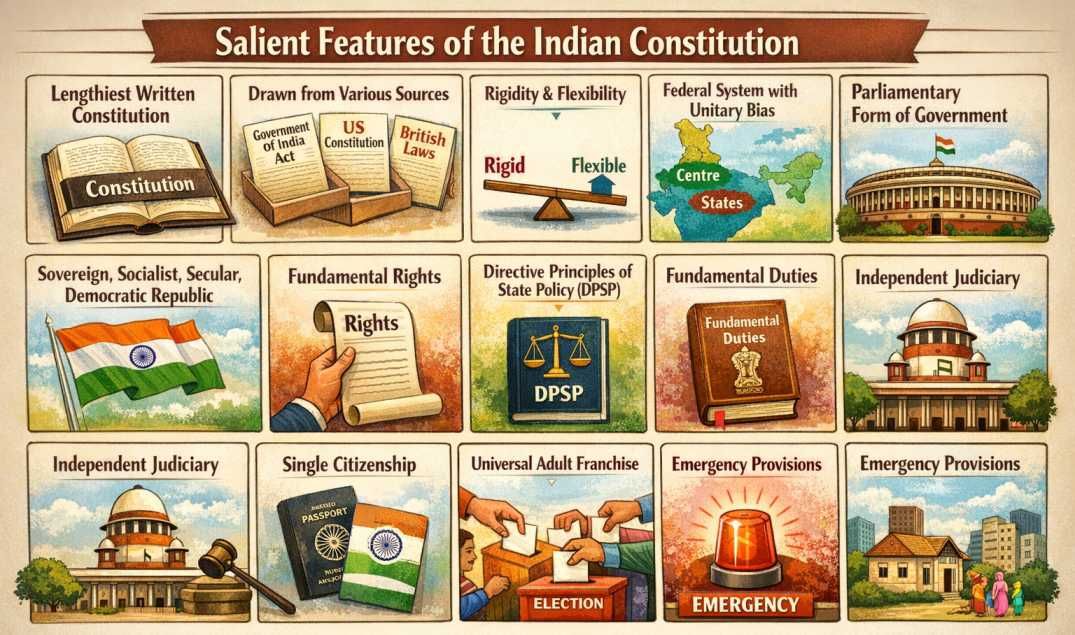
1. Lengthiest Written Constitution
- India has the longest written Constitution in the world.
- It contains detailed provisions covering governance, rights, and administration. This helps reduce ambiguity and ensure clarity in operations.
2. Drawn from Various Sources
The Constitution has borrowed features from different countries:
- Parliamentary system from the UK
- Fundamental Rights from the USA
- Directive Principles from Ireland
- Federal system from Canada
This makes it a blend of the best practices across the world.
3. Combination of Rigidity and Flexibility
The Constitution is neither too rigid nor too flexible.
- A simple majority can amend some provisions
- Others require a special majority or consent of states
This balance allows stability along with adaptability.
4. Federal System with Unitary Bias
India follows a federal structure with a strong central government.
- Powers are divided between the Centre and the States
- In emergencies, the Centre becomes more powerful
This is often called quasi-federal in nature.
5. Parliamentary Form of Government
India follows the parliamentary system:
- The President is the nominal head
- The Prime Minister is the real executive
- The executive is responsible to the legislature
This ensures accountability of the government.
6. Sovereign, Socialist, Secular, Democratic Republic
These values are reflected in the Preamble:
- Sovereign – India is independent
- Socialist – Focus on social and economic equality
- Secular – Equal respect for all religions
- Democratic – Government elected by people
- Republic – Elected head of state
7. Fundamental Rights
Part III guarantees Fundamental Rights to citizens:
- Right to Equality
- Right to Freedom
- Right against Exploitation
- Right to Freedom of Religion
- Cultural and Educational Rights
- Right to Constitutional Remedies
These rights are enforceable by courts and are crucial for democracy.
8. Directive Principles of State Policy (DPSP)
DPSPs guide the government in making policies for a welfare state.
- Not legally enforceable
- Important for governance and social justice
They complement Fundamental Rights.
9. Fundamental Duties
- Added by the 42nd Amendment
- These duties remind citizens of their responsibilities towards the nation, such as respecting the Constitution and promoting harmony.
10. Independent Judiciary
India has an independent judiciary to protect the Constitution:
- Supreme Court at the top
- Judicial review ensures laws follow the Constitution
This maintains the rule of law.
11. Single Citizenship
- Unlike federal countries such as the USA, India has a single citizenship, ensuring unity and equality among citizens.
12. Universal Adult Franchise
- Every citizen above 18 years has the right to vote, ensuring political equality and participation in democracy.
13. Emergency Provisions
The Constitution provides for emergencies:
- National Emergency
- State Emergency (President’s Rule)
- Financial Emergency
These ensure stability during crises.
14. Special Provisions for SCs, STs, and Other Groups
- The Constitution provides reservations and safeguards for disadvantaged groups to ensure social justice and equality.
15. Panchayati Raj and Urban Local Bodies
Through the 73rd and 74th Amendments:
- Strengthened local governance
- Promoted decentralisation
Must read: Important Articles in the Indian Constitution Related to UPSC Functions and Powers
Parts of the Indian Constitution
The Indian Constitution is a detailed document with 25 Parts, 12 Schedules, and 448 Articles. Each part of the Constitution deals with a specific subject. It explains the structure, powers, and functions of the Union, states, and local governments. Here is the list with subjects and articles covered under each part of the Indian Constitution:
| Parts | Subjects | Articles |
|---|---|---|
| Part I | Union & Its Territory | Article 1–4 |
| Part II | Citizenship | Article 5–11 |
| Part III | Fundamental Rights | Article 12–35 |
| Part IV | Directive Principles of State Policy | Article 36–51 |
| Part IV-A | Fundamental Duties | Article 51A |
| Part V | The Union | Article 52–151 |
| Part VI | The States | Article 152–237 |
| Part VII | 7th Constitutional Amendment Act, 1956 (Repealed) | — |
| Part VIII | Union Territories | Article 239–242 |
| Part IX | The Panchayats | Article 243–243O |
| Part IX-A | The Municipalities | Article 243P–243ZG |
| Part IX-B | Cooperative Societies | Article 243ZH–243ZT |
| Part X | Scheduled and Tribal Areas | Article 244–244A |
| Part XI | Relation between Union & States | Article 245–263 |
| Part XII | Finance, Property, Contracts and Suits | Article 264–300A |
| Part XIII | Trade, Commerce and Intercourse within India | Article 301–307 |
| Part XIV | Services under the Union and States | Article 308–323 |
| Part XIV-A | Tribunals | Article 323A–323B |
| Part XV | Elections | Article 324–329A |
| Part XVI | Special Provisions for Certain Classes | Article 330–342 |
| Part XVII | Official Languages | Article 343–351 |
| Part XVIII | Emergency Provisions | Article 352–360 |
| Part XIX | Miscellaneous | Article 361–367 |
| Part XX | Amendment of the Constitution | Article 368 |
| Part XXI | Temporary, Transitional and Special Provisions | Article 369–392 |
| Part XXII | Short Title, Commencement, Authoritative Text in Hindi and Repeals | Article 393–395 |
All important Articles of the Indian Constitution
The Constitution of India has 448 Articles, but for UPSC, you do not need to remember all of them. Some Articles are repeatedly asked in Prelims and are also very useful for GS Paper II in Mains.
If you focus on these important Articles of the Indian Constitution, your preparation becomes more targeted.
| Article | Provisions |
|---|---|
| Article 1 | Name and territory of the Union |
| Article 2 | Admission or establishment of new States |
| Article 3 | Formation of new States and alteration of areas, boundaries or names |
| Article 4 | Laws under Articles 2 and 3, including amendment of First and Fourth Schedules and related matters |
| Article 5 | Citizenship at the commencement of the Constitution |
| FUNDAMENTAL RIGHTS (PART III) Articles 12 to 35 | |
| Article 12 | Definition of State |
| Article 13 | Laws inconsistent with or in derogation of the Fundamental Rights |
| Right to Equality | |
| Article 14 | Equality before law |
| Article 15 | Prohibition of discrimination |
| Article 16 | Equality of opportunity in matters of public employment |
| Article 17 | Abolition of untouchability |
| Article 18 | Abolition of titles |
| Right to Freedom | |
| Article 19 | Six fundamental freedoms including speech, assembly, association, movement, residence, and profession |
| Article 20 | Protection in respect of conviction for offences |
| Article 21 | Protection of life and personal liberty |
| Article 21a | Right to Education |
| Article 22 | Protection against arrest and detention in certain cases |
| Right against Exploitation | |
| Article 23 | Prohibition of human trafficking and foced labour |
| Article 24 | Prohibition of child labour |
| Right to Freedom of Religion | |
| Article 25 | Freedom of conscience and free profession, practice, and propagation of religion |
| Article 26 | Freedom to manage religious affairs |
| Article 27 | Freedom from taxation for religion |
| Article 28 | Freedom regarding religious instruction or worship in educational institutions |
| Cultural and Educational Rights | |
| Article 29 | Protection of distinct language, script, or culture of any section of citizens, allowing them to conserve it |
| Article 30 | Right of minorities to establish and administer educational institutions |
| Article 31 Right to Property (Repealed by 44th Amendment in 1978, removing it from Part III and replacing it with Article 300A) | |
| Right to Constitutional Remedies | |
| Article 32 | Provides the right to move the Supreme Court for enforcement of Fundamental Rights |
| Article 33 | Empowers Parliament to modify Fundamental Rights for armed forces, police forces, and similar services |
| Article 34 | Allows restrictions on Fundamental Rights in areas where martial law is in force |
| Article 35 | Empowers Parliament to make laws for implementing certain Fundamental Rights provisions |
| Articles 36-51 | Directive Principles of State Policy (DPSP) |
| Article 51 A | Fundamental Duties |
| Article 52 | The President of India |
| Article 53 | Executive power of the Union |
| Article 61 | Impeachment of President |
| Article 63 | The Vice President of India |
| Article 64 | The Vice-President to be ex-officio Chairman of the Council of States |
| Article 72 | Pardoning Powers of the President and to suspend, remit, or commute sentences in certain cases |
| Article 73 | The extent of executive power of the Union |
| Article 74 | Council of Ministers to aid and advise the President |
| Article 75 | Prime Minister and Council of Ministers |
| Article 76 | Attorney General of India (AGI) |
| Article 79 | Constitution of Parliament |
| Article 85 | Sessions of Parliament |
| Article 100 | Rules for voting, quorum, and the validity of proceedings within the Houses of Parliament |
| Article 102 | Disqualifications for a person to be chosen as, or to remain, a member of either House of Parliament (MP) |
| Article 105 | Defines the powers, privileges, and immunities of Parliament, its members, and committees |
| Article 108 | Joint sitting of both houses of Parliament |
| Article 109 | Special procedure for passing Money Bills |
| Article 110 | Definition of Money Bill |
| Article 112 | Mandates the President to lay the Annual Financial Statement (Union Budget) before both Houses of Parliament |
| Article 114 | Appropriation Bills |
| Article 115 | Supplementary, additional, or excess grants |
| Article 116 | Votes on account, votes of credit, and exceptional grants |
| Article 117 | Special provisions for financial bills, specifically distinguishing them from money bills (Article 110) |
| Article 118 | House of Parliament (Lok Sabha and Rajya Sabha) to make rules for regulating its own procedure and conduct of business |
| Article 120 | Language to be used in Parliament |
| Article 122 | Prohibits courts from inquiring into parliamentary proceedings based on alleged procedural irregularities |
| Article 123 | Power of President to promulgate Ordinances |
| Article 124 | Establishment, constitution, and regulation of the Supreme Court of India |
| Article 129 | Establishes the Supreme Court as a "court of record" |
| Article 143 | Empowers the President to seek the Supreme Court's advisory opinion on questions of law or public importance |
| Article 148 | Comptroller and Auditor General of India |
| Article 152 | Definition of State |
| Article 153 | Governor of States |
| Article 163 | Council of Ministers to aid and advise the Governor |
| Article 164 | Chief Ministers of States |
| Article 165 | Appointment of the Advocate-General for each state by the Governor |
| Article 214 | High Courts |
| Article 215 | Establishes the High Courts as a "court of record". |
| Article 226 | Power of High Courts to issue certain writs |
| Article 230 | Extension of jurisdiction of High Courts to union territories |
| Article 231 | Establishment of a common High Court for two or more states |
| Article 239 | Administration of Union Territories (UTs) |
| Article 239 A | Creation of local Legislatures or Council of Ministers or both for certain Union territories |
| Article 239 AA | Special status to Delhi, designating it as the National Capital Territory (NCT) with a Lieutenant Governor (LG) and a Legislative Assembly |
| Article 243 to 243 O | Panchayati Raj Institutions (PRIs) |
| Article 243 P to 243ZG | Municipalities |
| Article 243 ZH to 243ZT | Cooperative Societies |
| Article 244 | Provides the framework for administering Scheduled and Tribal Areas, |
| Article 245 | Territorial jurisdiction for laws made by Parliament and State Legislatures |
| Article 248 | Parliament exclusive power to make laws on any subject not listed in the Concurrent List or State List, known as "residuary powers" |
| Article 249 | Power of Parliament to legislate with respect to a matter in the state list in the national interest |
| Article 250 | Empowers Parliament to legislate on matters listed in the State List during a Proclamation of Emergency |
| Article 263 | Empowers the President to establish an Inter-State Council |
| Article 280 | President to constitute a Finance Commission (FC) every five years or earlier |
| Article 312 | Parliament to create new All-India Services (AIS) common to the Union and States |
| Article 315 | Indian Constitution mandates the establishment of a Public Service Commission (PSC) for the Union (UPSC) and for each state (SPSC) |
| Article 323A | Administrative Tribunals |
| Article 323B | Other Tribunals |
| Article 324 | Superintendence, direction, and control of elections are to be vested in an Election Commission. |
| Article 343 | Official language of the union |
| Article 352 | Proclamation of National Emergency |
| Article 356 | President's Rule can be imposed on any state of India on the grounds of the failure of the constitutional machinery |
| Article 358 | Suspension of provisions of Article 19 during Emergencies |
| Article 360 | Financial Emergency |
| Article 368 | Outlines the process for amending the Constitution. It grants Parliament the authority to amend any provision of the Constitution by way of:
|
Must cover: List of All Important Constitutional Amendments for UPSC Prelims and Mains
Schedules of the Indian Constitution
The Constitution of India originally had 8 Schedules when it was adopted in 1949. Over time, with constitutional amendments, the number has increased to 12 Schedules. These Schedules provide detailed provisions related to administration, governance, and distribution of powers.
| Schedule | Features |
|---|---|
| First Schedule | Names of States and Union Territories; includes their territorial jurisdiction |
| Second Schedule | Salaries, allowances, and privileges of key constitutional authorities such as the President, Governors, Speakers, Judges of Supreme Court and High Courts, and CAG |
| Third Schedule | Forms of oath and affirmation for Union Ministers, MPs, Judges, CAG, State Ministers, and legislators |
| Fourth Schedule | Allocation of seats to States and Union Territories in the Rajya Sabha |
| Fifth Schedule | Administration and control of Scheduled Areas and Scheduled Tribes |
| Sixth Schedule | Administration of tribal areas in Assam, Meghalaya, Tripura, and Mizoram |
| Seventh Schedule | Division of powers through three lists: Union List, State List, and Concurrent List |
| Eighth Schedule | List of 22 official languages recognized by the Constitution |
| Ninth Schedule | Laws (mainly related to land reforms) protected from judicial review (added by 1st Amendment Act, 1951) |
| Tenth Schedule | Anti-Defection provisions; disqualification of MPs and MLAs on grounds of defection (52nd Amendment Act, 1985) |
| Eleventh Schedule | Powers and functions of Panchayats; covers 29 subjects (73rd Amendment Act, 1992) |
| Twelfth Schedule | Powers and functions of Municipalities; covers 18 subjects (74th Amendment Act, 1992) |
Must read: Basic Structure Doctrine UPSC Notes: Meaning, Significance & Key Cases
UPSC Prelims PYQs
QUESTION 1
As per Article 368 of the Constitution of India, the Parliament may amend any provision of the Constitution by way of:
- Addition
- Variation
- Repeal
Select the correct answer using the code given below:
QUESTION 2
With reference to the Constitution of India, prohibitions or limitations or provisions contained in ordinary laws cannot act as prohibitions or limitations on the constitutional powers under Article 142. It could mean which one of the following?
QUESTION 3
Under which of the following Articles of the Constitution of India, has the Supreme Court of India placed the Right to Privacy?
QUESTION 4
Which of the following statements are correct about the Constitution of India?
- Powers of the Municipalities are given in Part IX A of the Constitution.
- Emergency provisions are given in Part XVIII of the Constitution.
- Provisions related to the amendment of the Constitution are given in Part XX of the Constitution
Select the answer using the code given below:
QUESTION 5
Which of the following statements are correct in respect of a Money Bill in the Parliament?
- Article 109 mentions special procedure in respect of Money Bills.
- A Money Bill shall not be introduced in the Council of States.
- The Rajya Sabha can either approve the Bill or suggest changes but cannot reject it.
- Amendments to a Money Bill suggested by the Rajya Sabha have to be accepted by the Lok Sabha.
Select the answer using the code given below :
Conclusion
In conclusion, important Articles of the Constitution of India are a core part of UPSC preparation. They help in solving Prelims questions and writing better answers in GS Paper II Mains. Regular revision of these Articles, along with Parts and Schedules, will strengthen your concepts and improve retention.
Start your UPSC Preparation 2026/2027 with SuperKalam
SuperKalam is your personal mentor for UPSC preparation, guiding you at every step of the exam journey. Practice, revise, and evaluate– all in one place.
Download Now