Article 15 of the Indian Constitution [UPSC Polity Notes]
Article 15 prohibits discrimination on the grounds of religion, caste, race, sex, or place of birth. Learn key provisions, exceptions, & landmark cases for the UPSC Polity syllabus.
Jan, 2026
•6 min read
"I like the religion that teaches liberty, equality and fraternity."- Dr B.R. Ambedkar
These words convey that true faith lies in constitutional ideals of liberty, equality, and fraternity. In India’s diversity, Article 15 binds the State to prohibit discrimination, ensuring justice for all.
Article 15 is a highly relevant topic for UPSC Prelims and GS Paper II of Mains. Let us understand Article 15 in India.
What is Article 15?
Article 15 is a fundamental right that prohibits the State from discriminating against any citizen on grounds of religion, race, caste, sex, or place of birth.
However, the article also provides exceptions, allowing the State to make special provisions to help historically disadvantaged groups like Scheduled Castes (SCs), Scheduled Tribes (STs), and socially backward classes advance in education and society.
- Article 15 is part of Part III (Fundamental Rights), specifically comes within Articles 14-18, which deal with the Right to Equality.
- After the 103rd Constitutional Amendment (2019), Article 15 now has six clauses, up from the original provisions.
- The article covers discrimination in shops, restaurants, hotels, public entertainment venues, employment, and access to public utilities like wells and bathing ghats.
- The article uses the word "only," meaning discrimination is prohibited if it's solely on these grounds; other reasonable classifications remain permissible.
- While Article 15(1) restricts State discrimination, Article 15(2) extends to private individuals regarding access to public places.
Also read: Separation of Powers in India [UPSC Notes]
Provisions of Article 15 in the Indian Constitution
Article 15 contains multiple provisions that create a comprehensive framework against discrimination. Here's what each clause does:
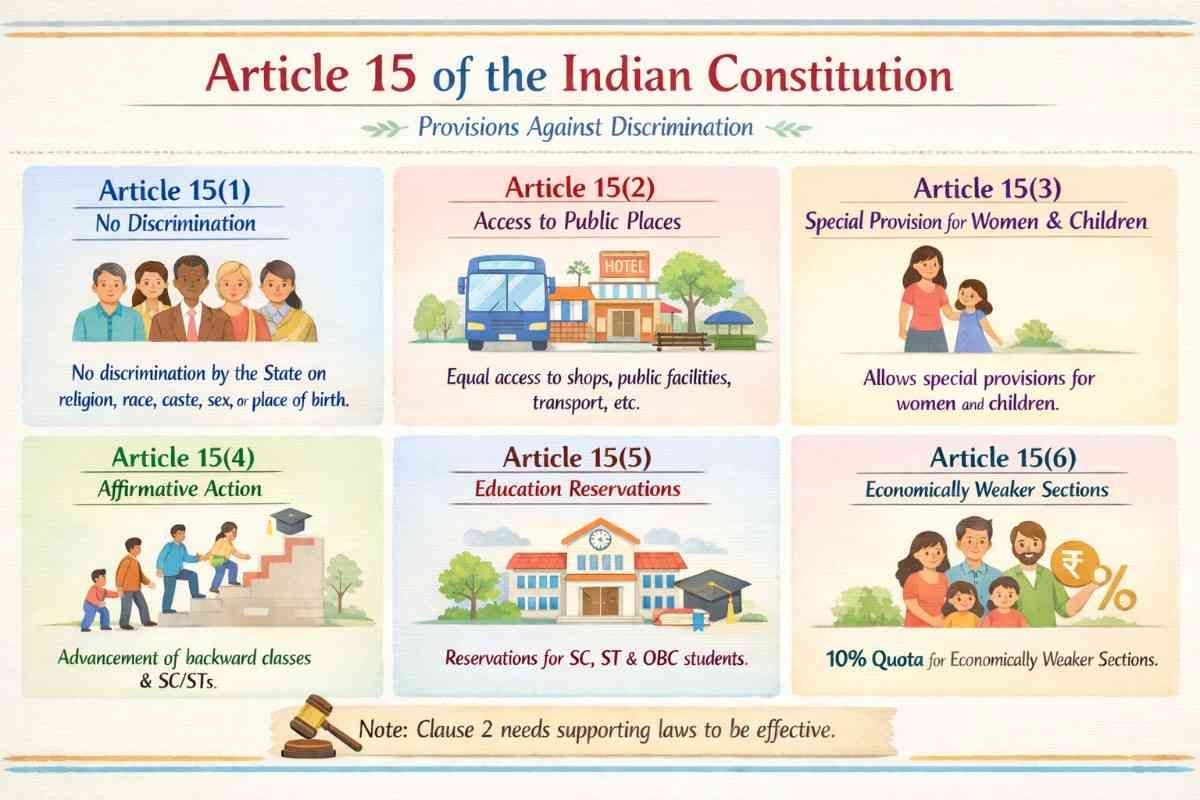
1. Article 15(1) - Prohibition of Direct Discrimination
- The State shall not discriminate against any citizen on grounds only of religion, race, caste, sex, or place of birth.
- It applies to all state action, whether legislative, executive, or judicial.
- Example: A government cannot deny admission to a school or a job based on these grounds alone.
2. Article 15(2) – Access to Public Places
- No citizen shall, on grounds only of religion, race, caste, sex, or place of birth, be denied access to:
- Shops, hotels, restaurants, and public entertainment places
- Wells, tanks, roads, and public facilities are maintained by the State
- Examples of Public Places: Public parks, roads, buses, ferries, government hospitals and clinics, public toilets and bathing ghats.
Clause 2 is NOT self-executing: It requires supporting laws to be effective (like the Protection of Civil Rights Act of 1955).
3. Article 15(3): Special Provisions for Women and Children
- Nothing in this Article shall prevent the State from making any special provision for women and children.
- These are not considered violations of Articles 15(1) and 15(2).
- Example: Separate women's coaches in trains, women's scholarships, and workplace safety measures for women.
4. Article 15(4): Affirmative Action for Backward Classes
- Nothing in this article or Article 29(2) prevents the State from making any special provision for the advancement of socially and educationally backward classes or for SCs/STs.
- Added by the First Constitutional Amendment (1951) in response to the Champakam Dorairajan case.
- Applies to both employment and educational opportunities.
5. Article 15(5) - Educational Institution Reservations
- Allows special provisions in admission to educational institutions for SC/ST and socially/educationally backward classes.
- Applies to private educational institutions (whether aided or unaided) except minority institutions under Article 30.
- Inserted by the 93rd Constitutional Amendment (2005).
6. Article 15(6) – Economically Weaker Sections
- Permits the State to make special provisions for economically disadvantaged citizens.
- Maximum limit of 10% reservation in the educational and employment sectors.
- This is independent of existing reservation ceilings.
- Added by the 103rd Constitutional Amendment (2019).
Key Exceptions to Article 15
While Article 15 broadly prohibits discrimination, the Constitution itself provides important exceptions that allow the State to take targeted action for social justice.
1. Special Provisions for Women and Children [Article 15(3)]
- The State can make laws exclusively benefiting women and children.
- These provisions don't violate Article 15.
- Examples: Prohibition of child labour, maternity benefits, women's reservation in local governance (after the 73rd Amendment), and separate examination centres for women.
2. Socially and Educationally Backward Classes [Article 15(4)]
- The government can reserve jobs and seats in educational institutions for SEBCs, SCs, and STs.
- This recognises historical injustices and aims to uplift marginalised communities.
- The 50% ceiling on total reservations (established in the Indra Sawhney case, 1992) is intended to prevent the excessive exclusion of the general category.
3. Educational Institutions Reservations [Article 15(5)]
- Specifically permits reservation in admission to schools, colleges, and universities.
- Can cover both government and private institutions (except minority institutions).
- Allows states to have different policies for different types of educational institutions.
4. Economically Weaker Sections [Article 15(6)]
- Can make special provisions solely on economic grounds.
- Limited to 10% maximum in the educational and employment sectors.
- Parameters include annual family income below ₹8 lakh, agricultural landholding limits, and residential property size restrictions.
- Significantly expands the scope of affirmative action beyond social backwardness.
Also read: Judicial Review in India: Meaning, Scope & Provisions [UPSC]
Landmark Cases for Article 15 of the Indian Constitution
The Supreme Court has interpreted Article 15 through several landmark judgments that shaped India's social justice framework.
1. State of Madras v. Champakam Dorairajan (1951)
- It was the first major constitutional challenge to reservation policies
- A medical college aspirant was denied admission under the caste-based reservation system in Madras.
- The policy allocated seats by fixed community quotas.
- It violated Article 15(1) (non-discrimination) and Article 29(2) (equal educational access).
Supreme Court Judgment:
- It struck down caste-based reservations as unconstitutional.
- Fundamental Rights prevail over Directive Principles of State Policy.
Constitutional Impact:
- The judgment stemmed First Amendment (1951).
- Introduced Article 15(4), creating a legal basis for reservations.
- Established that a constitutional amendment was needed to implement reservation policies.
2. Indra Sawhney v. Union of India (1992)
- Landmark 9-judge bench decision on OBC reservations (Mandal Commission).
- Challenge to the implementation of the Mandal Commission's 27% OBC reservation recommendation.
- It affected government job appointments.
Supreme Court Judgment:
- Upheld OBC reservations with strict conditions.
- Caste can be a valid indicator of social/educational backwardness.
- 50% ceiling on total reservations (rare exceptions only).
- The creamy layer must be excluded from the benefits of the backward classes.
- Reservations cannot apply to promotions (except SC/ST, added later)
Constitutional Impact:
- The judgment established a permanent framework for reservation implementation.
- Created judicially enforceable limits on reservation policy.
- Introduced the concept of creamy layer exclusion.
3. Joseph Shine v. Union of India (2018)
- It challenged gender discrimination under Article 15.
- The petition challenged Section 497 IPC (adultery law).
- The law criminalised adultery but was blatantly gender-discriminatory
Supreme Court Judgment:
- Struck down Section 497 as unconstitutional.
- Violated Article 14 (equality) and Article 15 (non-discrimination).
- The law treated women as property of husbands.
- Perpetuated patriarchal notions incompatible with constitutional values.
Constitutional Impact:
- The judgment decriminalised adultery in India.
- Expanded the scope of Article 15 beyond caste to encompass gender justice.
- Established that laws perpetuating gender stereotypes violate constitutional equality.
4. Janhit Abhiyan v. Union of India (2022)
- It led to the 103rd Constitutional Amendment (EWS reservation).
- An amendment was introduced to provide 10% reservation for the Economically Weaker Sections.
- Applied to forward castes in education and government jobs.
Supreme Court Judgment (3-2 majority):
- Upheld the constitutional validity of the EWS reservation.
- Economic criteria alone are a valid basis for reservations.
- Does not violate the basic structure of the Constitution.
- The 10% EWS ceiling is independent of the 50% limit for other categories.
- Economic backwardness is a legitimate ground for affirmative action.
Dissenting View (2 judges):
- Violated basic structure doctrine.
- Breached the 50% ceiling principle from Indra Sawhney.
Constitutional Impact:
- Validated the first reservation category based purely on economic criteria.
- Created a separate reservation track outside the traditional social backwardness framework.
Also read: Indian Judiciary UPSC Notes: History, Structure of Courts and Functions
UPSC Prelims MCQ on Article 15
QUESTION 1
Article 15(1) prohibits discrimination by the State on certain grounds. Which of the following is NOT covered under Article 15(1)?
Significance of Article 15
Article 15 is very important for equality and justice in India. It helps ensure fair treatment and inclusive development at many levels.
- Foundation of Equality and Justice: Article 15 is a constitutional cornerstone that ensures equal treatment and prevents the State from promoting historical discrimination based on caste, religion, race, sex, or place of birth.
- Protects Vulnerable Groups: Article 15 allows affirmative action for SCs, STs, women, OBCs, and EWS, showing the Constitution’s commitment to social justice as mentioned in the Preamble.
- Prevents Historical Discrimination: Article 15(2) bans discrimination in public places and facilities, correcting centuries of caste, gender, and religious exclusion.
- Adaptable to Changing Times: The article has evolved through constitutional amendments like the 103rd Amendment (EWS reservation) and judicial interpretation, making it socially relevant.
- International Human Rights Alignment: Article 15 follows global human rights principles of non-discrimination, equality, and dignity, aligning India with international standards.
UPSC Mains Previous Year Question
Explain the constitutional perspectives of Gender Justice with the help of relevant Constitutional Provisions and case laws. (2023)
Evaluate Your Answers nowWay Forward
While Article 15 has successfully addressed many aspects of discrimination, several contemporary issues demand attention:
- Better Implementation: Strong monitoring, easy complaint systems, and awareness campaigns are needed.
- Tackling Multiple Discrimination: People may face discrimination on more than one ground (like caste + gender). Policies must consider this intersectional nature.
- Covering the Private Sector: Anti-discrimination laws should also apply to private hospitals, colleges, restaurants, etc.
- Reviewing Reservation Impact: Reservation policies should be regularly checked to see if they are truly helping target groups.
- Improving EWS Criteria: The definition of economic weakness should be updated as society and the economy change.
Start Your UPSC Journey Smarter with SuperKalam
Crack UPSC with AI-powered guidance, personalised feedback, PYQs, Instant Mains answer Evaluation and expert-curated notes, all in one platform.
Join SuperKalam today and take your preparation to the next level!
Crack UPSC with your Personal AI Mentor
An AI-powered ecosystem to learn, practice, and evaluate with discipline
Download the SuperKalam App Now