Parliamentary Privileges (Article 105) – UPSC Notes
Parliamentary privileges are constitutional immunities ensuring legislative independence and free speech in Parliament. Study Article 105 meaning, breach, classification & challenges for UPSC Prelims & GS Paper 2.
Feb, 2026
•6 min read
Parliamentary Privileges under Article 105 of the Indian Constitution safeguard the freedom, authority, and dignity of Parliament. These parliamentary immunities ensure that Members of Parliament can perform their legislative functions without external pressure or legal intimidation.
This topic is crucial for UPSC Prelims (GS Paper 1) & Mains GS Paper 2 (Polity & Governance) under constitutional provisions, separation of powers, and recent debates on legislative accountability.
What are Parliamentary Privileges?
Parliamentary privileges are the rights and immunities enjoyed by Members of Parliament (MPs) to enable them to perform their legislative duties without external interference or intimidation. These privileges protect the dignity, authority, and functioning of Parliament and ensure that its proceedings are conducted in a disciplined and undisturbed manner.
1. Origin
Parliamentary privileges in India originated with the Charter Act 1833 and were further developed under the Government of India Act 1935, which formally recognised legislative freedom of speech.
2. Constitutional Basis
- Parliamentary privileges are enshrined in Article 105 of the Constitution of India.
- They provide freedom of speech in Parliament and immunity from legal proceedings for anything said or any vote given in Parliament or its committees.
3. Immunity from Legal Liability
- MPs are exempt from civil or criminal liability for statements made or acts done in the course of parliamentary duties.
- This ensures independent debate and decision-making.
4. Sources of Privileges
These privileges are derived from:
- The Constitution of India
- Parliamentary conventions
- Laws made by Parliament
- Rules of Procedure and Conduct of Business in Lok Sabha and Rajya Sabha
- Judicial interpretations
5. Co-terminus with Membership
- Parliamentary privileges exist only during the tenure of membership.
- Once a person ceases to be an MP, these privileges automatically end.
6. Not Absolute in Nature
- Parliamentary privileges are not unlimited. MPs must exercise them responsibly and cannot misuse them for personal benefit.
- Judicial review and constitutional principles act as safeguards against abuse.
Must read: Sessions of Parliament: Provisions & Types (UPSC Notes)
Classification of Parliamentary Privileges
Parliamentary privileges in India are broadly classified into Individual Privileges and Collective Privileges. Under Article 105, both individual members and the Houses of Parliament are granted certain immunities necessary for the effective discharge of their constitutional responsibilities.
1. Individual Privileges
These are rights enjoyed by individual MPs to enable them to perform their duties independently and without fear.
2. Collective Privileges
These are privileges enjoyed by each House of Parliament (Lok Sabha and Rajya Sabha) collectively to safeguard institutional authority and autonomy.
| Individual Privileges | Collective Privileges |
|---|---|
| Freedom of speech in Parliament. | Right to regulate its own internal proceedings. |
| Immunity from court proceedings for anything said or any vote given in Parliament or its committees. | Right to punish members or outsiders for breach of privilege or contempt of the House. |
| Freedom from arrest in civil cases during the session and 40 days before and after the session (as per convention). | Right to exclude strangers from its proceedings and hold secret sittings if required. |
| Exemption from jury service or attendance as a witness when the House is in session. | Right to publish or withhold debates and proceedings. |
| Protection from obstruction, intimidation, or harassment in discharge of parliamentary duties. | Right to inquire into and adjudicate matters of breach of privilege. |
Breach of Parliamentary Privileges
A breach of parliamentary privilege occurs when any act obstructs, insults, or undermines the rights, immunities, or authority of Parliament or its Members.
- It may be committed by an MP or by an outsider.
- Such a breach is treated seriously because it affects the dignity, independence, and smooth functioning of the legislature.
- Additionally, actions that obstruct legislative functioning may also be treated as contempt of the House, even if no specific privilege is directly violated.
When Does a Breach Occur?
A breach of parliamentary privilege may occur in the following situations:
- Obstructing an MP while performing parliamentary duties.
- Threatening or intimidating a member for speeches or votes given in the House.
- Publishing false or distorted reports of parliamentary proceedings.
- Disobeying orders or summons issued by a parliamentary committee.
- Leaking confidential committee reports before they are officially presented.
Example
If a person files a defamation case against an MP for statements made during a debate in Parliament, it would amount to a breach of privilege because MPs are immune from legal proceedings for anything said inside the House.
Procedure for Raising a Question of Parliamentary Privilege
A question of privilege is raised when a Member believes that a privilege of the House or of any MP has been violated.
- Authority: Only Parliament has the power to decide whether a breach of privilege or contempt has occurred. Courts do not have jurisdiction over such internal matters (subject to constitutional limits).
Step-by-Step Process
1. Notice to Presiding Officer: A Member must seek the consent of the Speaker (Lok Sabha) or the Chairman (Rajya Sabha) before raising a question of privilege.
2. Grant of Consent: If the presiding officer admits the notice, the matter may:
- Be taken up directly by the House, or
- Be referred to the Committee of Privileges.
3. Reference to Committee of Privileges:
- In Lok Sabha: 15 members
- In Rajya Sabha: 10 members
4. Role of the Committee of Privileges:
- Examines whether a breach occurred.
- Studies the nature, facts, and circumstances of the case.
- Submits a report with recommendations to the House.
- The House debates the report and decides whether to accept or reject the recommendations.
- Action is taken based on the final resolution of the House.
5. Chairman/Speaker’s Special Powers: The presiding officer may:
- Refer a matter suo motu (on their own initiative) to the Committee, or
- Conduct a preliminary inquiry and inform the House.
6. Key Restrictions on Privileges
- Only one privilege question can be raised per sitting.
- It must relate to a specific and recent matter.
7. Punishment for Breach of Privilege
If the House finds a person guilty, it may impose:
- Reprimand or warning
- Suspension (for MPs)
- Expulsion (in serious cases)
- Imprisonment (limited to the duration of the session)
Example Case:
In 1978, Indira Gandhi was found guilty of breach of privilege and contempt by the Lok Sabha Privileges Committee. She was expelled from Parliament and briefly imprisoned. However, the resolution was later rescinded in 1981.
Responsible Use of Parliamentary Privileges
Parliamentary privileges are meant to protect legislative independence, not to shield misconduct. Their effective use requires a balance between autonomy, accountability, and constitutional morality. The following measures can strengthen their proper application:
- Codification of Privileges: Clearly defining privileges through legislation can reduce ambiguity and prevent arbitrary interpretation, while remaining consistent with Article 105.
- Adherence to Constitutional Values: Privileges must align with fundamental rights, the rule of law, and democratic principles.
- Avoiding Political Misuse: Privilege motions should not be used as tools for political vendetta or to silence criticism.
- Transparency in Proceedings: Decisions related to breach of privilege should follow fair procedure and reasoned orders.
- Strengthening Committee Mechanisms: Privileges Committees should function impartially and ensure due process before recommending action.
- Respect for Judicial Review: While maintaining legislative autonomy, Parliament must operate within constitutional limits subject to judicial scrutiny in cases of illegality or substantive unconstitutionality.
- Promoting Ethical Conduct Among MPs: Responsible debate, fact-based arguments, and adherence to parliamentary ethics reduce unnecessary privilege conflicts.
Also read: President of India UPSC Notes: Elections, Veto Power & Impeachment Process
UPSC Prelims Polity PYQ
QUESTION 1
With reference to the Indian polity, consider the following statements:
I. The Governor of a State is not answerable to any court for the exercise and performance of the powers and duties of his/her office. II. No criminal proceedings shall be instituted or continued against the Governor during his/her term of office. III. Members of a State Legislature are not liable to any proceedings in any court in respect of anything said within the House.
Which of the statements given above are correct?
UPSC Mains PYQ on Parliamentary Privileges
The ‘Powers, Privileges and Immunities of Parliament and its Members’ as envisaged in Article 105 of the Constitution leave room for a large number of uncodified and un-enumerated privileges to continue. Assess the reasons for the absence of legal codification of the ‘parliamentary privileges.’ How can this problem be addressed? (UPSC CSE Mains 2014)
Evaluate Your Answer in 60 SecondsWay Forward
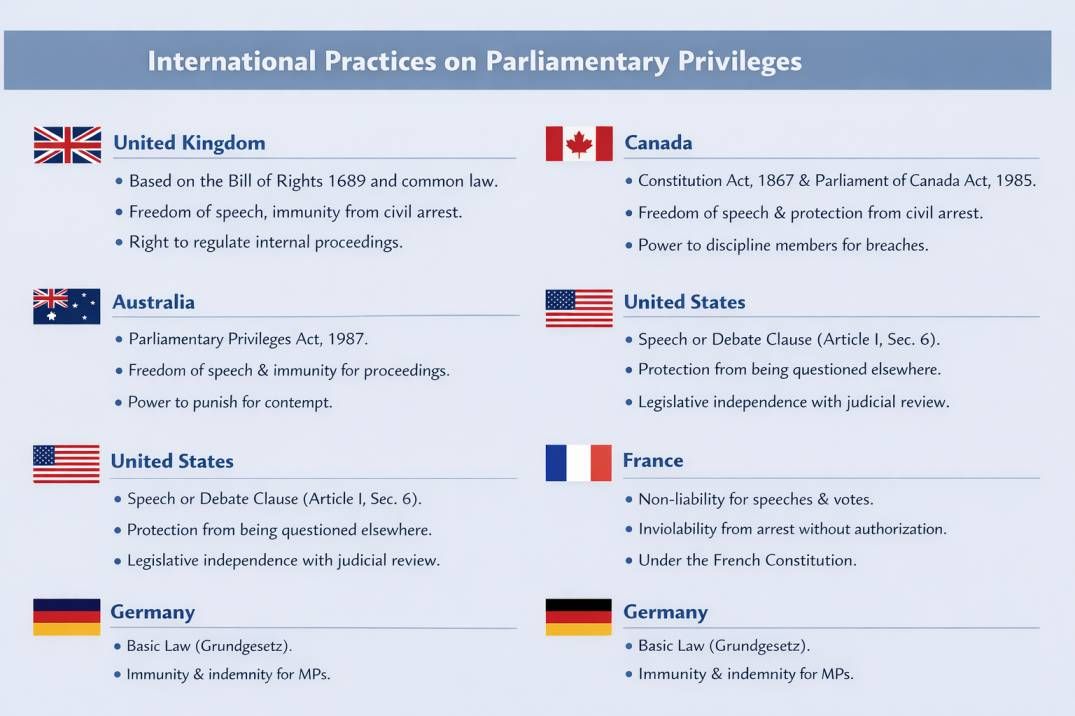
In a modern constitutional system, these Parliamentary privileges should evolve to ensure transparency, accountability, and respect for fundamental rights while preserving legislative independence under Article 105.
Start your UPSC Preparation 2027 with SuperKalam
SuperKalam is your personal mentor for UPSC preparation, guiding you at every step of the exam journey. Practice, revise, and evaluate– all in one place.
Download the App Now