World Bank UPSC Notes: History, Objectives, Functions & Reforms
World Bank UPSC Notes: Learn about its objectives, functions, structure, key reports, India’s role, reforms, and challenges. Read now for Prelims and Mains preparation.
Dec, 2025
•4 min read
About World Bank
The World Bank is an international financial institution founded in 1944 at the Bretton Woods Conference in New Hampshire, to rebuild war-devastated economies after World War II. The institution operates as a cooperative of 189 member countries working collectively to build a world free of poverty on a livable planet.
- The World Bank headquarters is located in Washington, D.C., United States.
- There are five constituent institutions under the World Bank Group:
1. IBRD
2. IDA
3. IFC
4. MIGA
5. ICSID
- It publishes the World Development Report (WDR), an annual flagship publication analysing global development challenges.
- India has been a member of the World Bank since 1944, joining as one of its original founding members.
- Harry White was the first President, appointed by U.S. President Harry S. Truman.
- Ajay Banga has been serving as the President of the World Bank since June 2023.
- India received its first World Bank loan in 1949 for the reconstruction and development of Indian Railways.
Also read: UN Framework Convention on Climate Change (UNFCCC): UPSC Notes
Objectives of the World Bank
The World Bank aims to end extreme poverty and promote shared prosperity through sustainable and inclusive development.
- End extreme poverty by reducing the share of people living on less than $2.15 per day by 2030.
- Promote sustainable development through green, resilient, and inclusive growth.
- Support efforts to mitigate and adapt to climate change.
- Enhance human capital through education, health, and social protection.
- Strengthen institutions and governance frameworks in developing nations.
- Ensuring economic development benefits all segments of society, particularly disadvantaged populations.
Also read: FATF (Financial Action Task Force): Definition, Objectives, Functions & Key Facts for UPSC
Key Functions of the World Bank
The World Bank accomplishes its objectives through several functions:
- Financial Assistance: Provides loans, grants, and risk guarantees to governments and private sector entities.
- Technical Expertise: Offers policy advice and implementation support across development sectors.
- Knowledge Creation: Publishes authoritative research reports and maintains the Open Knowledge Repository.
- Capacity Building: Trains public servants and officials through Knowledge Academy programs.
- Private Sector Development: Supports entrepreneurship and job creation through IFC and MIGA.
- Crisis Response: Addresses global challenges, including pandemics, climate disasters, and conflicts.
Also read: List of International Organisations and Their Headquarters for UPSC
What are Bretton Woods Institutions?
The Bretton Woods Institutions are the World Bank and International Monetary Fund (IMF), established at the 1944 United Nations Monetary and Financial Conference in Bretton Woods, New Hampshire.
1. World Bank (IBRD/IDA)
- Established to provide financial assistance for the reconstruction and long-term development of poor countries.
- It is mostly used for development projects (e.g., rebuilding infrastructure).
2. IMF
- Created to oversee the international monetary system.
- Its job is to stabilise exchange rates, balance-of-payments, and global financial flows, and to provide short-term loans to countries with currency crises.
Also read: Shanghai Cooperation Organisation
Organisational Structure of the World Bank Group (WBG)
The World Bank Group comprises five specialised institutions working together to achieve development goals.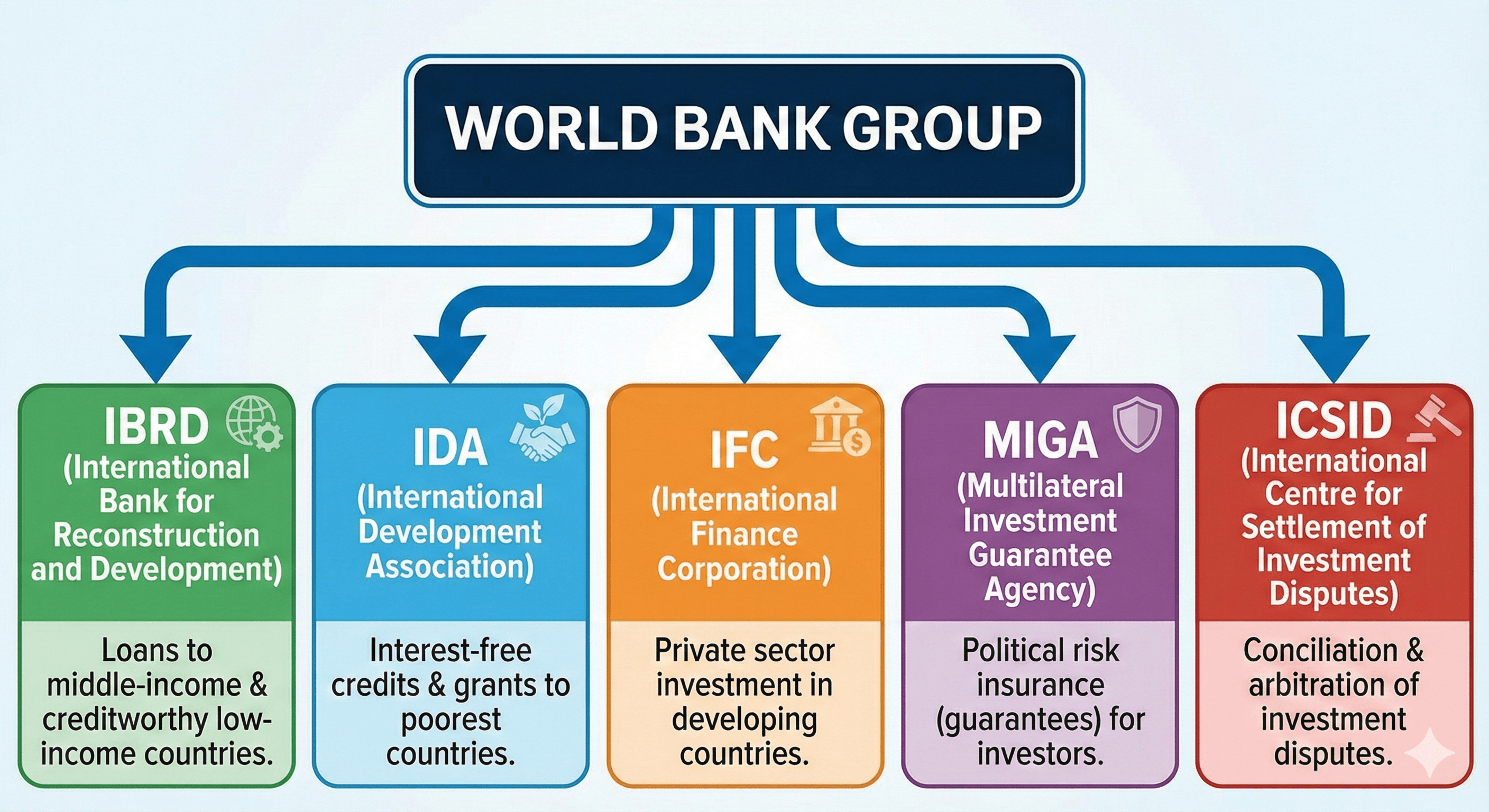
- International Bank for Reconstruction and Development (IBRD): Provides loans to middle-income and creditworthy low-income countries based on sovereign guarantees.
- International Development Association (IDA): Offers concessional financing (interest-free loans/grants) to the world's poorest countries.
- International Finance Corporation (IFC): Supports private sector development without sovereign guarantees.
- Multilateral Investment Guarantee Agency (MIGA): Provides political risk insurance and credit enhancement.
- International Centre for Settlement of Investment Disputes (ICSID): Facilitates investment dispute resolution.
Governance Structure:
- Board of Governors: Supreme decision-making body with one governor per member country (usually the Finance Minister).
- Board of Executive Directors: 25 executive directors handle daily operations, representing single countries or country groups.
Also read: UPSC Notes on CITES: Convention on International Trade in Endangered Species
Important Reports Published by the World Bank
The World Bank Group regularly publishes flagship research reports that guide global policy.
| Report Name | Focus Area |
|---|---|
| World Development Report | Standards for Development |
| Global Economic Prospects | Global Growth Forecasts |
| State and Trends of Carbon Pricing | Climate Policy |
| World Bank Group Annual Report | Institutional Activities |
| Global Economic Prospects | Regional Economic Analysis |
Also read: NATO: History, Structure, Challenges & Relations with India
India and the World Bank
India's partnership with the World Bank spans nearly eight decades, evolving from reconstruction assistance to strategic support for the Viksit Bharat 2047 vision.
- Founding member: India was one of the 44 original signatories of the 1944 Bretton Woods Agreements, helping establish the IBRD (World Bank).
- Strategic Focus: Country Partnership Framework (CPF) aligns with India's priorities for green, resilient, and inclusive development.
- Large borrower: Over the decades, India has received tens of billions of dollars in loans and credits from the World Bank and IDA for major Indian projects in areas like highways, rural development, education and urban infrastructure.
- Blend status: India is classified as a “blend” country-its income level makes it eligible for both IBRD and IDA financing.
- Development Goals: Supports India's transition from lower-middle income to high-middle income status by 2030.
UPSC Prelims PYQ on World Bank
QUESTION 1
The World Bank warned that India could become one of the first places where wet-bulb temperatures routinely exceed 35 °C. Which of the following statements best reflect(s) the implication of the above‐said report?
I. Peninsular India will most likely suffer from flooding, tropical cyclones and droughts. II. The survival of animals including humans will be affected as shedding of their body heat through perspiration becomes difficult.
Select the correct answer using the code given below.
The Growing Need for Reforms in the World Bank
The World Bank faces increasing pressure to reform its governance, financing models, and strategic priorities to address 21st-century development challenges more effectively.
- Governance Restructuring: Reduce US dominance (15.85% voting power) and veto authority over structural modifications.
- Climate Finance Balance: Adjust the 45% climate financing target amid US political pressures while maintaining development focus.
- Debt Transparency: Expand the Debtor Reporting System to all G20 countries for greater clarity.
- Mission Clarity: Balance "livable planet" agenda with traditional poverty reduction mandate.
- Capital Adequacy: Implement hybrid capital mechanisms and portfolio guarantee platforms to increase lending capacity
- Private Sector Mobilisation: Triple guarantee business by 2030 to unlock private capital for development.
World Bank Challenges
Despite its global impact, the World Bank faces serious challenges:
- Climate Crises: Increasing frequency of droughts, storms, and floods strains development resources.
- Demographic Pressures: Sub-Saharan Africa's working-age population is expected to double by 2050, requiring massive job creation.
- Policy Uncertainty: Trade disputes and geopolitical tensions deter investment in developing economies.
- Aid Reduction: Declining official development assistance tightens budget constraints in the poorest nations.
- US Funding Threats: Potential withdrawal of US support could cripple IDA financing for the poorest countries.
UPSC Mains Previous Year Question
The World Bank and the IMF, collectively known as the Bretton Woods Institutions, are the two intergovernmental pillars supporting the structure of the world’s economic and financial order. Superficially, the World Bank and the IMF exhibit many common characteristics, yet their role, functions, and mandates are distinctly different. Elucidate. (2013)
Evaluate Your Answer Now!Way Forward
The World Bank needs major reforms to stay effective in dealing with global challenges while continuing to support development.
- Give developing countries a bigger role and stronger voice in decision-making.
- Use new financial instruments and guarantees to attract more private investment.
- Combine climate action with poverty reduction so that both goals are achieved together.
- Expand digital governance (GovTech) to improve efficiency and reduce corruption.
Unlock your UPSC Success with SuperKalam
Get instant doubt clearance, customised study plans, unlimited MCQ practice, and fast Mains answer feedback.
Join thousands of aspirants learning with India’s AI-powered mentor today!