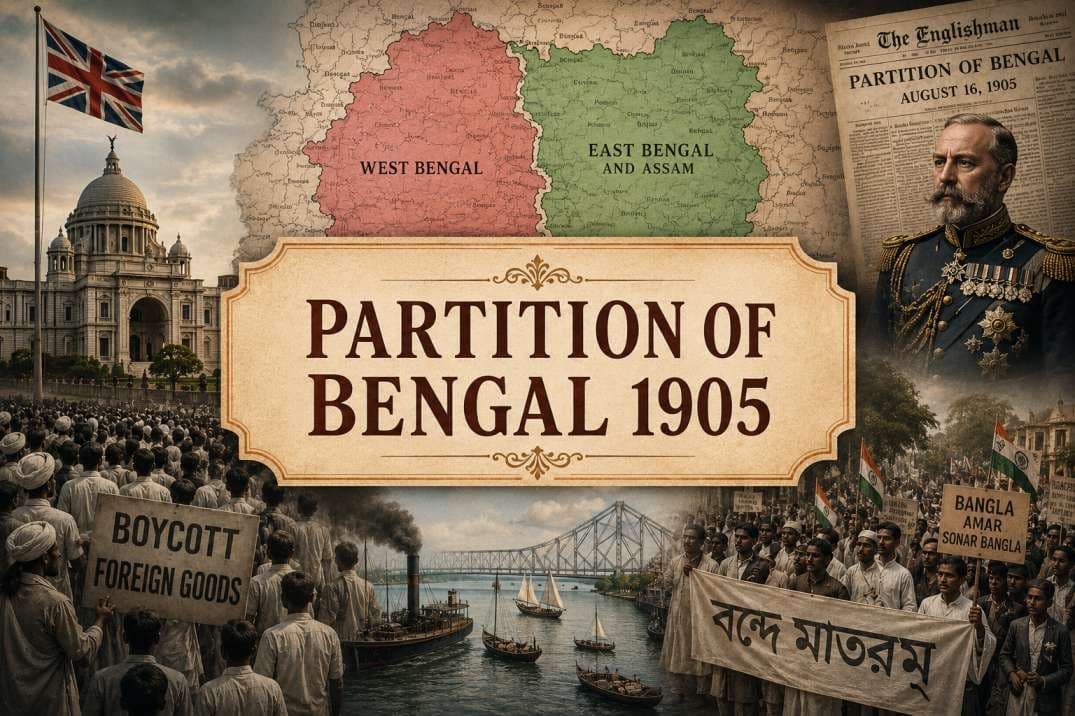
Communalism in India: Meaning, Evolution and Its Impact | UPSC Polity
Communalism arises when religion drives political conflict. Learn its causes, evolution, dimensions, legal safeguards, and measures —highly important for UPSC Prelims and Mains.
Dec, 2025
•8 min read
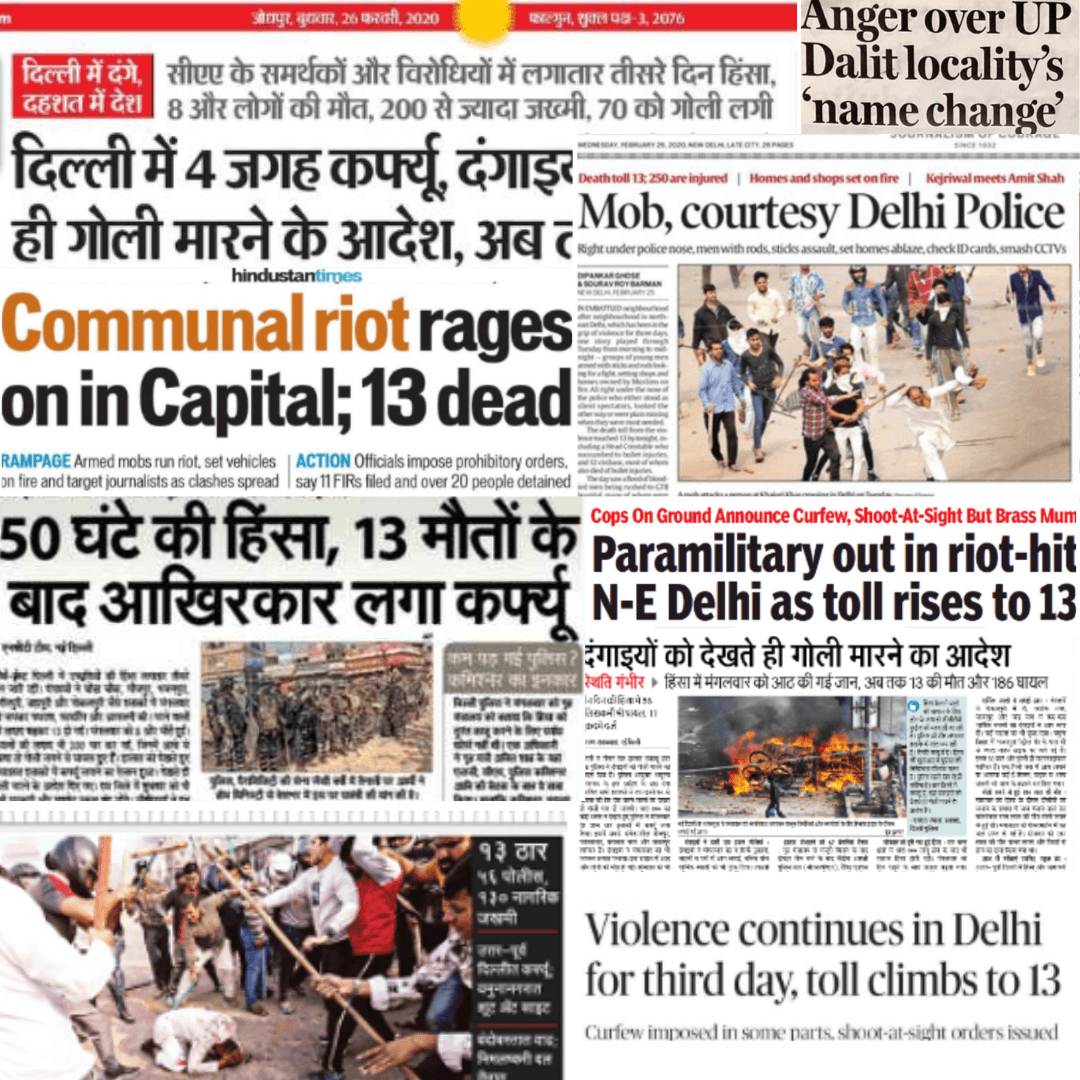
A single WhatsApp forward… a twisted headline… and suddenly an entire city feels on edge. It reminds us how sensitive and layered the issue of communalism is in India.
Communalism roots back to the British period, when divisions were encouraged for political gain, and over time, it gradually shaped social and political behaviour.
For UPSC aspirants, Communalism is an important theme because it connects history, society, governance and ethics. It helps you understand why communal issues emerge, how they influence decision-making, and what they mean for India’s unity.
What is Communalism?
Communalism is the idea that one’s religious community is superior to others and that different communities have completely separate and often conflicting interests. It creates a “us vs. them” mindset, where people start seeing their religious identity as more important than shared national or social bonds.
Communalism becomes especially dangerous when it turns extreme, pushing communities to see each other as enemies. In such situations, one group’s gain is seen as another’s loss, leading to fear, mistrust, and hostility.
Key Causes of Communalism
- Colonial divide-and-rule policies encouraged separate identities.
- Historical mistrust between religious communities due to past conflicts.
- Political mobilisation where leaders use religion to gain votes.
- Economic inequalities creating competition between communities for jobs, resources, and opportunities.
- Lack of education and awareness makes people vulnerable to rumours and misinformation.
- Communal propaganda spread through media, speeches, and now social media.
- Cultural stereotypes and prejudices passed across generations.
- Religious fundamentalism encouraging rigid, intolerant views.
Evolution of Communalism in India
Communalism in India has evolved through different phases of history, shaped by political strategies, social anxieties, and shifting identities. For UPSC aspirants, understanding this evolution is essential to connect Modern History, Society, Polity, and Internal Security.
1. Colonial Seeds & the Two-Nation Theory (Pre-1947)
Communalism took a sharp political form during colonial rule, especially with:
- Separate electorates (1909, 1919, 1935)
- Communal political organisations
- Communal narratives promoted for the divide-and-rule
The culmination of these tensions was the Two-Nation Theory, arguing that Hindus and Muslims were fundamentally separate nations. This ideology led to the Partition of 1947, causing unprecedented violence, displacement, and deep emotional scars.
2. Post-Independence Phase: Managing Diversity (1950s–1970s)
After 1947, the Indian state prioritised unity and integration. However, communal tensions persisted due to:
- Refugee rehabilitation issues
- Minority insecurity
- Localised political competition
- Occasional communal riots in various states
Jabalpur Riots (1961): Considered one of the first major communal riots in independent India, it was linked to economic rivalry between Hindu and Muslim communities in Madhya Pradesh.
3. Rise of Identity Movements: Language & Region (1960s–1980s)
Communalism in India is not only about religion, but it is also about identity-based mobilisation. Though not purely religious, many identity movements mimicked the structure of communal conflicts. For example:
- Anti-Hindi agitations in Tamil Nadu
- Assam Movement (late 1970s–80s)
- Tensions between the Bengali and Assamese populations
These movements showcased how language and region could become rallying points for group identities, often escalating into violence.
4. Punjab Crisis & the 1984 Anti-Sikh Riots
The Punjab crisis introduced a new dimension of communalism rooted in:
- Religious identity
- Regional aspirations
- Centre–state mistrust
The rise of militancy, Operation Blue Star, and the 1984 anti-Sikh riots after Indira Gandhi’s assassination marked a turning point. It revealed how state actions, extremist narratives, and political decisions can intertwine to inflame communal tensions.
5. Communal Flashpoints in the 1990s–2000s
This era saw some of the most intense communal episodes in independent India.
- Babri Masjid Demolition (1992): A defining moment that reshaped India’s communal politics and sparked widespread violence across states.
- Gujarat Riots (2002): Triggered after the Godhra train burning, the riots resulted in severe loss of life and long-term polarisation.
6. Communal Mobilisation in Semi-Urban & Rural India (2010s)
Communal tensions began spreading into smaller towns and rural areas, often driven by misinformation, local disputes, and political mobilisation.
- Muzaffarnagar Riots (2013) became a major example of how small triggers can escalate when rumours and identity narratives fuel fear and anger.
7. Digital-Era Communalism (2016–Present)
With social media becoming widespread, communalism has taken new forms:
- Fake news
- Edited videos
- Provocative posts
- Online hate campaigns
The 2020 Delhi riots highlighted how quickly digital misinformation can intensify on-ground tensions.
Communalism today spreads faster, travels further, and influences public opinion more deeply than ever before.
Also read: Fundamental Duties (Article 51A) in the Indian Constitution | UPSC Polity Notes
Dimensions of Communalism in India
Communalism appears in different forms depending on how strongly a community asserts its identity. These dimensions range from mild cultural expressions to extreme demands for separation or retaliation.
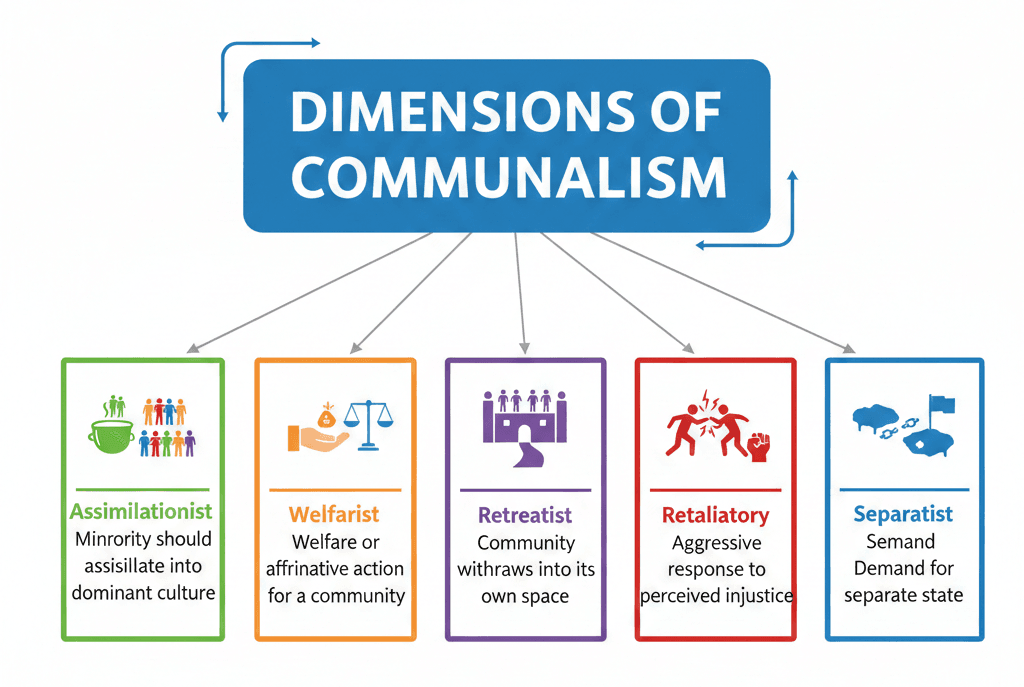
1. Assimilationist Communalism: This view argues that minority communities should give up their distinct cultural or religious practices and merge with the dominant community’s culture.
- Example: The Hindu Code Bill applies not only to Hindus but also to Sikhs, Buddhists, and Jains, reflecting an expectation of cultural similarity.
2. Welfarist Communalism: This dimension supports providing special welfare, protection, or affirmative action to a minority community to uplift its socio-economic condition.
- Example: Many community/religious associations offer hostels, scholarships, and financial help exclusively for their members.
3. Retreatist Communalism: Here, minority communities distance themselves from the dominant culture and prefer to live within their own closed cultural or social circles.
- Example: Communities forming exclusive settlements or choosing separate educational and cultural institutions to maintain their identity.
4. Retaliatory Communalism: This form emerges when a community responds aggressively to perceived injustice, discrimination, or attacks from another community.
- Example: Violent reactions or counter-mobilisation during communal clashes.
5. Separatist Communalism: The most extreme form, where a community demands a separate political unit or independent state based on religious identity.
- Example: The Khalistan movement in the 1980s, where certain groups in Punjab demanded a separate Sikh nation.
Also read: What is Rule of Law? UPSC Notes for Polity
Constitutional Provisions Against Communalism
The Indian Constitution provides strong safeguards to prevent communal discrimination and protect religious harmony. These provisions help maintain India’s secular character and ensure equal treatment of all communities.
1. Preamble: Foundation of Secularism
The Preamble declares India to be a “Secular” nation. This means:
- The State has no official religion
- All religions are treated equally
- Individuals are free to follow, practise, or change their religion
This sets the moral and constitutional foundation against communalism.
2. Fundamental Rights Protecting Religious Harmony
Article 14 – Equality Before Law
No person can be discriminated against based on religion.
Article 15 – Prohibition of Discrimination
The State cannot discriminate on grounds of religion, race, caste, sex, or place of birth.
Article 25 – Freedom of Religion
Every person is free to profess, practise, and propagate their religion (subject to public order, morality, and health).
Articles 26, 27, 28 – Protection of Religious Practices
- Communities can manage their own religious institutions (Art. 26).
- No person can be forced to pay taxes for promoting any religion (Art. 27).
- Religious instruction is banned in State-funded educational institutions (Art. 28).
Together, these fundamental rights prevent religious domination and promote equality.
3. DPSPs Promoting Communal Harmony
The Directive Principles of State Policy encourage the State to promote unity and harmony among all communities.
- Article 38: Promote social justice.
- Article 39(e): Prevent exploitation and discrimination.
- Article 51A(e) (Fundamental Duty): Promote harmony and the spirit of common brotherhood.
Though non-justiciable, these principles guide the government in reducing communal divides.
Important Supreme Court Judgments Related to Communalism
The Supreme Court has played a crucial role in upholding secularism and preventing the misuse of religion in politics.
1. S.R. Bommai vs. Union of India (1994)
A landmark judgment that strengthened secularism.
- Secularism is part of the Basic Structure of the Constitution.
- The State cannot promote any particular religion.
- Use of religion for political mobilisation is unconstitutional.
- Communal violence or state support to religious extremism can justify President’s Rule under Article 356.
This judgment remains the foundation of India’s judicial stand against communal politics.
2. Restricting Religion in Elections (Rulings under RPA, 1951)
The Court held that:
- Appealing for votes based on religion, caste, or community violates the Representation of the People Act, 1951.
- Elections should be fought on development issues, not religious identity.
This helps curb communal campaigning.
3. Judgments on Hate Speech
The Supreme Court has consistently ruled that:
- Hate speech is not protected under free speech.
- The State must take strict action against incitement to communal violence.
- Public figures have a greater responsibility to maintain harmony.
These rulings help control provocations that can escalate communal tensions.
Must read: Article 21 UPSC Notes: Protection of Life and Personal Liberty | UPSC Polity Fundamental Rights
State Response to Communalism
The Indian State uses a mix of laws, policies, institutions, and committees to prevent communal violence and promote harmony. These measures aim to strengthen social cohesion and ensure accountability during tensions.
Laws & Initiatives Against Communal Violence
1. Communal Harmony Guidelines, 2008
Issued by the Ministry of Home Affairs, these guidelines direct states to:
- Identify sensitive areas
- Strengthen intelligence and policing
- Take preventive action during festivals, elections, or tensions
- Ensure quick response and relief during communal incidents
2. National Foundation for Communal Harmony (NFCH)
An autonomous body under the Ministry of Home Affairs that:
- Supports children affected by communal violence
- Promotes interfaith harmony through awareness programs
3. IPC Section 153A
Makes it a criminal offence to:
- Promote enmity between groups based on religion, race, language, etc.
- Spread hatred, harming public harmony
This is a key legal tool against hate speech and inflammatory acts.
4. Bharatiya Nyaya Sanhita (BNS) Bill – Mob Lynching Provision
The proposed BNS introduces a specific offence for mob lynching, with punishments that can go up to the death penalty. This is a major step in recognising mob violence as a serious communal crime.
Important Government Reports
1. Sachar Committee (2006)
Studied the socio-economic and educational status of Muslims in India. Key findings highlighted:
- High levels of poverty
- Underrepresentation in government jobs
- Need for inclusive development
Its recommendations aim to reduce grievances that may fuel communal tension.
2. Ranganath Mishra Commission (2007)
Focused on religious and linguistic minorities. Recommended:
- Reservations for socially and economically backward minorities
- Strengthening minority welfare institutions
These reports guide the government in designing policies to reduce discrimination and promote harmony.
Must read about: Vande Mataram: The National Song of India UPSC | Recent Debate in the Parliament
UPSC Prelims PYQ on Communalism
QUESTION 1
What was the main reason for the split in the Indian National Congress at Surat in 1907?
Suggested Measures to Counter Communalism in India
As Mahatma Gandhi warned, “Communalism is a poison that destroys nations.” To counter this threat, India needs a mix of strong institutions, informed citizens, and a culture that celebrates diversity rather than fears it. Here is how the country can move toward a more peaceful, inclusive future.
1. Strengthen Constitutional Ethos
- Reinforce secular and democratic values through civic education.
- Promote constitutional literacy drives in schools, colleges, and communities.
- Encourage the political neutrality of state institutions such as the police and administration.
2. Inclusive Development & Social Justice
- Reduce socio-economic disparities that fuel resentment.
- Implement targeted welfare schemes for marginalised communities.
- Ensure equal access to education, healthcare, and employment opportunities.
3. Ethical & Responsible Politics
- Enforce strict action against hate speech and communal campaigning.
- Strengthen laws to prevent misuse of religion in elections (as emphasised in the S.R. Bommai case).
- Promote issue-based, development-oriented politics.
4. Media Responsibility & Digital Hygiene
- Regulate misinformation and communal narratives on social media.
- Promote fact-checking mechanisms and responsible journalism.
- Encourage community-based reporting that highlights harmony.
5. Community-Level Interventions
- Set up peace committees at the district and local levels.
- Facilitate interfaith dialogues, cultural exchanges, and youth leadership programs.
- Encourage religious leaders to issue joint appeals during sensitive periods.
- Using theatre, art, social media, and storytelling to promote tolerance.
- Collaborating with schools/colleges to foster constitutional values.
Must cover: Indian Judiciary UPSC Notes: History, Structure of Courts and Functions
Communalism vs. Secularism
Communalism | Secularism |
|---|---|
Prioritises the interests of one religious group | Equal respect for all religions |
Divisive and exclusivist | Inclusive and neutral |
Mobilises people on religious lines | Keeps religion separate from state affairs |
Creates conflict and mistrust | Promotes harmony and coexistence |
Against constitutional values | Upholds constitutional ideals |
Violence, discrimination | Peace, unity, equality |
How Communalism Challenges Indian Secularism
- Politicisation of Religion: Communal narratives influence electoral politics, weakening the state's secular character.
- Threat to Equality: Encourages discrimination against minority communities, violating Articles 14 and 15.
- Undermines Social Harmony: Fuels riots and mistrust, harming the constitutional vision of fraternity.
- Distorts Public Discourse: Replaces rational debate with identity-based polarisation.
- Weakens National Integration: Divides citizens along religious identities, challenging India’s pluralistic ethos.
- Pressure on Institutions: Communal tensions can influence administrative neutrality, policing, and justice delivery.
UPSC Mains PYQs on Communalism
Q1. Distinguish between religiousness/religiosity and communalism, giving one example of how the former has been transformed into the latter in independent India. (UPSC Mains 2017). Q2. Communalism arises either due to power struggle or relative deprivation. Argue by giving suitable illustrations. (UPSC Mains 2018).
Evaluate your Answer within 60 secondsWay Forward: Building a Harmonious and Inclusive India
“No religion has mandated the killing of another human being. Peace is the only path to progress.” — Mahatma Gandhi
Communalism is not just a law-and-order issue; it is a social, psychological, and political challenge. Solving it requires a holistic, multi-layered strategy that strengthens constitutional values, social trust, and institutional accountability.
Start your UPSC Preparation with SuperKalam
Your Personal AI Mentor that teaches, instantly evaluates Handwritten Answers & builds Daily Discipline. Cover 100 of % Prelims & Mains syllabus to add magic in your preparation.
Click the banner below:
Crack UPSC with your Personal AI Mentor
SuperKalam: An AI-powered ecosystem to learn, practice, and evaluate with discipline
Download the SuperKalam App Now