Vande Mataram: The National Song of India UPSC | Recent Debate in the Parliament
Why is Vande Mataram in the news? Learn its history, meaning, freedom struggle role, key milestones, and UPSC relevance. Read now!
Dec, 2025
•6 min read
वन्दे मातरम्!
सुजलाम् सुफलाम्, मलयजशीतलाम्,
शस्य श्यामलाम् मातरम्…
These lines, capable of stirring the deepest layers of patriotic emotions, have once again returned to the centre of national discussion.
As Parliament debates the national song again, it becomes important for UPSC aspirants to understand the history and significance of Vande Mataram and also the context of the present debate.
Why in the News?
The Lok Sabha has started a debate on the national song Vande Mataram. The discussion revolves around:
- Why were only two stanzas adopted in 1950?
- Was the decision political, cultural, or constitutional?
- Should the full song be revived in official practice today?
The discussion surfaced after the BJP alleged that the Congress under Jawaharlal Nehru truncated the song to two paragraphs due to religious concerns.
Why Cover This Topic for UPSC?
- Polity: National symbols, constitutional values, secularism
- Modern History: Swadeshi Movement, Nationalist movements & symbolism
- Current Affairs: Parliamentary debates and government decisions
- Culture: Literature, nationalism, social unity
What Does “Vande Mataram” Mean?
The phrase “Vande Mataram” simply means: “I bow to thee, Mother.” Its imagery of a divine, mother-like motherland inspired generations of revolutionaries, moderates, and common people alike.
Vande Mataram is an emotion woven into India’s freedom movement. Written by Bankim Chandra Chattopadhyay in the late 19th century, the song became a rallying cry for thousands of Indians who fought colonial rule.
The Journey of Vande Mataram
Let’s walk through its history step by step:
1885: The Composition
- Bankim Chandra Chattopadhyay wrote the poem on 7 November 1885 (earlier drafts date back to 1875).
- It was written in a blend of Sanskrit and Bengali, reflecting India’s linguistic-cultural unity.
1882: Appears in the novel Anandamath
- The song was included in Bankim Chandra’s novel Anandamath (1882), which depicted sannyasi revolutionaries fighting for freedom.
- Here, the motherland is personified as a divine figure, inspiring devotion and resistance.
1896: First Public Singing
- Rabindranath Tagore sang it first time at the Indian National Congress session in Calcutta.
- The entire assembly was moved, and this moment took the song nationwide.
1905: The Swadeshi Movement
- During the anti-partition movement in Bengal, Vande Mataram became the anthem of resistance.
- Students, workers, lawyers, revolutionaries, everyone sang it in protest marches.
British Ban
- The British became so uncomfortable with their influence that they banned its public singing in Bengal.
- But as history often works, the ban only made the song more powerful.
“Vande Mataram” as a Martyr’s Cry
- Many freedom fighters, such as Shirish Kumar and Babu Genu, embraced the song in their final moments.
- The song had become a symbol of courage.
1950: Officially Adopted as National Song
- On 24 January 1950, the Constituent Assembly declared Vande Mataram as the National Song of India.
- Dr Rajendra Prasad clarified that it would be given equal honour to the National Anthem.
- Only the first two stanzas were adopted officially, because they described the beauty of the nation rather than religious imagery.
- This was done to maintain unity and inclusivity in a diverse India.
2025: Completing 150 Years
- This year (2025), India is celebrating the 150th anniversary of Vande Mataram.
- The Cabinet has approved year-long celebrations to reconnect young Indians with its revolutionary spirit.
Why Only Two Stanzas?
The original song has six stanzas. The first two are about the land, its rivers, crops, forests, and breeze. But the later stanzas describe the motherland as a goddess-like figure, which some members of the Constituent Assembly felt might not resonate with citizens of all faiths.
So, they reached a middle path:
- Honour the song
- Preserve unity
- Adopt only 2 stanzas officially
This is the decision now being discussed again in Parliament.
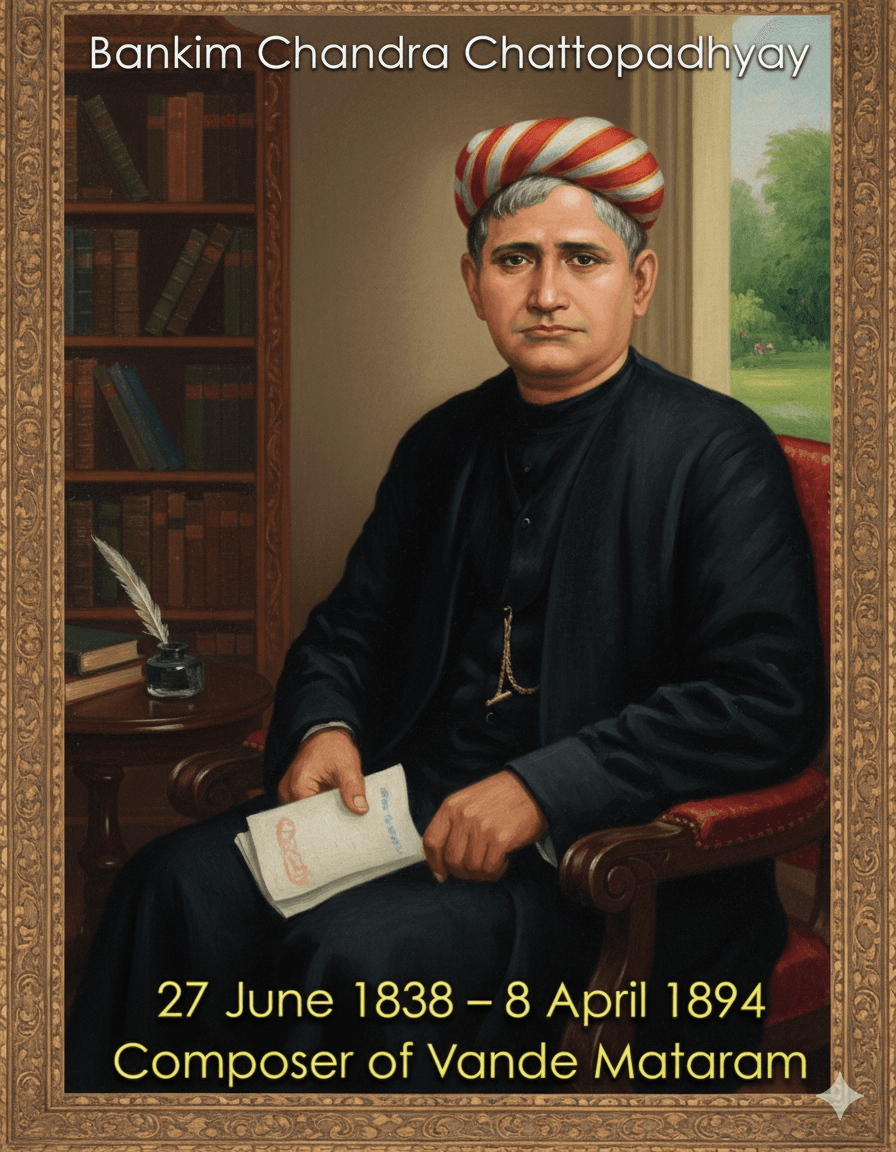
About Bankim Chandra ChattopadhyayBankim Chandra Chattopadhyay (1838–1894) was one of India’s earliest and most influential literary figures. He was often remembered as the "Sahitya Samrat" (Emperor of Literature) in Bengali literature. He played a crucial role in shaping India’s cultural and nationalist consciousness during the late 19th century.
|
Also read: Constitution Day of India 2025: National Festival of Constitutional Values
UPSC Prelims PYQ on National Song of India
QUESTION 1
Which among the following events happened earliest?
Vande Mataram in the Freedom Struggle
During the national movement, Vande Mataram became a rallying cry, a symbol of unity, and a source of courage.
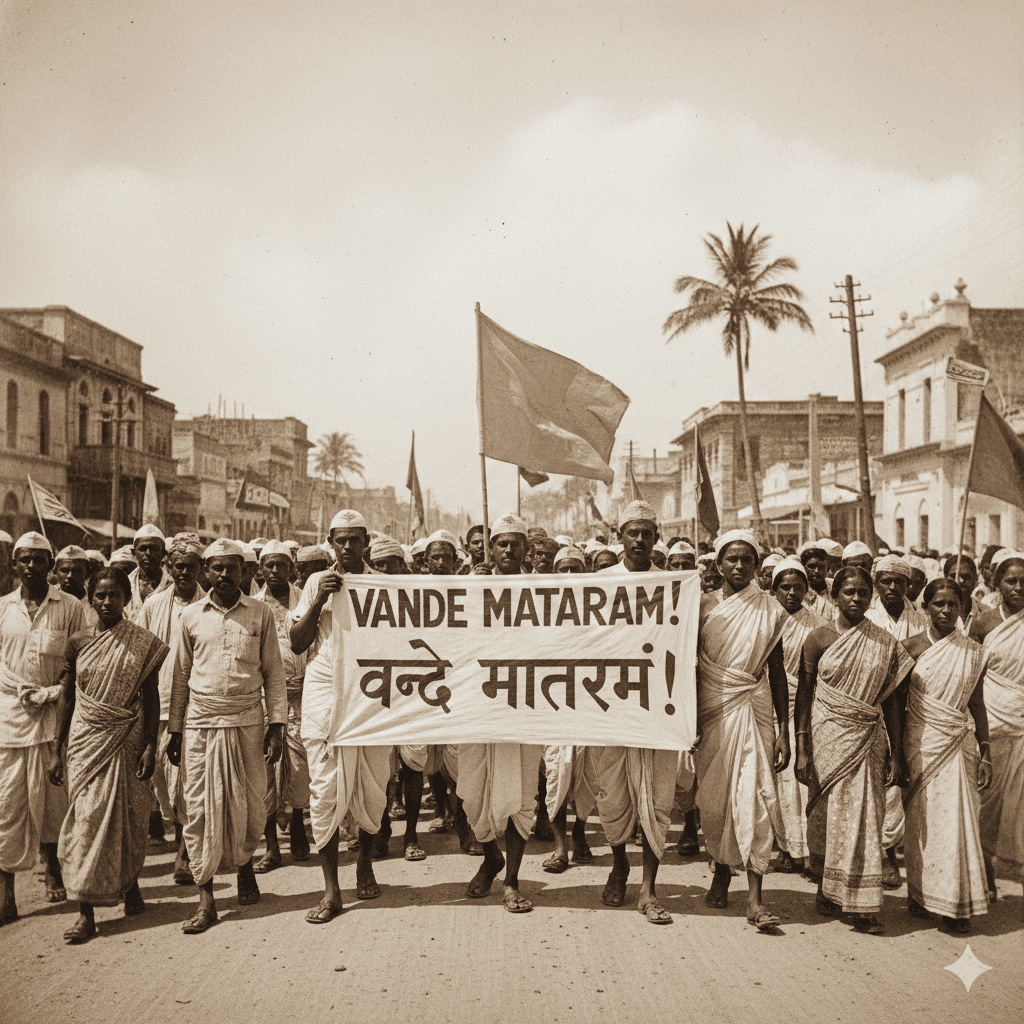
1. It United People Across Regions, Classes, and Communities
The song travelled quickly from Bengal to the rest of India.
- In Bengal, it became central to the anti-partition movement of 1905.
- In Maharashtra, leaders like Bal Gangadhar Tilak encouraged its public singing during protests.
- In Punjab, it inspired students and revolutionaries during meetings of the Ghadar movement.
2. It Gave Courage During Repression and Crisis
During British crackdowns, lathi charges, arrests, and even firing, the chant “Vande Mataram!” became a source of strength.
- During the Swadeshi protests, students expelled from colleges would march while chanting the song.
- Revolutionaries in secret groups like Anushilan Samiti and Jugantar used it as their motivating hymn.
It helped ordinary people feel part of a larger national purpose.
3. It Became the Soundtrack of the Swadeshi Movement
The Swadeshi Movement (1905–1908) gave the song its most powerful moment.
- It was sung at handloom centres, where people vowed to abandon foreign cloth.
- Boycott rallies against British-made goods began with Vande Mataram.
- Secret revolutionary meetings opened and closed with this song.
- When Aravinda Ghosh edited the newspaper Bande Mataram, the slogan reached an even wider audience.
4. It Became the Last Words of Many Martyrs
- Young martyr Shirish Kumar is known to have cried “Vande Mataram!” before being shot during a protest march in 1931.
- In Maharashtra, Babu Genu, who sacrificed his life while stopping a truck carrying foreign goods, shouted “Vande Mataram!” till his last breath.
- Several revolutionaries executed by the British, including members of the Hindustan Socialist Republican Association (HSRA), raised the slogan as a final salute to the motherland.
Significance of the National Song
- Celebrates the Motherland: Portrays India as सुजलाम् सुफलाम् — rich, fertile, and nurturing, reinforcing the idea of Bharat as a sacred mother.
- Civilisational Identity: “Bharat Mata” represents India’s cultural unity and shared heritage.
- Unifying Symbol: Helped people across regions, languages, and communities feel connected to one national identity.
- Spirit of Devotion & Sacrifice: Embodies gratitude towards the nation and inspires countless freedom fighters to dedicate themselves to national service.
- Continues to Inspire: Even today, Vande Mataram is sung at national events, including Independence Day and Republic Day programmes, school assemblies, government and official ceremonies, and cultural and patriotic gatherings.
Also read: Quit India Movement Day 2025: 83rd Anniversary of August Kranti
Vande Mataram — Code of Conduct
Unlike the National Anthem, which has formal rules and a legally mandated duration (52 seconds) under the Prevention of Insults to National Honour Act, 1971, Vande Mataram does not have any legally enforceable code of conduct.
- There is no compulsory etiquette, posture, or legal requirement associated with singing or reciting the National Song.
- However, the Constituent Assembly and President Rajendra Prasad accorded Vande Mataram equal honour and respect alongside the National Anthem.
- Over the years, government institutions, schools, and public programs have continued to treat it with high patriotic and cultural reverence.
- In practice, citizens stand, sing with respect, or observe silence out of voluntary dignity, even though it is not mandated by law.
What Does This Debate Mean for You as a UPSC Aspirant?
It teaches you that:
- National symbols have layered histories
- Nation-building involves balancing emotions with inclusiveness
- Parliamentary debates often connect the past with the present identity
- Cultural topics can be deeply meaningful and asked in the UPSC Interview
Understanding Vande Mataram is understanding a piece of India’s soul.
Also read: Preamble of India UPSC Notes: Meaning, Objectives, Resolution & Landmark Cases Explained
Final Words
Vande Mataram is more than a composition. It is the sound of India’s awakening, struggle, unity, sacrifice, and pride.
As debates continue in Parliament and across the country, one thing remains unchanged: the song’s ability to inspire pride, unity, and a sense of duty towards Bharat.
Hon'ble Prime Minister Narendra Modi recently captured this spirit when he said:
"If patriotism and love for Mother India are feelings beyond words, then Vande Mataram is the song that gives a concrete expression to those feelings."
Start your UPSC Preparation with SuperKalam
Your Personal AI Mentor that teaches, instantly evaluates Handwritten Answers & builds Daily Discipline. Cover 100 of % Prelims & Mains syllabus to add magic in your preparation.
Click the banner below:
Prepare for UPSC Smarter with SuperKalam
Your Personal AI Mentor that teaches, instantly evaluates Handwritten Answers & builds Daily Discipline
Download the SuperKalam App Now