"Women as a class neither belong to a minority group nor are they regarded as forming a backward class." In the light of this statement, discuss the evolution of women's reservation from local bodies to Parliament.
"Women as a class neither belong to a minority group nor are they regarded as forming a backward class." In the light of this statement, discuss the evolution of women's reservation from local bodies to Parliament.
Transcending the labels of minority or backwardness, women's political agency through Article 243D and the Constitution (106th Amendment) Act seeks to institutionalize their participation, ensuring substantive equality within India's multi-tiered representative democracy.
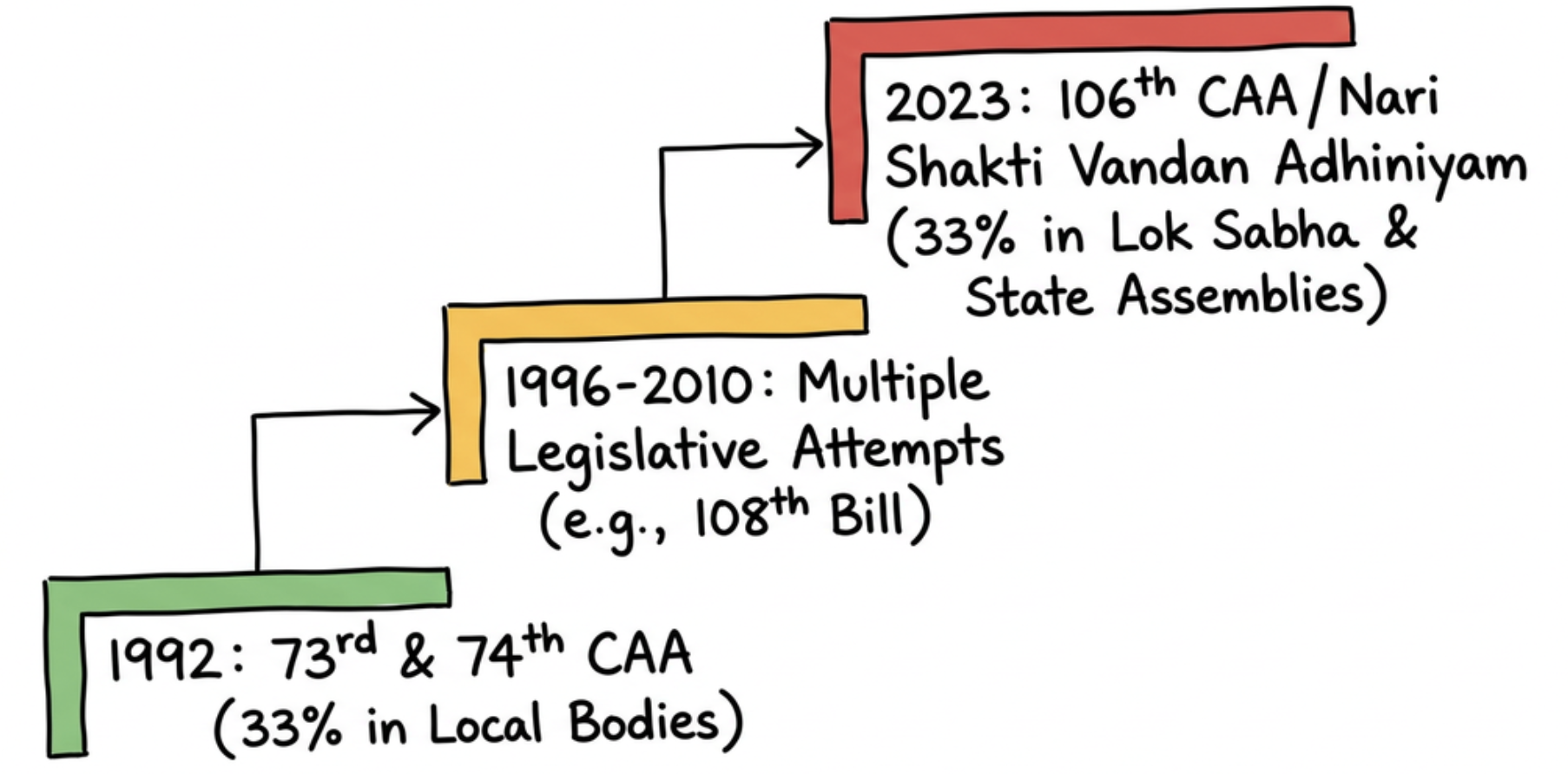
Evolution of Women’s Political Representation in India
Evolution at the Local Level
-
The 73rd and 74th Amendments (1992) mandated one-third seats for women.
- Eg: Article 243D and Article 243T secure grassroots female political agency.
-
States expanded mandates to achieve gender parity.
- Eg: By 2025, 21 states and 2 UTs increased local body reservations to 50%.
-
Reservations created a leadership pool improving welfare outcomes.
- Eg: By April 2026, 1.5 million women held PRI positions, constituting 46% of representatives.
-
Structural barriers still dilute the exercise of actual power.
- Eg: 'Pati Panchayats' (proxy leadership) and patriarchal norms limit autonomy.
Transition to State and National Legislatures
-
The Constitution (106th Amendment) Act, 2023, or Nari Shakti Vandan Adhiniyam, bridges representational gaps.
- Eg: It mandates 33% reservation in the Lok Sabha, State Assemblies, and Delhi Assembly.
-
Implementation is tied to future administrative processes.
- Eg: Reservation is deferred until delimitation following the first Census after the Act.
-
Projections suggest seat rollout remains a medium-term goal.
- Eg: Per 2026 government statements, reservations are projected for 2032 or 2034.
-
Debate persists over linking rights to census timelines.
- Eg: In April 2026, the 131st Amendment Bill for immediate implementation failed to pass.
-
States advocate for reservation based on current seat strengths.
- Eg: In August 2026, the Tamil Nadu assembly urged implementation by the 2029 elections.
-
Evolution reflects women as essential partners in governance.
- Eg: The Supreme Court noted that reservation ensures substantive equality.
Actualizing the Nari Shakti Vandan Adhiniyam through the Doctrine of Substantive Equality will dismantle systemic barriers. This commitment to Constitutional Morality secures women’s roles as equal architects of India’s future governance.
Answer Length
Model answers may exceed the word limit for better clarity and depth. Use them as a guide, but always frame your final answer within the exam’s prescribed limit.
Evaluate this PYQ now
Write your answer & evaluate in just 60 seconds




500+ students evaluated
Model Answers from
- 2026Indian Polity15 MarksView Answer
To what extent do pressure groups, social movements and corporate lobbies deepen pluralistic democracy in India by representing excluded interests? Analyse whether the growing convergence of corporate wealth and political power poses a threat to the autonomy of formal democratic institutions.
- 2026Indian Polity15 MarksView Answer
Examine how the separation of powers is practised in India compared to the rigid presidential model of the United States of America. In this context, compare the actual authority of the Indian Prime Minister with that of the President of the USA.
- 2026Indian Polity15 MarksView Answer
How far has the Indian federal framework been successful in accommodating regional and cultural diversities? Highlight the role of asymmetric federalism and suggest measures to make dispute resolution mechanisms more effective.
- 2026Indian Polity15 MarksView Answer
What is meant by judicial legislation? In this context, discuss the verdicts of the apex court allowing "passive euthanasia" and a "living will".
- 2026Indian Polity15 MarksView Answer
Discuss the position of the Governor in the federal polity of India. What is the nature of his power while giving assent to a bill passed by the State Legislature? Is he bound by the aid and advice of his Council of Ministers in all his functions?
- 2026Indian Polity10 MarksView Answer
Do constitutional bodies like the National Commission for Scheduled Castes (NCSC) and the National Commission for Scheduled Tribes (NCST) possess adequate enforcement powers to secure substantive social equality? Suggest measures to enhance their institutional effectiveness.
Model Answers by Subject


Crack UPSC with your
Personal AI Mentor
An AI-powered ecosystem to learn, practice, and evaluate with discipline



