Discuss the position of the Governor in the federal polity of India. What is the nature of his power while giving assent to a bill passed by the State Legislature? Is he bound by the aid and advice of his Council of Ministers in all his functions?
Discuss the position of the Governor in the federal polity of India. What is the nature of his power while giving assent to a bill passed by the State Legislature? Is he bound by the aid and advice of his Council of Ministers in all his functions?
The Governor, functioning as the Constitutional Head under Article 153, navigates a complex federal role where legislative powers under Article 200 often clash with the discretionary limits defined by the Sarkaria Commission.
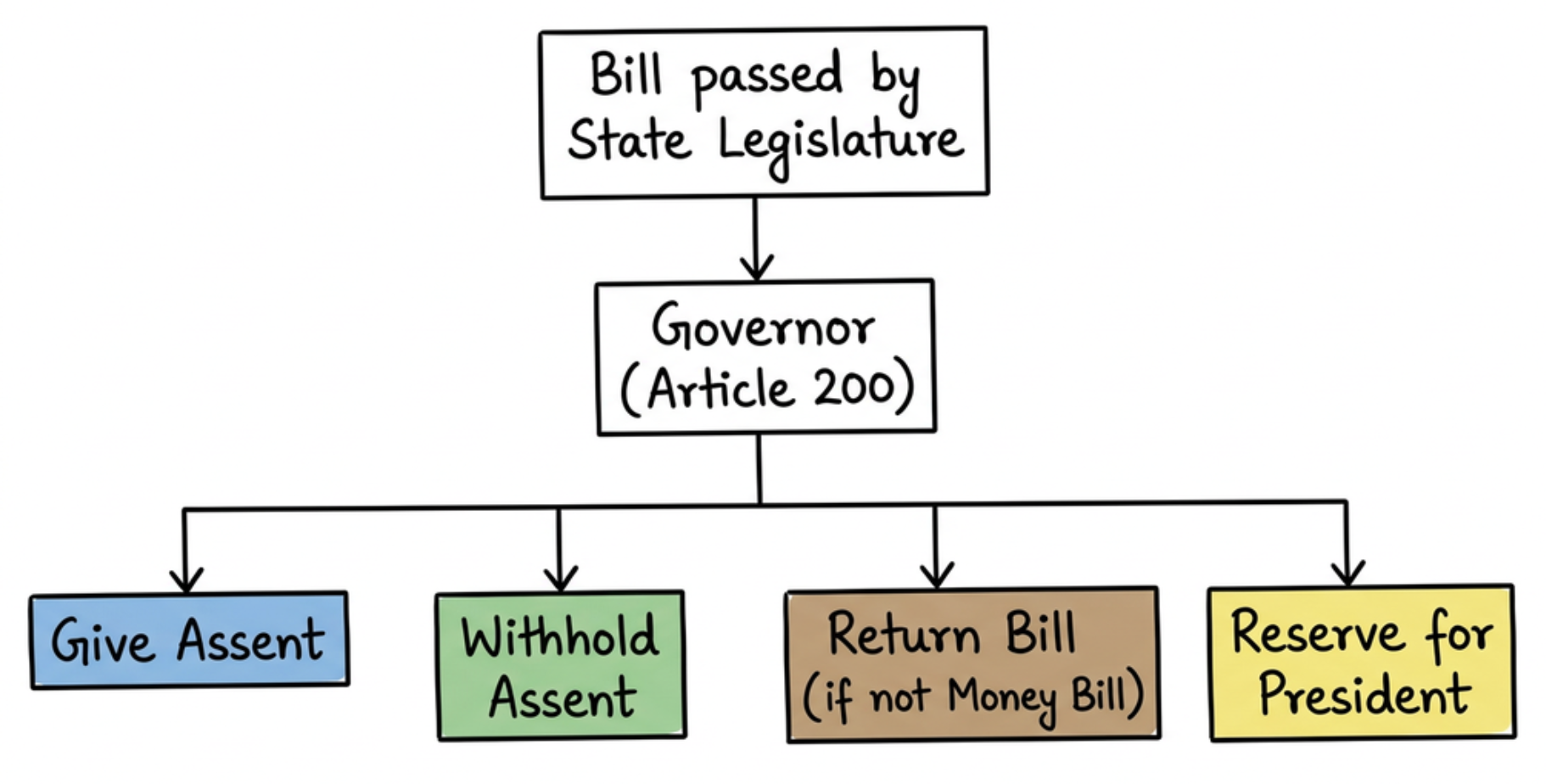
Position and Powers of the Governor in Indian Federalism
Position of the Governor in the Federal Polity
-
Constitutional Sentinel: ensures that the State government functions in accordance with the provisions of the Constitution.
-
Federal Link: acts as a communication channel, submitting reports to the Centre under Article 356.
- Eg: Sarkaria Commission (reiterated 2026) recommending neutral, eminent, outside-state figures for the role.
-
Executive Head: all formal executive actions of the State are taken in his name under Article 166.
-
Agent of the Centre: often perceived as a tool for Central interference, creating friction in federalism.
- Eg: 2026 Tamil Nadu and Kerala disputes regarding the omission of Union-critical remarks in assembly speeches.
-
Stability Arbiter: plays a crucial role during hung assemblies by inviting leaders likely to command a majority.
Nature of Power Regarding Assent to Bills
-
Article 200 Authority: allows granting assent, withholding assent, or reserving bills for the President’s consideration.
-
Limited Discretion: cannot indefinitely stall legislation or use a pocket veto per the Supreme Court’s November 2025 ruling.
-
Obligatory Return: must grant assent if a non-money bill is returned for reconsideration and passed again.
-
Presidential Referral: mandatory reservation of any bills that derogate from the powers of the High Court.
-
Reasonable Timeframe: while no specific limit exists, the SC ruled in 2025 that decisions require a reasonable timeframe.
Aid and Advice of the Council of Ministers
-
Article 163(1) Requirement: generally bound by the aid and advice of the Council of Ministers (CoM).
-
Constitutional Discretion: unlike the President, the Governor has explicit powers to act independently of the CoM.
-
Situational Discretion: includes the appointment of a CM during hung assemblies or dismissal of the CoM.
-
Chancellor Functions: acts in an ex-officio capacity, though the Punchhi Commission (2026) suggests restricting non-constitutional roles.
- Eg: Recent legislative efforts to remove the Governor as Chancellor of State Universities.
-
Finality of Discretion: under Article 163(2), the Governor's decision on whether a matter is discretionary remains final.
Adhering to the Punchhi Commission recommendations regarding legislative timelines ensures that Article 200 functions uphold Constitutional Morality, thereby fostering stable governance and preserving the spirit of Cooperative Federalism within India.
Answer Length
Model answers may exceed the word limit for better clarity and depth. Use them as a guide, but always frame your final answer within the exam’s prescribed limit.
Evaluate this PYQ now
Write your answer & evaluate in just 60 seconds




500+ students evaluated
Model Answers from
- 2026Indian Polity15 MarksView Answer
To what extent do pressure groups, social movements and corporate lobbies deepen pluralistic democracy in India by representing excluded interests? Analyse whether the growing convergence of corporate wealth and political power poses a threat to the autonomy of formal democratic institutions.
- 2026Indian Polity15 MarksView Answer
Examine how the separation of powers is practised in India compared to the rigid presidential model of the United States of America. In this context, compare the actual authority of the Indian Prime Minister with that of the President of the USA.
- 2026Indian Polity15 MarksView Answer
How far has the Indian federal framework been successful in accommodating regional and cultural diversities? Highlight the role of asymmetric federalism and suggest measures to make dispute resolution mechanisms more effective.
- 2026Indian Polity15 MarksView Answer
What is meant by judicial legislation? In this context, discuss the verdicts of the apex court allowing "passive euthanasia" and a "living will".
- 2026Indian Polity10 MarksView Answer
Do constitutional bodies like the National Commission for Scheduled Castes (NCSC) and the National Commission for Scheduled Tribes (NCST) possess adequate enforcement powers to secure substantive social equality? Suggest measures to enhance their institutional effectiveness.
- 2026Indian Polity10 MarksView Answer
Is the right to vote a fundamental right? Discuss the position of the Election Commission of India while undertaking the revision of electoral rolls. Can it also examine the question of citizenship of voters?
Model Answers by Subject


Crack UPSC with your
Personal AI Mentor
An AI-powered ecosystem to learn, practice, and evaluate with discipline