Examine how the separation of powers is practised in India compared to the rigid presidential model of the United States of America. In this context, compare the actual authority of the Indian Prime Minister with that of the President of the USA.
Examine how the separation of powers is practised in India compared to the rigid presidential model of the United States of America. In this context, compare the actual authority of the Indian Prime Minister with that of the President of the USA.
The United States Constitution enforces a rigid water-tight compartmentalisation of governance, whereas the Indian polity adopts functional overlap through Article 75, creating a distinct relationship between the executive and legislative branches.
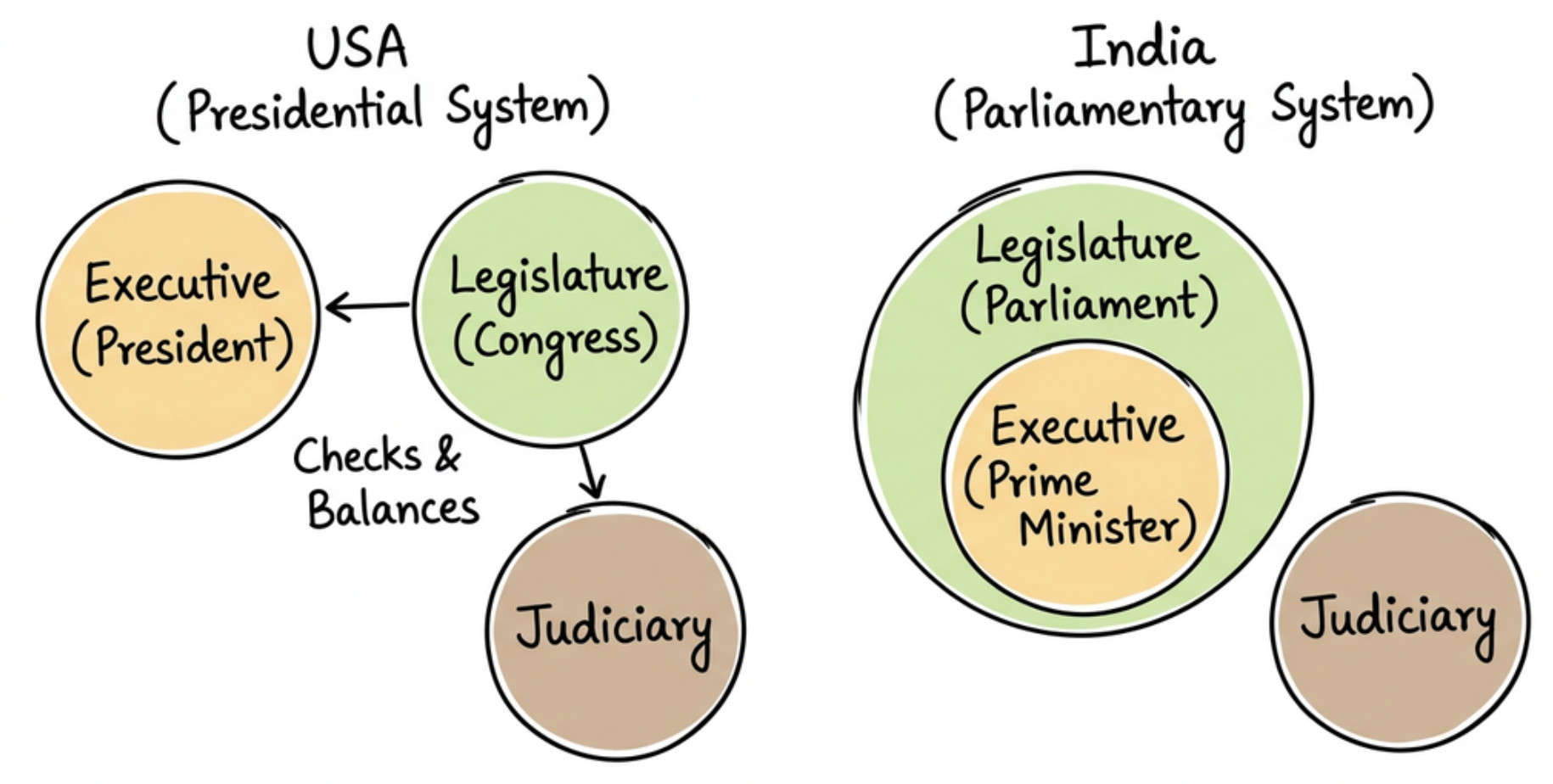
Comparative Separation of Powers in India and USA
Practice of Separation of Powers: India vs. USA
-
India follows a fused model where the executive is part of and responsible to the legislature (Article 75).
- Eg: The Public Accounts Committee briefing in July 2026 on C&AG tax reports.
-
In the USA, the President and Cabinet cannot be members of Congress, maintaining a non-overlapping personnel structure.
-
Indian courts review via "procedure established by law," while the US applies the broader "due process of law."
- Eg: The SC's 2026 ruling in Adani Power v Union of India preventing executive overreach.
-
The US President holds a suspensive veto Congress can override, while the Indian President acts on Aid and Advice.
-
Both maintain independent judiciaries, but India’s Collegium system limits executive influence more than US Presidential appointments.
- Eg: The Supreme Court (Number of Judges) Amendment Bill 2026 legislative role.
-
Indian Parliament scrutinises delegated legislation, while US courts strike down executive orders via the Non-delegation doctrine.
-
US Presidents face a political trial in the Senate, whereas Indian Prime Ministers lose power via No-Confidence Motion.
Comparison of Authority: Indian PM vs. US President
-
The PM derives power from a Parliamentary majority, while the US President has a direct popular mandate.
-
The Indian PM, as Leader of the House, directly initiates legislation like the Income Tax Act 2025.
-
The PM leads a Council of equals, whereas the US President appoints a subordinate "Kitchen Cabinet."
-
The US President has a fixed four-year term, but the Indian PM’s tenure depends on continuing legislative support.
-
The Indian PMO acts as a "nerve centre," coordinating federal ministries more directly than the US West Wing.
- Eg: The PMO's 2026 reforms to remove laws via the Tribunals Reforms Act 2026.
-
The US President requires Senate confirmation for posts, while the Indian PM has near-absolute discretion in appointments.
-
The US President deals with sovereign states, whereas the Indian PM exercises control via the Unified Waqf Management Act 2025.
-
The Indian PM can advise the Proclamation of Emergency (Article 352), a power not explicitly available to the US President.
Incorporating Second Administrative Reforms Commission recommendations will enhance legislative oversight, ensuring that Article 74 functions to uphold the Rule of Law while navigating complex and evolving modern governance challenges.
Answer Length
Model answers may exceed the word limit for better clarity and depth. Use them as a guide, but always frame your final answer within the exam’s prescribed limit.
Evaluate this PYQ now
Write your answer & evaluate in just 60 seconds




500+ students evaluated
Model Answers from
- 2026Indian Polity15 MarksView Answer
To what extent do pressure groups, social movements and corporate lobbies deepen pluralistic democracy in India by representing excluded interests? Analyse whether the growing convergence of corporate wealth and political power poses a threat to the autonomy of formal democratic institutions.
- 2026Indian Polity15 MarksView Answer
How far has the Indian federal framework been successful in accommodating regional and cultural diversities? Highlight the role of asymmetric federalism and suggest measures to make dispute resolution mechanisms more effective.
- 2026Indian Polity15 MarksView Answer
What is meant by judicial legislation? In this context, discuss the verdicts of the apex court allowing "passive euthanasia" and a "living will".
- 2026Indian Polity15 MarksView Answer
Discuss the position of the Governor in the federal polity of India. What is the nature of his power while giving assent to a bill passed by the State Legislature? Is he bound by the aid and advice of his Council of Ministers in all his functions?
- 2026Indian Polity10 MarksView Answer
Do constitutional bodies like the National Commission for Scheduled Castes (NCSC) and the National Commission for Scheduled Tribes (NCST) possess adequate enforcement powers to secure substantive social equality? Suggest measures to enhance their institutional effectiveness.
- 2026Indian Polity10 MarksView Answer
Is the right to vote a fundamental right? Discuss the position of the Election Commission of India while undertaking the revision of electoral rolls. Can it also examine the question of citizenship of voters?
Model Answers by Subject


Crack UPSC with your
Personal AI Mentor
An AI-powered ecosystem to learn, practice, and evaluate with discipline



