Do constitutional bodies like the National Commission for Scheduled Castes (NCSC) and the National Commission for Scheduled Tribes (NCST) possess adequate enforcement powers to secure substantive social equality? Suggest measures to enhance their institutional effectiveness.
Do constitutional bodies like the National Commission for Scheduled Castes (NCSC) and the National Commission for Scheduled Tribes (NCST) possess adequate enforcement powers to secure substantive social equality? Suggest measures to enhance their institutional effectiveness.
While Article 338 and Article 338A vest the NCSC and NCST with civil court powers for investigations, the limitations of their advisory mandate often impede the realization of substantive equality for marginalized communities.
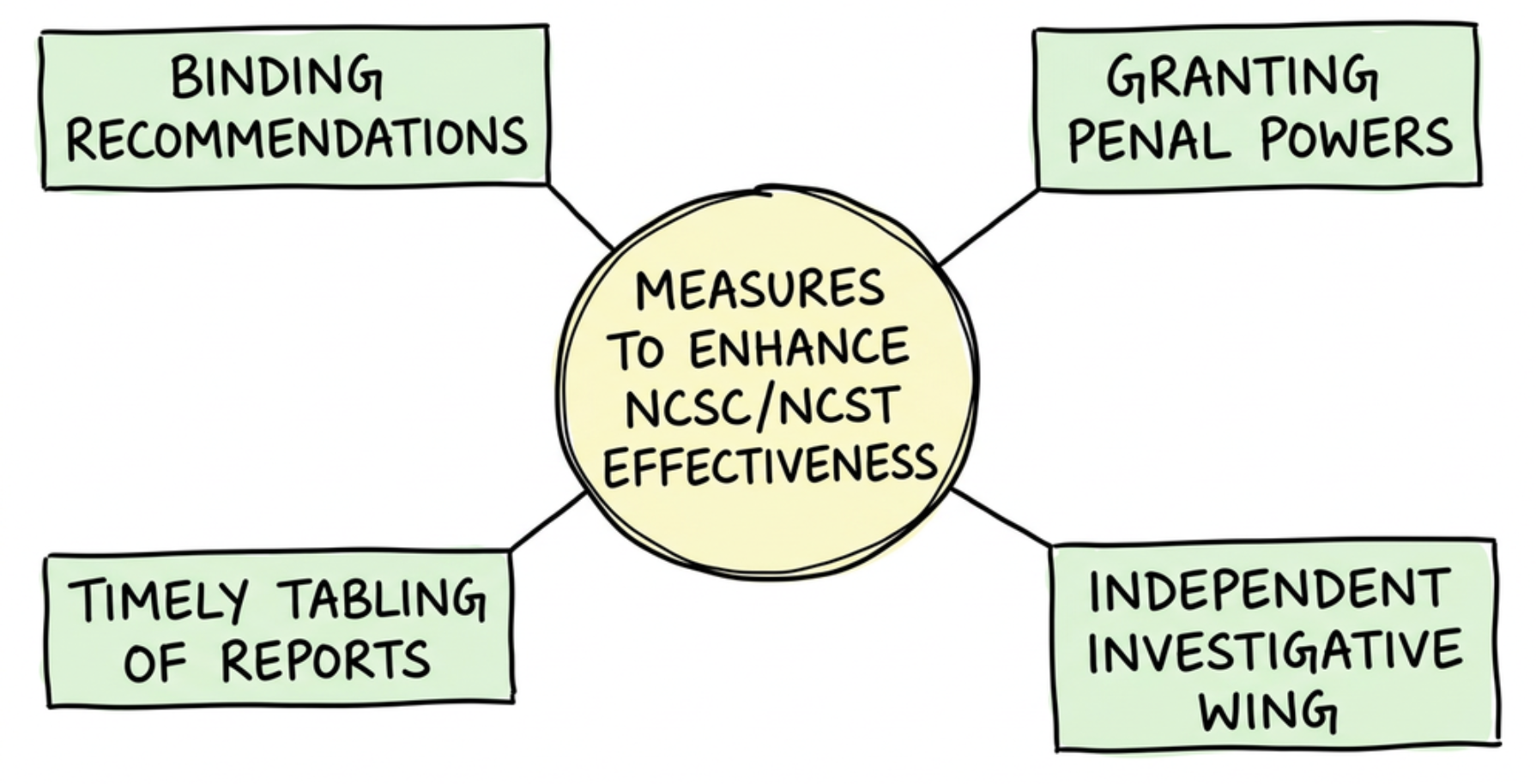
Measures to Enhance Effectiveness of NCSC and NCST
Adequacy of Enforcement Powers
-
Advisory Mandate: Commissions lack adjudicatory authority, making recommendations non-binding on governments.
- Eg: Supreme Court ruling (July 2026) clarified NCSC lacks binding powers in service disputes.
-
Investigative Scope: Commissions possess civil court powers to summon witnesses but cannot award punishments.
-
Implementation Gaps: Success depends on executive cooperation, often resulting in low compliance by departments.
-
Pendency Burden: Heavy backlogs hinder timely justice despite resolving record grievances recently.
- Eg: NCSC reported resolving 60,000 cases nationally between 2024 and 2026.
-
Staffing Constraints: Chronic vacancies and lack of specialized personnel limit monitoring and research depth.
- Eg: Ministry of Tribal Affairs (June 2026) reported NCST operating with under 50% strength.
Measures to Enhance Effectiveness
-
Binding Authority: Amend Articles 338 and 338A to make recommendations binding or require rejection justifications.
- Eg: Proposed June 2026 amendments aim to grant NCSC binding authority.
-
Legislative Strengthening: Update the Atrocities Act to protect community interests and prevent procedural hurdles.
- Eg: August 2026 proposals suggest safeguarding ST livelihoods via Atrocities Act amendments.
-
Financial Autonomy: Grant commissions independent budgets to ensure operational freedom from parent ministries.
-
Decentralized Infrastructure: Establish regional benches and digital portals for transparent, time-bound grievance redressal.
-
Human Resource Reform: Mandate timely appointments and dedicated investigative wings to improve report quality.
Adopting the Venkatachaliah Commission reports and strictly enforcing the Protection of Civil Rights Act will empower these commissions to translate the vision of Constitutional Morality into a tangible social reality.
Answer Length
Model answers may exceed the word limit for better clarity and depth. Use them as a guide, but always frame your final answer within the exam’s prescribed limit.
Evaluate this PYQ now
Write your answer & evaluate in just 60 seconds




500+ students evaluated
Model Answers from
- 2026Indian Polity15 MarksView Answer
To what extent do pressure groups, social movements and corporate lobbies deepen pluralistic democracy in India by representing excluded interests? Analyse whether the growing convergence of corporate wealth and political power poses a threat to the autonomy of formal democratic institutions.
- 2026Indian Polity15 MarksView Answer
Examine how the separation of powers is practised in India compared to the rigid presidential model of the United States of America. In this context, compare the actual authority of the Indian Prime Minister with that of the President of the USA.
- 2026Indian Polity15 MarksView Answer
How far has the Indian federal framework been successful in accommodating regional and cultural diversities? Highlight the role of asymmetric federalism and suggest measures to make dispute resolution mechanisms more effective.
- 2026Indian Polity15 MarksView Answer
What is meant by judicial legislation? In this context, discuss the verdicts of the apex court allowing "passive euthanasia" and a "living will".
- 2026Indian Polity15 MarksView Answer
Discuss the position of the Governor in the federal polity of India. What is the nature of his power while giving assent to a bill passed by the State Legislature? Is he bound by the aid and advice of his Council of Ministers in all his functions?
- 2026Indian Polity10 MarksView Answer
Is the right to vote a fundamental right? Discuss the position of the Election Commission of India while undertaking the revision of electoral rolls. Can it also examine the question of citizenship of voters?
Model Answers by Subject


Crack UPSC with your
Personal AI Mentor
An AI-powered ecosystem to learn, practice, and evaluate with discipline