What is meant by judicial legislation? In this context, discuss the verdicts of the apex court allowing "passive euthanasia" and a "living will".
What is meant by judicial legislation? In this context, discuss the verdicts of the apex court allowing "passive euthanasia" and a "living will".
Judicial legislation refers to the Supreme Court formulating binding guidelines to fill legislative vacuums, ensuring the protection of Fundamental Rights. This proactive role, anchored in the Basic Structure, serves as a vital tool for Constitutional Morality when Parliament remains silent.
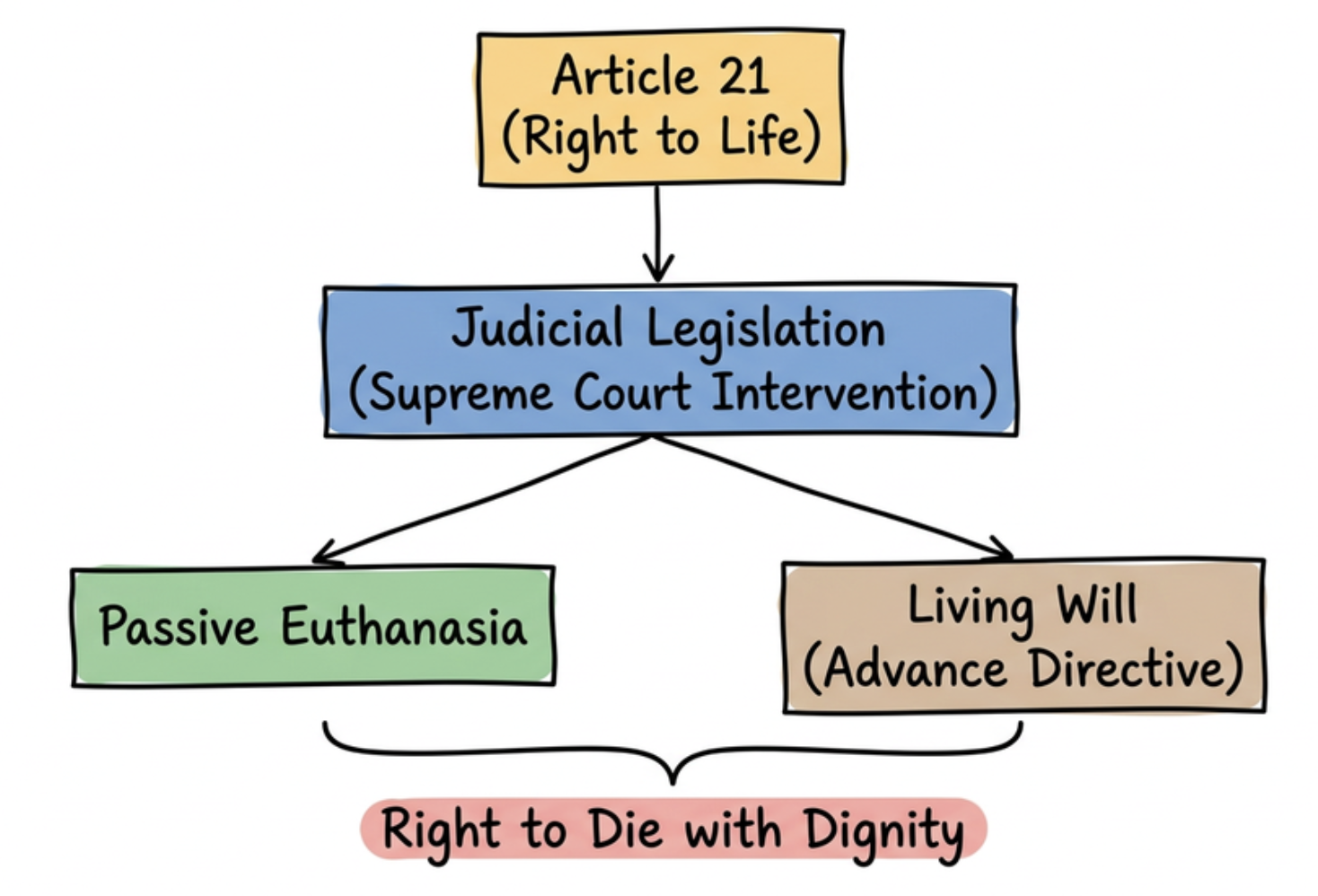
Judicial Expansion of Article 21: Right to Die with Dignity
Concept and Constitutional Basis of Judicial Legislation
-
Legislative Gap Filling: courts issue directions to address legal voids.
- Eg: Vishaka v. State of Rajasthan (1997) established sexual harassment guidelines.
-
Article 141 Authority: law declared by the Supreme Court binds all courts.
- Eg: Article 141 ensures uniform application of norms.
-
Article 142 Power: the court exercises power to pass decrees.
- Eg: Article 142 simplified passive euthanasia procedures in 2023.
-
Article 21 Expansion: the judiciary interprets life to include dignity.
- Eg: Maneka Gandhi v. State of Union (1978) broadened personal liberty.
-
Separation of Powers: judicial legislation acts as a check.
- Eg: Kesavananda Bharati (1973) limits reach to constitutional boundaries.
Evolution of Passive Euthanasia Jurisprudence
-
P. Rathinam Precedent: the court held life included the right to die.
- Eg: P. Rathinam v. Union of India (1994) struck down Section 309 of the IPC.
-
Gian Kaur Reversal: the bench clarified life does not encompass perishing.
- Eg: Gian Kaur v. State of Punjab (1996) overruled the Rathinam verdict.
-
Aruna Shanbaug Milestone: the court permitted passive euthanasia under monitoring.
- Eg: Aruna Shanbaug v. Union of India (2011) distinguished active and passive euthanasia.
-
Common Cause Recognition: the judiciary recognized the right to die with dignity.
- Eg: Common Cause v. Union of India (2018) legalized medical directives.
-
Harish Rana Clarification: rulings confirm treatments can be withheld.
- Eg: Harish Rana Case (March 2026) applied best interests standard.
Living Will Framework and Way Forward
-
Advance Medical Directive: individuals document refusal of life support.
- Eg: Common Cause (2018) guidelines mandate informed consent.
-
Simplified Execution Process: modifications allowed wills attested by notaries.
- Eg: Supreme Court (2023) removed the Judicial Magistrate requirement.
-
Medical Board Scrutiny: a board must certify the condition.
- Eg: Ministry of Health Draft Guidelines (2024) detail withdrawal procedures.
-
Implementation Obstacles: delays hinder the use of wills.
- Eg: Bombay High Court (June 2024) criticized slow implementation.
-
Need for Statute: the judiciary urges Parliament to enact legislation.
- Eg: Law Commission of India (Report 241) recommended a framework.
The transition from judicial guidelines to statutory law is essential to ensure legal certainty and institutional efficiency. Enacting a dedicated End-of-Life Care Bill would harmonize medical ethics with the Constitutional mandate of human dignity.
Answer Length
Model answers may exceed the word limit for better clarity and depth. Use them as a guide, but always frame your final answer within the exam’s prescribed limit.
Evaluate this PYQ now
Write your answer & evaluate in just 60 seconds




500+ students evaluated
Model Answers from
- 2026Indian Polity15 MarksView Answer
To what extent do pressure groups, social movements and corporate lobbies deepen pluralistic democracy in India by representing excluded interests? Analyse whether the growing convergence of corporate wealth and political power poses a threat to the autonomy of formal democratic institutions.
- 2026Indian Polity15 MarksView Answer
Examine how the separation of powers is practised in India compared to the rigid presidential model of the United States of America. In this context, compare the actual authority of the Indian Prime Minister with that of the President of the USA.
- 2026Indian Polity15 MarksView Answer
How far has the Indian federal framework been successful in accommodating regional and cultural diversities? Highlight the role of asymmetric federalism and suggest measures to make dispute resolution mechanisms more effective.
- 2026Indian Polity15 MarksView Answer
Discuss the position of the Governor in the federal polity of India. What is the nature of his power while giving assent to a bill passed by the State Legislature? Is he bound by the aid and advice of his Council of Ministers in all his functions?
- 2026Indian Polity10 MarksView Answer
Do constitutional bodies like the National Commission for Scheduled Castes (NCSC) and the National Commission for Scheduled Tribes (NCST) possess adequate enforcement powers to secure substantive social equality? Suggest measures to enhance their institutional effectiveness.
- 2026Indian Polity10 MarksView Answer
Is the right to vote a fundamental right? Discuss the position of the Election Commission of India while undertaking the revision of electoral rolls. Can it also examine the question of citizenship of voters?
Model Answers by Subject


Crack UPSC with your
Personal AI Mentor
An AI-powered ecosystem to learn, practice, and evaluate with discipline



