To what extent do pressure groups, social movements and corporate lobbies deepen pluralistic democracy in India by representing excluded interests? Analyse whether the growing convergence of corporate wealth and political power poses a threat to the autonomy of formal democratic institutions.
To what extent do pressure groups, social movements and corporate lobbies deepen pluralistic democracy in India by representing excluded interests? Analyse whether the growing convergence of corporate wealth and political power poses a threat to the autonomy of formal democratic institutions.
While the Right to form associations under Article 19(1)(c) facilitates pluralistic representation, the growing financial influence of Electoral Trusts highlighted in ADR reports (2025) challenges the functional autonomy of democratic institutions.
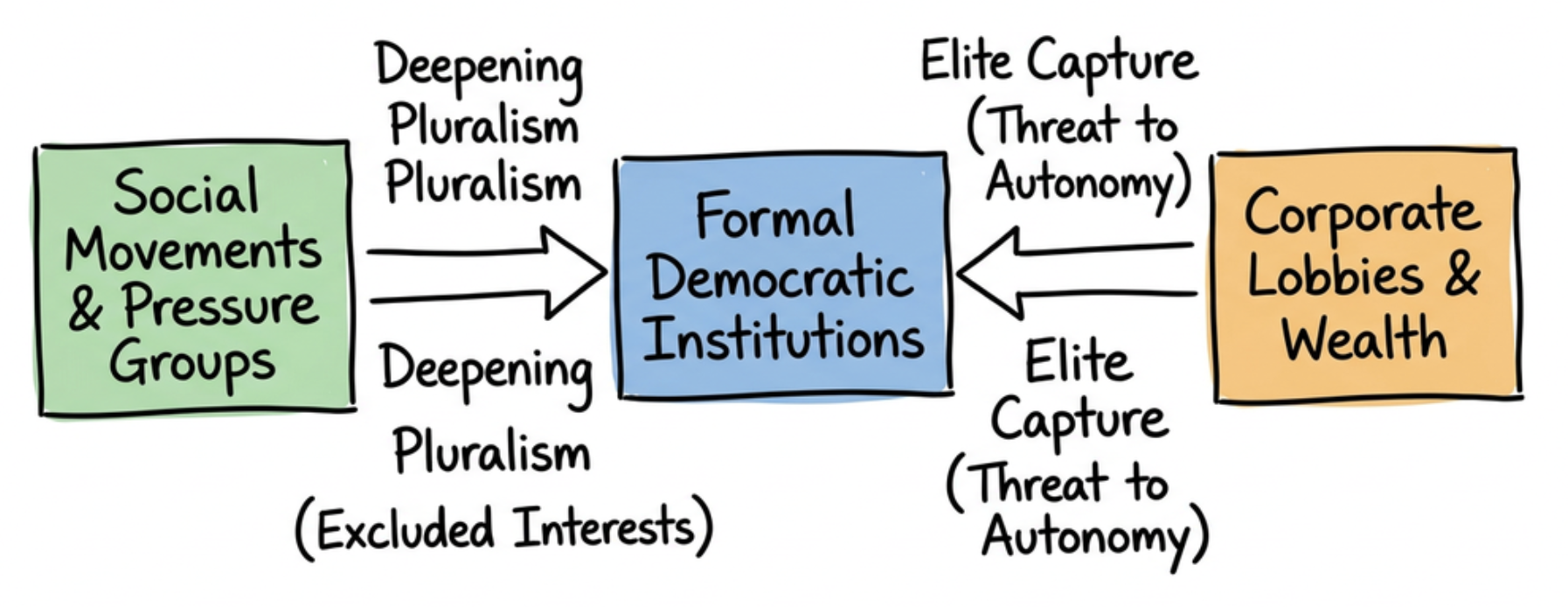
Dual Impact of Interest Groups on Democratic Institutions
Role of Pressure Groups, Movements, and Lobbies in Deepening Democracy
-
Articulating Marginalized Voices: Grassroots movements ensure concerns of excluded groups reach policy tables.
- Eg: NACDAOR Adivasi rights advocacy in 2026.
-
Influencing Policy Outcomes: These groups bridge the gap for legislative and systemic reforms.
- Eg: Protests against NEET mismanagement in 2026.
-
Ensuring Administrative Accountability: Social movements act as watchdogs to prevent executive overreach.
- Eg: Cockroach Janta Party (CJP) opposing the National Education Policy in 2026.
-
Providing Specialized Expertise: NGOs offer technical data that helps the government frame policies.
- Eg: Aahwahan Foundation’s 2026 healthcare and skill initiatives.
-
Promoting Constitutional Literacy: Civil society groups empower citizens by educating them on rights.
- Eg: Human Rights Law Network legal safeguards in 2026.
-
Channeling Public Discontent: Movements provide non-violent outlets for grievances to prevent instability.
- Eg: 2026 education protest solidarity.
-
Advocating for Global Standards: Domestic groups align Indian policy with international human rights.
- Eg: Reports to UN Committee on the Elimination of Racial Discrimination, July 2026.
Convergence of Corporate Wealth and Political Power as a Threat to Institutions
-
Distorting Electoral Equality: Massive corporate funding creates an uneven playing field for visibility.
- Eg: ADR data (2025) showing ₹6,128 crore contributions.
-
Erosion of Policy Autonomy: Dependence on donors leads to regulatory capture favoring financial contributors.
- Eg: Electoral Trusts providing 60.53% of FY 2024-25 donations.
-
Compromising Financial Transparency: Anonymous donation routes mask backers and hinder informed voting.
- Eg: 2025 challenge against Section 13A(d) of the Income Tax Act.
-
Weakening Institutional Neutrality: Wealth influences the functioning of regulators and investigative agencies.
- Eg: Supreme Court (2026) stressing ECI’s black money duty.
-
Marginalizing Non-Corporate Interests: Public issues are sidelined if they conflict with profit motives.
- Eg: 161% year-on-year political donation increase (2025).
-
Undermining Voter Trust: Perceived quid pro quo relationships reduce faith in democratic fairness.
- Eg: Supreme Court (2024) striking down the Electoral Bonds Scheme.
-
Concentration of Political Influence: Disproportionate wealth leads to dominance and reduced pluralism.
- Eg: ADR reports (2025) noting BJP received ₹5,717 crore.
-
Threatening Legislative Integrity: Appeasing donors leads to rushed legislation without adequate scrutiny.
- Eg: 2026 Electoral Trusts funding concerns.
Adopting Indrajit Gupta Committee recommendations and strengthening the Representation of the People Act is essential to uphold Constitutional Morality and preserve the integrity of India’s pluralistic democratic framework.
Answer Length
Model answers may exceed the word limit for better clarity and depth. Use them as a guide, but always frame your final answer within the exam’s prescribed limit.
Evaluate this PYQ now
Write your answer & evaluate in just 60 seconds




500+ students evaluated
Model Answers from
- 2026Indian Polity15 MarksView Answer
Examine how the separation of powers is practised in India compared to the rigid presidential model of the United States of America. In this context, compare the actual authority of the Indian Prime Minister with that of the President of the USA.
- 2026Indian Polity15 MarksView Answer
How far has the Indian federal framework been successful in accommodating regional and cultural diversities? Highlight the role of asymmetric federalism and suggest measures to make dispute resolution mechanisms more effective.
- 2026Indian Polity15 MarksView Answer
What is meant by judicial legislation? In this context, discuss the verdicts of the apex court allowing "passive euthanasia" and a "living will".
- 2026Indian Polity15 MarksView Answer
Discuss the position of the Governor in the federal polity of India. What is the nature of his power while giving assent to a bill passed by the State Legislature? Is he bound by the aid and advice of his Council of Ministers in all his functions?
- 2026Indian Polity10 MarksView Answer
Do constitutional bodies like the National Commission for Scheduled Castes (NCSC) and the National Commission for Scheduled Tribes (NCST) possess adequate enforcement powers to secure substantive social equality? Suggest measures to enhance their institutional effectiveness.
- 2026Indian Polity10 MarksView Answer
Is the right to vote a fundamental right? Discuss the position of the Election Commission of India while undertaking the revision of electoral rolls. Can it also examine the question of citizenship of voters?
Model Answers by Subject


Crack UPSC with your
Personal AI Mentor
An AI-powered ecosystem to learn, practice, and evaluate with discipline



