How far has the Indian federal framework been successful in accommodating regional and cultural diversities? Highlight the role of asymmetric federalism and suggest measures to make dispute resolution mechanisms more effective.
How far has the Indian federal framework been successful in accommodating regional and cultural diversities? Highlight the role of asymmetric federalism and suggest measures to make dispute resolution mechanisms more effective.
India’s "Sui Generis" federalism utilizes Article 371 to accommodate diverse regional identities, yet persistent frictions necessitate strengthening the Inter-State Council to ensure that constitutional flexibility translates into long-term political and administrative stability.
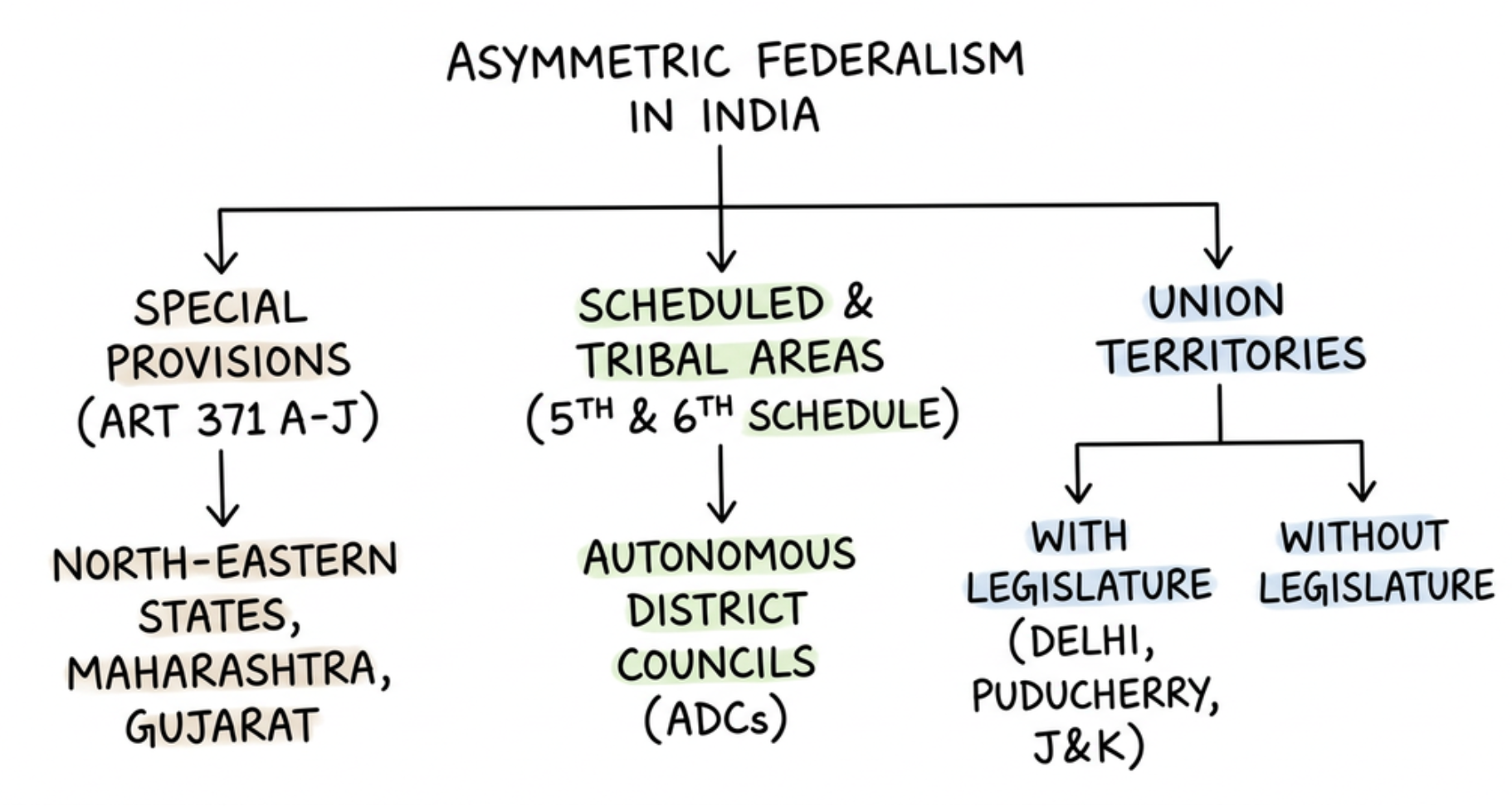
Classification of Asymmetric Federalism in India
Success in Accommodating Regional and Cultural Diversities
-
Linguistic reorganization under the States Reorganisation Act, 1956 prevented secessionist tendencies by creating states based on language.
-
The 73rd and 74th Amendments empowered local bodies to address grassroots cultural specificities through democratic decentralization.
-
The NITI Aayog State Support Mission (2025-26) assists states in setting socio-economic roadmaps tailored to regional strengths.
- Eg: The North Eastern Region Index focuses on unique developmental needs.
-
Fundamental Rights under Articles 29 and 30 ensure minorities can conserve their distinct language, script, and culture.
-
The Finance Commission uses demographic performance criteria to balance equity and efficiency across diverse states.
- Eg: The Fiscal Health Index 2026 tracks sustainability across varying economic capacities.
Role of Asymmetric Federalism
-
Article 371 provides customized administrative requirements for states including Maharashtra, Gujarat, and Andhra Pradesh.
-
The Fifth and Sixth Schedules allow autonomous councils to govern tribal areas according to their customary laws.
- Eg: Demands for Sixth Schedule status in Ladakh highlight continued asymmetric protection.
-
Disproportionate representation in the Rajya Sabha ensures smaller states maintain a political voice in national legislation.
-
Special Category Status supports states facing geographical and socio-economic disadvantages through developmental exceptions.
-
The Constitution (131st Amendment) Bill, 2026 emphasizes protecting states with lower fertility rates from losing political weight.
- Eg: The post-2026 Delimitation exercise remains a critical flashpoint for federal equilibrium.
Measures for Effective Dispute Resolution
-
Mandating regular meetings under Article 263 helps the Inter-State Council resolve policy frictions before they reach courts.
-
Implementing clear guidelines for discretionary powers under Articles 200 and 201 prevents legislative deadlocks.
- Eg: Supreme Court rulings (2025) emphasize Gubernatorial assent as a constitutional function.
-
Strengthening the Alternative Dispute Resolution ecosystem reduces the judicial burden regarding inter-state water or border rows.
- Eg: The 165th Parliamentary Standing Committee Report (2026) recommends institutional ADR mechanisms.
-
Implementing the Draft Arbitration and Conciliation Bill 2024 enhances efficiency in commercial and inter-governmental disputes.
-
Utilizing the "NITI for States" platform provides data-driven mediation in various fiscal and developmental conflicts.
Upholding the Basic Structure Doctrine while operationalizing the Punchhi Commission recommendations through Article 263 will institutionalize effective dispute resolution, ensuring the resilient unity and integrity of the diverse Indian nation.
Answer Length
Model answers may exceed the word limit for better clarity and depth. Use them as a guide, but always frame your final answer within the exam’s prescribed limit.
Evaluate this PYQ now
Write your answer & evaluate in just 60 seconds




500+ students evaluated
Model Answers from
- 2026Indian Polity15 MarksView Answer
To what extent do pressure groups, social movements and corporate lobbies deepen pluralistic democracy in India by representing excluded interests? Analyse whether the growing convergence of corporate wealth and political power poses a threat to the autonomy of formal democratic institutions.
- 2026Indian Polity15 MarksView Answer
Examine how the separation of powers is practised in India compared to the rigid presidential model of the United States of America. In this context, compare the actual authority of the Indian Prime Minister with that of the President of the USA.
- 2026Indian Polity15 MarksView Answer
What is meant by judicial legislation? In this context, discuss the verdicts of the apex court allowing "passive euthanasia" and a "living will".
- 2026Indian Polity15 MarksView Answer
Discuss the position of the Governor in the federal polity of India. What is the nature of his power while giving assent to a bill passed by the State Legislature? Is he bound by the aid and advice of his Council of Ministers in all his functions?
- 2026Indian Polity10 MarksView Answer
Do constitutional bodies like the National Commission for Scheduled Castes (NCSC) and the National Commission for Scheduled Tribes (NCST) possess adequate enforcement powers to secure substantive social equality? Suggest measures to enhance their institutional effectiveness.
- 2026Indian Polity10 MarksView Answer
Is the right to vote a fundamental right? Discuss the position of the Election Commission of India while undertaking the revision of electoral rolls. Can it also examine the question of citizenship of voters?
Model Answers by Subject


Crack UPSC with your
Personal AI Mentor
An AI-powered ecosystem to learn, practice, and evaluate with discipline



