Examine whether the constitutional office of the Lok Sabha Speaker has become vulnerable to partisan politics under the current anti-defection regime. What institutional changes are required to ensure the neutrality of the Lok Sabha Speaker in managing a polarised House?
Examine whether the constitutional office of the Lok Sabha Speaker has become vulnerable to partisan politics under the current anti-defection regime. What institutional changes are required to ensure the neutrality of the Lok Sabha Speaker in managing a polarised House?
The constitutional office of the Speaker, established under Article 93, faces a crisis of neutrality as the Tenth Schedule and subsequent interpretations in the Kihoto Hollohan judgment expose the chair to systemic partisan pressures.
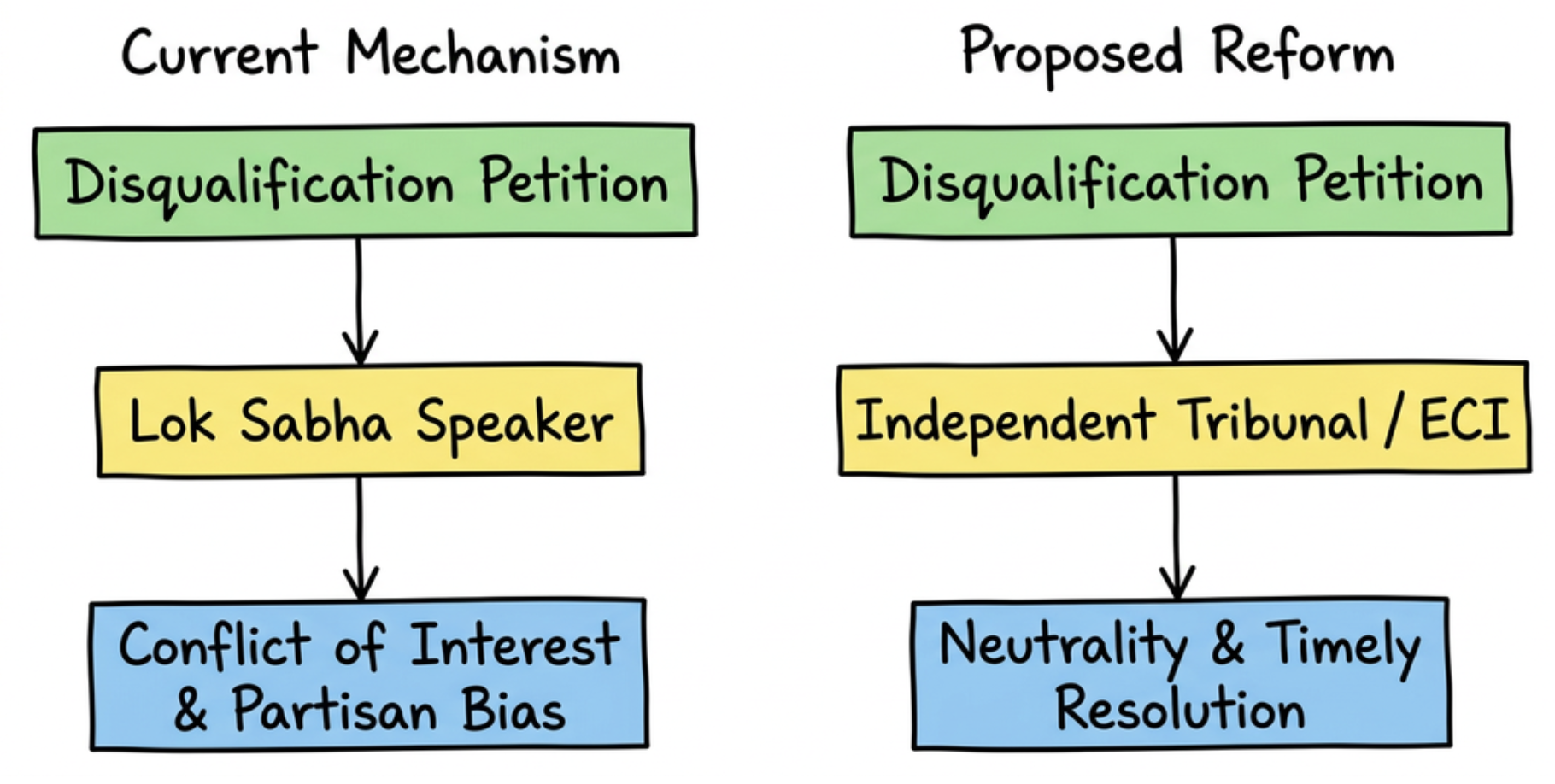
Reforming Anti-Defection Adjudication for Neutrality and Timely Resolution
Vulnerability to Partisan Politics
-
Discretionary Delays: Lacking constitutional timeframes, Speakers often delay disqualification petitions to favor ruling parties.
- Eg: The Supreme Court in February 2026 set a three-week deadline for the Telangana Speaker regarding BRS defections.
-
Partisan Adjudication: Rulings on mergers and splits frequently reflect political alignment rather than constitutional merit.
- Eg: The Shiv Sena (UBT) challenged the 2026 decision concerning the merger of six MPs.
-
Conflict of Interest: Retaining political party membership creates dual loyalties that erode the perception of impartiality.
-
Judicial Interference: Increased judicial review of Speaker actions highlights a perceived failure in maintaining institutional autonomy.
- Eg: In July 2025, the SC ruled Speakers lack Article 212 immunity when acting as tribunals.
-
Selective Disruption Management: Allegations of partisan conduct arise from disproportionate suspensions and time allocation during debates.
Required Institutional Changes
-
Independent Tribunals: Transferring disqualification powers to an external body or the Election Commission as suggested by the Supreme Court.
-
Mandatory Resignation: Adopting the British convention where the Speaker formally resigns from their political party upon election.
-
Fixed Timelines: Amending the Constitution to mandate a three-month window for deciding all Tenth Schedule petitions.
-
Deputy Speaker Election: Mandating the election of an Opposition Deputy Speaker to ensure balanced House management.
-
Codified Guidelines: Drafting a clear, non-discretionary manual for member suspensions and floor management to minimize bias.
Implementing the Keisham Meghachandra Singh case directives alongside the British Convention of party resignation will strengthen Constitutional Morality, effectively insulating the Speaker’s chair from corrosive partisan influences.
Answer Length
Model answers may exceed the word limit for better clarity and depth. Use them as a guide, but always frame your final answer within the exam’s prescribed limit.
Evaluate this PYQ now
Write your answer & evaluate in just 60 seconds




500+ students evaluated
Model Answers from
- 2026Indian Polity15 MarksView Answer
To what extent do pressure groups, social movements and corporate lobbies deepen pluralistic democracy in India by representing excluded interests? Analyse whether the growing convergence of corporate wealth and political power poses a threat to the autonomy of formal democratic institutions.
- 2026Indian Polity15 MarksView Answer
Examine how the separation of powers is practised in India compared to the rigid presidential model of the United States of America. In this context, compare the actual authority of the Indian Prime Minister with that of the President of the USA.
- 2026Indian Polity15 MarksView Answer
How far has the Indian federal framework been successful in accommodating regional and cultural diversities? Highlight the role of asymmetric federalism and suggest measures to make dispute resolution mechanisms more effective.
- 2026Indian Polity15 MarksView Answer
What is meant by judicial legislation? In this context, discuss the verdicts of the apex court allowing "passive euthanasia" and a "living will".
- 2026Indian Polity15 MarksView Answer
Discuss the position of the Governor in the federal polity of India. What is the nature of his power while giving assent to a bill passed by the State Legislature? Is he bound by the aid and advice of his Council of Ministers in all his functions?
- 2026Indian Polity10 MarksView Answer
Do constitutional bodies like the National Commission for Scheduled Castes (NCSC) and the National Commission for Scheduled Tribes (NCST) possess adequate enforcement powers to secure substantive social equality? Suggest measures to enhance their institutional effectiveness.
Model Answers by Subject


Crack UPSC with your
Personal AI Mentor
An AI-powered ecosystem to learn, practice, and evaluate with discipline



