Secularism: Complete UPSC Notes | Indian Polity
Secularism means state neutrality toward religions. Get complete UPSC notes on Indian secularism, constitutional provisions, Supreme Court judgments, and criticisms. Read now!
Jan, 2026
•6 min read
"For a successful revolution, we need more than just democracy. We need a spirit of inclusiveness and secularism." - Dr A.P.J. Abdul Kalam.
Secularism is a foundational principle of the Indian Constitution that ensures the State maintains neutrality in religious matters while guaranteeing every citizen the freedom to profess, practice, and propagate religion.
For the UPSC Civil Services Examination, secularism is a high-priority topic under GS Paper I (Indian Society) and GS Paper II (Constitution, Fundamental Rights, and Governance). Questions are frequently asked on its constitutional provisions, judicial interpretations, debates, and contemporary issues, making it crucial for both Prelims and Mains preparation.
Let’s study this topic in detail!
What is Secularism?
Secularism means the separation of religion from politics, government, and state affairs. In the Indian context, secularism means treating all religions equally without any bias.
The Constitution uses two Sanskrit terms to explain this idea: Dharmanirapaksata (impartiality toward religion) and Sarva Dharma Sama Bhava (equal respect for all religions).
- The word "secular" was not in the original Constitution of 1950.
- Added to the Preamble by the 42nd Amendment in 1976 during the Emergency.
- India describes itself as a "Sovereign Socialist Secular Democratic Republic".
- Secularism is part of the basic structure of the Constitution and cannot be removed.
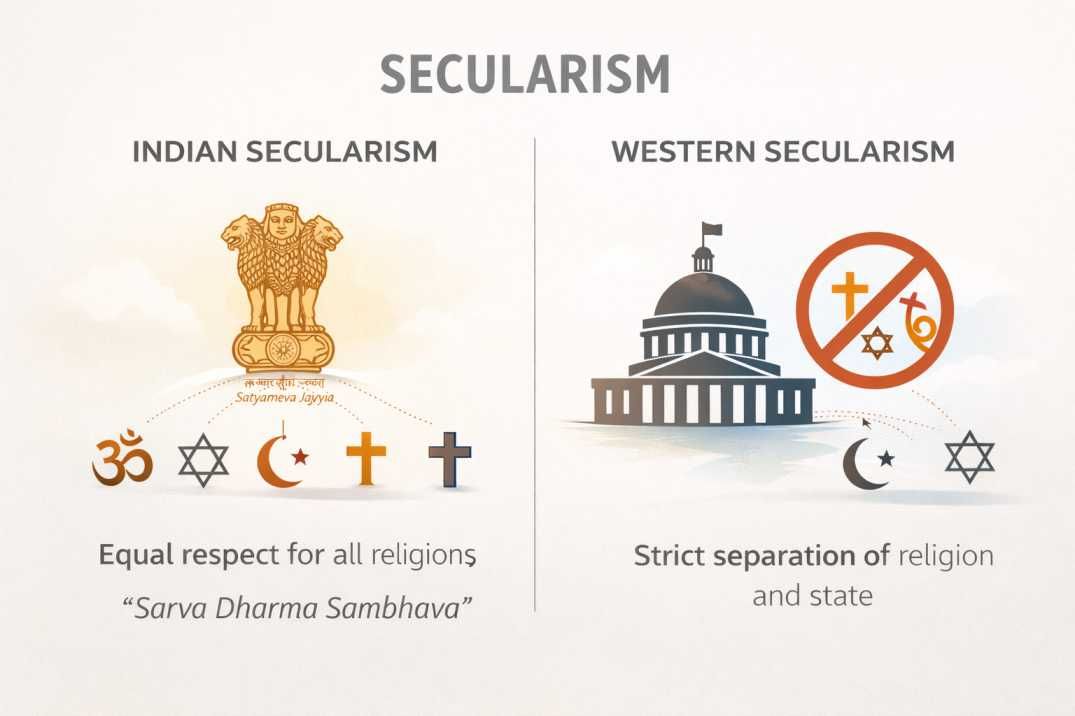
- Unlike Western secularism, Indian secularism allows positive state engagement with religion.
- Articles 25-28 (Fundamental Rights) of the Constitution provide the foundation for religious freedom and secular governance.
Also read: National Human Rights Commission (NHRC) of India | UPSC Notes
Objectives of Secularism in India
The framers of the Indian Constitution embedded secularism to achieve multiple critical goals in a diverse, multi-religious nation.
- Prevent Inter-Religious Domination: Ensures that one religious community cannot dominate another. The state remains neutral and treats all religions equally.
- Prevent Intra-Religious Domination: Addresses problems within religions themselves, such as gender discrimination or caste hierarchy. The state can intervene to promote equality within religious communities.
- Protect Individual Conscience: Guarantees that every person can choose their religion freely without state coercion or interference.
- Maintain Principled Distance: The state keeps distance from all faiths while ensuring equal protection and respect for religious practices.
- Ensure Social Cohesion: In a diverse society like India, secularism creates a framework where different religions coexist peacefully.
- Protect Minority Rights: Safeguards religious minorities from majority domination, a critical concern in India's multi-religious setup.
Also read: Charter Act of 1813 (UPSC Notes)
Evolution of Secularism in India
Secularism in India evolved over centuries, shaped by India's history, rulers, and struggles.
- Ancient India (300 BC): Emperor Ashoka of the Mauryan Empire promoted religious tolerance. In his 12th Rock Edict, he said the state should respect all religions and not persecute any sect.
- Medieval Period: Rulers like Akbar (1556-1605) promoted interfaith dialogue and patronised scholars from different religions.
- 1950: The Constitution comes into force on January 26. Articles 25-28 guarantee religious freedom and implement secular principles.
- 1962: In the Sardar Taheruddin Syedna case, the Supreme Court formally declares that Articles 25 and 26 embody the secular nature of Indian democracy.
- 1973: Kesavananda Bharati judgment confirms that secularism is part of the basic structure of the Constitution and cannot be removed even by Parliament.
- 1975: Indira Gandhi v. Raj Narain case clarifies that the state should have no religion of its own.
- 1976 (June 25 - 1977): The Emergency period. The 42nd Amendment adds "socialist" and "secular" explicitly to the Preamble.
- 1994: S.R. Bommai judgment reaffirms that India was secular from the start and that any unsecular policies violate the constitutional mandate.
Also read: Separation of Powers in India [UPSC Notes]
Constitutional Provisions for Secularism in India
The Constitution protects secularism through specific articles and principles that function as safeguards against religious domination or state bias.
- Article 14 guarantees equality before the law, prohibiting the state from discriminating based on religion.
- Article 15 explicitly bans discrimination by the state on grounds of religion, caste, sex, or place of birth.
- Article 25 grants every person the right to freely profess, practice, and propagate religion, subject to public order, morality, and health. This is the cornerstone of religious freedom.
- Article 26 allows all religious denominations to manage their own religious affairs independently.
- Article 27 prohibits the state from compelling any person to pay taxes for promoting a particular religion.
- Article 28 bans compulsory religious instruction in state-funded educational institutions.
- Articles 29 and 30 protect the rights of religious and linguistic minorities to establish and manage their own educational institutions.
- Article 51A (Fundamental Duty) requires every citizen to promote harmony and brotherhood, transcending religious, linguistic, and regional diversities.
The Preamble of the Constitution itself declares India a "Secular Democratic Republic," making secularism a foundational objective.
Also read: Article 32 of the Indian Constitution: Right to Constitutional Remedies | UPSC Notes
Difference Between Indian Secularism and Western Secularism
While both models aim for religious harmony, they operate on fundamentally different principles.
| Aspect | Indian Secularism | Western Secularism |
|---|---|---|
| Core Philosophy | Equal respect for all religions. | Strict separation of church and state. |
| State Role | Can intervene in religion for social justice. | Non-interference with religion. |
| Funding Religious Institutions | Permitted (Waqf boards, temple management) | Generally prohibited |
| Religious Expression | Equally supported by the state | Restricted to private/worship spaces. |
| Personal Laws | Multiple personal laws recognised (Hindu, Muslim, Christian) | Uniform civil law for all citizens |
| Judicial Approach | Uses the "Sarvadharma Sambhava" principle. | Uses strict church-state separation. |
In Indian secularism, the state plays an active role. It prevents one religion from dominating others, works against discrimination within religions (such as gender and caste bias), provides equal support to all faiths, and protects the rights of minorities. This is called “positive secularism” because the state actively promotes equality instead of staying neutral.
Also read: Anti-Defection Law in India
Landmark Judicial Cases on Secularism in India
The Indian judiciary has played a crucial role in interpreting and strengthening secularism as a basic feature of the Constitution through several landmark judgments.
1. Sardar Taheruddin Syedna Saheb v. State of Bombay (1962)
- Supreme Court's first major expression on the secular Constitution.
- Articles 25-26 embody religious tolerance.
- Established a secular democracy as the constitutional foundation.
2. Sabarimala Temple Entry Case (2018)
- 4:1 majority struck down the women's entry ban.
- Held constitutional equality overrides religious practice claims.
- Established that even essential religious practices must respect fundamental rights.
- Gender equality supersedes religious autonomy.
3. Ram Janambhoomi/Ayodhya Cases (1994, 2019)
- Property disputes involving religious sites are resolved within the secular legal domain.
- The court refused to determine "comparative religious significance".
- Upheld secular principles in judicial adjudication.
- Religious matters cannot override constitutional law.
4. Hindutva Judgments: R. Y. Prabhoo v. P. K. Kunte (1995)
- Justice Verma defined Hindutva as "a way of life".
- Used the Sarva Dharma Sambhava (religious tolerance) principle.
- Controversial shift from a strict secular interpretation.
- Received criticism for conflating religion with nationalism.
UPSC Prelims PYQs on Secularism
QUESTION 1
Consider the following statements:
- The Constitution of India defines its ‘basic structure’ in terms of federalism, secularism, fundamental rights and democracy.
- The Constitution of India provides for ‘judicial review’ to safeguard the citizens’ liberties and to preserve the ideals on which the Constitution is based.
Which of the statements given above is/are correct?
Criticisms of Secularism in India
Despite its constitutional importance, secularism faces serious challenges in practice.
- Communalism: Some politicians use religion to gain votes. This leads to communal tension, riots, and violence, which weakens secular values.
- Pseudo-Secularism: Many people feel the state is not equally fair to all religions. They argue that some religions face more control than others, creating doubts about true neutrality.
- Caste and Reservation Politics: Politics based on caste often increases divisions instead of reducing discrimination, harming the idea of equality.
- Different Personal Laws: Different religions follow different personal laws for marriage and inheritance. This creates unequal treatment and raises questions about justice.
- Recent Concerns (2024): There are worries about rising communal violence, pressure on institutions, and majoritarian politics affecting secular principles.
Also read: Communalism in India: Meaning, Evolution and Its Impact | UPSC Polity
UPSC Mains PYQ on Secularism
How do the Indian debates on secularism differ from the debates in the West? (2014)
Evaluate Your Answer Now!Way Forward
India must strengthen secularism through deliberate action:
- Promote regular conversations between religious communities to build mutual understanding and defuse tensions.
- Ensure that state institutions, police, judiciary, and administration treat all religions equally without bias.
- Consider a common legal framework for personal matters to ensure equal justice, while respecting religious autonomy where possible.
- Enforce strict laws against communal violence and hate speech; discourage politicians from exploiting religious divisions for electoral gains.
Start your UPSC Preparation 2026/2027 with SuperKalam
SuperKalam is your personal mentor for UPSC preparation, guiding you at every step of the exam journey. Practice, revise, and evaluate– all in one place.
Download the App Now