Particularly Vulnerable Tribal Groups (PVTGs) - UPSC Notes
PVTGs are the most socio-economically vulnerable among Scheduled Tribes, identified for special protection. Get complete notes on PVTGs UPSC - criteria, rights, schemes, case study & challenges.
Feb, 2026
•7 min read
Particularly Vulnerable Tribal Groups (PVTGs) are the most socio-economically disadvantaged sections among Scheduled Tribes, identified for focused protection and development. The topic is crucial for Prelims (GS Paper I) & Mains GS Paper II (Polity & Governance) and GS Paper I (Indian Society).
Here, you will understand the concept of PVTGs, their constitutional safeguards, government schemes, and policy challenges. Let's get started!
What are Particularly Vulnerable Tribal Groups (PVTGs)?
Particularly Vulnerable Tribal Groups (PVTGs) are a distinct sub-classification within Scheduled Tribes, identified as the most vulnerable tribal communities in India. Earlier known as Primitive Tribal Groups (PTGs), this category was created to ensure focused protection and targeted development interventions.
- The idea was first recommended by the Dhebar Commission.
- Acting on its recommendations, the Government of India identified 52 PTGs during the Fifth Five-Year Plan (1974–79).
- In 2006, the term PTGs was officially replaced with PVTGs to adopt a more appropriate and sensitive terminology.
Currently, out of 705 Scheduled Tribes, 75 are categorised as PVTGs. These groups reside across 18 States and the Union Territory of Andaman and Nicobar Islands.
Criteria for Identification of PVTGs
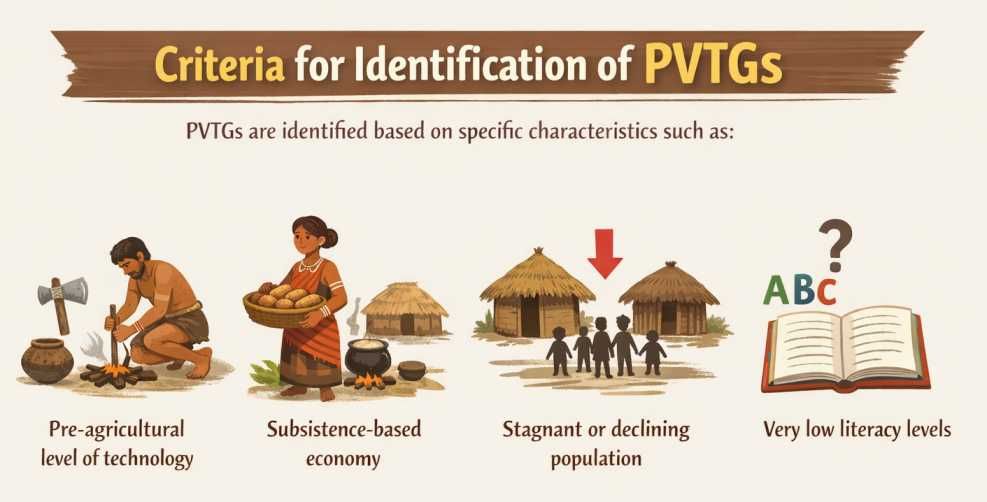
PVTGs are identified based on the following characteristics:
1. Pre-agricultural level of technology
- Practice hunting-gathering, shifting cultivation, or rudimentary agriculture
- Limited use of modern tools and irrigation techniques
2. Subsistence-based economy
- Depend primarily on forest produce, small-scale farming, or daily wage labour
- Low surplus production and limited market participation
3. Stagnant or declining population
- Low population growth due to poor health indicators, malnutrition, and high mortality rates
4. Very low literacy levels
- Limited access to formal education
- High dropout rates and low female literacy
Population and Distribution of PVTGs
In India, Scheduled Tribes constitute 8.6% of the total population, while inhabiting nearly 15% of the country’s geographical area. The total estimated population of PVTGs is 45.56 lakh.
The top three states with the largest population of PVTGs are:
- Madhya Pradesh – 12.28 lakh
- Maharashtra – 6.2 lakh
- Andhra Pradesh – 4.9 lakh
Also read: Important Tribes in India [UPSC Notes]
Rights of PVTGs under the Indian Constitution
The Constitution of India provides special protections to PVTGs to preserve their identity, land, culture, and access to development.
1. Equality and Affirmative Action
- Article 14 guarantees equality before the law.
- Article 15(4) empowers the State to make special provisions for the advancement of Scheduled Tribes.
- Article 16(4) allows reservations in public employment.
2. Protection from Exploitation
- Article 23 prohibits forced labour and trafficking.
- Article 24 prohibits child labour in hazardous occupations.
Given that many PVTGs live in remote forest areas and face economic distress, these safeguards protect them from bonded labour, land alienation, and exploitation by middlemen or contractors.
3. Directive for Educational and Economic Upliftment
Article 46 directs the State to promote the educational and economic interests of Scheduled Tribes and protect them from social injustice and exploitation.
4. Political Representation
Articles 330 and 332 provide reservation of seats for Scheduled Tribes in the Lok Sabha and State Legislative Assemblies.
5. Administration of Tribal Areas
- Article 244 provides for the administration of the Scheduled Areas under the Fifth and Sixth Schedules.
These provisions enable protective governance in tribal-majority areas, helping safeguard land rights, customary practices, and community resources that many PVTGs depend upon.
6. Recognition as Scheduled Tribes
Article 342 empowers the President to notify the Scheduled Tribes in a state or Union Territory.
Habitat Rights of PVTGs
While the Constitution provides the broad framework, habitat rights give PVTGs stronger ground-level protection.
Under Section 3(1)(e) of the Scheduled Tribes and Other Traditional Forest Dwellers (Recognition of Forest Rights) Act, 2006, PVTGs receive exclusive habitat rights. These rights:
- Protect their traditional territories and customary boundaries
- Safeguard socio-cultural practices and traditional knowledge
- Secure forest-based livelihoods
- Preserve ecological and cultural heritage
Importantly, habitat rights do not grant private ownership but legally recognise community-based customary rights over their habitat. These rights also receive protection under:
- Forest Conservation Act, 1980
- Right to Fair Compensation and Transparency in Land Acquisition, Rehabilitation and Resettlement Act, 2013
- Scheduled Castes and Scheduled Tribes (Prevention of Atrocities) Act, 1989
Must cover: SC ST (Prevention of Atrocities) Act 1989 - UPSC Notes
State-wise List of Particularly Vulnerable Tribal Groups (PVTGs)
The Government of India has notified 75 Particularly Vulnerable Tribal Groups (PVTGs) across 18 States and one Union Territory. The table below presents the State/UT-wise distribution of PVTGs for UPSC:
| Name of the State / UT | Name of PVTGs |
|---|---|
| Andhra Pradesh | Bodo Gadaba, Bondo Poroja, Chenchu, Dongria Khond, Gutob Gadaba, Khond Poroja, Kolam, Kondareddis, Konda Savaras, Kutia Khond, Parengi Poroja, Thoti |
| Bihar (including Jharkhand) | Asurs, Birhor, Birjia, Hill Kharia, Korwas, Mal Paharia, Parhaiyas, Sauria Paharia, Savar |
| Gujarat | Kathodi, Kotwalia, Padhar, Siddi, Kolgha |
| Karnataka | Jenu Kuruba, Koraga |
| Kerala | Cholanaikayan (a section of Kattunaickans), Kadar, Kattunayakan, Kurumbas, Koraga |
| Madhya Pradesh (including Chhattisgarh) | Abujh Marias, Baigas, Bharias, Hill Korbas, Kamars, Saharias, Birhor |
| Maharashtra | Katkaria (Kathodia), Kolam, Maria Gond |
| Manipur | Marram Nagas |
| Odisha | Birhor, Bondo, Didayi, Dongria-Khond, Juangs, Kharias, Kutia Kondh, Lanjia Sauras, Lodhas, Mankidias, Paudi Bhuyans, Soura, Chuktia Bhunjia |
| Rajasthan | Seharias |
| Tamil Nadu | Kattu Nayakans, Kotas, Kurumbas, Irulas, Paniyans, Todas |
| Tripura | Reangs |
| Uttar Pradesh (including Uttarakhand) | Buxas, Rajis |
| West Bengal | Birhor, Lodhas, Totos |
| Andaman & Nicobar Islands (UT) | Great Andamanese, Jarawas, Onges, Sentinelese, Shom Pens |
- Odisha has the highest number of PVTGs.
- Some tribes, such as Birhor and Koraga appear in more than one state.
- The Andaman & Nicobar Islands host some of the most isolated and vulnerable tribal communities in India.
Also read: National Commission for Scheduled Tribes (NCST) | UPSC
Government Schemes & Initiatives for (PVTGs
The Government of India has launched several dedicated schemes and initiatives to improve the living conditions and socio-economic development for the PVTGs.
1. PM-Janjati Adivasi Nyaya Maha Abhiyan (PM-JANMAN)
This is the flagship national mission launched in November 2023 specifically for PVTGs. It targets 22,000+ PVTG villages and aims to comprehensively improve infrastructure and services through multi-sectoral action. Key components include:
- Construction of pucca houses for PVTG families
- Development of roads and connectivity
- Provision of piped drinking water and off-grid solar power
- Deployment of mobile medical units for healthcare
- Establishment of anganwadi centres and vocational training for education & skills
- Expansion of communication networks and livelihood support
The campaign also conducts IEC (Information-Education-Communication) outreach to ensure awareness and enrollment across tribal habitations. The government has extended PM-JANMAN implementation until 2027 to strengthen delivery.
2. Scheme for Development of PVTGs
Implemented by the Ministry of Tribal Affairs, this scheme focuses on the holistic socio-economic development of all 75 PVTGs. It adopts a habitat development approach to improve the quality of life while preserving cultural heritage. Areas of support include:
- Housing and improved sanitation
- Education and health infrastructure
- Land distribution and development
- Agriculture and animal husbandry support
- Installation of renewable energy sources
- Construction of link roads
- Skill development and social security support
3. Education & Cultural Support
Several broader schemes include provisions for PVTG education:
- Eklavya Model Residential Schools (EMRS): These offer quality residential schooling for tribal children, including PVTGs, with reservations in admissions.
- Scholarships: Post-matric and merit-based scholarships help PVTG students continue their education.
- Cultural Preservation Initiatives: To protect traditional arts, crafts, and language heritage.
4. Housing & Infrastructure Schemes
- Pradhan Mantri Awas Yojana – Gramin (PMAY-G): Rural housing scheme that benefits PVTG households to secure safe and pucca homes.
Other connectivity missions (like road and telecom projects under PM-JANMAN) improve access to markets, services, and opportunities.
5. Health & Welfare Interventions
- Awareness and health camps under the outreach campaigns address issues like sickle cell disease, a major health concern among tribal populations.
- Mobile medical units and Ayushman Bharat benefits help improve access to healthcare.
6. Livelihood & Economic Support
- Programs like Van Dhan Vikas Kendras and tribal livelihood missions support tribal products and minor forest produce value chains.
- Skill development and employment linkages are integrated into outreach campaigns under tribal welfare missions.
7. Outreach and Benefit Saturation Campaigns
Dharti Aaba Janbhagidari Abhiyan aoperate on the ground in tribal districts to ensure delivery of entitlements, including Aadhaar registration, bank accounts, insurance, pensions, and scheme enrollments — directly to tribal families.
These efforts exemplify India’s shift from isolated tribal welfare to holistic tribal empowerment.
Also cover: Polyandry in India: Hatti Tribe Jodidara Tradition in Himachal
UPSC Prelims PYQs on PVTGs
QUESTION 1
Consider the following statements about Particularly Vulnerable Tribal Groups (PVTGs) in India :
- PVTGs reside in 18 States and one Union Territory.
- A stagnant or declining population is one of the criteria for determining PVTG status.
- There are 95 PVTGs officially notified in the country so far.
- Irular and Konda Reddi Tribes are included in the list of PVTGs.
Which of the statements given above are correct?
Challenges Faced by Particularly Vulnerable Tribal Groups (PVTGs)
PVTGs continue to face deep-rooted socio-economic and governance challenges. Identifying these gaps is crucial to understand why targeted interventions often struggle to achieve full impact on the ground.
1. Geographical Isolation & Poor Connectivity
- Most PVTGs live in remote forested and hilly regions.
- Lack of roads, transport, and digital access limits service delivery.
- Administrative outreach remains weak in scattered habitations.
2. Health Crisis & Malnutrition
- High rates of infant and maternal mortality.
- Severe malnutrition and anaemia.
- Limited access to hospitals and trained medical staff.
- Prevalence of diseases like malaria, tuberculosis, and sickle cell anaemia.
3. Land Alienation & Habitat Insecurity
- Delays in recognition of habitat rights under the FRA, 2006.
- Displacement due to mining, infrastructure, and conservation projects.
- Conflict between conservation policies and community rights.
4. Education Gaps & High Dropout Rates
- Very low literacy levels, especially among women.
- Language barriers in formal schooling.
- High dropout rates due to poverty and migration.
5. Livelihood Vulnerability
- Dependence on minor forest produce and subsistence farming.
- Low market access and exploitation by middlemen.
- Climate change affecting forest-based livelihoods.
6. Administrative & Implementation Gaps
- Slow implementation of schemes like PM-JANMAN.
- Lack of updated and reliable data on PVTG populations.
- Poor coordination between state and central agencies.
Case Study: Baiga Tribe (Madhya Pradesh)
The Baiga community, notified as a PVTG in Madhya Pradesh, has frequently reported high malnutrition levels and displacement concerns due to forest conservation measures. Several reports have highlighted nutritional distress among Baiga children in districts such as Dindori and Mandla, raising concerns about access to healthcare and livelihood insecurity.
This case highlights how development, conservation, and tribal rights often intersect, creating complex governance challenges.
Also cover this recent topic here: MGNREGA Vs VB-G RAM G [UPSC 2025]
UPSC Mains Practice Question on PVTGs
"Particularly Vulnerable Tribal Groups (PVTGs) require a differentiated policy approach within the broader Scheduled Tribe framework." Examine the need for special protections and evaluate the effectiveness of recent government initiatives for their development. (150 words, 10 marks)
Evaluate your Answer in 60 SecondsWay Forward
“The soul of India lives in its villages.” — Mahatma Gandhi
If India’s soul lives in its villages, it certainly lives in its tribal habitats too. Ensuring justice and dignity for Particularly Vulnerable Tribal Groups (PVTGs) is a welfare responsibility and a constitutional commitment.
- Ensure Full Habitat Rights Implementation: Fast-track recognition of habitat rights under the Forest Rights Act and protect PVTGs from displacement and land alienation.
- Shift from Welfare to Empowerment: Move beyond subsidies to sustainable livelihood models—community-led forest enterprises, skill development, and local value addition.
- Strengthen Last-Mile Governance: Use mobile governance units, digital inclusion, and decentralised planning to reach remote PVTG habitations effectively.
- Improve Health & Nutrition Infrastructure: Deploy dedicated health teams, nutrition monitoring, and disease-specific interventions in PVTG-dominated areas.
- Community-Centric Policy Design: Adopt participatory planning by involving tribal elders and local institutions in decision-making processes.
A truly inclusive India will emerge only when its most vulnerable communities move from survival to dignity, from isolation to empowerment.
Start your UPSC Preparation 2027 with SuperKalam
SuperKalam is your personal mentor for UPSC preparation, guiding you at every step of the exam journey. Practice, revise, and evaluate– all in one place.
Download Now