MGNREGA Vs VB-G RAM G [UPSC 2025]
MGNREGA, India’s rural employment guarantee law, is replaced by VB-G RAM G Bill 2025-know key changes, implications, and UPSC Prelims & Mains relevance.
Dec, 2025
•4 min read
Why in the News?
MGNREGA, India’s rural job guarantee law since 2005, has been formally replaced by the Viksit Bharat–Guarantee for Rozgar and Ajeevika Mission (Gramin) Bill, 2025 (VB-G RAM G), after receiving the President’s assent, making it a law.
Why Cover this Topic for UPSC?
- Relevant for UPSC Prelims
- Relevant for GS Paper II (Polity & Governance)
- Relevant for GS Paper III (Economy & Inclusive Growth)
- Important for Essay Papers
What is MGNREGA?
The Mahatma Gandhi National Rural Employment Guarantee Act (MGNREGA) is India's flagship rural welfare and employment guarantee scheme that provides a legal right to wage employment for rural households.
For example, if you live in rural India and want to work, the government guarantees to offer you at least 100 days of paid unskilled labour in a financial year.
- Launched in 2005 by the Ministry of Rural Development.
- Minimum 100 days of guaranteed wage employment per rural household per financial year.
- Work is provided on demand; a household applies, and the government must provide work.
- Paid at state-notified minimum wage rates (average ₹210-₹280 per day, varying by state).
- A job card is issued to each rural household to track work and wages.
- Operational in all 28 states and 8 union territories across rural India.
Also read: PM MUDRA Yojana 2025: Shishu to Tarun [UPSC Notes]
Objectives of MGNREGA
The core aim of MGNREGA is to provide rural households with livelihood security through guaranteed employment while enhancing rural infrastructure.
- Guaranteed wage employment: Minimum 100 days(now 125 days under VB-G RAM G) of unskilled work per rural household on demand, creating durable assets.
- Livelihood security: Provides a stable income and helps build household assets.
- Social inclusion: Ensures participation of SCs, STs, women, and landless workers.
- Institutional strengthening: Empowers Gram Panchayats and strengthens PRIs through decentralised planning.
- Poverty reduction: Acts as a safety net during job scarcity, reducing distress migration.
- Rural infrastructure: Creates durable assets improving agriculture, water security, and rural productivity.
Also read: BharatNet Project | UPSC Governance Notes
Key Provisions of MGNREGA
MGNREGA was structured with specific legal and operational provisions to ensure equitable implementation.
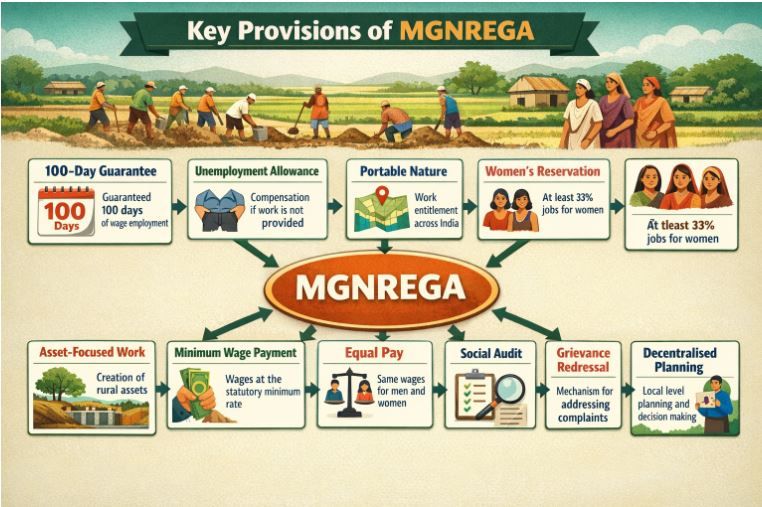
- 100-Day Guarantee: Every rural household had a legal right to apply for and receive up to 100 days of work annually.
- Unemployment Allowance: If work is not provided within 15 days of demand, the worker is entitled to unemployment allowance equal to 50% of the minimum wage for the remaining period.
- Portable Nature: Workers can register for work in any gram panchayat within their state, enabling labour mobility.
- Women's Reservation: Mandatory minimum 33% allocation of work to women.
- Asset-Focused Work: Works categorised into four areas: water conservation, land development, rural infrastructure (roads, connectivity), and agricultural assets.
- Wage payment: Minimum wages as notified by the state must be paid within 15 days of work completion.
- Equal pay: Women workers receive equal wages for identical work as men.
- Social Audit: Mandatory social audit every 6 months, where villagers could inspect work quality and detect fraud through gram sabhas.
- Grievance Redressal: Formal mechanisms to lodge complaints against malpractices or non-payment of wages.
- Decentralised Planning: Gram Panchayats played key roles in identifying work sites and managing implementation.
Also read: PM SVANidhi Scheme: Empowering Urban Street Vendors
Difference Between MGNREGA vs VB-G RAM G
VB-G RAM G is the new rural employment law, replacing MGNREGA, which is expected to be implemented in late 2025.
| Parameter | MGNREGA (2005) | VB-G RAM G (2025) |
|---|---|---|
| Full Form | Mahatma Gandhi National Rural Employment Guarantee Act | Viksit Bharat - Guarantee for Rozgar and Ajeevika Mission (Gramin) |
| Nature of Scheme | Demand-driven (work on demand from workers) | Supply-driven with normative allocation (planned allocation by the state) |
| Employment Guarantee | 100 Days per household per financial year. | 125 Days per household per financial year. |
| Funding Pattern (Wages) | 100% funded by the Centre (for unskilled wages). |
|
| Focus Areas | Any asset type (scattered approach) | 4 strategic priorities: Water security, Core rural infrastructure, Livelihood assets, Climate-resilient works |
| Agri-Season Ban | No mandatory ban on work during harvest seasons. | Mandatory 60-day pause on work during peak agricultural seasons (sowing/harvesting) to prevent labour shortage for farming. |
| Planning Process | Bottom-Up: Gram Sabha decides the shelf of projects; decisions ratified by the Panchayat. | Integrated Planning: Viksit Gram Panchayat Plans aligned with PM Gati Shakti and higher-level infrastructure goals. |
| Panchayat Categorization | No classification of Panchayats. | Panchayats are classified into Category A, B, and C based on development parameters for "saturation-mode" planning. |
Also read: Prime Minister Dhan-Dhaanya Krishi Yojana
Significance of MGNREGA
MGNREGA marks a shift from welfare to rights-based employment and is among the world’s largest job guarantee schemes, with an impact beyond just income support.
1. Legal Guarantee of Employment
- Provides a statutory right to 100 days of guaranteed wage employment per financial year to rural households.
- If employment is not provided within 15 days of demand, workers are entitled to unemployment allowance.
2. Poverty Alleviation
- It works as a safety net during economic or farm crises by providing income support and reducing rural poverty.
- In FY 2024–25, 15.99 crore households were registered, generating 290.60 crore person-days of employment.
3. Women's Empowerment
- Women's participation has surged from 48% (FY 2013–14) to 58.15% (FY 2024–25), with 440.7 lakh women participating in FY 2024–25.
- Provides equal wage opportunities and reduces gender pay gaps in rural labour markets.
4. Rural Infrastructure Development
- It helps build long-lasting assets like water structures, rural roads, farm ponds, trees, and improves soil quality.
- Over 6.26 crore assets have been geo-tagged in the public domain for transparency.
5. Skill Development Integration
- Project UNNATI (launched December 2019) targets skill development of MGNREGA workers, with 90,894 candidates trained by March 31, 2025.
UPSC Prelims PYQ on MGNREGA
QUESTION 1
Among the following, who are eligible to benefit from the “Mahatma Gandhi National Rural Employment Guarantee Act”?
Recent Developments in MGNREGA
In December 2025, MGNREGA was replaced by the VB–G RAM G Act, 2025, marking a major shift in rural employment policy. The new law aims to fix long-standing issues and align rural development with the Viksit Bharat 2047 vision.
- The Act received Presidential assent on December 21, 2025, officially repealing MGNREGA.
- Upgraded from the previous 100-day guarantee to 125 days of wage employment per rural household annually.
- Workers are assured jobs for 305 days in a year, but up to 60 days of no work are kept aside during sowing and harvesting seasons, so that enough labour is available for farming.
- The disbursement of daily wages shall be made weekly or, in any case, not later than a fortnight after the date on which such work was done.
- Transitions from a Central Sector scheme to a Centrally Sponsored scheme with shared responsibility between the Centre and the states.
- Replaces the demand-driven, open-ended approach with a planned, structured framework aligned with four priority development verticals:
- water and livelihood infrastructure,
- agricultural support infrastructure,
- climate resilience and environmental management
- rural connectivity
- Budget allocation retained at Rs 86,000 crore for FY 2025–26, described as the highest-ever allocation at the Budget Estimate stage outside the pandemic period.
- Employment creation is now integrated with infrastructure development through decentralised, village-level Viksit Gram Panchayat Plans.
Also read: PM-JUGA Scheme
Challenges Faced by MGNREGA
MGNREGA is an important scheme for rural employment and livelihood security, but several on-ground issues reduce its effectiveness and limit its full potential.
- Delay in wage payments: Workers often receive wages late due to administrative and technical issues, which reduces trust in the scheme.
- Insufficient and irregular funding: Funds released by the Centre are sometimes inadequate or delayed, leading to the stoppage of work.
- Low awareness among workers: Many workers are not fully aware of their rights, such as guaranteed employment or unemployment allowance.
- Poor planning and quality of work: In some areas, projects are not well planned, resulting in low-quality or less useful assets.
- Corruption and leakages: Fake job cards, inflated work records, and middlemen reduce benefits to genuine workers.
- Staff shortages at the local level: Gram Panchayats often lack trained staff to plan, implement, and monitor work effectively.
Must read: Kisan Diwas 2025: History, Theme, & Significance [UPSC]
UPSC Mains Practice Question
MGNREGA not only directly contributes to creating rural infrastructure and assets, but also indirectly helps increase rural demand and employment. Discuss achievements and issues associated with this scheme.
Evaluate Your Answer Now!Way Forward
The shift from MGNREGA to VB-G RAM G is a major change in rural employment policy. Its success depends on smooth implementation and strong safeguards.
- Ensure workers do not lose jobs or income during the shift, with clear guidelines for states and gram panchayats.
- Provide adequate funds, trained staff, and technical support so local bodies can plan and manage works effectively.
- Proper use of AI, biometrics, GPS, and real-time monitoring, with information accessible to gram sabhas.
- Support financially weak states through incentives rather than penalties under the 60:40 funding model.
Start Your UPSC Journey Smarter with SuperKalam
Crack UPSC with AI-powered guidance, personalised feedback, PYQs, NCERT MCQs and expert-curated notes, all in one platform.
Join SuperKalam today and take your preparation to the next level!