Kisan Diwas 2025: History, Theme, & Significance [UPSC]
National Farmers Day 2025 (Kisan Diwas) is observed on 23 December every year. Read about its history, theme, significance, Chaudhary Charan Singh’s contributions and UPSC relevance.
Dec, 2025
•6 min read
“जय जवान, जय किसान”
India is primarily an agrarian economy where farmers form the backbone of food security, rural livelihoods, and socio-economic stability. Recognising their contribution, National Farmers Day, also known as Kisan Diwas, is observed every year on 23 December across India to honour the invaluable contribution of farmers to the nation’s economy and food security.
The day marks the birth anniversary of Chaudhary Charan Singh, India’s fifth Prime Minister and a strong advocate of farmers’ rights and rural development.
Why Cover This Topic for UPSC?
Kisan Diwas 2025 is relevant for UPSC from multiple dimensions:
- GS Paper I: Role of agriculture in Indian society
- GS Paper II: Government policies, farmer welfare schemes
- GS Paper III: Agriculture, agrarian reforms, sustainability
- Essay Paper: Farmers, rural distress, inclusive growth
- Prelims: Dates, schemes, personalities, themes
National Farmers Day 2025 Theme
As of now, no officially notified theme for Kisan Diwas 2025 has been announced; the focus remains on farmers’ welfare and agrarian reforms.
“Vikasit Bharat 2047 – The Role of FPOs in Globalising Indian Agriculture”
This highlights the growing importance of Farmer-Producer Organisations (FPOs) in building Indian agriculture from subsistence-based farming to a market-oriented and globally competitive sector.
FPOs help small and marginal farmers by enhancing their collective bargaining power, increasing access to markets, technology, credit, and exports, thereby supporting the vision of a Viksit Bharat by 2047.
History of National Farmers Day
The Government of India officially declared 23 December as National Farmers' Day in 2001. It commemorates the birth anniversary of Chaudhary Charan Singh, India’s fifth Prime Minister.
- Chaudhary Charan Singh is remembered as a champion of farmers’ rights and rural development.
- He played a crucial role in land reforms and the abolition of the zamindari system.
- The day acknowledges farmers’ contribution to national food security and economic stability.
- It provides a platform to discuss agrarian challenges, policy reforms, MSP, climate change, and farmer welfare.
- Awareness programmes, seminars, KVK activities, and agricultural campaigns are organised nationwide.
- National Farmers Day reinforces that India’s overall development is inseparable from agricultural growth.
Important Facts
- Agriculture employs ~45% of India’s workforce (Periodic Labour Force Survey).
- Contribution of agriculture to GDP: ~18%.
- India has 86% small and marginal farmers (Agriculture Census).
- Over 10,000 FPOs have been formed under government support programmes.
Significance of the National Farmers’ Day
Farmers’ Day goes beyond a symbolic celebration and holds deep economic, social, and developmental significance for India. It serves as an annual reminder of the central role farmers play in nation-building and sustainable growth.
- Acknowledges farmers as food providers and economic stabilisers, ensuring national food security and rural livelihoods.
- Brings focus to critical agrarian challenges such as income instability, climate change impacts, indebtedness, and market access.
- Promotes dialogue on sustainable and climate-resilient agriculture, encouraging natural farming, resource efficiency, and technological adoption.
- Encourages youth participation, innovation, and agri-entrepreneurship, helping address rural distress and migration.
- Reinforces the need for inclusive rural development, aligning agricultural growth with social justice, equity, and long-term policy reforms.
About the Legendary Chaudhary Charan Singh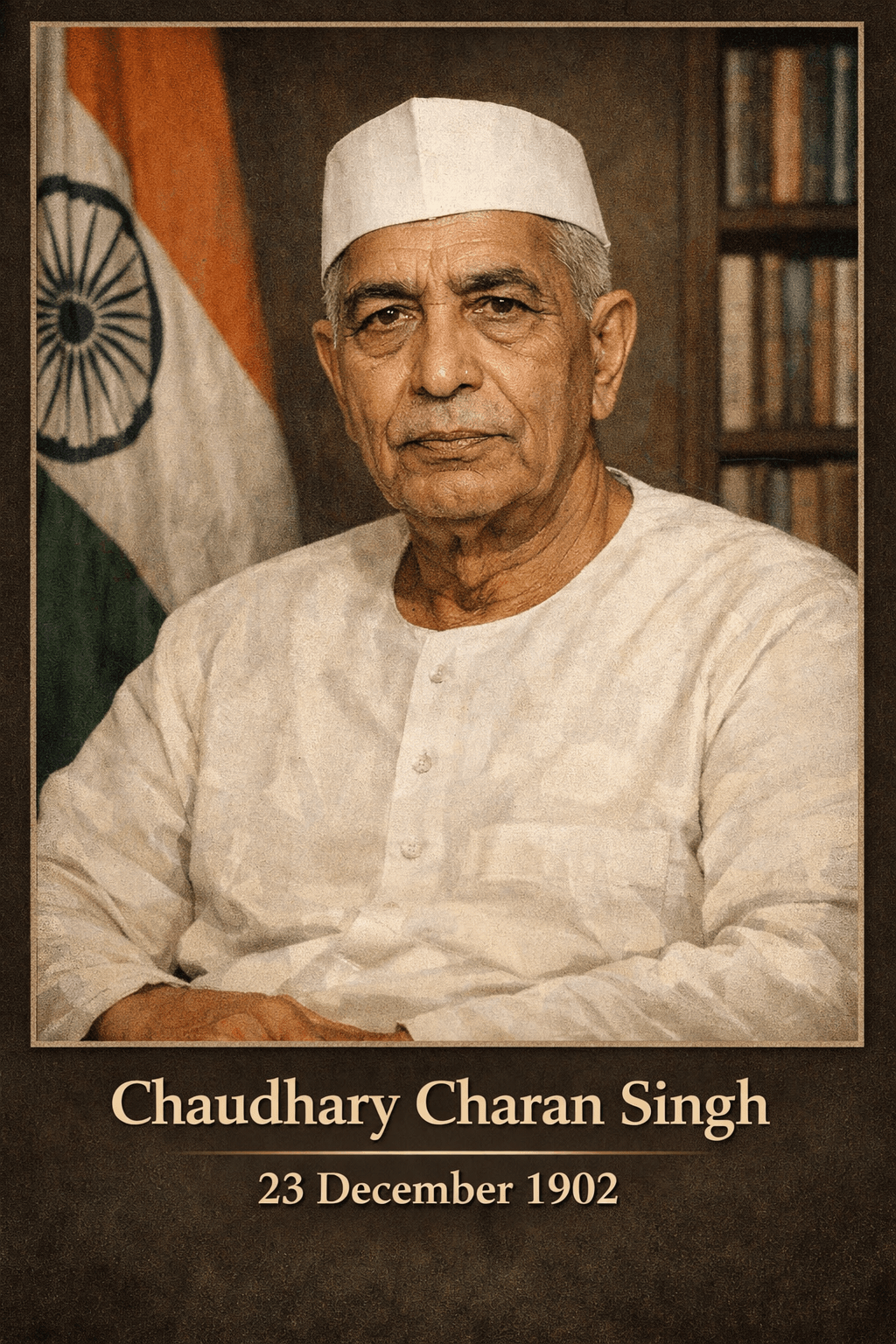 Chaudhary Charan Singh was an Indian freedom fighter, visionary statesman, and pioneering agrarian reformer who served as the fifth Prime Minister of India (1979–1980). Born on 23 December 1902 in a peasant family in Uttar Pradesh, he developed an early and intimate understanding of rural life, agrarian distress, and the structural challenges faced by Indian farmers. Owing to his unwavering commitment to agrarian justice and rural empowerment, Chaudhary Charan Singh is widely remembered in Indian political history as the “Champion of Farmers.”
|
Also read: UNGA Declares 2026 International Year of the Woman Farmer
Key Schemes for Farmers in India
The Government of India has launched several schemes to improve farmers’ income, productivity, and resilience:
Also read: Prime Minister Dhan-Dhaanya Krishi Yojana
UPSC Prelims PYQ about Agricultural Schemes
QUESTION 1
Under the Kisan Credit Card scheme, short-term credit support is given to farmers for which of the following purposes?
- Working capital for maintenance of farm assets
- Purchase of combine harvesters, tractors and mini trucks.
- Consumption requirements of farm households
- Post-harvest expense
- Construction of family house and setting up of village cold storage facility.
Select the correct answer
Final Words
Kisan Diwas 2025 is a reminder that India’s dream of becoming a Viksit Bharat by 2047 cannot be achieved without empowering its farmers. Strengthening FPOs, ensuring fair incomes, adopting sustainable practices, and respecting the dignity of farmers must remain national priorities.
“जब किसान सशक्त होगा, तभी राष्ट्र समृद्ध होगा।”
For UPSC aspirants, this topic reflects the soul of India’s development journey.