SC ST (Prevention of Atrocities) Act 1989 - UPSC Notes
The SC ST (Prevention of Atrocities) Act, 1989 is a law protecting SC/ST communities from caste-based violence. Get complete UPSC notes on its provisions, punishments, challenges, and amendments.
Feb, 2026
•8 min read
The Scheduled Caste and Scheduled Tribes (Prevention of Atrocities) Act 1989 is a crucial act for understanding social justice and constitutional safeguards in India. This act was enacted to prevent atrocities against Scheduled Castes and Scheduled Tribes, ensure dignity, and provide speedy justice. This topic is highly relevant to Prelims (GS Paper I) & Mains (GS Paper II, Polity & Governance) and GS Paper I (Indian Society).
Let's study the SC ST Act for UPSC in detail!
About the SC ST (Prevention of Atrocities) Act, 1989
The SC ST (Prevention of Atrocities) Act, 1989, is a landmark social justice legislation enacted by the Parliament of India to protect members of the Scheduled Castes (SCs) and the Scheduled Tribes (STs) from caste-based discrimination, violence, and humiliation. It aims to prevent atrocities, provide special safeguards, and ensure the speedy delivery of justice to victims.
Why was the Act Enacted?
Despite constitutional guarantees under Fundamental Rights (Articles 14, 15, 17, and 21), incidents of caste-based atrocities continued across India. The existing provisions of the Indian Penal Code (now Bhartiya Nayay Sanhita) were found inadequate to address the gravity and nature of such crimes. Therefore, the government enacted the SC ST Act to:
- Prevent specific offences against SCs and STs
- Provide stringent punishments for perpetrators
- Establish Special Courts for speedy trials
- Ensure relief and rehabilitation for victims
Must cover: Article 15 of the Indian Constitution [UPSC Polity Notes]
Nature and Scope of the Act
The Act specifically defines various offences as “atrocities” when committed against members of SC/ST communities. It covers acts such as social boycott, forced labour, dispossession of land, physical violence, sexual exploitation, and intentional humiliation in public places.
Before we examine the provisions of the SC ST Act, it is essential to first understand who are classified as the Scheduled Castes and Scheduled Tribes under the Constitution of India.
Must cover: Important Tribes in India [UPSC Notes]
What are Scheduled Castes (SCs)?
Scheduled Castes are socially disadvantaged communities that have historically faced discrimination, especially the practice of untouchability.
- Under Article 366(24), Scheduled Castes refer to such castes, races, or tribes deemed as SCs under Article 341.
- As per Article 341, the President of India specifies the list of Scheduled Castes through a public notification.
- Parliament has the power to include or exclude communities from this list.
Population (2011 Census):
- Around 16.6 crore people
- Nearly 16% of India’s total population
What are Scheduled Tribes (STs)?
Scheduled Tribes are indigenous communities with distinct cultural identities, geographical isolation, and socio-economic backwardness.
- Under Article 366(25), Scheduled Tribes are those communities deemed as STs under Article 342.
- As per Article 342, the President of India notifies the Scheduled Tribes after consulting the Governor of the concerned state.
- Parliament can amend the list.
Population (2011 Census):
- Around 10.43 crore people
- More than 8% of India’s total population
This constitutional recognition forms the foundation for protective laws like the SC ST (Prevention of Atrocities) Act, 1989.
Must read: National Commission for Scheduled Tribes (NCST) | UPSC
Provisions of the SC ST Act, 1989
The Act has been strengthened through amendments in 2015 and 2018 to make its provisions more effective. Let's understand the key provisions!
1. Definition of Atrocities
The Act clearly defines specific offences as “atrocities” when committed against members of the Scheduled Castes and the Scheduled Tribes. These include:
- Forcing a person to consume inedible or obnoxious substances
- Social or economic boycott
- Dispossession from land or interference with land rights
- Physical assault, sexual violence, or humiliation in public view
- Obstructing access to public places, water sources, or places of worship
- Preventing SC/ST individuals from exercising constitutional rights
The 2015 amendment expanded the list of offences to cover new forms of discrimination and harassment.
2. Stringent Punishments
- Prescribes enhanced penalties for offences committed against SC/ST members.
- Most offences are cognizable and non-bailable.
- Public servants who neglect their duties under the Act can also face punishment.
This ensures accountability not only of offenders but also of authorities responsible for enforcement.
3. Establishment of Special Courts
The Act mandates the setting up of Exclusive Special Courts or Special Courts for the speedy trial of offences.
- Appointment of Special Public Prosecutors to conduct cases effectively.
- To ensure time-bound justice and reduce the pendency of cases.
4. Relief, Compensation, and Rehabilitation
- Provides for immediate relief to victims and their families.
- Includes financial compensation, medical aid, legal aid, and rehabilitation support.
- State governments must prepare contingency plans for effective implementation.
5. Preventive and Monitoring Measures
- District Magistrates and Superintendents of Police are assigned specific responsibilities to prevent atrocities.
- Establishment of State and District-level Vigilance and Monitoring Committees.
- Regular review of implementation by state authorities.
6. Protection of Victims and Witnesses
- Ensures protection against intimidation or harassment.
- Provides for relocation and other safety measures when necessary.
- Emphasises safeguarding the dignity and rights of victims throughout the judicial process.
7. Bar on Anticipatory Bail
- The Act restricts the application of anticipatory bail for persons accused of committing offences under it (reinforced through the 2018 amendment).
- This provision was introduced to strengthen deterrence and prevent misuse of legal loopholes.
8. Presumption as to Offences
- If the accused knew that the victim belonged to an SC/ST community, the court may presume the offence was committed under the Act.
- This shifts a part of the evidentiary burden in certain cases.
Also read: Armed Forces Special Powers Act 1958 (AFSPA): UPSC Notes
Punishment under the SC ST Act
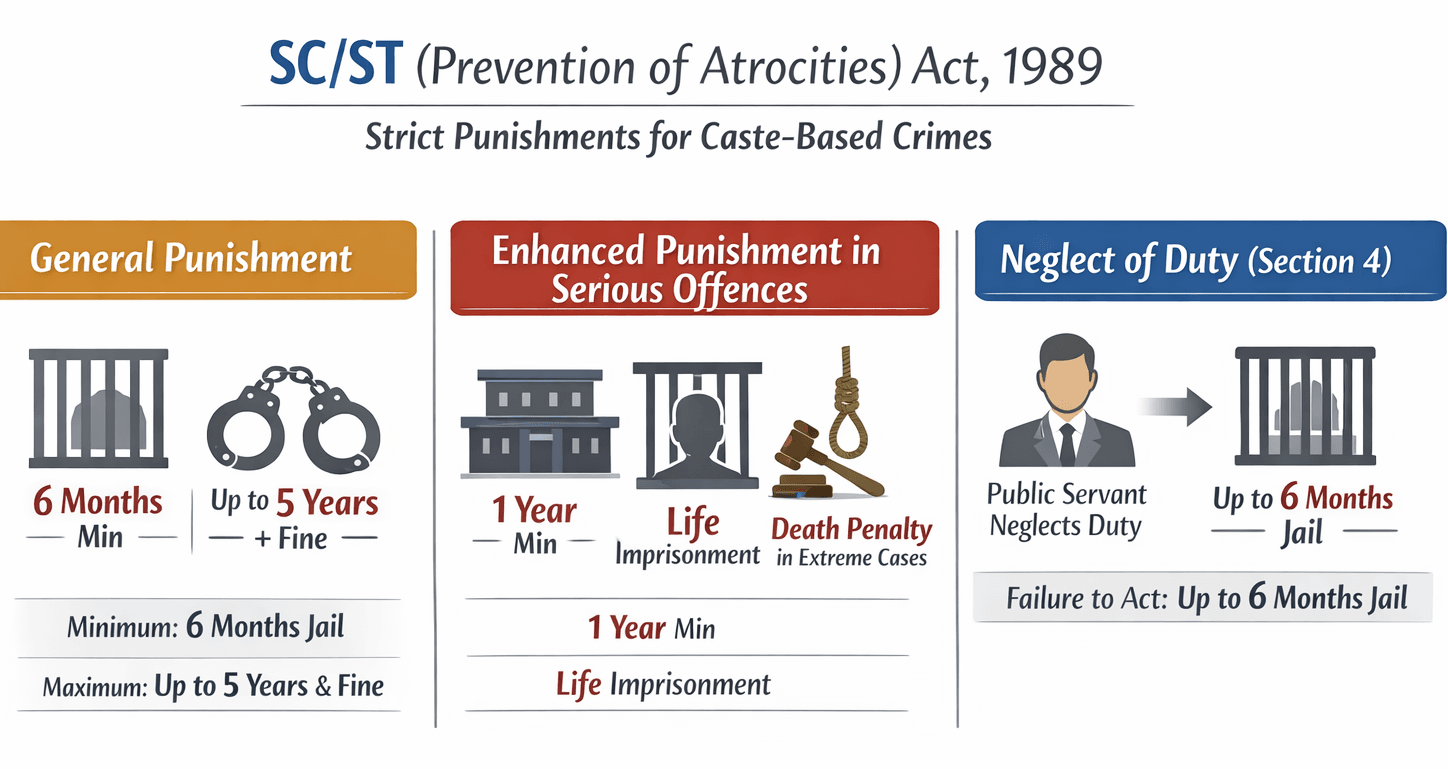
The Scheduled Castes and Scheduled Tribes (Prevention of Atrocities) Act, 1989, prescribes stringent punishments to deter caste-based crimes and ensure accountability.
1. General Punishment
- In most offences, the minimum punishment is six months of imprisonment.
- The maximum punishment generally extends up to five years, along with a fine.
2. Enhanced Punishment in Serious Offences
- For grave offences, the minimum imprisonment may extend to one year.
- The maximum punishment can extend to life imprisonment.
In extremely serious cases, the Act also allows for the death penalty, as per applicable provisions of law.
3. Punishment for Neglect of Duty (Section 4)
Section 4 specifically addresses neglect of duties by public servants.
- If a public servant (who is not a member of SC/ST) wilfully neglects duties required under the Act—such as registering complaints or conducting proper investigation—
- He or she is liable for imprisonment up to six months.
This provision ensures that enforcement authorities remain accountable and that victims receive timely protection and justice.
UPSC Prelims Practice MCQ on SC ST Act 1989
QUESTION 1
With reference to the Scheduled Castes and Scheduled Tribes (Prevention of Atrocities) Act, 1989, consider the following statements:
- The Act provides for the establishment of Special Courts for speedy trial of offences.
- All offences under the Act are compoundable in nature.
- The Act includes provisions for punishment of public servants for neglect of duty.
- The Act bars the grant of anticipatory bail to accused persons in certain cases.
Which of the statements given above are correct?
Challenges in Implementation of the SC ST Act
Despite its strong legal framework, the SC ST Act faces several implementation challenges that hinder its effectiveness on the ground.
1. High Incidence of Atrocities
- Reports on frequent caste-based violence and discrimination, indicating deep-rooted social bias against Dalits and Adivasis.
- Uttar Pradesh, Rajasthan and Madhya Pradesh are among the states with the highest number of reported atrocities.
2. Low Conviction Rates and Delays
- Even where complaints are lodged, conviction rates remain low due to delayed investigations, poor evidence gathering and procedural weaknesses.
- In many cases, investigations remain pending for long periods, slowing the legal process.
3. Insufficient Special Courts and Infrastructure
- Many districts do not have special courts as mandated for atrocity cases, slowing judicial disposal.
- Institutional structures such as SC/ST protection cells and vigilance committees vary widely across states, limiting the uniform application of the Act.
4. Fear of Retaliation and Under-Reporting
- Many victims fear backlash or ostracism, which can deter them from filing complaints or pursuing cases to conclusion.
- Social stigma and economic dependencies add to the reluctance among survivors of caste-based atrocities to approach authorities.
5. Allegations of Misuse and Abuse of Process
- Courts and commentators have noted instances where the Act is misapplied in civil disputes or personal conflicts, burdening the legal system.
- Media and judicial observations also reflect debates over false or exaggerated complaints.
Must cover this recent topic here: UGC New Rules 2026: Provisions Against Caste Discrimination
UPSC Mains Practice Question on SC ST Act 1989
Discuss the key provisions of the SC ST (Prevention of Atrocities) Act, 1989 and examine the major challenges in its effective enforcement. (15 marks 250 words)
Evaluate Your Answer in 60 SecondsWay Forward
“Injustice anywhere is a threat to justice everywhere.” – Martin Luther King Jr.
To make the Scheduled Castes and Scheduled Tribes (Prevention of Atrocities) Act, 1989 truly effective, India must move beyond legal safeguards toward social transformation.
- Ensure time-bound investigation and fast-track trials.
- Strengthen Exclusive Special Courts in all districts.
- Improve victim compensation and witness protection.
- Sensitize police and judiciary through regular training.
- Promote social awareness to eliminate caste-based prejudice.
A just society demands not only strong laws but strong implementation rooted in constitutional morality.
Start your UPSC Preparation 2027 with SuperKalam
SuperKalam is your personal mentor for UPSC preparation, guiding you at every step of the exam journey. Practice, revise, and evaluate– all in one place.
Download the App Now