UGC New Rules 2026: Provisions Against Caste Discrimination
New UGC Rules 2026 simplified for UPSC: key provisions, equal opportunity centres, equity committees, penalties, and higher education reforms in India for GS-II governance.
Jan, 2026
•8 min read
The University Grants Commission (UGC) has notified the University Grants Commission (Promotion of Equity in Higher Education Institutions) Regulations, 2026, aimed at preventing caste-based discrimination in higher education institutions (HEIs). The regulations seek to strengthen equity, inclusion, and grievance redressal mechanisms within universities and colleges across India.
However, the notification of these rules has sparked nationwide protests and debates. But what do these UGC New Rules 2026 contain? Why are students and faculty groups protesting against them?
Let’s understand this topic for UPSC GS Paper I and GS Paper II, focusing on its background, provisions, and concerns.
Provisions of the UGC (Promotion of Equity in Higher Education Institutions) Regulations, 2026
The 2026 UGC Regulations set out mandatory mechanisms to prevent discrimination and promote equity in higher education institutions.
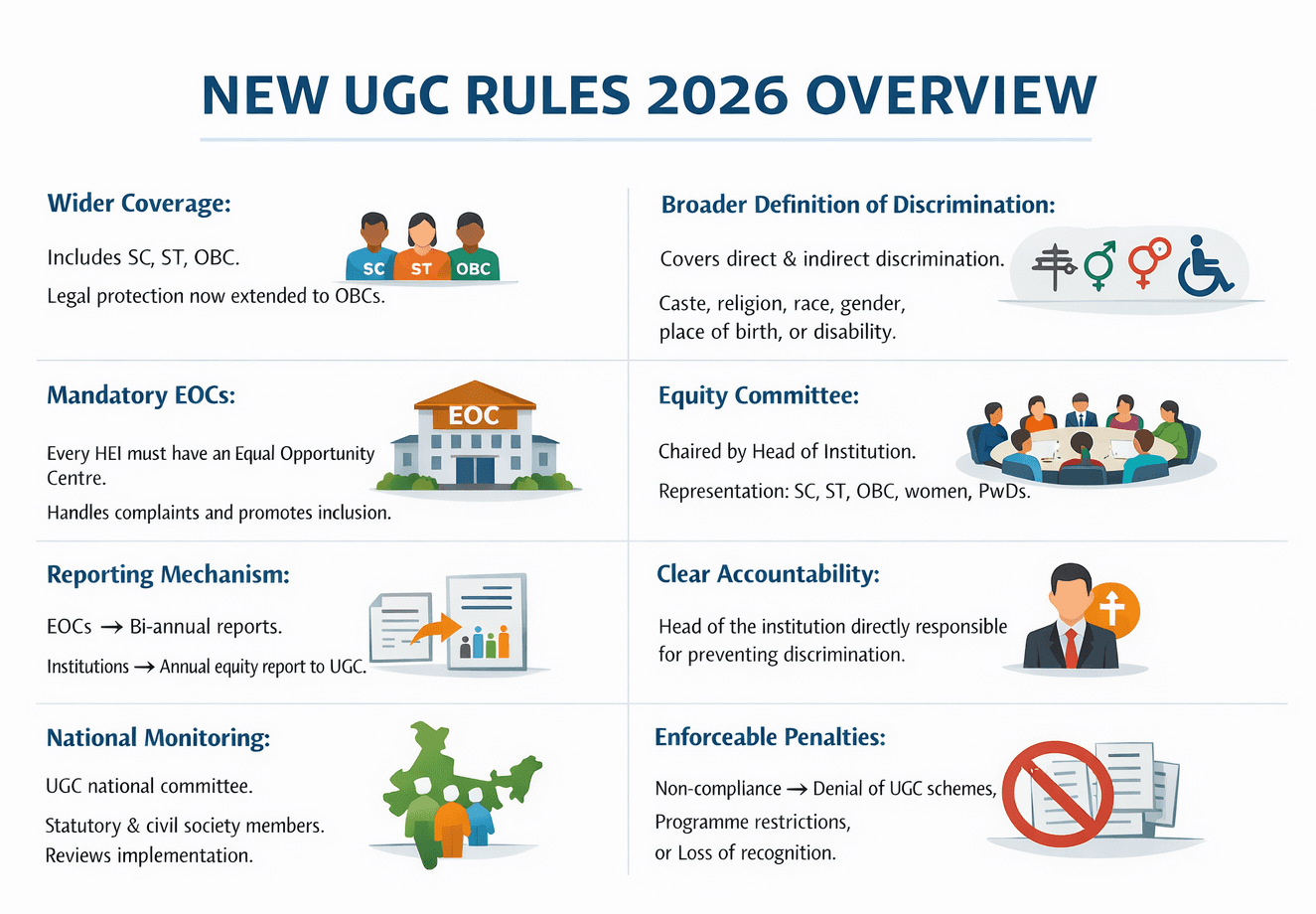
1. Wider Coverage of Caste-Based Discrimination: The regulations clearly define caste-based discrimination to include unfair treatment against SCs, STs, and OBCs. This explicitly brings OBCs under legal protection, correcting a gap in the earlier draft.
2. Expanded Meaning of Discrimination: Discrimination includes any direct or indirect unfair treatment based on caste, religion, race, gender, place of birth, or disability, especially when it affects equality in education or violates human dignity.
3. Mandatory Equal Opportunity Centres (EOCs): Every higher education institution must set up an Equal Opportunity Centre (EOC) to promote inclusion and handle complaints related to discrimination on campus.
4. Equity Committee under EOC: Each institution must form an Equity Committee, chaired by the head of the institution, with mandatory representation from SCs, STs, OBCs, women, and persons with disabilities, ensuring inclusive decision-making.
5. Reporting and Accountability: EOCs must submit bi-annual reports, and institutions must file an annual equity report to the UGC, strengthening transparency and accountability.
6. Institutional Responsibility: The regulations place a clear responsibility on institutions to prevent discrimination, with the head of the institution directly accountable for implementation.
7. National-Level Monitoring: UGC will set up a national monitoring committee with members from statutory bodies and civil society to review implementation and address complaints. The committee will meet at least twice a year.
8. Penalties for Non-Compliance: Institutions violating the rules may face denial of UGC schemes, restrictions on academic programmes, or loss of UGC recognition, making the regulations legally enforceable.
What is the University Grants Commission (UGC)?The University Grants Commission (UGC) is a statutory body responsible for the coordination, funding, and maintenance of standards in higher education in India. Its main role is to ensure uniform quality and systematic development of universities across the country. Evolution and Background
Organisation and Structure
Key Functions of the UGC
|
Also read: Constitutional Bodies in India
Significance of the New UGC Regulations 2026
The urgency of such regulations is underlined by a 2019 study by IIT Delhi, which reported that nearly 75% of students from historically disadvantaged castes experienced some form of discrimination on campus. These regulations mark a crucial step toward ensuring equity and dignity on university campuses. Here's how:
- More Inclusive Approach: By explicitly including Other Backward Classes (OBCs), the regulations adopt a more inclusive approach to social justice.
- Clear Institutional Responsibility: The regulations fix clear responsibility on higher education institutions and their heads, reducing ambiguity in handling discrimination cases.
- Improved Grievance Redressal: Mandatory Equal Opportunity Centres ensure faster and more accessible grievance redressal for students and staff.
- From Guidelines to Enforcement: The introduction of strict penalties marks a shift from advisory guidelines to enforceable regulations.
Overall, the regulations aim to ensure equality, dignity, and a safer learning environment on university campuses.
Also cover: National Human Rights Commission (NHRC) of India | UPSC Notes
UPSC Prelims Practice MCQ on UGC
QUESTION 1
Consider the following statements regarding the University Grants Commission (UGC) of India:
- UGC was established after the recommendations of the Radhakrishnan Commission.
- It is a statutory body established by an Act of Parliament.
- Its primary responsibility is to take all such steps as it may deem fit for the promotion and coordination of university education.
- UGC is not involved in the funding of universities.
How many of the statements given above are correct?
Role of the Equal Opportunity Centre (EOC)
The Equal Opportunity Centre (EOC) is the key institutional body under the UGC Regulations, 2026, responsible for promoting equity and inclusion on campus.
- Promotion of Equity and Inclusion: Ensure equal opportunity for all stakeholders and promote social inclusion within the HEI.
- Prevention of Discrimination: Work towards eliminating actual and perceived discrimination among students, teaching, and non-teaching staff.
- Inclusive Campus Environment: Help create a safe, respectful, and socially harmonious academic environment.
- Awareness and Sensitisation: Conduct awareness programmes on equity, inclusion, and non-discrimination.
- Support for Disadvantaged Groups: Provide support to students and staff from disadvantaged sections and ensure protection against retaliation.
- Information and Reporting: Share information on welfare schemes and maintain mechanisms for reporting discrimination complaints.
- Institutional Coordination: Promote inclusive admission processes and coordinate with the government and other agencies for academic and financial support.
Composition of the Equity Committee
Every Higher Education Institution must constitute an Equity Committee under the Equal Opportunity Centre to examine complaints, recommend action, and ensure compliance with equity norms.
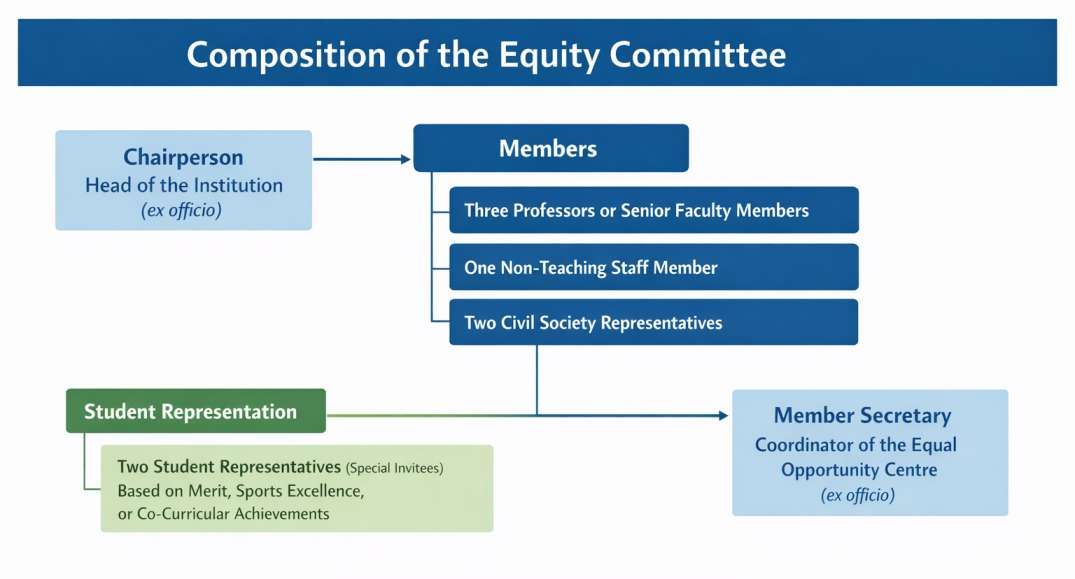
1. Chairperson: Head of the Institution (ex officio)
2. Members:
- Three Professors or Senior Faculty Members
- One Non-Teaching Staff Member
- Two Representatives from Civil Society with relevant experience
3. Student Representation: Two Student Representatives (as Special Invitees), nominated based on academic merit, sports excellence, or co-curricular achievements
4. Member Secretary: Coordinator of the Equal Opportunity Centre (ex officio)
Mandatory Representation
The committee must ensure adequate representation from:
- Scheduled Castes (SC)
- Scheduled Tribes (ST)
- Other Backward Classes (OBC)
- Women
- Persons with Disabilities
How Caste Discrimination Affects Access to Education in India
Caste discrimination goes against the ideals of equality, dignity, and fraternity in the Constitution. It weakens trust in systems meant to protect disadvantaged groups.
- Limited Access to Quality Education: Prejudice and poor school outcomes make it harder for many SC/ST/OBC students to enter top colleges and universities. This restricts social mobility and opportunity.
- Higher Dropout Rates: Many students from marginalised groups face academic stress, financial hardship, and discrimination, which increases the chances of dropping out before completing their studies.
- Psychological Exclusion and Stigma: The stigma attached to being from a “reserved category” can cause anxiety, low self-esteem, and adverse academic outcomes.
- Weak Grievance Redressal: Many SC/ST Cells in institutions lack real power or autonomy, often prioritising institutional image over justice for victims.
- Social Segregation on Campuses: Government reports (like the Thorat Committee, 2007) found that segregation in hostels, dining areas, and activities can isolate marginalised students socially.
Real Campus Incidents
- A Dalit student at Lucknow University reported caste-based harassment and threats, highlighting ongoing campus bias.
- Cases like Rohith Vemula (University of Hyderabad) show how caste discrimination can deeply affect student life and mental health.
- Surveys at IIT Bombay revealed that some SC/ST students described caste bias affecting their campus experience.
Students at various universities have protested against caste discrimination, showing continued tension and demand for stronger action.
Must read: Article 15 of the Indian Constitution [UPSC Polity Notes]
Recent Debate and Protests Around the UGC Equity Regulations, 2026
The UGC’s new equity regulations have sparked widespread debate and protests across India since they were notified.
Arguments in Support
Supporters argue that the regulations provide long-needed legal safeguards against caste-based discrimination on campuses. They see the rules as a step toward social justice, inclusion, accountability, and effective grievance redressal.
Arguments Against
Opponents, including some student groups, fear possible misuse of the provisions and argue that the rules lack safeguards against false complaints. Concerns have also been raised about institutional autonomy and increased administrative burden on universities.
Overall, the debate reflects the challenge of balancing anti-discrimination measures with fairness, due process, and campus harmony in higher education.
Must read: Communalism in India: Meaning, Evolution and Its Impact | UPSC Polity
UPSC Mains Practice Question on New UGC Rules 2026
“The UGC (Promotion of Equity in Higher Education Institutions) Regulations, 2026 mark a shift from advisory guidelines to enforceable accountability.” Critically examine the key provisions of these regulations and assess their significance in promoting inclusive and discrimination-free higher education in India. (250 words)
Evaluate your Answer NowThe Way Ahead
“Equality may be a fiction, but nonetheless one must accept it as a governing principle.” — Dr B.R. Ambedkar
To translate the UGC Rules 2026 into real impact, the focus should be on:
- Strengthening Equal Opportunity Centres with trained staff
- Ensuring timely reporting and transparent grievance redressal
- Building awareness among students and faculty
- Linking compliance with institutional funding and recognition
A rule-based framework, backed by accountability, can ensure inclusive and discrimination-free campuses.
Start your UPSC Preparation 2026/2027 with SuperKalam
SuperKalam is your personal mentor for UPSC preparation, guiding you at every step of the exam journey. Practice, revise, and evaluate– all in one place.
Download Now