AstroSat - India's First Space Observatory (UPSC Notes)
AstroSat, India’s first dedicated space observatory, studies the universe in UV and X-ray wavelengths. Get complete AstroSat UPSC notes covering mission, payloads, and discoveries for Prelims & Mains.
Feb, 2026
•6 min read
AstroSat is India’s first dedicated space observatory, launched by the Indian Space Research Organisation to study the universe in multiple wavelengths. AstroSat is highly relevant for UPSC under GS Paper III (Science & Technology), covering space technology, indigenous achievements, and India’s growing capabilities in astrophysics research.
Let's study AstroSat for UPSC in detail!
What is AstroSat?
AstroSat is India’s first dedicated space observatory mission designed to study celestial objects across multiple wavelengths at the same time. It was launched by the Indian Space Research Organisation in 2015. With a lift-off mass of approximately 1513 kg, it was launched by PSLV-C30 into a 650 km low Earth orbit, inclined at 6° to the equator, ensuring optimal conditions for astronomical observations.
| Feature | Details |
|---|---|
| Mission Type | Space-based astronomy observatory |
| Launch Date | 28 September 2015 |
| Launch Vehicle | PSLV-C30 (XL) |
| Launch Site | Satish Dhawan Space Centre, Sriharikota |
| Spectral Coverage | UV (Near & Far), Optical (limited), X-ray (0.3–100 keV) |
| Key Capability | Simultaneous multi-wavelength observation |
| Total Payloads | 5 |
| Control Centre | ISTRAC, Bengaluru |
The spacecraft is managed by the Mission Operations Complex (MOX) under the ISRO Telemetry, Tracking and Command Network, Bengaluru. MOX controls and monitors the satellite throughout its mission life.
Payloads of AstroSat
AstroSat carries five scientific payloads that allow it to observe the universe across ultraviolet and X-ray wavelengths simultaneously. Each instrument serves a specific scientific purpose.
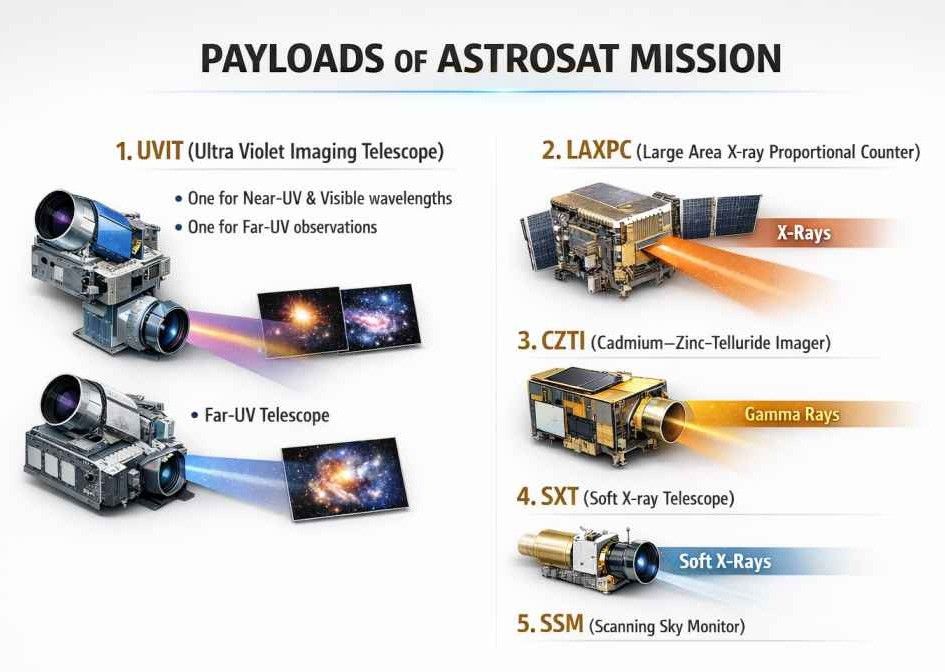
1. UVIT (Ultra Violet Imaging Telescope)
Designed for high-resolution imaging in the ultraviolet and visible bands. Consists of two co-aligned telescopes:
- One for Near-UV (NUV) and Visible wavelengths
- One for Far-UV (FUV) observations
Helps in studying star formation, galaxies, and hot stellar objects.
2. LAXPC (Large Area X-ray Proportional Counter)
- Observes high-energy X-rays.
- Useful for studying compact objects like neutron stars and black holes.
- Provides high time-resolution data.
3. CZTI (Cadmium–Zinc–Telluride Imager)
- Detects hard X-rays.
- Studies gamma-ray bursts and high-energy cosmic sources.
- Also measures X-ray polarisation.
4. SXT (Soft X-ray Telescope)
- Observes soft X-ray emissions from astronomical sources.
- Helps analyse the temperature, composition, and structure of cosmic objects.
5. SSM (Scanning Sky Monitor)
- Continuously scans the sky to detect transient X-ray sources.
- Alerts scientists to sudden cosmic events like outbursts.
Objectives of the AstroSat Mission
To understand high-energy processes in binary star systems containing neutron stars and black holes.
- To estimate the magnetic fields of neutron stars.
- To study star birth regions and high-energy processes in star systems lying beyond our galaxy.
- To detect new, briefly bright X-ray sources in the sky.
- To perform a limited deep field survey of the Universe in the Ultraviolet region.
At present, all the payloads are operational and are observing the cosmic sources. The spacecraft and payloads are healthy. The first six months were dedicated to performance verification and calibration of payloads. After that, the science observations by the payloads began.
Also read: Mission Sudarshan Chakra: India’s Indigenous Air Defence System
UPSC Prelims PYQ on AstroSat
QUESTION 1
With reference to ‘Astrosat’, the astronomical observatory launched by India, which of the following statements is/are correct?
- Other than the USA and Russia, India is the only country to have launched a similar observatory into space.
- Astrosat is a 2000 kg satellite placed in an orbit at 1650 km above the surface of the Earth.
Results & Contributions of AstroSat
AstroSat has delivered important scientific results and strengthened India’s role in global astrophysics.
Major Scientific Discoveries
1. Unveiling the Distant Universe
- AstroSat made the first detection of far-ultraviolet (FUV) photons from a galaxy about 9.3 billion light-years away.
- It is helping astronomers study the early universe and galaxy formation.
2. Multi-wavelength Breakthroughs
- By observing cosmic sources simultaneously in UV, optical, and X-ray bands, AstroSat has provided insights into black holes, neutron stars, and binary systems.
3. X-Ray Polarisation Studies
- The CZTI instrument detected X-ray polarisation from objects like the Crab pulsar and gamma-ray bursts.
- These measurements offer clues about magnetic fields and particle acceleration in extreme cosmic environments.
4. New Star Formation Insights
- UVIT’s high-resolution ultraviolet imaging has mapped star birth regions and distant stellar populations, including young stars in the bulge of the Andromeda Galaxy (M31).
5. Understanding Active Galactic Nuclei
- AstroSat observations of sources like OJ287 have constrained models of jet emissions and radiation mechanisms by correlating UV and X-ray behaviour over time.
Scientific Output & Community Impact
- Hundreds of research publications: Data from AstroSat have been used in 275 + refereed articles and numerous conference papers and circulars.
- Global research engagement: Over 3,400 registered scientists from more than 57 countries access AstroSat data for studies.
- Academic growth: The mission has fostered astrophysics research at numerous Indian universities and supported many doctoral theses.
AstroSat continues operating well beyond its planned 5-year life, demonstrating robust spacecraft and payload design.
Must cover: K-4 Ballistic Missile Test by India | UPSC
Conclusion
AstroSat stands as a milestone in India’s space journey, showcasing indigenous capability in advanced space astronomy. It has strengthened India’s position in global astrophysics research. For UPSC aspirants, AstroSat is a key example of India’s scientific achievements under GS Paper III (Science & Technology) and reflects the growing depth of India’s space programme.
Also read: India AI Impact Summit 2026 in New Delhi
Start your UPSC Preparation 2027 with SuperKalam
SuperKalam is your personal mentor for UPSC preparation, guiding you at every step of the exam journey. Practice, revise, and evaluate– all in one place.
Download Now