India AI Impact Summit 2026 in New Delhi
India AI Impact Summit 2026 will be held from 16 to 20 February in New Delhi, focusing on global AI governance and India's role in the global AI economy. Read now for UPSC GS-II & GS-III.
Feb, 2026
•6 min read
The India AI Impact Summit 2026 is scheduled to be held at Bharat Mandapam, New Delhi, from 16 to 20 February 2026, marking a historic moment in global technology governance. The summit will be the first global AI summit to be hosted in the Global South.
The summit will bring together top policymakers, global technology CEOs, researchers, startups, and multilateral institutions to shape the future of Artificial Intelligence (AI). This makes it a highly relevant topic for UPSC Prelims and Mains (GS-II & GS-III).
What is the India AI Impact Summit 2026?
The India AI Impact Summit 2026 will be hosted by the Ministry of Electronics & Information Technology (MeitY), and is a global platform focused on:
- AI governance and regulation
- Responsible AI development
- Innovation and startup ecosystem
- Global investment partnerships
- Ethical and inclusive AI
India’s approach through the India–AI Impact Summit 2026 will focus on translating global discussions into development outcomes aligned with national priorities under the IndiaAI mission and Digital India Initiative.
The Background of Global AI Cooperation
The India AI Impact Summit 2026 builds upon a series of international efforts to create a coordinated global framework for AI governance. Over the past three years, the focus of global AI summits has steadily evolved.
- The Bletchley Park AI Safety Summit (2023) primarily focused on identifying catastrophic and frontier AI risks, emphasising safety and the need for international cooperation to prevent misuse of advanced AI systems.
- The Seoul AI Summit (2024) expanded the agenda beyond safety to include innovation, inclusivity, and research collaboration, highlighting the importance of equitable access to AI technologies.
- The Paris AI Action Summit (2025) shifted attention toward implementation, regulatory frameworks, and economic opportunities arising from AI adoption.
Each summit gradually broadened the discussion, moving from risk awareness to innovation and practical deployment.
Also read: Asia Manufacturing Index 2026: India at 6th Position (UPSC)
Why the India AI Impact Summit 2026 Matters
The India AI Impact Summit 2026 comes at a critical moment in global technological transformation.
Across the world, nations are racing to dominate AI development, control semiconductor supply chains, and influence global AI governance standards. In this competitive environment, India’s decision to host a global AI summit carries deep strategic significance.
1. AI as a Driver of Economic Power
- Artificial Intelligence is expected to become a major engine of global economic growth.
- Countries leading in AI innovation are likely to gain higher productivity, better competitiveness, and technological dominance.
- AI-driven sectors such as fintech, health-tech, ed-tech, autonomous systems, and robotics are expanding rapidly.
2. AI and Military Strategy
AI is transforming modern warfare and defence systems:
- Autonomous weapons systems
- AI-driven surveillance
- Predictive intelligence analysis
- Cyber warfare capabilities
3. AI and Labour Market Disruption
AI and automation are rapidly altering global job markets:
- Routine and repetitive jobs face higher automation risks.
- Demand is increasing for AI-skilled professionals.
- New jobs are emerging in data science, machine learning, AI ethics, and cybersecurity.
4. AI and Digital Security
AI has both protective and destructive capabilities in cyberspace:
- AI strengthens cybersecurity through threat detection.
- At the same time, it enables sophisticated cyberattacks, misinformation campaigns, and deepfake technologies.
- Recent global concerns around misinformation, electoral interference, and algorithmic bias have intensified the demand for global AI regulatory standards.
India’s leadership in this summit signals its readiness to contribute to global digital governance frameworks.
5. Global Competition for AI Standards
Today, AI governance is fragmented. Different countries are developing their own regulatory approaches:
- Some prioritise strict regulation and ethical safeguards.
- Others prioritise rapid innovation and market expansion.
In this evolving scenario, whoever shapes AI standards will influence global trade, data flows, and digital sovereignty.
By hosting the summit, India positions itself as:
- A bridge between developed and developing nations
- A representative voice of the Global South
- A promoter of inclusive and human-centric AI governance
6. AI as the New Geopolitical Frontier
Just as oil defined geopolitics in the 20th century and data shaped the early 21st century, AI is emerging as the defining strategic resource of the coming decades.
- High-performance computing
- Advanced semiconductors
- Large datasets
- AI research ecosystems
These features will determine global power hierarchies.
Must cover: AI in Education: How AI is Revolutionising UPSC Preparation
Foundational Pillars of the India AI Impact Summit 2026
The India AI Impact Summit 2026 adopts an impact-oriented and people-centric vision for Artificial Intelligence. To structure global cooperation, the summit is built on Three Sutras (guiding principles) and Seven Chakras (priority action areas).
The Three Sutras
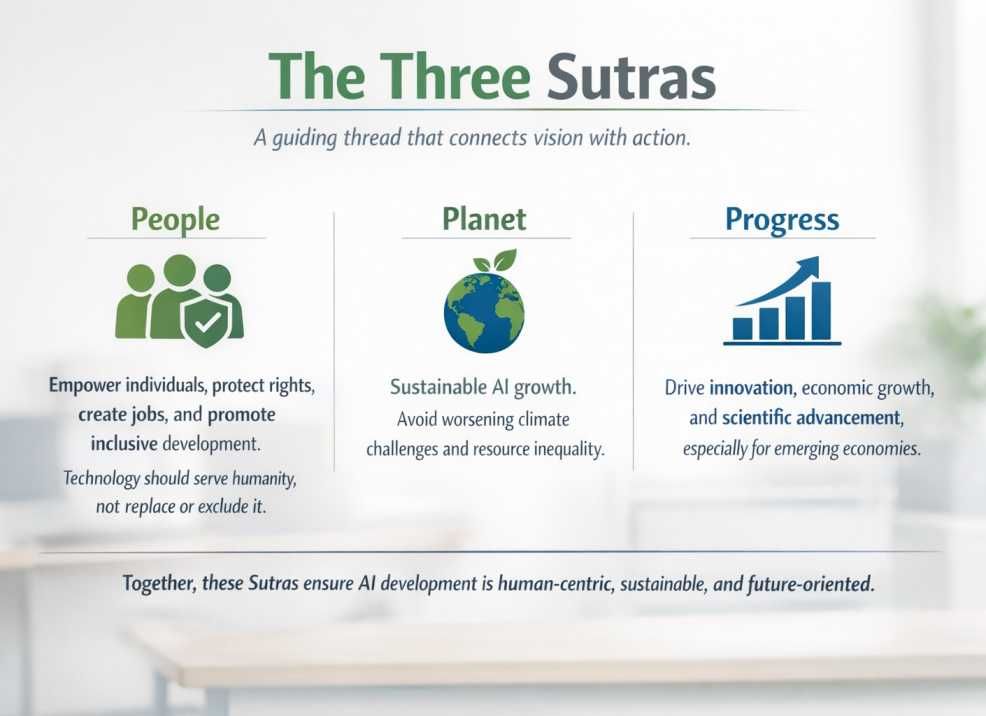
The word Sutra means a guiding thread that connects vision with action. These three Sutras define India’s approach to AI governance and development:
- People: AI must empower individuals, protect rights, create jobs, and promote inclusive development. Technology should serve humanity, not replace or exclude it.
- Planet: AI growth must remain environmentally sustainable. Energy-intensive AI systems should not worsen climate challenges or resource inequality.
- Progress: AI should drive innovation, economic growth, scientific advancement, and long-term development, especially for emerging economies.
Together, these Sutras ensure that AI development remains human-centric, sustainable, and future-oriented.
The Seven Chakras
Building on the Sutras, the summit discussions are organised around seven Chakras. Each Chakra represents a practical area of international cooperation.
- Human Capital
- Inclusion for Social Empowerment
- Safe and Trusted AI
- Resilience, Innovation and Efficiency
- Science
- Democratizing AI Resources
- AI for Economic Growth & Social Good
This aligns AI innovation with inclusive growth and national development goals.
Expected Outcomes of the India AI Impact Summit 2026
The expected outcomes of the India AI Impact Summit 2026 are aligned with India’s national development priorities and global AI leadership ambitions.
1. Practical AI Deployment
- Promotion of real-world AI applications across governance, healthcare, agriculture, and industry.
- Focus on scalable and citizen-centric AI solutions.
2. Stronger Governance & Regulatory Frameworks
- Alignment of AI policies with global standards.
- Strengthening responsible AI guidelines, safety mechanisms, and institutional coordination.
3. Institutional & Policy Coordination
- Better coordination between the central and state governments.
- Integration of AI strategies across ministries and sectors.
4. Assessment of Industrial Readiness
- Evaluation of regional preparedness for AI-driven industrial growth.
- Encouragement of AI adoption in MSMEs and emerging sectors.
5. Skill Development & Workforce Transition
- Expansion of AI skilling and reskilling programs.
- Preparation of the workforce for automation and AI-led transformation.
6. Awareness & Public Engagement
- Increased understanding of AI applications and risks.
- Building public trust in responsible AI deployment.
7. Strengthened Multi-Stakeholder Partnerships
- Deeper collaboration among government, academia, startups, and private industry.
- Creation of long-term partnerships to promote inclusive and sustainable AI growth.
Conclusion
The India AI Impact Summit 2026 marks a significant step in positioning India as a key player in global AI governance. By combining responsible regulation, inclusive development, and strategic innovation, the summit strengthens India’s ambition to become a norm-setter in emerging technologies.
For UPSC aspirants, it represents a crucial intersection of governance, international relations, technology, and economic development, making it a highly relevant topic for the upcoming examination cycle.
Must read: Which AI Platform is Best for UPSC Preparation in 2025: ChatGPT vs SuperKalam
Start your UPSC Preparation 2026/2027 with SuperKalam
SuperKalam is your personal mentor for UPSC preparation, guiding you at every step of the exam journey. Practice, revise, and evaluate– all in one place.
Download Now