Kudankulam Cyber Attack 2019: Dtrack, Air Gaps and Nuclear Cybersecurity
The 2019 Dtrack malware breach at Kudankulam showed that air-gapped nuclear plants are not immune to cyber intrusion. A short 2026 update covers the separate data-leak reports.
Oct, 2026
•10 min read

Context
The 2019 malware intrusion at the Kudankulam Nuclear Power Plant exposed fundamental vulnerabilities in India's critical infrastructure doctrine, demonstrating that physical air-gaps cannot isolate vital operational networks from sophisticated foreign cyber espionage without active internal micro-segmentation and rigorous institutional coordination. The incident revealed that hostile state-sponsored payloads can bypass perimeter defences through supply chains and routine administrative vectors. While plant reactors remained physically safe, the breach dismantled the long-held assumption that physical isolation equals operational invulnerability. For national security planners, securing India's strategic assets now requires a decisive shift from passive containment to continuous zero-trust verification.
Why It Matters Now: Kudankulam 2019 Breach and the 2026 Leak Reports
The Kudankulam cyber breach established an enduring precedent for critical infrastructure protection under Section 70 of the Information Technology Act, 2000. Nuclear plants and power grids remain targets for sophisticated cyber actors, and the 2019 case is still the reference example for administrative-network intrusions. The Indian Computer Emergency Response Team (CERT-In) first detected anomalous activity and alerted the Department of Atomic Energy regarding the Kudankulam malware intrusion on 4 September 2019. The event forced a comprehensive re-evaluation of institutional reporting mechanisms across the National Critical Information Infrastructure Protection Centre (NCIIPC) and domestic plant operators.
2026 update: a separate data-leak report
This is distinct from the 2019 malware case. On 15 July 2026, Reuters reported that about 19,000 files (18,997 files, 14.3 GB) linked to the Kudankulam plant were exposed online, with a group calling itself World Leaks claiming the data. The files were reportedly traced to a Reliance Infrastructure server hosted at Yotta, which noted suspicious activity on 29 May; the files were online from 11 June. NPCIL said the data relates only to conventional Balance of Plant common service facilities and not to nuclear safety or security systems, and Union Science Minister Jitendra Singh dismissed the reports as per the Times of India (16 July 2026). These claims are as reported; they do not change the 2019 findings above.
The Kudankulam Breach: What Actually Happened Inside India's Flagship Nuclear Plant
The Nuclear Power Corporation of India Limited confirmed on 30 October 2019 that a malware infection had breached an administrative computer at the Kudankulam facility. The acknowledgement followed intense public scrutiny triggered two days earlier when cyber intelligence analyst Pukhraj Singh disclosed anomalous signatures detected on VirusTotal.
Initial institutional reactions exposed severe communication fractures within India's strategic establishment. On 29 October 2019, Kudankulam plant authorities had issued an outright denial, claiming that nuclear control systems are standalone and completely immune to external cyber attacks. The contradictory statements damaged institutional transparency:
- 28 October 2019: Threat intelligence indicators pointing to a Kudankulam breach surfaced in the public domain via researcher disclosures.
- 29 October 2019: Kudankulam plant management issued a public release asserting that cyber attacks on the plant control network were impossible.
- 30 October 2019: The Nuclear Power Corporation of India Limited superseded the local denial, confirming an active malware intrusion on the administrative network.
Investigations confirmed that the operational reactor systems remained segregated, but the administrative compromise highlighted dangerous gaps in local network perimeter surveillance.
Discuss with Superkalam
Identify the statutory provisions in the Information Technology Act, 2000 that govern Critical Information Infrastructure, NCIIPC, and CERT-In.
Ask NowThe Air-Gap Myth: How Malware Crosses From Office Computers to Critical Reactor Systems
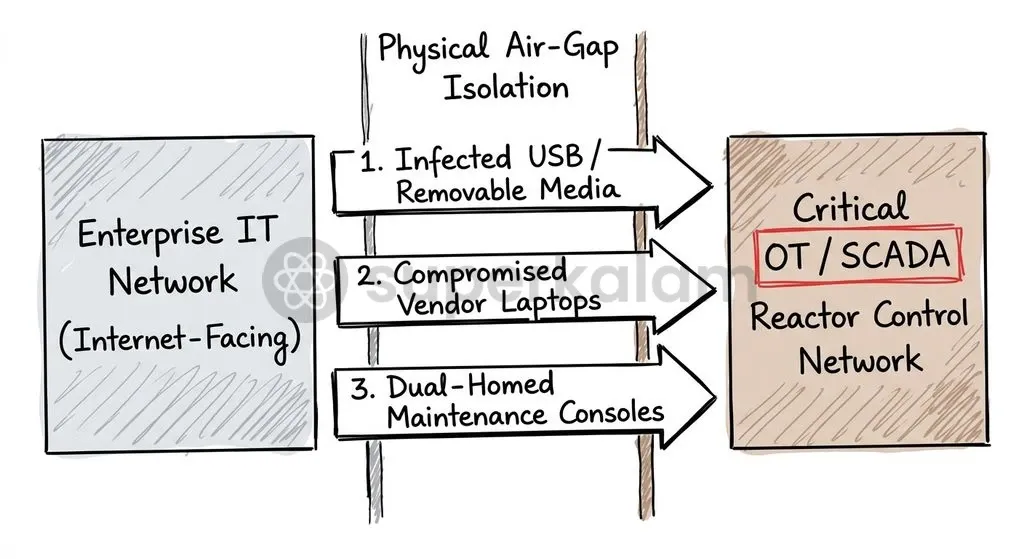
Physical air-gapping isolates sensitive industrial controllers from the public internet, yet modern advanced persistent threats consistently circumvent this barrier through physical media and maintenance vectors. Nuclear reactor dynamics depend on Operational Technology and SCADA networks operating on isolated control loops. However, plant personnel routinely bridge these boundaries using external storage drives, vendor diagnostics software, and portable maintenance laptops.
The global vulnerability of air-gapped nuclear architecture was demonstrated historically in 2010 when the Stuxnet cyber attack compromised Iran's uranium enrichment centrifuges at Natanz. Stuxnet breached an air-gapped facility via infected USB drives, using weaponised zero-day vulnerabilities to subvert programmable logic controllers. Common routes by which administrative and engineering networks end up bridged include:
- Vendor and maintenance pathways: Third-party field engineers introduce connected diagnostic hardware into air-gapped zones without rigorous sandboxing.
- Removable storage devices: Employees using infected flash drives transfer data between administrative local area networks and offline engineering stations.
- Dual-homed workstations: Systems connected simultaneously to internal intranets and external peripherals undermine network segmentation.
Air-gapping acts merely as a physical partition rather than an active security control. When malicious software infiltrates an intermediate workstation, passive isolation fails to prevent lateral reconnaissance.
Who Targeted Kudankulam? Lazarus Group, Dtrack, and the Threat of Foreign Espionage
Cybersecurity researchers identified the malicious payload recovered from the Kudankulam local area network as Dtrack, a specialised espionage Trojan attributed to North Korea's Lazarus Group. The Dtrack malware detected in the facility contained hardcoded administrative credentials, engineered to traverse internal Server Message Block shares across local enterprise workstations.
Dtrack is a data-stealing espionage tool, and its presence on an administrative network pointed to intelligence gathering rather than immediate sabotage.
- Credential harvesting: The malware extracted keystrokes, browser histories, host IP addresses, and network topologies to map the internal plant architecture.
- Lateral traversal: Automated network scripts systematically scanned subnet ranges to locate engineering blueprints, personnel records, and configuration logs.
- Strategic pre-positioning: State-backed actors routinely compromise administrative perimeters to secure long-term access for potential wartime exploitation.
State-sponsored intrusions into nuclear energy infrastructure demonstrate that foreign adversaries treat civilian utilities as strategic intelligence targets.
Discuss with Superkalam
Explain how routine maintenance practices and vendor diagnostic tools can compromise an air-gapped industrial network.
Ask NowWhere India's Cyber Defences Fractured: Coordination Gaps Between NCIIPC, CERT-In, and Plant Operators
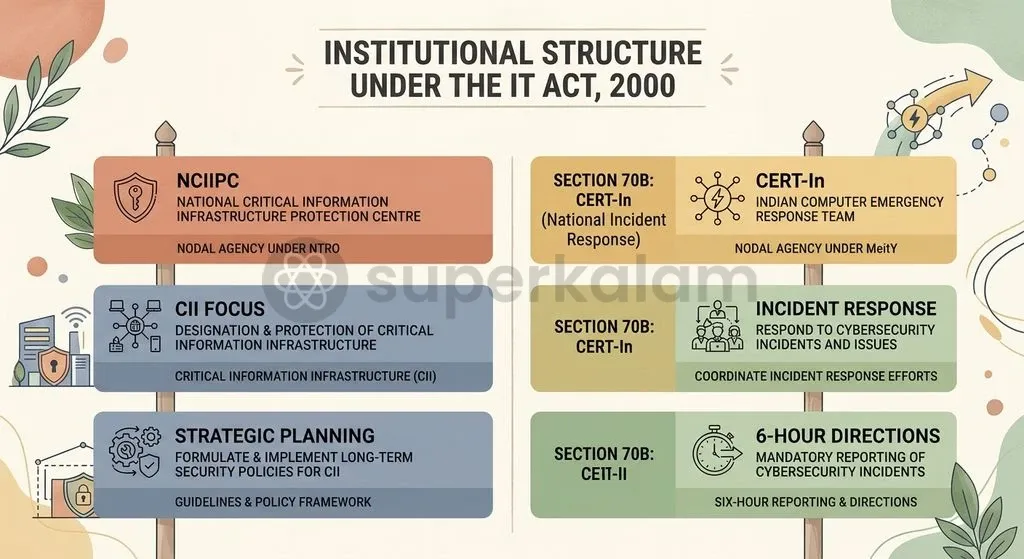
The Information Technology Act, 2000 establishes a dual institutional framework for national cybersecurity, but jurisdictional overlaps caused operational friction during the Kudankulam response. Under Section 70 of the Information Technology Act, 2000, the central government designates computer systems affecting national security, economy, and public safety as Critical Information Infrastructure. Operational protection for these assets falls between two separate statutory agencies operating under different administrative hierarchies.
The National Critical Information Infrastructure Protection Centre operates under Section 70A as the national nodal agency for critical infrastructure under the National Technical Research Organisation. Concurrently, the Indian Computer Emergency Response Team functions under Section 70B within the Ministry of Electronics and Information Technology as the national agency for general cyber incident response.
| Dimension | NCIIPC (Section 70A) | CERT-In (Section 70B) | Plant Operators (NPCIL / DAE) |
|---|---|---|---|
| Parent Body | National Technical Research Organisation | Ministry of Electronics and Information Technology | Department of Atomic Energy |
| Statutory Role | Protecting designated Critical Information Infrastructure | National incident response, collection, and analysis | On-site plant management and physical generation |
| Operational Mandate | Strategic vulnerability assessment and advisory notices | Emergency incident handling across public and private networks | Executing daily operational safety and cyber hygiene |
| Response Friction | Advisory body lacking direct executive command over plant networks | Alerted authorities on 4 September 2019, weeks before public containment | Issued categorical public denial on 29 October before confirming breach |
The initial handling of the Kudankulam intrusion exposed significant coordination barriers. CERT-In detected the threat in early September 2019, yet local plant administrators remained poorly coordinated with national intelligence advisories. Regulatory oversight from the Atomic Energy Regulatory Board focuses on physical reactor safety, requiring closer technical harmonisation with civilian cybersecurity agencies.
Discuss with Superkalam
Analyze the structural reasons behind the conflicting public statements issued by Kudankulam plant authorities and NPCIL in October 2019.
Ask NowInformation Technology vs Operational Technology: Why Traditional Firewalls Fail on Industrial Control Systems
Industrial facilities depend on fundamentally distinct network environments, rendering standard corporate cybersecurity tools ineffective inside operational control loops. Information Technology systems prioritise data confidentiality, regular software patching, and high bandwidth. Conversely, Operational Technology systems governing nuclear and electrical infrastructure prioritise deterministic availability, human safety, and uninterrupted mechanical processes.
Traditional firewalls and commercial antivirus suites cannot adequately protect industrial networks due to distinct operational constraints:
- Legacy operating systems: Industrial controllers frequently rely on proprietary firmware that cannot accommodate third-party endpoint security software without voiding regulatory certifications.
- Inability to patch dynamically: Operational technology environments cannot undergo frequent reboots or weekly software updates without shutting down live power generation.
- Protocol incompatibility: Supervisory Control and Data Acquisition systems rely on specialised industrial protocols that standard enterprise firewalls fail to inspect or decode.
| Attribute | Information Technology (IT) | Operational Technology (OT) |
|---|---|---|
| Core Priority | Confidentiality, Integrity, Availability (CIA) | Safety, Reliability, Availability, Integrity |
| System Lifecycles | 3 to 5 years (frequent hardware upgrades) | 15 to 30 years (legacy hardware and embedded firmware) |
| Patch Frequency | Regular, automated monthly software updates | Infrequent; restricted to scheduled plant refuelling outages |
| Interruption Impact | Business delay, financial disruption, data loss | Physical damage, reactor shutdown, ecological hazards |
A failure to understand the boundary between enterprise IT and industrial OT creates false security assumptions. When adversaries compromise administrative IT environments, insecure bridging assets allow malicious commands to infiltrate sensitive control networks.
Discuss with Superkalam
Evaluate the adequacy of relying on perimeter firewalls versus adopting a Zero Trust Architecture in civil nuclear infrastructure.
Ask NowRethinking Critical Infrastructure Defence: Moving from Perimeter Walls to Zero Trust Architecture
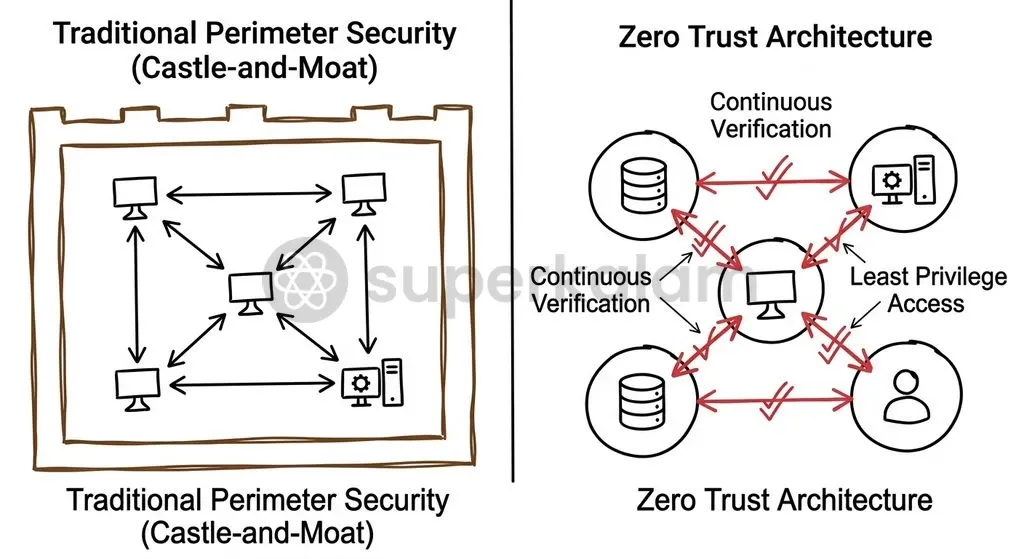
Zero Trust Architecture replaces the outdated security doctrine of implicit perimeter trust with an operational model requiring continuous dynamic verification. The National Institute of Standards and Technology defines Zero Trust Architecture in Special Publication 800-207 as an enterprise cybersecurity plan based on least-privilege access and network micro-segmentation.
Traditional nuclear plant perimeter models assume that every device inside the facility network is trustworthy. In contrast, a zero-trust model enforces three operational mandates across both administrative and engineering assets:
- Continuous authentication and validation: No user or machine is implicitly trusted based on physical presence inside the facility or connection to the internal local area network.
- Network micro-segmentation: Internal networks are divided into granular, isolated zones, preventing lateral traversal by malware even if an administrative workstation is compromised.
- Least-privilege role assignment: Access credentials for plant personnel and external contractors expire immediately after completing specific operational tasks, eliminating hardcoded administrative keys.
Implementing zero-trust architecture ensures that a compromised laptop in a corporate office cannot serve as an unmonitored staging ground for foreign espionage payloads.
Way Forward: A Practical Blueprint to Protect India's Nuclear and Energy Grids
Securing critical infrastructure requires structural regulatory reforms, rigorous technical enforcement, and updated cyber hygiene protocols across all strategic public utilities. After the incident, the government told the Rajya Sabha that nuclear plants would undergo quarterly safety audits, and NPCIL maintained that plant control and instrumentation systems are not connected to the administrative network or the internet.
To build comprehensive resilience across national energy assets, strategic authorities must advance three institutional measures:
- Enforce statutory incident reporting timelines: Critical infrastructure entities must strictly adhere to the six-hour cyber incident reporting mandate issued by CERT-In under Section 70B(6) of the Information Technology Act. Immediate reporting prevents misleading institutional denials and enables rapid national mitigation.
- Mandate independent pre-deployment testing: Plant operators must conduct mandatory third-party software audits and vulnerability assessments before deploying any local area network modifications or administrative web applications.
- Institutionalise third-party vendor risk controls: Facilities must enforce CERT-In's Information Security Best Practices guidelines to monitor supply-chain components, sanitize diagnostic hardware, and eliminate unauthorized removable storage drives.
Integrating technical micro-segmentation with unified institutional accountability will ensure that India's strategic assets withstand evolving state-sponsored cyber warfare.
Key Takeaways
- The Nuclear Power Corporation of India Limited confirmed on 30 October 2019 that a malware infection breached an administrative PC at the Kudankulam Nuclear Power Plant, contradicting an earlier local denial.
- The Dtrack malware detected in the administrative network was identified as an espionage tool linked to North Korea's Lazarus Group, carrying hardcoded administrative credentials to traverse local network shares.
- Physical air-gapping does not guarantee absolute security; payloads cross isolated perimeters via infected USB drives, vendor maintenance equipment, and dual-homed maintenance laptops.
- Critical Information Infrastructure protection is divided under the Information Technology Act, 2000 between NCIIPC under Section 70A and CERT-In under Section 70B, necessitating seamless inter-agency coordination.
- NPCIL said the infected PC was on the administrative network and that plant control systems are not connected to external networks; the Rajya Sabha was told of quarterly safety audits at nuclear plants.
Mains Question
"Physical air-gaps can no longer be equated with absolute invulnerability in critical information infrastructure." In light of the Kudankulam nuclear plant incident, critically examine the operational and institutional challenges in safeguarding India's strategic assets. (15 Marks)
Evaluate NowMains Question
Evaluate the efficacy of the dual institutional framework established under Section 70A and Section 70B of the Information Technology Act, 2000 in mitigating state-sponsored cyber threats to critical infrastructure. (10 Marks)
Evaluate NowPractice MCQs
QUESTION 1
Regarding the institutional cybersecurity framework under the Information Technology Act, 2000, consider the following statements:
- The National Critical Information Infrastructure Protection Centre (NCIIPC) operates under Section 70A as the nodal agency under the National Technical Research Organisation.
- The Indian Computer Emergency Response Team (CERT-In) is designated under Section 70B within the Ministry of Electronics and Information Technology.
- Critical Information Infrastructure is defined and designated by the central government under Section 70 of the Act.
Which of the statements given above are correct?
QUESTION 2
With reference to the cyber intrusion at the Kudankulam Nuclear Power Plant and critical infrastructure vulnerabilities, consider the following statements:
- The operational reactor systems at Kudankulam were directly manipulated via the public internet.
- The malicious software identified in the Kudankulam network was Dtrack, attributed to the Lazarus Group.
- Air-gapping guarantees absolute security against advanced malware that infiltrates administrative networks.
Which of the statements given above is/are correct?
QUESTION 3
Consider the following statements regarding the vectors that can breach an air-gapped critical infrastructure network:
- Dual-homed workstations bridging intranet and external peripherals.
- The use of removable USB storage devices between administrative and offline engineering stations.
- Third-party vendor maintenance laptops and diagnostic software introduced without sandboxing.
Which of the statements given above are correct?
QUESTION 4
The Stuxnet cyber attack of 2010 is cited in the context of critical infrastructure protection primarily because it:
QUESTION 5
Consider the following statements regarding the Dtrack malware recovered during the Kudankulam intrusion:
- It contained hardcoded administrative credentials to traverse Server Message Block (SMB) shares.
- It immediately executed kinetic physical sabotage on the reactor core control loops.
- It performed credential harvesting and automated subnet scanning for internal network mapping.
Which of the statements given above is/are correct?