Supreme Court Access for Women Journalists: Open Justice & Equality
Beyond nominal entry passes, open justice requires dismantling institutional gatekeeping and physical barriers confronting women journalists in the apex court.
Nov, 2026
•8 min read
Overview
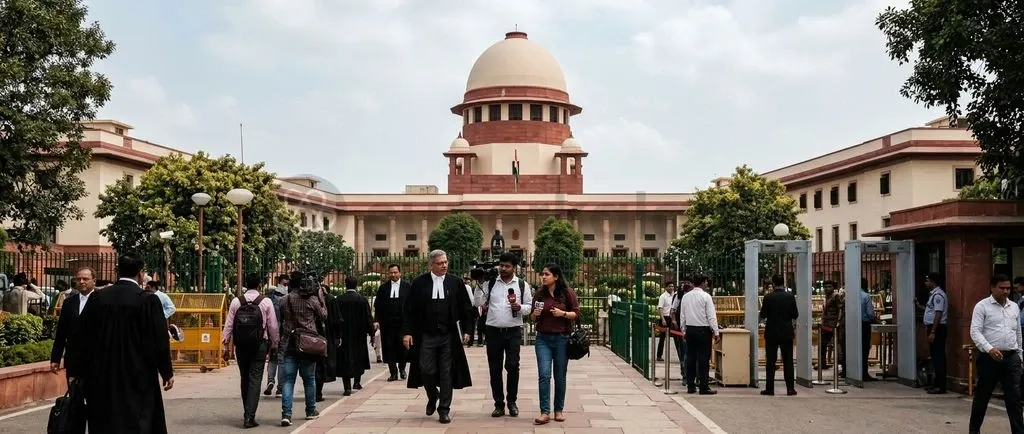
Open justice requires visible and accessible judicial proceedings. Yet, formal entry passes do not guarantee substantive equality for women reporting from the Supreme Court of India.
Deep-seated infrastructural deficits, legacy accreditation thresholds, and male-dominated corridors still constrain women correspondents. Constitutional guarantees under Article 19(1)(a) must work alongside substantive equality under Article 14 and affirmative protections under Article 15(3). Dismantling institutional gatekeeping requires moving past nominal badges toward physical safety, transparent norms, and equal working space.
Why in the News?
The Supreme Court of India faces renewed scrutiny over procedural and physical barriers confronting legal correspondents. Two recent developments brought this debate to the fore:
- Removal of degree requirement: As of October 2024, the Supreme Court administration formally eliminated the mandatory law degree requirement for legal correspondent accreditation, an administrative reform announced by the Chief Justice of India that broadened eligibility beyond legally trained reporters.
- Constitutional litigation on access: Rejoinder submissions in Network of Women in Media, India (NWMI) v. Union of India before the Supreme Court argued that gathering news cannot depend entirely on state accreditation or institutional employment.
These shifts question whether apex court reporting spaces offer genuine substantive access or merely nominal clearance.
Why Apex Court Access Goes Beyond Issuing Entry Passes
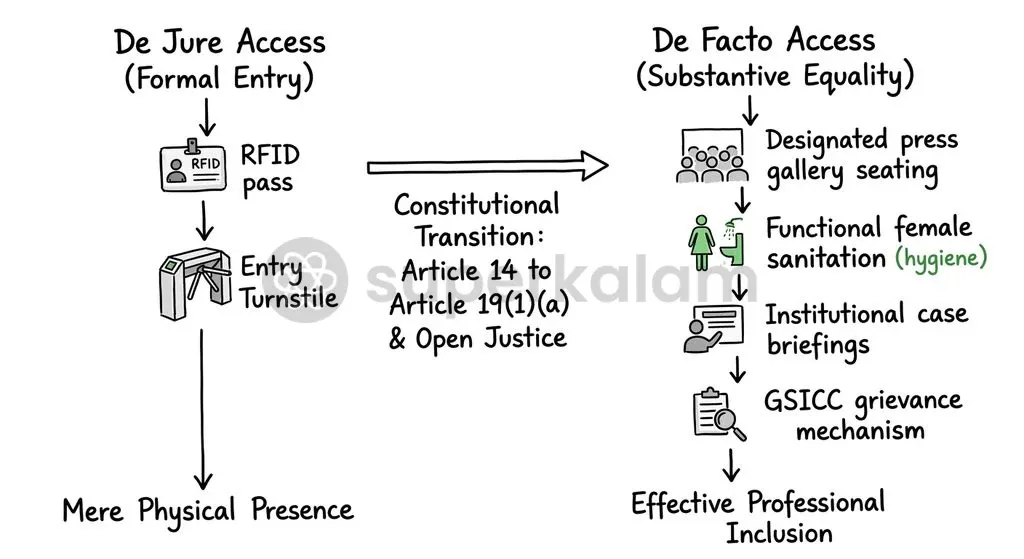
The Supreme Court of India is both a constitutional court and an everyday workplace for dozens of accredited reporters. A sharp divide separates formal entry from genuine professional access inside courtrooms:
- De jure clearance: Radio-frequency identification cards and temporary passes clear perimeter gates without ensuring safety.
- De facto exclusion: Congestion, physical intimidation, and space crunches inside courtrooms impede real-time work.
The Supreme Court acknowledged these conditions when notifying the Gender Sensitisation and Sexual Harassment of Women at the Supreme Court of India (Prevention, Prohibition and Redressal) Regulations, 2013. Physical entry cards alone cannot protect bodily safety and dignity in packed corridors. Substantive equality requires that female reporters cover high-stakes hearings without enduring regular harassment or physical displacement.
Discuss with Superkalam
Which landmark 1966 judgment first affirmed that court reporters act as an indispensable link between the public and open court hearings?
Ask NowHow Court Accreditation Rules Function as Structural Filters
The Supreme Court Press Gallery Accreditation Guidelines historically applied restrictive qualifying thresholds. Under the earlier accreditation norms, an applicant needed a recognised law degree and seven years of professional experience. Although the administration dropped the law degree prerequisite in October 2024, strict institutional filters remain.
| Regulatory Feature | Old Norms (Pre-October 2024) | Current Framework (Post-October 2024) | Gender & Diversity Impact |
|---|---|---|---|
| Academic Prerequisite | Mandatory recognised Bachelor of Laws (LL.B.) degree | Law degree requirement formally removed by administrative decision | Broadens baseline eligibility for generalist women journalists |
| Experience Requirement | Seven years of professional experience | Multi-year continuous legal journalism tenure retained | Disadvantages early-career reporters facing career breaks |
| Media Quota Ceilings | Capped accreditations per media house based on print circulation thresholds | Organisational quota caps and circulation benchmarks enforced | Constrains digital-first and freelance platforms where women lead |
| Digital Media Ingress | Highly restricted; prioritised legacy national print dailies and wire agencies | Modest digital accommodation, but print thresholds remain predominant | Limits independent investigative platforms and non-traditional legal commentators |
Registry accreditation norms still enforce strict organisational quotas and circulation floors on media houses. These quantitative thresholds penalise freelance reporters and digital-first outlets, where women journalists often work. Legacy media organisations historically assign court beats to senior male journalists, so inflexible quotas perpetuate indirect institutional exclusion against independent women reporters.
Discuss with Superkalam
How does the concept of substantive equality under Articles 14 and 15(3) differ from formal equality in the context of court entry passes?
Ask NowInfrastructural and Physical Barriers Inside Court Corridors
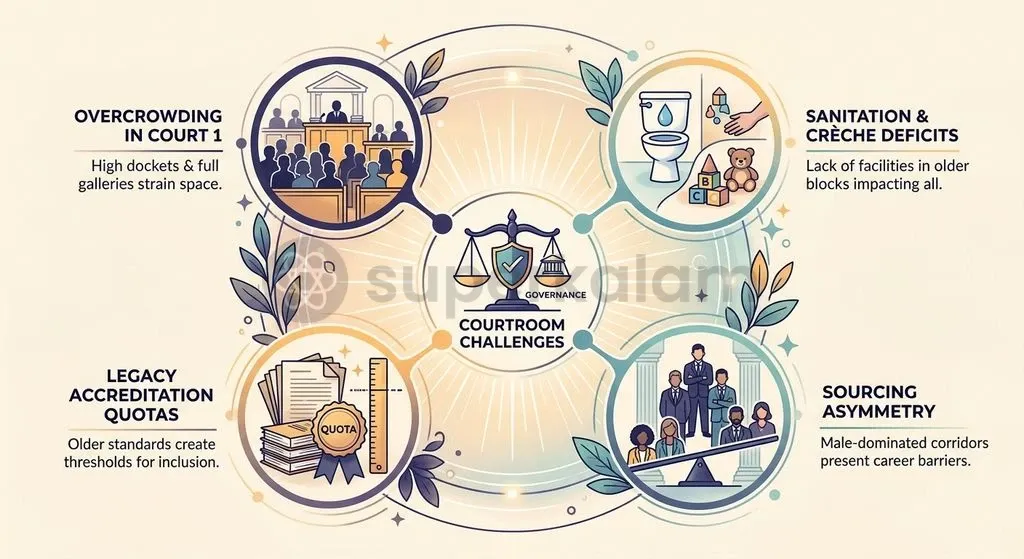
The Chief Justice's Courtroom (Court 1) regularly faces extreme overcrowding during constitutional hearings and urgent motion lists. Structural appraisals reveal two pressing logistical barriers:
- Courtroom spatial crushing: Press gallery management reports indicate that intense crushing in Court 1 endangers journalists, leaving women reporters exposed to physical jostling without dedicated, enforced press seating.
- Sanitation and rest shortfalls: Older architectural wings lack sufficient hygienic washrooms and designated rest areas for female journalists, while limited crèche support strains those spending ten to twelve continuous hours on campus.
When high-profile matters begin, the surge of advocates, clerks, and interns easily displaces journalists. Clean amenities and secure spaces are not optional luxuries; they form the indispensable physical foundation of an equitable workplace.
Discuss with Superkalam
Break down the ways in which informal corridor networking between the Bar and the Bench creates information asymmetry for non-traditional journalists.
Ask NowMale-Dominated Bar-Bench Culture and the Sourcing Disadvantage
The Supreme Court Bar Association (SCBA) and informal corridor networks remain overwhelmingly male. Research by the Centre for Law and Policy Research indicates that informal patriarchal circles inside advocate chambers and bar lounges operate as informal clearing houses for key legal documents. Senior litigators frequently share unredacted petitions, written arguments, and prompt order clarifications through networks that rarely include women reporters.
This dynamic creates marked information asymmetry during daily reporting cycles:
- Corridor gatekeeping: Vital updates and strategic litigation filings circulate within informal social networks before official registry uploads.
- Access to senior counsel: Evening chamber briefings frequently occur in male-centric spaces, impeding women journalists who face mobility and safety constraints.
- Clarification disparities: Rapid bench observations require swift verification with arguing counsel, where established male camaraderie often secures immediate briefings at the cost of excluded peers.
Informal networks distort fair reporting by making daily legal journalism rely on exclusionary social capital rather than objective professional work.
Constitutional Dimensions: From Formal Equality to Substantive Inclusion
The Constitution of India secures courtroom journalism through intersecting fundamental rights:
- Article 19(1)(a): Guarantees freedom of speech and expression, incorporating press freedom and the citizen's right to receive information on judicial proceedings.
- Article 19(1)(g): Protects the professional right to practise legal journalism free from arbitrary administrative barriers.
- Articles 14 and 15(3): Demands substantive equality rather than formal symmetry, empowering the court administration to adopt affirmative measures that eliminate indirect systemic discrimination.
- Article 21: Requires judicial authorities to protect the dignity and bodily integrity of women legal reporters within court precincts.
Facially neutral policies that disproportionately burden women violate substantive equality. The judiciary must actively dismantle informal structural impediments to honour these constitutional guarantees.
Discuss with Superkalam
What administrative reforms would you propose to ensure Supreme Court press accreditation accommodates freelance and digital journalists while preserving courtroom decorum?
Ask NowOpen Justice Precedents: From Naresh Mirajkar to Swapnil Tripathi
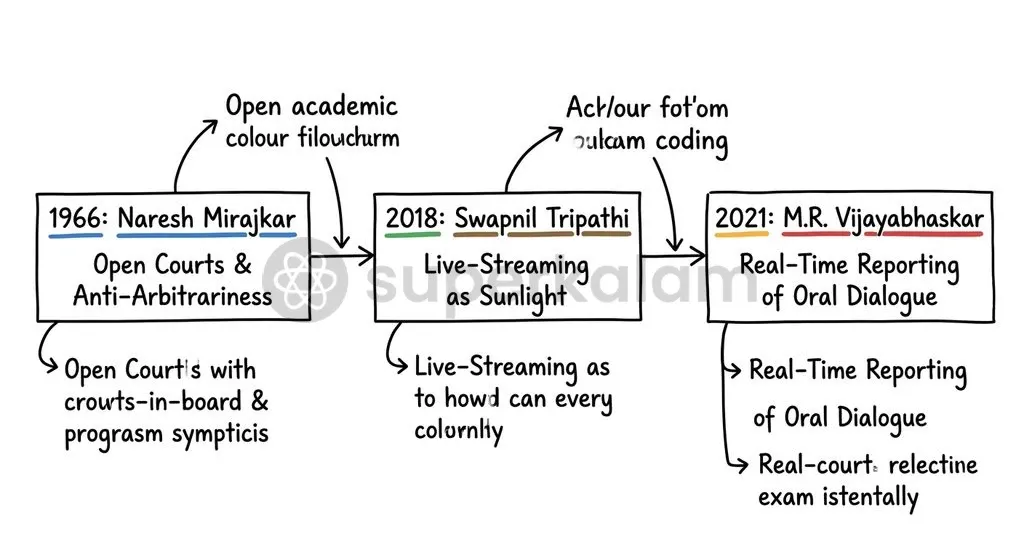
The Supreme Court has long maintained that public scrutiny anchors judicial integrity. In Naresh Shridhar Mirajkar v. State of Maharashtra (1966), a nine-judge Constitution Bench ruled that public trials prevent judicial caprice and foster public confidence. The bench held that the court reporter acts as an indispensable link through whom citizens witness legal proceedings.
In Swapnil Tripathi v. Supreme Court of India (2018), a three-judge Bench affirmed that "sunlight is the best disinfectant," extending open justice to visual and technological reach via digital streaming. Chief Election Commissioner of India v. M.R. Vijayabhaskar (2021) expanded this framework further, holding that Article 19(1)(a) protects real-time reporting of courtroom oral remarks and exchanges between judges and counsel.
| Precedent | Coram / Bench | Core Constitutional Ratio | Impact on Press & Open Justice |
|---|---|---|---|
| Naresh Shridhar Mirajkar v. State of Maharashtra (1966) | 9-Judge Constitution Bench | Open court hearings prevent judicial arbitrariness; public justice is the rule | Confirmed court reporters operate as indispensable public watchdogs |
| Swapnil Tripathi v. Supreme Court of India (2018) | 3-Judge Bench | Public access must evolve technologically; sunlight is the ultimate disinfectant | Mandated live-streaming and widened physical and digital ingress |
| Chief Election Commissioner v. M.R. Vijayabhaskar (2021) | 2-Judge Bench | Real-time reporting of bench oral remarks is protected under Article 19(1)(a) | Validated digital and social media live-tweeting from inside courtrooms |
Steps to Build a Gender-Inclusive Supreme Court Press Corps
The Gender Sensitisation and Internal Complaints Committee (GSICC) is the apex judicial forum addressing harassment in the Supreme Court. Established under Regulation 4 of the 2013 Regulations, the Chief Justice of India reconstitutes the GSICC with a sitting woman Supreme Court judge as Chairperson and a statutory female majority.
While the GSICC provides formal grievance redress, operational reforms must improve the everyday reporting environment:
- Infrastructural safety audits: Court administration guidelines recommend regular safety reviews to inspect corridor movement, reserve working desks, and expand modern washrooms across court wings.
- Digital transparency: Supreme Court e-Committee reforms urge standardised digital passes, clear online accreditation thresholds, and prompt Registry press statements to curb informal gatekeeping.
Targeted space allocations and structured information flows ensure that open justice remains truly inclusive for all court correspondents.
Key Takeaways
- De jure access through entry cards does not guarantee substantive equality or safety for female reporters, leaving an administrative gap within court precincts.
- The Supreme Court administration eliminated the mandatory law degree barrier in October 2024, yet rigid organizational quotas continue to constrain freelance and digital-first women journalists.
- Severe physical overcrowding in Court 1 during Constitution Bench hearings poses safety risks, compounded by inadequate sanitation and rest facilities in heritage court wings.
- The open justice doctrine evolved from Naresh Mirajkar (1966) through Swapnil Tripathi (2018) to M.R. Vijayabhaskar (2021), anchoring real-time courtroom reporting within Article 19(1)(a).
- Reconciling open justice with substantive equality requires applying Article 14 and Article 15(3) through comprehensive gender safety audits, transparent digital accreditation, and active institutional anti-harassment safeguards via the GSICC.
Mains Question
'Formal accreditation and de jure perimeter entry do not automatically translate into substantive equality for women reporting from constitutional courts.' In light of infrastructural shortfalls and male-dominated bar-bench networks, examine this statement. (10 Marks)
Evaluate NowMains Question
'Open justice requires not merely the absence of judicial arbitrariness, but actively ensuring that court reporting is inclusive, accessible, and safe.' Trace the evolution of the open justice doctrine from Naresh Mirajkar to Swapnil Tripathi and M.R. Vijayabhaskar, and critically analyse the systemic barriers that impede its realization for women journalists. (15 Marks)
Evaluate NowPractice MCQs
QUESTION 1
Regarding legal precedents concerning open justice and courtroom reporting in India, consider the following statements:
- In Naresh Shridhar Mirajkar v. State of Maharashtra (1966), a nine-judge Constitution Bench held that public trials prevent judicial caprice and foster public confidence.
- In Swapnil Tripathi v. Supreme Court of India (2018), the Supreme Court mandated live-streaming of proceedings, noting that sunlight is the best disinfectant.
- In Chief Election Commissioner of India v. M.R. Vijayabhaskar (2021), the court held that Article 19(1)(a) protects real-time reporting of courtroom oral remarks. Which of the statements given above are correct?
QUESTION 2
With reference to the Supreme Court of India's norms for the accreditation of legal correspondents, consider the following statements:
- In October 2024, the Supreme Court administration eliminated the mandatory law degree requirement for legal correspondent accreditation.
- Under the earlier accreditation norms, an applicant required a recognised law degree and seven years of professional experience.
- Registry accreditation norms have completely eliminated media quota ceilings and circulation thresholds for print organisations. Which of the statements given above is/are correct?
QUESTION 3
Consider the following statements regarding the constitutional framework governing court reporting and professional access in India:
- The citizen's right to receive information regarding judicial proceedings is incorporated under Article 19(1)(a).
- Article 15(3) empowers court administration to take affirmative measures to dismantle indirect systemic discrimination against women.
- Protection of bodily integrity and dignity of women journalists within court premises is derived from Article 21. Which of the statements given above is/are correct?
QUESTION 4
Which of the following regulations was notified by the Supreme Court of India in 2013 to address safety and dignity within its precincts?
QUESTION 5
With reference to the practical and structural constraints faced by women correspondents inside the Supreme Court of India, consider the following statements:
- Digital-first and freelance platforms, where women reporters are frequently represented, face constraints due to quantitative organisational quota ceilings based on print circulation.
- Informal male-dominated networks in advocate chambers and bar lounges lead to information asymmetry regarding strategic filings and prompt order clarifications. Which of the statements given above is/are correct?