CAQM 2027 Clean Air Mandate: Moving Beyond GRAP in Delhi-NCR
As episodic emergency curbs fail to clean Delhi's skies, CAQM places direct legal accountability on district collectors for year-round baseline pollution cuts.
Nov, 2026
•11 min read
Overview
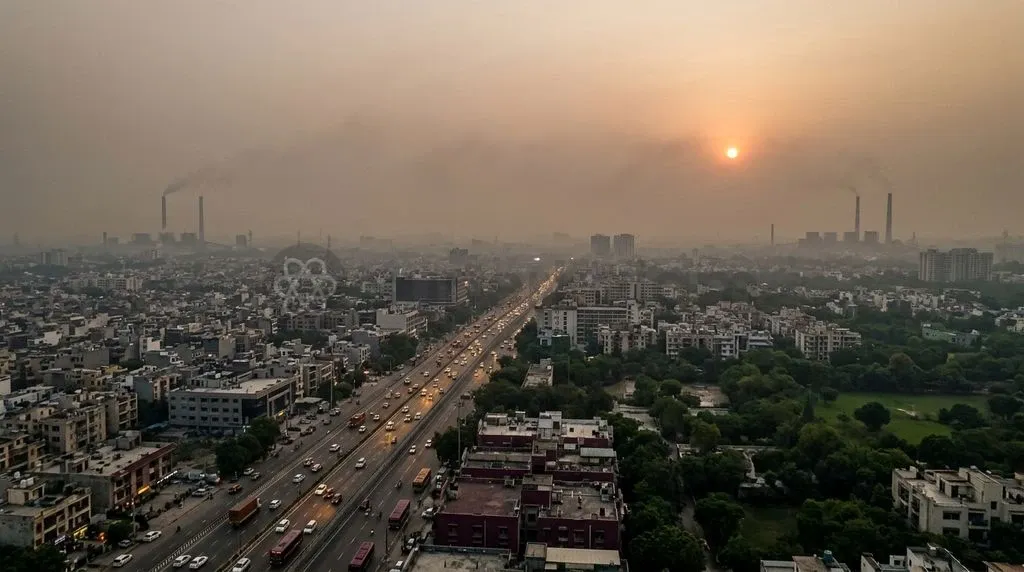
On 18 November 2026, the Commission for Air Quality Management issued a statutory order mandating decentralised, district-level clean air action plans for 2027 across the National Capital Region. The directive marks a structural shift away from reactive winter emergency bans toward year-round baseline emissions management.
By establishing legally enforceable targets to cut annual particulate pollution by 15% to 20% in 2027 relative to 2026, the regulator aims to tackle institutional inertia across the NCR airshed. Achieving these outcomes will test whether municipal accountability and cross-border enforcement can overcome persistent structural deficits.
Why in the News? The Shift to District-Level Air Quality Planning
The Commission for Air Quality Management ordered the preparation of the Annual Action Plan-2027 on 18 November 2026, introducing decentralised district-level clean air plans across the National Capital Region for the first time.
The order instructs state governments in Delhi, Haryana, Uttar Pradesh, and Rajasthan to enforce specific compliance baselines:
- Micro-Plan Submission: Municipal corporations and District Magistrates must upload their local plans to the CAQM portal by 5 December 2026.
- Pollution Reduction Baselines: Authorities must cut annual average levels of AQI, PM2.5, and PM10 by 15% to 20% in 2027 compared to 2026 levels.
- Personal Administrative Liability: Every intervention across municipal wards and districts must assign operational officers by name and designation to eliminate bureaucratic evasion.
Discuss with Superkalam
Recall the exact percentage range by which the CAQM mandates the reduction of annual average AQI, PM2.5, and PM10 in 2027 compared to 2026.
Ask NowWhat Is the CAQM and How Does It Regulate Delhi-NCR's Airshed?
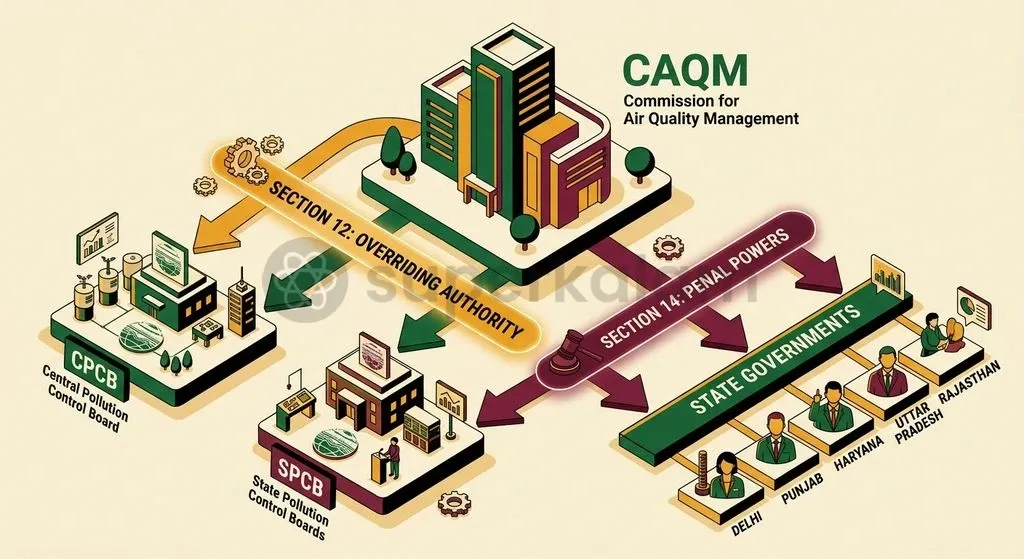
The Commission for Air Quality Management is a permanent statutory body constituted under the Commission for Air Quality Management in National Capital Region and Adjoining Areas Act, 2021 (Act No. 29 of 2021). This statute dissolved the Supreme Court-constituted Environment Pollution (Prevention and Control) Authority, which had functioned since 1998. Unlike its ad-hoc predecessor, the Commission holds direct legislative authority over the transboundary airshed spanning Delhi, Punjab, Haryana, Uttar Pradesh, and Rajasthan.
Section 12 gives the Commission overriding powers over conflicting directions issued by other statutory regulators. Its binding orders supersede directives issued by the Central Pollution Control Board, State Pollution Control Boards, and state governments across the NCR airshed.
The Commission also holds penal powers under Section 14 to address contraventions and non-compliance. However, the proviso to Section 14(1) explicitly exempts farmers from criminal imprisonment for stubble burning, restricting their liability to Environmental Compensation under Section 15.
| Statutory Dimension | Legal Provision & Scope |
|---|---|
| **Governing Statute** | CAQM in NCR and Adjoining Areas Act, 2021 (Act No. 29 of 2021) |
| **Predecessor Body** | Dissolved EPCA (constituted 1998 under Environment Protection Act, 1986) |
| **Jurisdictional Reach** | Delhi, Punjab, Haryana, Uttar Pradesh, and Rajasthan |
| **Supremacy Clause** | Section 12 directions override CPCB, SPCBs, and State Governments |
| **Farmer Liability Limit** | Proviso to Section 14(1) bars imprisonment; limits penal action to Sec 15 EC |
Why Did GRAP Fall Short? The Flaws of Episodic Crisis Management
The Graded Response Action Plan was notified by the Ministry of Environment, Forest and Climate Change in January 2017 following Supreme Court directions in M.C. Mehta v. Union of India (2016). GRAP is an episodic emergency protocol structured into four stages triggered by specific Air Quality Index thresholds. While designed to prevent severe public health crises during winter meteorological inversions, GRAP relies entirely on temporary prohibitions.
These episodic emergency prohibitions leave Delhi's underlying toxic baseline unaffected:
- Persistent Ambient Toxicity: Delhi's winter average AQI remained elevated between 280 and 295 despite successive emergency interventions.
- Routine Crisis Triggers: Over 75% of winter days required emergency Stage II or higher curbs, showing that emergency exceptions became the operative norm.
- Unaddressed Baseline Sources: Reactive bans trigger severe economic disruption for informal daily-wage construction workers while leaving unpaved road dust, non-winter industrial emissions, and steady vehicular growth unchecked.
Discuss with Superkalam
Explain why emergency episodic curbs under GRAP failed to lower Delhi's baseline ambient air toxicity across successive winter seasons.
Ask NowInside the 2027 Directive: Key Targets, Timelines, and Sectoral Mandates
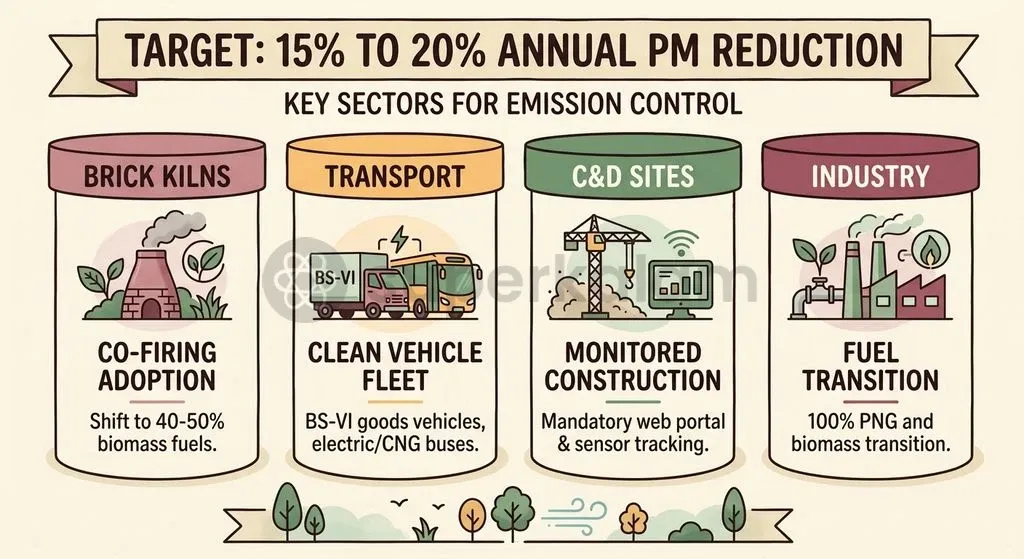
The CAQM's November 2026 framework establishes targeted mandates across key polluting sectors to secure structural reductions across the NCR airshed:
- Targeted Pollution Reduction: Requires a 15% to 20% reduction in annual average AQI, PM2.5, and PM10 concentrations across Delhi-NCR in 2027 relative to 2026 baselines.
- Biomass Co-firing in Brick Kilns: Under CAQM Direction No. 92, all brick kilns in Punjab and non-NCR Haryana must co-fire paddy-straw biomass pellets at 40% by 1 November 2027 and 50% by 1 November 2028.
- Commercial Fleet Clean-Fuel Restrictions: CAQM Direction No. 88 bans the entry of light, medium, and heavy goods vehicles below Bharat Stage VI (BS-VI) standards into the National Capital Territory of Delhi.
- Inter-State Bus Fleet Transition: Under CAQM Direction No. 93, all inter-state passenger buses entering Delhi, including All India Tourist Permit vehicles, must operate strictly on Electric, CNG, or BS-VI Diesel propulsion.
- C&D Digital Surveillance: Projects covering plot sizes of 500 square metres or larger must register on a centralised state web portal and deploy continuous video surveillance alongside automated dust sensors.
- Industrial Fuel Substitution: Prohibits heavily polluting fuels such as furnace oil, pet coke, and raw coal across NCR, requiring a 100% transition to Piped Natural Gas or approved biomass fuels.
| Sector / Domain | Binding Regulatory Mandate | Enforcement Timeline |
|---|---|---|
| **Airshed Particulates** | 15% to 20% annual cut in AQI, PM2.5, and PM10 | Baseline year 2027 vs 2026 |
| **Brick Kiln Co-firing** | 40% to 50% paddy-straw biomass pellet blending | 1 Nov 2027 & 1 Nov 2028 |
| **Goods Vehicle Entry** | Mandatory BS-VI compliance for LGV/MGV/HGV | CAQM Direction No. 88 |
| **Inter-State Buses** | Mandatory Electric, CNG, or BS-VI Diesel | CAQM Direction No. 93 |
| **C&D Plot Management** | Portal registration, webcams, and dust sensors | Mandatory for plots >= 500m² |
| **Industrial Operations** | 100% PNG or approved biomass; zero dirty fuel | Absolute NCR-wide ban |
Emergency Reaction vs. Baseline Mitigation: How the Approaches Differ
The Graded Response Action Plan treats air pollution as an episodic public health emergency, relying on reactive restrictions that take effect only after ambient toxicity rises. In contrast, the CAQM 2027 directive approaches air pollution as a continuous structural failure requiring decentralised, year-round mitigation.
| Dimension | Graded Response Action Plan (GRAP) | CAQM 2027 District Action Plans |
|---|---|---|
| **Statutory Origin** | MoEFCC notification (2017) pursuant to *M.C. Mehta (2016)* | Mandate under CAQM Act, 2021 (Act No. 29 of 2021) |
| **Operational Philosophy** | Episodic crisis management triggered by seasonal spikes | Preventative, continuous year-round source reduction |
| **Governance Unit** | Centralised, state-wide declarations across NCR | Decentralised, ward-level and district-level execution |
| **Accountability Model** | Diffuse institutional responsibility without personal liability | Officers identified by name and designation in plans |
| **Core Mechanisms** | Emergency construction bans, vehicle curbs, diesel genset limits | Industrial PNG shifts, bus electrification, kiln co-firing |
| **Baseline Target** | No percentage targets for annual ambient concentrations | Enforceable 15% to 20% cuts in annual average particulates |
Discuss with Superkalam
If you were a District Magistrate in NCR, how would you operationalise the CAQM requirement of assigning personal administrative liability by name and designation?
Ask NowStructural Challenges: Inter-State Coordination and Local Governance Deficits
The CAQM’s mandate faces deep friction within India’s federal structure, where political boundaries divide a single meteorological airshed. Under the Gazette of India notification G.S.R. 690(E) dated 6 November 2024, the central government doubled environmental compensation penalties on farmers to up to ₹30,000 for holdings exceeding five acres.
Yet agricultural burnings continued unabated. By mid-November 2026, Punjab recorded 5,972 paddy stubble burning incidents, exceeding the 5,114 fires recorded during the entire 2025 season. This surge prompted the Commission to issue Section 14 show-cause notices to six district administrations.
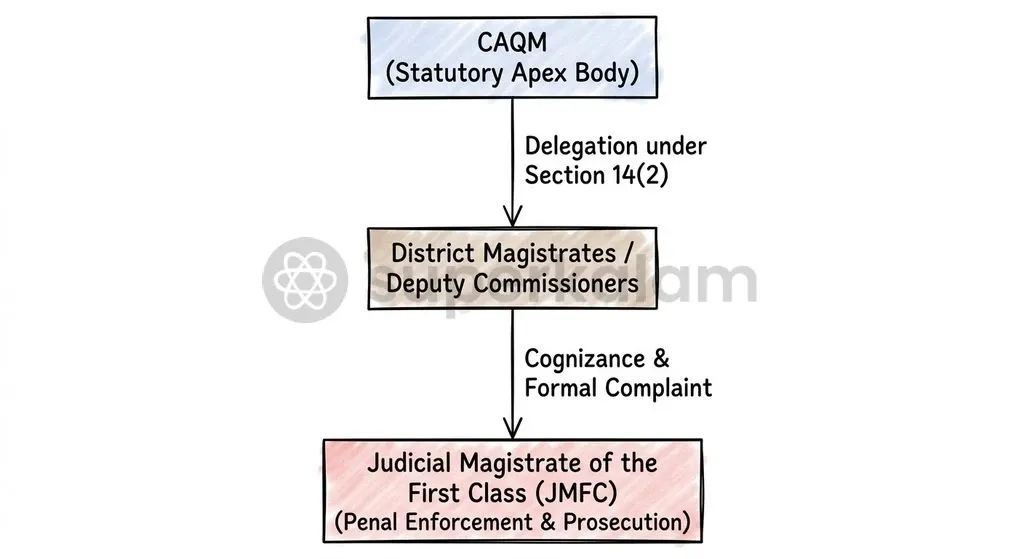
Weak administrative prosecution compounds these enforcement failures. In October and November 2024, the Supreme Court pulled up Punjab and Haryana for zero criminal prosecutions under Section 14 of the CAQM Act against defaulting government officials. The Commission subsequently delegated powers under Section 14(2) to District Magistrates and Deputy Commissioners to file criminal complaints before Judicial Magistrates.
- Delegation: State Chief Secretary and CAQM Commission delegate prosecution powers under Section 14(2).
- Magisterial Complaint: District Magistrates and Deputy Commissioners initiate complaints against non-compliant officials.
- Judicial Cognisance: First Class Judicial Magistrates take cognisance of administrative dereliction.
- Penal Adjudication: Regular criminal trial leading to penal accountability and sentencing.
Local administrative deficits further undermine execution across urban local bodies. An official CAQM review revealed that as of 31 October 2026, only 44 of the 72 new Continuous Ambient Air Quality Monitoring Stations planned for 2026 were installed across NCR, with Haryana installing zero of its 23 targeted stations. In Delhi, where 46 to 52 CAAQMS stations operate, coverage falls short of the roughly 60 stations required under CAQM grid benchmarking to eliminate spatial blind spots.
Constitutional Dimensions: Right to Clean Air as a Fundamental Right
Judicial interpretation of the Indian Constitution has placed ecological integrity within the framework of fundamental rights. In Subhash Kumar v. State of Bihar (1991), the Supreme Court ruled that the right to life under Article 21 includes the right to enjoy pollution-free air and water. This judicial stance transformed environmental protection from a non-justiciable Directive Principle under Article 48A into an enforceable fundamental right under Part III.
| Case Citation | Year | Doctrinal Principle Established |
|---|---|---|
| **Subhash Kumar v. Bihar** | 1991 | Expands Article 21 Right to Life to encompass pollution-free air |
| **M.C. Mehta v. Kamal Nath** | 1997 | Inscribes Public Trust Doctrine; State holds air in sovereign trust |
| **M.K. Ranjitsinh v. UOI** | 2024 | Derives right against climate change degradation from Arts 14 & 21 |
In M.C. Mehta v. Kamal Nath (1997), the Supreme Court expanded this doctrine by embedding the Public Trust Doctrine into Indian environmental law. The doctrine dictates that ambient environmental commons like clean air are held by the state in fiduciary trust for citizens and cannot be transferred to private commercial interests.
This constitutional jurisprudence was further reinforced in M.K. Ranjitsinh v. Union of India (2024), where the Court linked the right to be free from adverse climate impacts directly to Articles 14 and 21. When municipal bodies fail to implement air action plans, they breach both statutory mandates and core constitutional guarantees.
Discuss with Superkalam
Analyse the institutional and legal factors that limit the effectiveness of Section 12 statutory supremacy when addressing transboundary agricultural stubble burning.
Ask NowThe Way Forward: Building a Cohesive, Multi-Sector Airshed Strategy
Addressing transboundary pollution across the Indo-Gangetic Plain requires moving beyond fragmented administrative declarations:
- Operationalising Bureaucratic Accountability: District Magistrates must exercise their delegated Section 14(2) powers by filing criminal complaints against officials who fail to enforce industrial fuel prohibitions, dust controls, and burning bans.
- Expanding Grid-Based Monitoring Networks: State governments must address CAAQMS installation shortfalls, particularly in Haryana and peripheral NCR districts, to eliminate spatial blind spots identified in CAQM reviews.
- Financing Crop-Residue Supply Chains: Stubble management should transition from punitive compensation toward market incentives by scaling up paddy-pellet co-firing in brick kilns under Direction No. 92.
- Targeting Municipal Road Dust: Urban local bodies must allocate municipal green funds to mechanised sweepers, end-to-end paving, and daily water-sprinkling networks across dense transit corridors.
- Harmonising Regional Public Transit: Transport authorities across Delhi, Haryana, UP, and Rajasthan must accelerate the shift of public buses to Electric, CNG, and BS-VI propulsion required under Direction No. 93.
Key Takeaways
- The CAQM 2027 directive mandates decentralised, district-level clean air plans to cut annual average particulate concentrations by 15% to 20% in 2027 relative to 2026 baselines.
- The CAQM holds statutory supremacy under Section 12 of the CAQM Act, 2021, allowing its directions to override conflicting orders from state pollution control boards and state governments.
- GRAP's episodic crisis curbs left structural emissions unchanged, with winter AQI in Delhi averaging 280 to 295 and over 75% of winter days requiring emergency curbs.
- The regulatory framework combines mandatory C&D portal registrations, a total ban on dirty industrial fuels, BS-VI standards for commercial goods vehicles, and phased biomass pellet co-firing in brick kilns.
- Landmark Supreme Court jurisprudence, from Subhash Kumar (1991) to M.K. Ranjitsinh (2024), anchors the right to clean air directly within the fundamental guarantees of Articles 14 and 21.
Mains Question
"The Graded Response Action Plan (GRAP) operates on episodic emergency prohibitions that leave the underlying ambient toxicity unaddressed." In light of this statement, critically examine how the CAQM Annual Action Plan-2027 marks a structural departure toward decentralised baseline mitigation in the NCR airshed. (15 Marks)
Evaluate NowMains Question
"Section 12 of the CAQM Act vests the Commission with overriding statutory authority, yet transboundary air quality management continues to face friction within India's federal framework." Evaluate. (10 Marks)
Evaluate NowPractice MCQs
QUESTION 1
With reference to the Commission for Air Quality Management in National Capital Region and Adjoining Areas Act, 2021, consider the following statements:
- The Commission exercises statutory jurisdiction across the transboundary airshed spanning Delhi, Punjab, Haryana, Uttar Pradesh, and Rajasthan.
- Under Section 12 of the Act, directions issued by the Commission supersede conflicting orders issued by the Central Pollution Control Board and State Pollution Control Boards.
- The proviso to Section 14(1) imposes mandatory criminal imprisonment on farmers who engage in stubble burning.
Which of the statements given above is/are correct?
QUESTION 2
Regarding the sectoral mandates and directives issued by the Commission for Air Quality Management (CAQM), consider the following statements:
- Brick kilns in Punjab and non-NCR Haryana are mandated to co-fire paddy-straw biomass pellets at 40% by November 2027 and 50% by November 2028.
- All goods vehicles entering the National Capital Territory of Delhi must comply with Bharat Stage VI (BS-VI) standards under Direction No. 88.
- Centralised portal registration and dust sensor deployment are mandatory only for construction and demolition (C&D) projects with plot sizes exceeding 5,000 square metres.
Which of the statements given above are correct?
QUESTION 3
Consider the following statements comparing the Graded Response Action Plan (GRAP) with the CAQM Annual Action Plan-2027 framework:
- GRAP functions as an episodic emergency response triggered by Air Quality Index thresholds, whereas the 2027 plans focus on year-round baseline mitigation.
- Unlike GRAP, the 2027 district-level plans enforce accountability by requiring operational officers to be identified by name and designation.
- The 2027 mandate sets a legally enforceable target to reduce annual average AQI, PM2.5, and PM10 concentrations by 15% to 20% compared to 2026 levels.
Which of the statements given above is/are correct?
QUESTION 4
The Graded Response Action Plan (GRAP) for the National Capital Region was notified by the Ministry of Environment, Forest and Climate Change in 2017 pursuant to directives issued in which of the following Supreme Court cases?
QUESTION 5
Under Gazette notification G.S.R. 690(E) and the provisions of the CAQM Act, what is the maximum Environmental Compensation penalty leviable on farmers with landholdings exceeding five acres for stubble burning?
Discuss with Superkalam
Weigh the efficacy of raising fiscal penalties up to ₹30,000 versus providing technological or biomass co-firing solutions to halt farm fires, and propose a viable enforcement strategy.
Ask Now