SEBI FPI Norms Overhaul: Balancing Capital Inflows and Market Surveillance
Balancing market liquidity against corporate surveillance, SEBI's shift from strict disclosure mandates highlights India's evolving capital diplomacy.
Nov, 2026
•9 min read

Overview
The Securities and Exchange Board of India has proposed abolishing its Additional Disclosure Framework for Foreign Portfolio Investors to reconcile rigorous anti-evasion scrutiny with global asset allocation realities. Driven by substantial capital outflows exceeding ₹5.61 lakh crore between October 2024 and October 2026, the market regulator is recalibrating its supervisory perimeter toward standard international norms.
This structural transition is not regulatory backpedalling. Rather, it represents a strategic exercise in capital diplomacy designed to eliminate operational friction while preserving core statutory anti-money laundering safeguards. As India navigates shifting weights in benchmark equity indices, institutional flexibility has become necessary to sustain sovereign and pension allocations without compromising market integrity.
Why in the News: SEBI's Move to Recalibrate Foreign Portfolio Investor Rules
The Securities and Exchange Board of India published a consultation paper proposing to completely abolish the Additional Disclosure Framework for Foreign Portfolio Investors. The market regulator highlighted mounting operational friction and uncompetitive compliance burdens as primary rationales for reconsidering the regime.
The supervisory review addresses acute market pressures that developed over a two-year window:
- Persistent capital flight: Foreign portfolio investors pulled out more than ₹5.61 lakh crore from domestic equities between October 2024 and October 2026.
- Substantial market footprint: As of November 2026, foreign portfolio investors hold approximately 16% to 17% of total Indian listed equity capitalisation, representing an aggregate valuation of more than $800 billion.
Sustained capital liquidations threatened secondary market stability. Consequently, the statutory regulator acted to balance domestic surveillance against international capital competitiveness.
Discuss with Superkalam
What are the two specific exposure triggers established by SEBI in August 2023 that subjected an FPI to granular look-through disclosures?
Ask NowThe Mechanism: What Are FPI Disclosure Norms and Beneficial Ownership Rules?
Foreign Portfolio Investor disclosure norms require offshore investment entities to declare the ultimate human beneficiaries controlling their pooled capital structures. The market regulator established this regime via circular under Regulations 22(6) and 22(7) of the SEBI (FPI) Regulations, 2019. The framework mandated full look-through beneficial ownership disclosure down to natural persons without granting any materiality exemption thresholds.
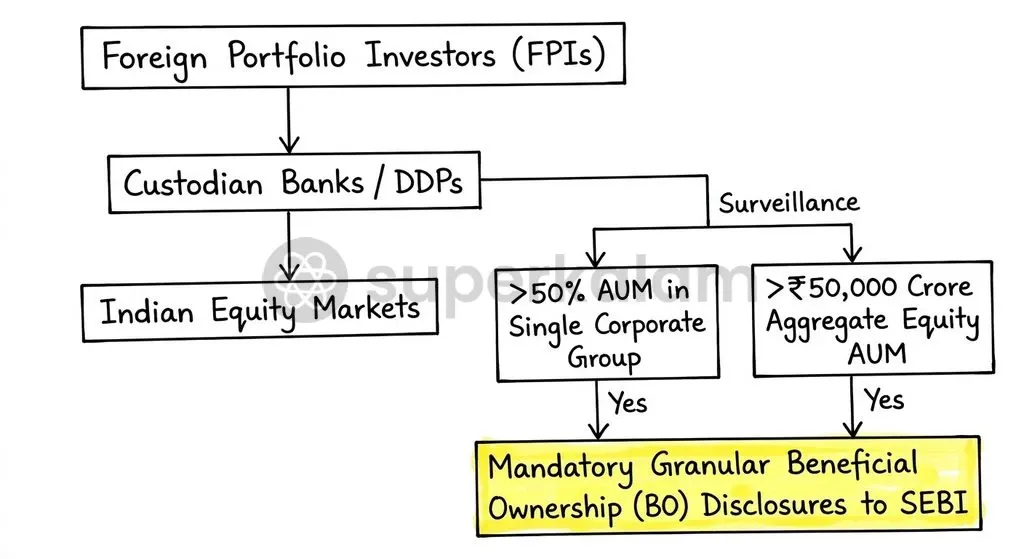
The August 2023 directives instituted two objective operational triggers to identify concentrated exposure:
- Group Concentration Trigger: An investment vehicle allocating more than 50% of its Indian equity AUM into a single domestic corporate group.
- Aggregate Scale Trigger: An offshore fund holding over ₹25,000 crore in domestic equity assets, whether individually or jointly across an affiliated investor group.
The Securities and Exchange Board of India subsequently doubled the size-based exposure trigger to ₹50,000 crore of equity AUM via a circular issued in April 2025. The primary enforcement objective focused on preventing promoters from using opaque offshore structures to bypass the mandatory 25% Minimum Public Shareholding rule established under Rules 19(2)(b) and 19A of the Securities Contracts (Regulation) Rules, 1957. A secondary mandate targeted the circumvention of DPIIT Press Note 3 of 2020, which demands mandatory government approval for investments originating from nations sharing land borders with India.
The Macro Push: India's Expanding Index Weights in the Global Scramble for Capital
Global institutional allocators rely heavily on benchmark index weightings to distribute passive and active equity capital across developing nations. India's representation in the MSCI Emerging Markets Index peaked at approximately 21.2% in September 2024, marking a historic expansion of domestic sovereign footprint.
The subsequent phase brought intense international headwinds as global asset managers initiated major sector rotations. Capital reallocations toward artificial intelligence and semiconductor manufacturing hardware in East Asian economies reduced domestic index weightings to between 12% and 13% by mid-2026. The rapid drop in allocation highlighted the vulnerability of domestic financial markets to international liquidity movements.
Retaining long-term passive institutional inflows requires targeted structural solutions:
- Custodial clearing: Streamlined processing across domestic custodian banks.
- Depository onboarding: Accelerated entry pipelines for qualified global funds.
- Compliance predictability: Transparent rules aligned with standard international practices.
The regulator introduced the Single Window Automatic & Generalised Access for Trusted Foreign Investors framework to counter capital headwinds. The initiative accelerates onboarding turnaround periods to five business days for low-risk entities, including sovereign wealth funds, central banks, and regulated pension managers. Modern index competition demonstrates that rigid administrative requirements can depress institutional capital deployment during macroeconomic downturns.
Discuss with Superkalam
Explain why foreign multi-manager funds experienced operational friction complying with SEBI's zero-threshold beneficial ownership disclosure rules compared to FATF guidelines.
Ask NowSide-by-Side: Strict PMLA Anti-Evasion Mandates Versus the New Eased Directives
The Prevention of Money Laundering Act, 2002 governs the statutory baseline for financial transparency and beneficiary identification across Indian markets. Under Rule 9 of the Prevention of Money Laundering (Maintenance of Records) Rules, 2005, the Ministry of Finance reduced the general beneficial ownership threshold through 2023 amendments to 10% across companies, trusts, and partnership structures. The Additional Disclosure Framework superseded these baseline parameters by enforcing a zero-threshold look-through obligation on flagged offshore vehicles.
Major developed jurisdictions maintain far more relaxed investor identification benchmarks under international compliance compacts. Financial centres such as the United States, United Kingdom, Singapore, Japan, and Hong Kong enforce a 25% beneficial ownership threshold in alignment with FATF Recommendation 10. The divergence created severe cross-border friction, as foreign multi-manager funds struggled to extract complete personal records from passive underlying unit holders.
| Regulatory Parameter | Baseline Regime (PMLR / PMLA 2002) | Additional Disclosure Framework (August 2023) | Proposed Recalibrated Directives (2026) |
|---|---|---|---|
| Beneficial Ownership Threshold | 10% across companies, trusts, and partnerships | Full look-through disclosure with zero materiality threshold | Standard PMLA alignment; 25% FATF Recommendation 10 parity |
| Group Concentration Metric | General statutory disclosure of substantial holdings | Mandatory reporting if single-group exposure exceeds 50% of Indian equity AUM | Repeal of additional framework; reliance on periodic KYC verification |
| Scale-Based Trigger | Not applicable | Initially ₹25,000 crore; raised in 2025 to ₹50,000 crore Indian equity AUM | Complete abolition of dedicated asset-size trigger |
| Offshore Derivatives Treatment | Baseline registration norms | Mandatory dedicated registration; prohibition of exchange derivative hedging | Integrated risk surveillance without redundant granular disclosures |
| Onboarding Processing Speed | Variable multi-week verification cycles | Stringent look-through reviews causing prolonged operational delays | SWAGAT-FI fast-track processing within five business days for trusted funds |

Discuss with Superkalam
How might a sovereign wealth fund utilize the proposed SWAGAT-FI framework to manage portfolio rebalancing into Indian equities?
Ask NowThe Core Tension: Does Regulatory Flexibility Risk Round-Tripping and Shell Entities?
The primary regulatory dilemma lies in preventing illicit domestic capital from returning disguised as legitimate foreign portfolio investment. Round-tripping describes the financial manoeuvre where untaxed domestic funds are routed through offshore shell companies located in low-tax jurisdictions to purchase shares in domestic corporations. Unscrupulous corporate promoters historically exploited omnibus accounts to conceal actual ownership, thereby flouting the statutory 25% public float ceiling.
Judicial and appellate rulings have defined the boundaries of regulatory intervention in this domain:
- Supreme Court in Vishal Tiwari (2024): Held that omitting specific 'opaque structures' provisions in 2019 was justified because rules shifted to mandatory upfront beneficial ownership declarations under the Prevention of Money Laundering Rules.
- Supreme Court in Mahua Moitra (2026): Dismissed a plea seeking mandatory public disclosure of all ultimate beneficial owners, holding that no writ of mandamus lies without an enabling statutory framework.
- Securities Appellate Tribunal rulings: Upheld SEBI's authority to demand granular look-through disclosures during targeted enforcement actions involving entities like Elara India Opportunities Fund and Vespera Fund.
Discuss with Superkalam
Compare the risks of capital flight against the risks of corporate promoter round-tripping when relaxing FPI disclosure norms.
Ask NowPragmatic Diplomacy or Oversight Deficit? Evaluating Market Liquidity Against Investor Scrutiny
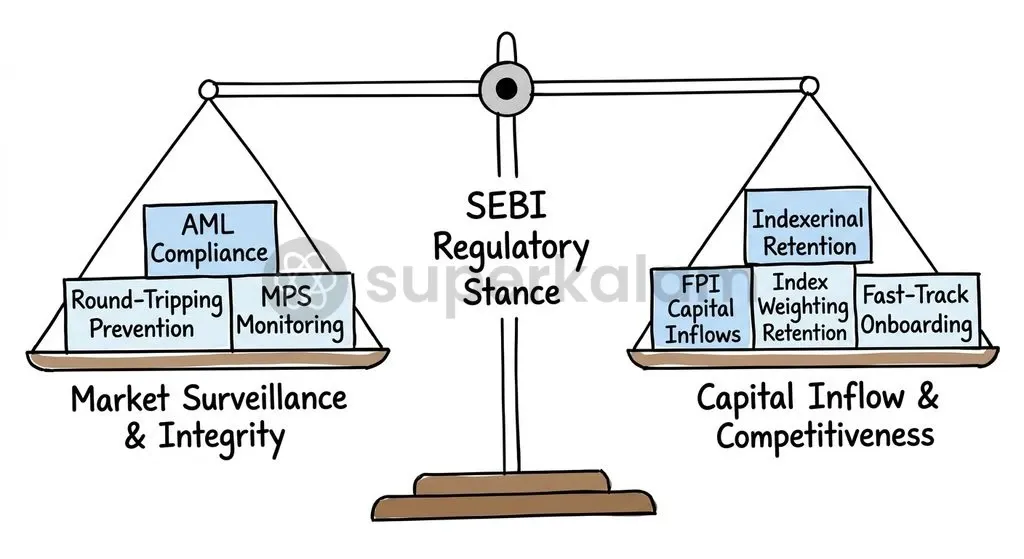
The policy debate divides financial market observers over whether regulatory relaxation compromises core surveillance or constitutes essential economic realpolitik. Sceptics contend that dismantling targeted disclosure mechanisms represents an oversight retreat that leaves stock prices vulnerable to corporate manipulation. When offshore pooled funds bypass granular scrutiny, regulatory agencies struggle to establish corporate concentration in real time.
Supporters counter that the original directives imposed an asymmetrical operational burden that isolated the domestic market from global liquidity pipelines. The market regulator systematically carved out exemptions prior to proposing full repeal, reflecting an ongoing process of empirical adjustments:
- Promoterless Corporate Groups: Carved out an exemption for offshore funds holding shares in corporate groups without an identifiable promoter, provided total holdings remained under 3% of apex equity.
- Endowments and Foundations: Exempted Category I University Funds and Endowments possessing global AUM above ₹10,000 crore and Indian equity exposure below 25%.
- KYC Review Harmonisation: Rationalised periodic Know Your Customer review timelines for low- and medium-risk funds in October 2026 to mitigate recurring documentation hurdles.
The proposed repeal does not extinguish core investor accountability. Foreign investors remain bound by statutory customer identification requirements and anti-money laundering reporting under the Prevention of Money Laundering Act, 2002. The regulatory recalibration reflects pragmatic capital diplomacy rather than institutional surrender, removing bespoke domestic friction to align supervisory mechanisms with the Financial Action Task Force architecture.
Discuss with Superkalam
Propose an alternative monitoring mechanism that SEBI could adopt to identify shell entity round-tripping without imposing onerous upfront disclosure thresholds on passive institutional funds.
Ask NowWay Forward: Building Predictable Guardrails to Secure Both Inflows and Market Integrity
A sustainable regulatory architecture must combine friction-free institutional entry with rigorous ex-post market surveillance. Complete reliance on ex-ante documentation creates operational gridlocks that deter long-term sovereign allocators and pension funds.
To balance supervision with competitiveness, the reform agenda focuses on three complementary pillars:
- Ex-post surveillance technology: Expanding algorithmic surveillance across the Securities and Exchange Board of India allows authorities to monitor unusual trading patterns without immobilising legitimate foreign capital.
- Inter-agency coordination: Establishing seamless information sharing between the Reserve Bank of India, the Financial Intelligence Unit, and capital market regulators prevents systemic regulatory arbitrage.
- International standardisation: Aligning domestic investor criteria with Financial Action Task Force guidelines protects national financial stability while sustaining global index weightings.
Strengthening bilateral tax treaties and cross-border regulatory arrangements ensures that enforcement agencies obtain swift investigative access when suspicious fund structures emerge. Transparent regulatory frameworks protect the rights of retail investors, prevent artificial market manipulation, and reinforce India's status as a premier global investment destination.
Key Takeaways
- The Securities and Exchange Board of India proposed repealing the Additional Disclosure Framework to remove operational hurdles following ₹5.61 lakh crore in equity outflows between October 2024 and October 2026.
- Introduced in August 2023, the Additional Disclosure Framework mandated full look-through beneficial ownership disclosures for offshore funds exceeding a 50% corporate group concentration or designated equity asset ceilings.
- The regulatory overhaul resolves discrepancies with major international hubs like the United States and Singapore, which enforce a standard 25% ownership threshold under FATF Recommendation 10.
- Foreign investors remain subject to baseline customer verification standards and reporting requirements under the Prevention of Money Laundering Act, 2002.
- Institutional initiatives such as the SWAGAT-FI fast-track system reduce onboarding times to five business days for trusted investors, reflecting strategic capital diplomacy to defend benchmark index allocations.
Mains Question
"The tension between stringent beneficial ownership disclosure and ease of doing business highlights the challenges of financial regulation in open economies." In this context, evaluate the Securities and Exchange Board of India's proposal to recalibrate the Additional Disclosure Framework for Foreign Portfolio Investors. (15 Marks)
Evaluate NowMains Question
Examine how SEBI's regulatory shift towards international parity under FATF Recommendation 10 reconciles market liquidity imperatives with statutory safeguards against round-tripping. (10 Marks)
Evaluate NowPractice MCQs
QUESTION 1
With reference to Foreign Portfolio Investors (FPI) regulations in India, consider the following statements:
- The Additional Disclosure Framework established in August 2023 required full look-through beneficial ownership disclosures down to natural persons without any materiality threshold.
- The scale-based exposure trigger under the 2023 framework was initially set at ₹25,000 crore of Indian equity AUM, which was subsequently doubled in April 2025.
- The statutory Minimum Public Shareholding rule for listed Indian corporate entities mandates a minimum public float of 10% under the Securities Contracts (Regulation) Rules, 1957. Which of the statements given above are correct?
QUESTION 2
Consider the following statements regarding the Prevention of Money Laundering (Maintenance of Records) Rules, 2005 and global standards:
- Under the 2023 amendments to Rule 9 of PMLR, the general beneficial ownership threshold was reduced to 10% across companies, trusts, and partnership firms.
- International jurisdictions including the United States, United Kingdom, and Singapore enforce a 25% beneficial ownership threshold aligned with FATF Recommendation 10.
- Under Indian rules, partnership firms maintain a lower beneficial ownership threshold than corporate entities. Which of the statements given above is/are correct?
QUESTION 3
Regarding regulatory frameworks and capital allocation mechanisms mentioned in the context of Indian securities markets, consider the following statements:
- The Single Window Automatic & Generalised Access for Trusted Foreign Investors (SWAGAT-FI) initiative targets onboarding turnaround within five business days for low-risk entities.
- DPIIT Press Note 3 of 2020 mandates automatic clearance for foreign investments originating from countries sharing land borders with India.
- In Vishal Tiwari v. Union of India (2024), the Supreme Court observed that the omission of opaque structure provisions in 2019 was justified due to mandatory upfront beneficial ownership declarations under PMLA rules. Which of the statements given above is/are correct?
QUESTION 4
What is the primary rationale behind the Group Concentration Trigger instituted by SEBI under the Additional Disclosure Framework for Foreign Portfolio Investors?
QUESTION 5
Consider the following statements regarding foreign portfolio investments in the Indian equity market:
- As of November 2026, foreign portfolio investors accounted for approximately 16% to 17% of total Indian listed equity capitalisation.
- India's weighting in the MSCI Emerging Markets Index peaked at over 21% in September 2024 before contracting due to global capital reallocations towards artificial intelligence and hardware sectors in East Asia. Which of the statements given above is/are correct?