CCMB Nerve Regeneration Study: Unlocking Dormant Genes for Spinal Repair
By proving spinal axon repair is a genetic regulation challenge rather than a permanent barrier, Indian scientists opened new frontiers for biotechnology.
Nov, 2026
•8 min read
Overview
Scientists at the CSIR-Centre for Cellular and Molecular Biology have unlocked a fundamental genetic mechanism governing nerve repair. Their work demonstrates that reactivating developmental transcription factors allows injured mammalian spinal axons to regrow.
Mature central nervous system neurons retain the latent genetic blueprint for regeneration. However, they lose epigenetic accessibility to pro-growth pathways during adult maturation.
By reviving dormant transcriptional programmes using NR2F1 and NR2F6, the team enabled severed nerve fibres to cross inhibitory physical scars in adult mice. This milestone shifts neurobiology from treating physical spinal trauma as permanently irreversible to treating axonal dormancy as an addressable gene-regulation challenge.
Why Is the CCMB Nerve Regeneration Study in the News?
Researchers at the CSIR-Centre for Cellular and Molecular Biology in Hyderabad successfully demonstrated that reactivating specific dormant genes allows severed mammalian spinal cord nerves to bridge severe physical crush injuries.
According to a landmark study published in The EMBO Journal by Sahu and colleagues, delivering the transcription factor genes NR2F1 or NR2F6 into adult mice enabled severed corticospinal tract nerve fibres to regenerate across a complete thoracic spinal cord crush injury. The findings challenge the longstanding medical consensus that central nervous system damage in adult mammals is intrinsically unrepairable.
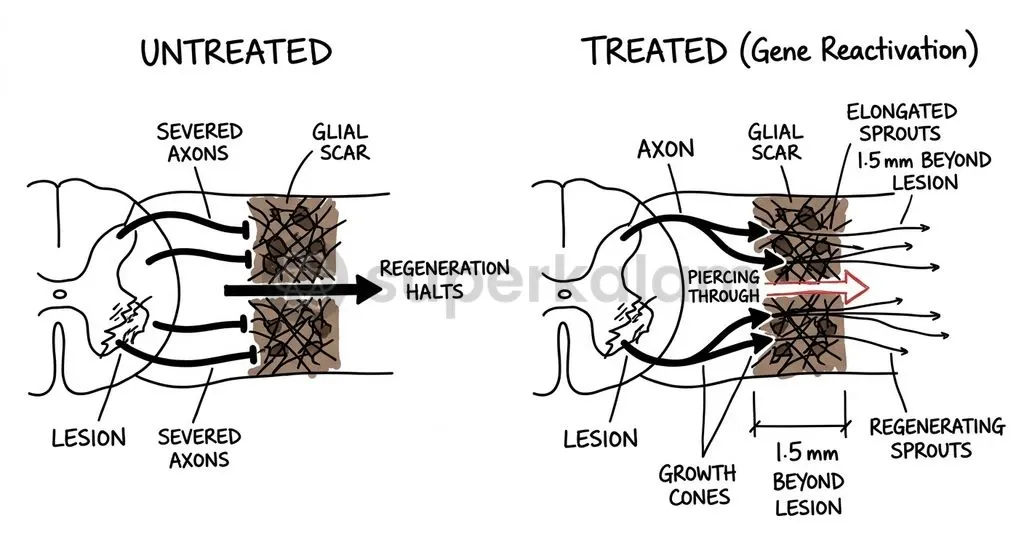
As reported by CSIR-CCMB, regenerating nerve fibres in treated adult mice crossed the dense injury lesion and extended up to 1.5 millimetres beyond the inhibitory glial scar. In untreated control animals, regenerating nerve projections remained stunted and halted entirely at the scar boundary.
Functional recovery accompanied this cellular growth, with treated mice regaining:
- Hind-limb weight support during stance
- Plantar stepping while walking
- Improved grip strength starting five weeks post-injury
Discuss with Superkalam
Which two transcription factors did the CSIR-CCMB team reactivate to stimulate axonal regrowth in injured adult mice?
Ask NowThe Biological Puzzle: Why Mammalian Nerves Struggle to Heal
Adult mammalian central nervous system neurons fail to mend because mature cells switch off embryonic growth programmes and face hostile local tissue.
During embryonic development, nascent neurons rapidly extend axons across vast distances to establish intricate sensory and motor networks. As the brain matures, this rapid elongation ceases. Neurons shut down growth pathways to lock in precise synaptic connections and prevent aberrant wiring.
According to research published in Science by Park and colleagues, intrinsic regenerative failure in adult mammalian central axons is governed by the developmental down-regulation of the mTOR signalling pathway, which is heavily suppressed by the tumour suppressor phosphatase PTEN.
The CSIR-CCMB team established that mature central neurons do not delete their developmental genetic machinery. Instead, repair stalls behind two primary molecular roadblocks:
- Loss of Chromatin Accessibility: Pro-growth enhancer sequences become physically inaccessible to the cellular machinery.
- Heterochromatin Silencing: Key elongation genes remain locked behind tightly condensed heterochromatin, preventing transcription factor binding.
Central vs Peripheral Nervous System: A Tale of Two Environments
The human nervous system displays a sharp biological contrast between peripheral and central nerve repair. Peripheral nerves regenerate readily, whereas central spinal and cerebral tracts fail to mend.
| Feature | Peripheral Nervous System (PNS) | Central Nervous System (CNS) |
|---|---|---|
| Primary Location | Nerves branching across limbs and trunk outside the skull and spine | Brain and spinal cord encased within cranial and vertebral bones |
| Myelin-Producing Glia | Schwann cells | Oligodendrocytes |
| Debris Clearance Speed | Rapid via coordinated Wallerian degeneration and macrophages | Slow and incomplete, leaving persistent degraded myelin fragments |
| Physical Guidance | Forms structured tubular Bands of Büngner | Forms a dense, impassable glial scar of reactive astrocytes |
| Extrinsic Chemical Milieu | Neurotrophic factors such as NGF and BDNF facilitate growth | Myelin inhibitors and CSPGs physically halt axonal growth cones |
| Intrinsic Growth Capacity | Moderate; reactivates pro-growth programmes spontaneously | Dormant; developmental elongation genes remain epigenetically silenced |
According to standard neurobiology literature, axons in the mammalian Peripheral Nervous System regenerate spontaneously, while adult Central Nervous System axons remain trapped by physical and biochemical barriers. Principles of Neural Science explains that peripheral repair relies on Schwann cells. These glial cells digest damaged axonal fragments, deposit neurotrophic growth factors, and establish physical guidance pathways termed Bands of Büngner.
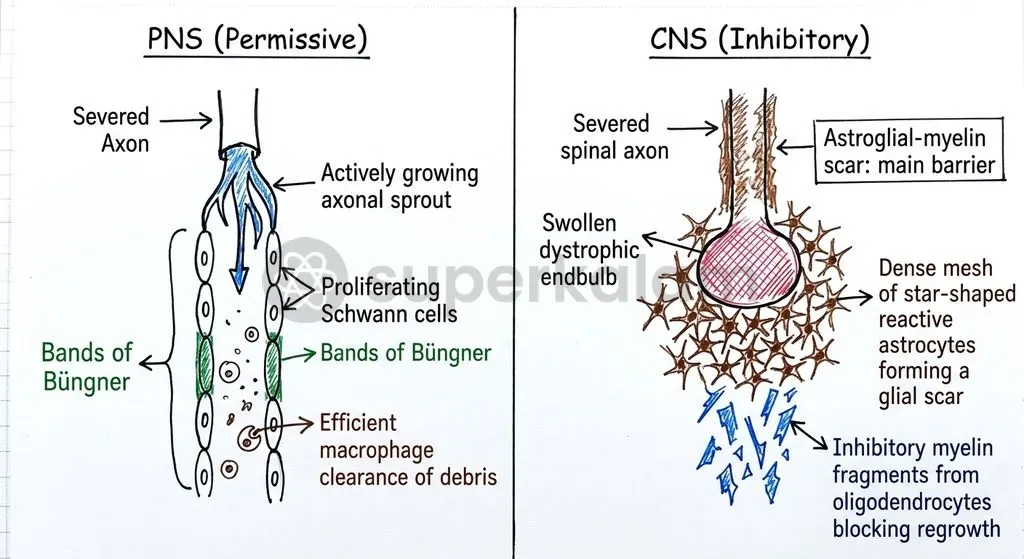
Conversely, central nerve injuries trigger a catastrophic inflammatory cascade. Reactive astrocytes migrate to the lesion and deposit a dense extracellular meshwork laden with chondroitin sulphate proteoglycans, as documented in The EMBO Journal. Damaged central oligodendrocytes release myelin-associated inhibitory proteins, including Nogo-A, MAG, and OMgp, which trigger the collapse of advancing axonal growth cones.
Discuss with Superkalam
Explain how the structural role of Schwann cells in the PNS differs from that of reactive astrocytes in the CNS after nerve injury.
Ask NowDecoding the Discovery: How NR2F1 and NR2F6 Control Nerve Regrowth
The CSIR-CCMB investigation identified two orphan nuclear receptor transcription factors that reverse intrinsic neuronal dormancy. These proteins unlock silenced pro-growth chromatin regions. Transcription factors bind specific genomic sequences to control the rate of ribosomal gene transcription into messenger RNA.
A press release from CSIR-CCMB notes that cellular expression of the genes NR2F1 and NR2F6 naturally plummets by 70% to 80% as mammalian neurons transition from early embryonic development into adult maturity. Reactivating these individual regulatory proteins in injured adult corticospinal neurons initiated distinct molecular cascades that successfully restored axonal elongation:
- Epigenetic Remodelling via NR2F1: Operating predominantly as a transcriptional activator, NR2F1 modifies local chromatin architecture to unmask silenced enhancer sequences. This structural relaxation allows RNA polymerase to access genes required for structural reconstruction of the neuronal cytoskeleton.
- Metabolic Reprogramming via NR2F6: Operating primarily as a transcriptional repressor, NR2F6 selectively throttles baseline cellular maintenance and redundant protein manufacturing. This down-regulation conserves cellular energy and reorganises three-dimensional chromatin loops to re-engage dormant elongation pathways.
Discuss with Superkalam
Why did adult homeothermic mammals trade away central nervous system regenerative plasticity during evolution?
Ask NowHow Mammals Compare to Regenerative Champions in Nature
Lower vertebrates mend severed spinal columns with ease, whereas adult mammals cannot.
Teleost fish such as the zebrafish (Danio rerio) and urodele amphibians like newts can sever their spinal cords and completely restore functional swimming motor patterns within months, as documented in Developmental Biology. The architectural responses diverge sharply across species:
- Non-Mammalian Vertebrates: Ependymo-radial glial cells proliferate rapidly to span the lesion site, forming a permissive cellular bridge rather than a dense, impenetrable scar.
- Adult Mammals: Spinal injuries trigger reactive astrogliosis that seals the damaged tissue to prevent systemic infection and limit haemorrhagic necrosis, sacrificing tissue continuity.
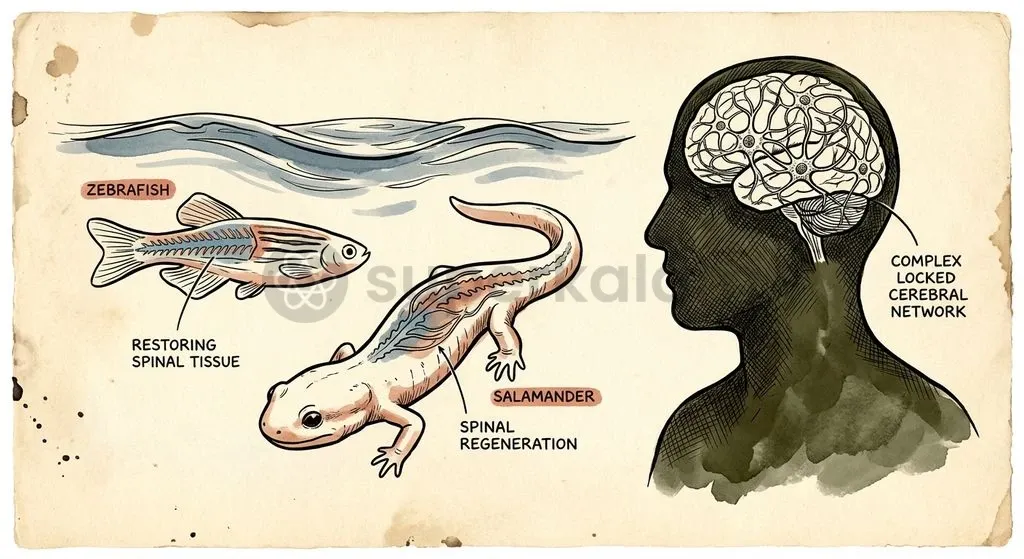
Evolutionary biologists hypothesise that adult homeothermic mammals sacrificed regenerative plasticity in the central nervous system to lock in complex learned synaptic circuitry, per commentary in Nature Reviews Neuroscience. This trade-off also suppressed oncogenic risks linked with high cellular turnover. While lower vertebrates retain high cellular plasticity, mammalian survival depends on stable long-term memory consolidation, fine motor coordination, and stringent protection against malignant transformation in long-lived tissues.
From Petri Dish to Clinic: Hurdles in Treating Spinal Cord Injuries
Translating the CSIR-CCMB findings from controlled rodent experiments into clinical medical therapies presents substantial biological and technical hurdles.
The primary limitation highlighted by Sahu and colleagues in The EMBO Journal is timing. The researchers administered adeno-associated viral vectors carrying NR2F1 and NR2F6 intracortically prior to injury. In clinical emergency settings, therapeutic interventions must occur hours, days, or weeks after traumatic spinal impact rather than prophylactically before an accident.
Human anatomical dimensions also dwarf rodent nervous systems. A human spinal cord requires regenerating axons to navigate distances exceeding 50 to 100 centimetres to reinnervate paralysed limbs, compared to the roughly 1.5 millimetres traversed in mouse models. Regrowing central axons over such macroscopic scales without misrouting remains an immense bioengineering challenge.
Clinical gene delivery also introduces serious safety risks:
- Epigenetic and Oncogenic Transformation: Ectopic expression of potent nuclear receptors and chromatin remodellers risks activating off-target proto-oncogenes, potentially driving tumour formation in non-target tissues.
- Vector Immunogenicity: Repeated administration of high-titer adeno-associated viral vectors can provoke severe host neuroinflammatory responses.
- Aberrant Synaptogenesis: Unregulated axonal sprouting can cause miswired synaptic connections. As documented in The Lancet Neurology, erroneous circuit wiring often precipitates intractable neuropathic pain, debilitating muscular spasticity, or life-threatening autonomic dysreflexia.
Discuss with Superkalam
Weigh the therapeutic promise of viral-mediated transcription factor delivery against the clinical risks of aberrant synaptogenesis and oncogenesis in human spinal repair.
Ask NowStrengthening India's Biomedical and Translational Research Ecosystem
Indigenous scientific breakthroughs from national laboratories like CSIR-CCMB highlight India's expanding capacity for foundational discovery in the life sciences. The Council of Scientific and Industrial Research, which administers CCMB Hyderabad, coordinates dozens of premier national laboratories driving innovation across industrial, agricultural, and therapeutic sectors.
To bridge the gap between bench discovery and patient bedside, India has deployed targeted statutory and policy mechanisms:
- Anusandhan National Research Foundation Act (2023): The statute designates the Prime Minister as the ex-officio President of the Governing Board. This board coordinates strategic investments across national laboratories and central universities to bridge foundational academic research with commercial biomedical trials.
- BioE3 Policy: Approved by the Union Cabinet on 24 August 2024, this biotechnology framework channels national resources into precision biotherapeutics, regenerative cellular therapies, and high-performance biomanufacturing.
Sustained policy support through the Department of Biotechnology and ANRF funding streams provides critical backing. This institutional framework ensures that groundbreaking discoveries within premier Indian laboratories transition safely into human clinical pipelines.
Key Takeaways
- The Breakthrough: Researchers at CSIR-CCMB demonstrated that reactivating the transcription factor genes NR2F1 or NR2F6 enables severed corticospinal tract nerve fibres to regenerate across complete thoracic spinal injuries in adult mice.
- The Mechanism: NR2F1 and NR2F6, whose expression declines by 70% to 80% during neural maturation, are epigenetic master switches that restore chromatin accessibility and reorganise gene networks necessary for axonal outgrowth.
- CNS vs PNS: While peripheral nerves regenerate spontaneously via Schwann cells and Bands of Büngner, central nerves are constrained by reactive astrocytic glial scars containing CSPGs and inhibitory myelin proteins like Nogo-A.
- Translational Hurdles: Moving from rodent models to human therapy requires overcoming viral delivery risks, preventing aberrant synaptogenesis and neuropathic pain, and bridging human anatomical distances of 50 to 100 centimetres.
- Policy Architecture: Translating indigenous deep-science discoveries into clinical therapies relies on funding and coordination from the Anusandhan National Research Foundation Act, 2023 and the Union Cabinet's BioE3 Policy.
Mains Question
"Mature central nervous system neurons retain the latent genetic blueprint for regeneration, shifting neurobiology from treating spinal trauma as permanently irreversible to treating axonal dormancy as an addressable gene-regulation challenge." Elucidate. (15 Marks)
Evaluate NowMains Question
Highlighting recent breakthroughs such as CSIR-CCMB's nerve regeneration study, evaluate the role of the Anusandhan National Research Foundation (ANRF) Act, 2023 in bridging the divide between foundational biomedical discoveries and clinical translational applications. (10 Marks)
Evaluate NowPractice MCQs
QUESTION 1
Consider the following statements regarding nerve regeneration in the mammalian nervous system:
- In the peripheral nervous system, Schwann cells facilitate repair by clearing debris and establishing guidance pathways known as Bands of Büngner.
- In the central nervous system, damaged oligodendrocytes release inhibitory proteins such as Nogo-A, MAG, and OMgp that trigger the collapse of axonal growth cones.
- Mature central nervous system neurons fail to regenerate primarily because they permanently delete their developmental pro-growth genetic machinery. Which of the statements given above are correct?
QUESTION 2
With reference to the nerve regeneration discovery by the CSIR-Centre for Cellular and Molecular Biology (CSIR-CCMB), consider the following statements:
- The delivery of orphan nuclear receptor genes NR2F1 or NR2F6 enabled severed corticospinal tract axons to cross thoracic spinal cord crush injuries in adult mice.
- NR2F1 operates predominantly as a transcriptional activator that unmasks silenced enhancer sequences to aid cytoskeletal reconstruction.
- NR2F6 functions primarily as a transcriptional repressor that throttles baseline cellular maintenance to conserve energy for elongation. Which of the statements given above is/are correct?
QUESTION 3
Consider the following statements regarding regenerative responses across different vertebrate taxa:
- Teleost fish and urodele amphibians restore spinal cord continuity through ependymo-radial glial cells that form a permissive cellular bridge.
- In adult mammals, reactive astrogliosis deposits a dense scar rich in chondroitin sulphate proteoglycans that impedes axonal crossing.
- Intrinsic regenerative failure in adult mammalian central axons involves developmental down-regulation of the mTOR signalling pathway suppressed by PTEN. Which of the statements given above is/are correct?
QUESTION 4
With reference to research governance and policy frameworks in India, consider the following statements:
- Under the Anusandhan National Research Foundation Act, 2023, the Prime Minister serves as the ex-officio President of the Governing Board.
- The BioE3 Policy was approved by the Union Cabinet in August 2024 to support biotechnology-driven innovation and precision therapeutics. Which of the statements given above is/are correct?
QUESTION 5
In the context of translating the CSIR-CCMB spinal cord repair findings into human clinical therapies, which of the following represents a significant experimental limitation highlighted in the study?
Discuss with Superkalam
Design a strategic roadmap under the Anusandhan National Research Foundation (ANRF) to transition pre-injury animal gene therapies into post-trauma human clinical interventions.
Ask Now