E85 and E100 Flex-Fuel Vehicles in India: CMVR Amendment and Challenges
MoRTH has amended the Central Motor Vehicles Rules to include E100 with E85 for certified flex-fuel vehicles, but fuel pricing, taxation and pump infrastructure remain hurdles for India.
Oct, 2026
•12 min read
Context
The Ministry of Road Transport and Highways has amended the Central Motor Vehicles Rules, 1989 (notified as G.S.R. 911(E) dated 23 October 2026). The update expressly includes E100 alongside E85 in emission certification provisions, for specially designed and certified flex-fuel vehicles only. Yet the shift towards high-blend ethanol faces a practical hurdle: ethanol's lower volumetric energy density means more litres are burned per kilometre.
Real-world adoption depends on fuel pricing relative to petrol, fuel taxation and dedicated dispensing infrastructure, while feedstock choices raise food-security questions.
Why in the News: The New CMVR Standards for E85 and E100 Vehicles
The Ministry of Road Transport and Highways amended the Central Motor Vehicles Rules, 1989 to update emission certification provisions so that E100 is expressly included alongside E85. These fuels are meant only for specially designed and certified flex-fuel vehicles, not for existing petrol vehicles. The update covers the emission and safety requirements such vehicles must meet.
Decarbonisation targets under the Ethanol Blended Petrol Programme initially focused on low-level blends such as E10 and E20, which existing vehicle fleets could absorb with minor recalibrations. High-blend fuels require a fundamentally different operational approach:
- Low-blend fuels (E10, E20): Run on standard internal combustion engines with minor software recalibrations.
- High-blend fuels (E85, E100): Demand dedicated metallurgy, distinct type-approval regimes, and altered fuel injection systems.
India's regulatory framework provides legal certainty for automakers. However, market viability hinges on whether retail fuel pricing can offset the severe mileage reduction inherent in ethanol's lower energy density.
Discuss with Superkalam
Recall the stoichiometric air-fuel ratio required for neat ethanol (E100) compared to conventional motor petrol.
Ask NowWhat the CMVR 1989 Amendment Actually Changes for Automakers
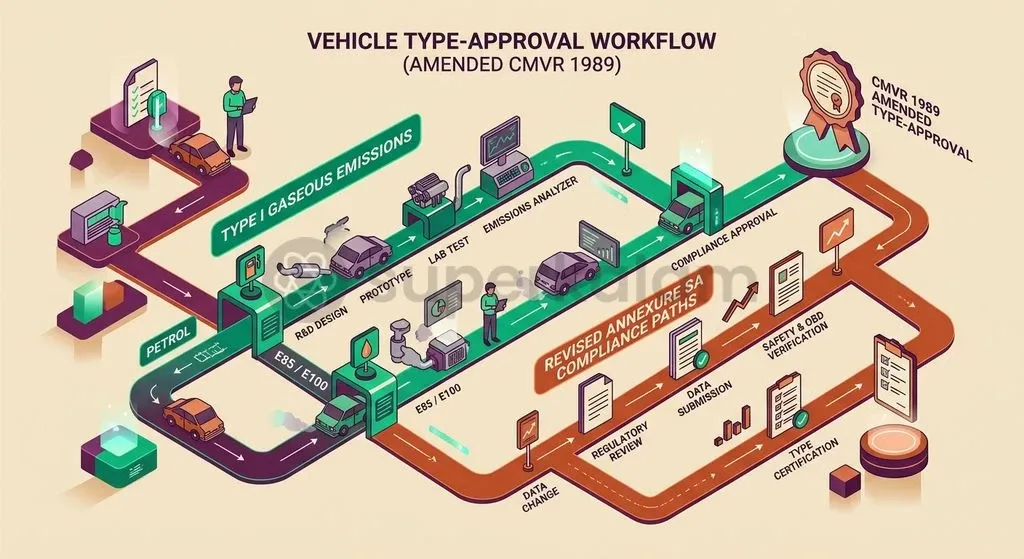
The Central Motor Vehicles Rules, 1989 amendments replace 'E85' with 'E85 or E100' in specified tables under Rule 115, which govern emission type-approval testing for flex-fuel vehicles. Testing agencies must evaluate engines against gaseous emission limits using either E85 or neat E100 reference fuels. An explanatory note specifies that E85 and E100 are for vehicles designed by original equipment manufacturers (OEMs) as flex-fuel vehicles. This prevents consumers from putting high-blend fuels into incompatible conventional petrol engines.
The annexure reference for E100 vehicles changes from Annexure S to Annexure SA. Evaporative emission tests and similar checks continue to use standard gasoline.
Automakers also gain regulatory room to homologate larger utility vehicles and light delivery fleets. The Ministry of Road Transport and Highways raised the gross vehicle weight threshold in Rule 115(18), Table 2 from 3,000 kg to 3,500 kg threshold limits. This modification expands the light vehicle category, allowing commercial passenger carriers and small commercial trucks to undergo flex-fuel certification under light-duty standards rather than heavy-duty truck protocols.
| Regulatory Parameter | Prior Framework (Pre-Amendment) | Amended CMVR 1989 Framework |
|---|---|---|
| Fuel Scope in Rule 115 | Restricted primarily to E85 in high-blend testing tables | Formally expanded to 'E85 or E100' in specified Rule 115 tables |
| Consumer Safeguard | No explicit statutory bar against misfuelling standard cars | Explanatory note restricts use to OEM-designed flex-fuel vehicles |
| Documentation Reference | Annexure S reference for E100 vehicles | Annexure SA reference for E100 vehicles |
| Gross Vehicle Weight (GVW) | Capped at 3,000 kg for light-duty flex-fuel emission tables | Elevated to 3,500 kg, expanding commercial flex-fuel eligibility |
The Engineering Hurdle: Corrosion, Cold Starts, and the FFV-SHEV Solution
High-blend ethanol fuels demand heavy mechanical modifications. Standard petrol engines exposed to ethanol concentrations above 20% suffer mechanical wear because ethanol is hygroscopic, absorbing atmospheric moisture to form acidic compounds. Automotive Research Association of India studies show that accommodating neat ethanol requires three key engineering changes:
- Fuel system metallurgy: Manufacturers must replace nitrile rubbers and reactive metals with fluorocarbon elastomers, Teflon hoses, and stainless steel fuel delivery components.
- Air-fuel ratio recalibration: Neat ethanol requires a stoichiometric air-fuel ratio of approximately 9.0:1 compared to petrol's 14.7:1, requiring high-flow fuel injectors delivering roughly 30% to 40% more volume per combustion cycle.
- Cold-start management: Ethanol has a high latent heat of vaporisation (840 to 900 kJ/kg, over double petrol's 350 kJ/kg) and a flash point of roughly 13°C, forcing engines above E20 to integrate auxiliary cold-start systems such as heated fuel rails, specialised glow plugs, or secondary petrol reservoirs.
Flex-Fuel Strong Hybrid Electric Vehicles (FFV-SHEVs) provide an engineering workaround. By pairing an ethanol-tolerant engine with an electric motor and regenerative battery, the hybrid system buffers the combustion powertrain during high-load acceleration and inefficient idling. This configuration recovers part of the efficiency lost to high blends, though it adds significant chassis cost.
Discuss with Superkalam
Explain the physical mechanism that causes neat ethanol engines to struggle with cold starts in low ambient temperatures.
Ask NowThe Mileage Penalty: Why Ethanol's Lower Energy Density Hits Consumer Wallets
The NITI Aayog notes that ethanol contains roughly 30% to 33% lower volumetric energy density than motor petrol, directly reducing flex-fuel vehicle fuel economy. Motor petrol delivers an energy density of approximately 32 to 34.8 megajoules per litre, whereas neat fuel ethanol provides only 21.2 to 23.5 megajoules per litre. Because internal combustion engines extract kinetic energy by burning fuel mass, lower-energy liquids inevitably burn more litres to cover identical distances.
Running a flex-fuel vehicle on E85 or E100 therefore burns more litres per kilometre than petrol. Whether high-blend ethanol is attractive depends on its retail price relative to petrol, which this article does not quantify.
| Fuel | Approx. energy density (MJ/L) |
| Petrol | ~32 to 34.8 |
| Neat ethanol (E100) | ~21.2 to 23.5 |
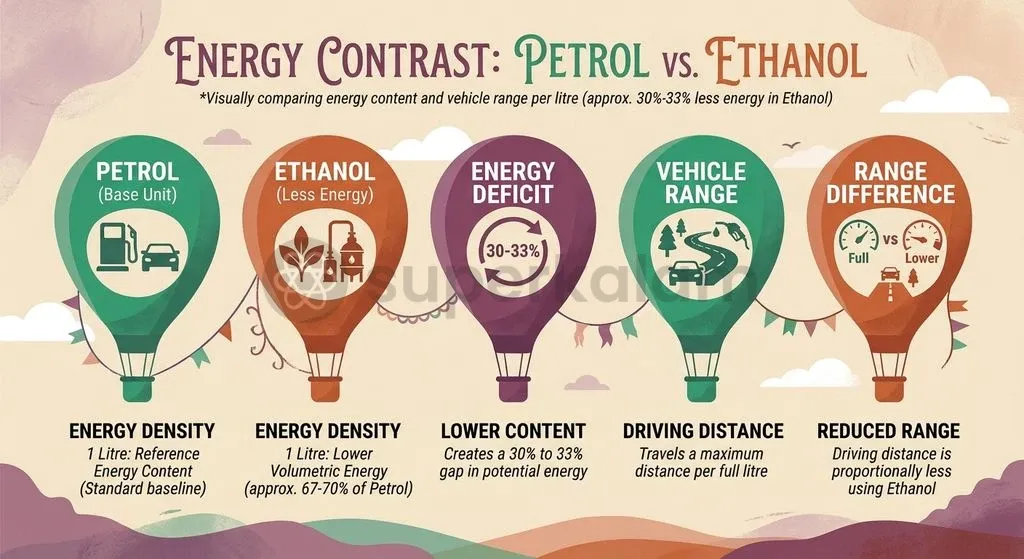
The graphic compares the energy content of neat ethanol and petrol. Energy content is not the same as measured mileage: actual fuel consumption on E85 or E100 depends on the blend and the vehicle, so the 30% to 33% figure should not be read as an exact loss in range.
The Feedstock Dilemma: Moving Beyond Sugarcane to Grains and Water Costs
The National Biofuel Coordination Committee has expanded ethanol feedstock procurement to maize and surplus foodgrains, intensifying debates surrounding agricultural water depletion and food security. Early blending milestones relied primarily on sugarcane juice, B-heavy molasses, and C-heavy molasses from sugar mills. Reaching higher blending thresholds required diversifying the feedstock base, prompting policy interventions that subsidised distilleries utilising damaged foodgrains, surplus rice from the Food Corporation of India, and dedicated maize crops.
Diverting staple crops into distilleries creates trade-offs between national energy security and food price stability, including price pressure in animal feed markets.
Discuss with Superkalam
Explain how a commercial fleet can work out the fuel price discount E100 would need to offer, given its lower mileage per litre, to keep monthly running costs from rising when it shifts from petrol.
Ask NowGlobal Playbook: What India Can Learn from Brazil's Dual-Pricing Model
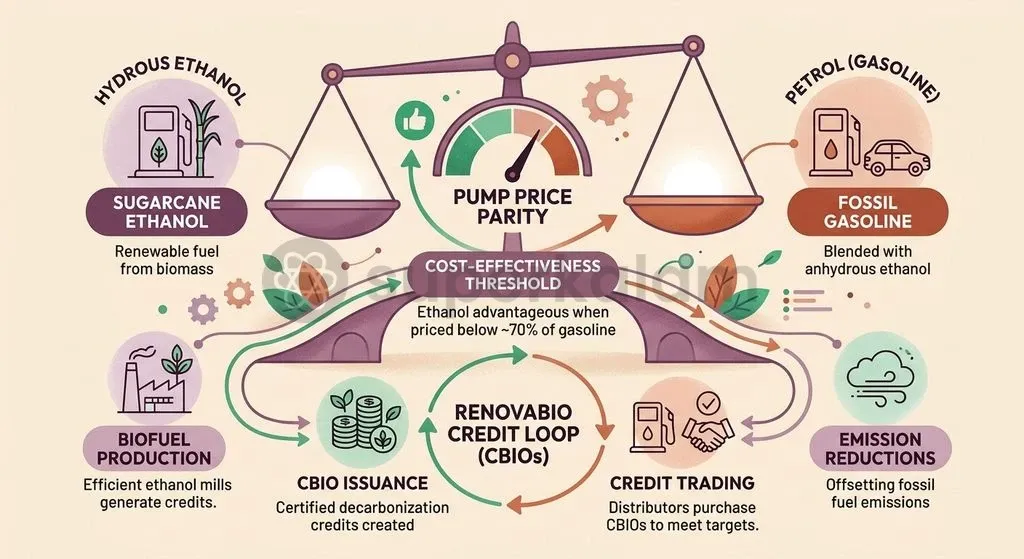
Brazil established a successful flex-fuel ecosystem under its Proálcool programme by maintaining a transparent retail pricing mechanism aligned with ethanol's thermodynamic properties. Initiated in response to global oil shocks, the Brazilian model developed a nationwide dual-fuel retail infrastructure where fuel stations dispense both anhydrous ethanol blended into petrol (E27) and neat hydrous ethanol (E100), which contains 4% to 7% water by volume. Brazilian motorists driving flex-fuel vehicles choose between petrol and ethanol at every refuelling stop based on real-time pump price ratios.
Consumer adoption in Brazil is governed by the widely recognised 70% parity rule monitored by regulatory authorities. The Brazilian National Agency of Petroleum, Natural Gas and Biofuels monitors retail pricing to ensure consumers know that choosing hydrous ethanol makes economic sense only when its pump price is 70% or less of regular petrol. When ethanol prices rise above the 70% threshold due to sugarcane harvest shortfalls, consumers switch back to petrol-blend fuels, protecting household budgets from an artificial mileage penalty.
Supply-side economics in Brazil is supported by the RenovaBio framework, enacted under Federal Law No. 13,576. RenovaBio operates a market-based decarbonisation credit system where biofuel producers generate Decarbonisation Credits (CBIOs) based on verified lifecycle greenhouse gas reductions. Fossil fuel distributors must purchase these tradeable CBIO credits to meet annual emissions mandates, creating a self-sustaining funding mechanism that subsidises clean ethanol production without draining fiscal budgets.
| Policy Pillar | Brazil Flex-Fuel Architecture | India Current Status |
|---|---|---|
| Retail Fuel Offerings | Nationwide E27 blend alongside standalone hydrous E100 | E10 and expanding E20; E85/E100 confined to pilot projects |
| Consumer Parity Rule | Institutionalised 70% pump price threshold published at stations | No dynamic parity pricing mechanism linked to energy density |
| Carbon Market Support | RenovaBio tradable CBIO credits mandated for fuel distributors | Direct state production subsidies without market emissions credits |
| Supply Infrastructure | Dedicated storage, hydrous fuel logistics, and multi-fuel pumps | Fuel stations lack dedicated tanks and dispensers for neat ethanol |
The Policy Balancing Act: Tax Parity, Pump Infrastructure, and Way Forward
The Goods and Services Tax Council rationalised GST with effect from 22 September 2025: the 28% slab and the compensation cess were removed, small cars moved to 18% and other cars to 40%, while electric vehicles attract 5% GST. Tax treatment relative to other clean-mobility options therefore remains one factor in how quickly flex-fuel vehicles can scale.
Cost is only one part of adoption. Vehicle makers must also redesign fuel systems and engines for high-ethanol blends, and buyers need fuel that is easy to find.
Physical distribution bottlenecks present an equally severe operational hurdle. India's retail network of over 90,000 fuel retail stations lacks dedicated dispensing units, isolated underground storage tanks, and ethanol-resistant vapour recovery systems necessary to store and dispense neat E85 or E100 fuels. Neat ethanol's corrosive characteristics prevent oil marketing companies from pumping high-blend fuels through conventional pipelines and retail dispensers without costly equipment retrofits.
A coherent way forward requires addressing four integrated policy levers:
- Fiscal and Duty Rationalisation: Tax policy for flex-fuel vehicles should be reviewed against other clean-mobility options so that higher vehicle manufacturing costs do not stall adoption.
- Dynamic Retail Price Parity: Fuel pricing frameworks should keep E85 and E100 competitive with petrol on a per-kilometre running-cost basis, since ethanol's lower volumetric energy density means more litres are burned per kilometre.
- Dedicated Distribution Infrastructure: Oil marketing companies must invest in ethanol-resistant fuel logistics, adding dedicated dispensing pumps and insulated underground storage tanks across major national transport corridors.
- Feedstock Planning: The National Biofuel Coordination Committee should tie distillery support to feedstocks that do not compete with food supply, such as 2G agricultural residues.
Discuss with Superkalam
Analyse the trade-offs between utilizing maize versus broken rice as alternative feedstocks under the National Biofuel Coordination Committee's procurement expansion.
Ask NowKey Takeaways
- Statutory change: MoRTH amended the Central Motor Vehicles Rules, 1989 so that emission certification provisions expressly include E100 alongside E85, for specially designed and certified vehicles only.
- Energy density: ethanol (21.2 to 23.5 MJ/L) carries less energy per litre than petrol (32 to 34.8 MJ/L), so flex-fuel vehicles use more litres per kilometre.
- Automotive engineering adaptations for high-ethanol blends require non-corrosive fluorocarbon elastomers, high-flow injectors delivering 30% to 40% more volume, and specialised cold-start systems to counter ethanol's high latent heat of vaporisation.
- GST was rationalised from 22 September 2025 (28% slab and compensation cess removed; small cars 18%, other cars 40%, electric vehicles 5%), and tax treatment remains one factor in flex-fuel adoption.
Mains Question
"The transition to high-blend ethanol fuels like E85 and E100 presents a trilemma between regulatory decarbonisation targets, consumer fuel economics, and natural resource sustainability." Critically examine this statement in light of the recent amendments to the Central Motor Vehicles Rules, 1989. (15 Marks)
Evaluate NowMains Question
Highlighting the engineering modifications necessitated by high-blend ethanol fuels, elucidate how the Central Motor Vehicles Rules (CMVR) framework safeguards vehicle safety and durability. (10 Marks)
Evaluate NowPractice MCQs
QUESTION 1
With reference to the recent amendments to the Central Motor Vehicles Rules (CMVR), 1989 regarding flex-fuel vehicles, consider the following statements:
- The regulatory framework expands high-blend emission testing standards from E85 to include neat ethanol (E100).
- The amendment permits E100 to be used in any conventional petrol vehicle.
- The gross vehicle weight (GVW) ceiling for light-duty flex-fuel emission testing tables has been raised from 3,000 kg to 3,500 kg.
Which of the statements given above are correct?
QUESTION 2
Consider the following statements regarding the technical and physical properties of neat ethanol (E100) compared to unblended motor petrol:
- Ethanol exhibits a lower latent heat of vaporisation than petrol, which facilitates rapid cold-weather ignition.
- The stoichiometric air-fuel ratio required for neat ethanol combustion is approximately 9.0:1, compared to roughly 14.7:1 for petrol.
- Due to its lower volumetric energy density, operating an engine on E100 leads to lower fuel economy (km per litre) than petrol.
Which of the statements given above is/are correct?
QUESTION 3
With reference to alternative agricultural feedstocks for ethanol production in India, consider the following statements:
- Among sugarcane, maize, and rice, rice exhibits the highest water consumption per litre of ethanol produced.
- Maize requires less water per litre of ethanol produced than sugarcane.
- The National Biofuel Coordination Committee has permitted the procurement of surplus rice and maize to diversify the feedstock base.
Which of the statements given above is/are correct?
QUESTION 4
Under the amended Central Motor Vehicles Rules, 1989, E85 and E100 fuels are intended for which of the following?
QUESTION 5
Consider the following statements regarding the deployment of Flex-Fuel Strong Hybrid Electric Vehicles (FFV-SHEVs):
- They integrate an electric motor and battery system with an ethanol-tolerant internal combustion engine.
- They operate without the need for fluorocarbon elastomers or stainless steel in their fuel systems.
- The hybrid powertrain helps mitigate volumetric efficiency losses by assisting during high-load acceleration and idling.
Which of the statements given above is/are correct?
Discuss with Superkalam
Design a regulatory and fiscal policy framework that could enable India to reconcile consumer adoption of flex-fuel vehicles with agricultural groundwater depletion.
Ask Now