What is the CyberDome Project? Explain how it
can be useful in controlling internet crimes in
India.
What is the CyberDome Project? Explain how it
can be useful in controlling internet crimes in
India.
The CyberDome Project, initiated by Kerala Police in 2017, represents India's first comprehensive cybersecurity ecosystem integrating public-private partnerships to combat evolving cyber threats through advanced technology and collaborative intelligence sharing.
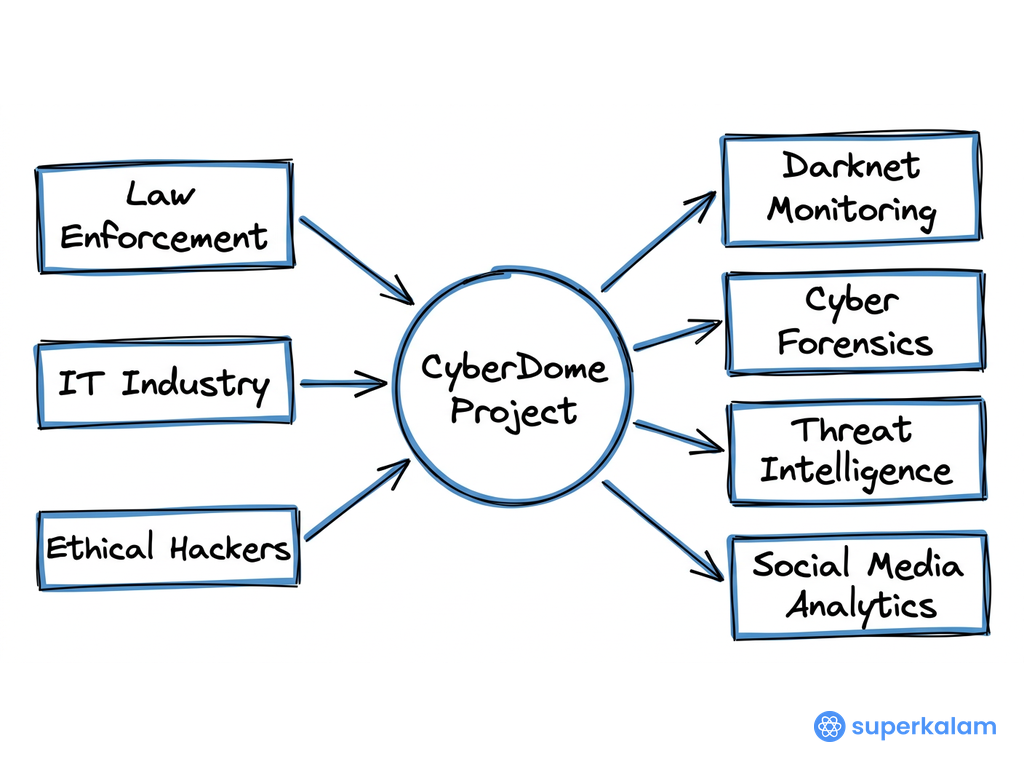
CyberDome Project hub and spoke framework
What is CyberDome Project
- Multi-stakeholder cybersecurity initiative involving Kerala Police, IT companies, and academic institutions
- India's first state-level cyber security ecosystem with real-time threat monitoring capabilities
- Integration of advanced AI-powered analytics and machine learning for threat detection
- 24/7 cyber command center with dedicated incident response teams
- Collaborative platform connecting over 150 IT companies and security researchers
Utility in Controlling Internet Crimes
-
Enhanced Detection and Prevention
- Real-time monitoring of cyber threats with automated alert systems
- Advanced digital forensics capabilities reducing investigation time by 60%
- Predictive analytics identifying potential cyber attack patterns before execution
- Integration with national cyber coordination center for threat intelligence sharing
- Behavioral analysis tools detecting suspicious online activities and fraud attempts
-
Capacity Building and Training
- Training of over 15,000 police personnel in cybercrime investigation techniques (2023-24)
- Development of specialized cyber cells in all police stations across Kerala
- Public awareness campaigns reaching 2 million citizens annually
- Industry collaboration for continuous skill upgradation and technology transfer
- Creation of cyber volunteers network for community-based threat reporting
-
Operational Achievements
- 40% increase in cybercrime case resolution rate since implementation
- Successfully prevented financial frauds worth ₹500 crores in 2024
- 50% reduction in average case investigation time
- Effective coordination with Interpol and international law enforcement agencies
- Development of indigenous cybersecurity tools reducing foreign dependency
The CyberDome model demonstrates the effectiveness of collaborative cybersecurity governance, providing a replicable framework for other states while strengthening India's overall digital security infrastructure under the National Cyber Security Strategy 2020.
Answer Length
Model answers may exceed the word limit for better clarity and depth. Use them as a guide, but always frame your final answer within the exam’s prescribed limit.
Evaluate this PYQ now
Write your answer & evaluate in just 60 seconds




500+ students evaluated
Model Answers from
- 2019Internal Security15 MarksView Answer
Cross-Border movement of insurgents is only one of the several security challenges facing the policing of the border in North-East India. Examine the various challenges currently emanating across the India-Myanmar border. Also, discuss the steps to counter the challenges.
- 2019Internal Security15 MarksView Answer
Indian Government has recently strengthened the anti-terrorism laws by amending the unlawful Activities (Prevention) Act (UAPA), 1967 and the NIA act. Analyse the changes in the context of the prevailing security environment while discussing the scope and reasons for opposing the UAPA by human rights organisations.
- 2019Internal Security10 MarksView Answer
The banning of ‘Jammat-e-Islami’ in Jammu and
Kashmir brought into focus the role of
over-ground workers (OGWs) in assisting
terrorist organizations. Examine the role
played by OGWs in assisting terrorist
organizations in insurgency-affected areas.
Discuss measures to neutralize the influence
of OGWs.
Model Answers by Subject


Crack UPSC with your
Personal AI Mentor
An AI-powered ecosystem to learn, practice, and evaluate with discipline



