National Flag of India [UPSC Notes]
National Flag of India for UPSC: Evolution, Flag Code 2002, dimensions & Do's/Don'ts. Must cover UPSC notes on Article 51A & history for aspirants.
Jan, 2026
•4 min read
This flag does not symbolise the triumph of individuals or the Congress but the triumph of the whole country. The flag of India is a symbol of freedom and democracy, not only for India but for the world as a whole. - Pandit Jawaharlal Nehru
On 15 August 1947, Pandit Jawaharlal Nehru hoisted the Tiranga at the Red Fort, marking India’s independence. The flag represents the long freedom struggle, sacrifices, and hopes of the Indian people. Even today, the Tiranga stands for unity, democracy, and national pride. For UPSC aspirants, understanding the flag means understanding the spirit and values of India.
About the National Flag of India
The National Flag of India is a horizontal rectangular tricolour featuring three equal horizontal bands of saffron (Kesari) at the top, white in the middle, and green at the bottom.
At the centre of the white band sits the Ashoka Chakra, a navy blue wheel with 24 equally spaced spokes, representing truth and the eternal cycle of life.
- The flag was formally adopted by the Constituent Assembly on July 22, 1947, and became India's official flag on August 15, 1947.
- The ratio of length to width is fixed at 3:2.
- Each colour has a symbolic meaning: Saffron represents courage and sacrifice, White represents peace and truth, and Green represents growth and fertility.
- The Ashoka Chakra represents dharma (righteousness) and symbolises that "life exists in movement and death in stagnation."
- The original design is credited to Pingali Venkayya, an agriculturist and freedom fighter from Andhra Pradesh.
- Article 51A(a) makes it a Fundamental Duty of every citizen to abide by the Constitution and respect the National Flag.
Also read: PM Narendra Modi’s 79th Independence Day Speech: Key Highlights & UPSC Relevance
Evolution of the Flag of India
India’s national flag has evolved along with the freedom struggle, showing how the hopes, ideas, and awareness of the Indian people changed over time.
1906 (The Calcutta Flag)
- The first national flag was hoisted on August 7, 1906, in the Parsee Bagan Square (Green Park), Calcutta.
- It had three horizontal stripes of red, yellow and green.
- It had eight half-open lotuses on the green stripe and was written "Vande Mataram" in Devnagari on the central yellow stripe.
1907 (The Berlin Committee Flag)
- Hoisted by Madam Bhikaji Cama in Stuttgart (and later displayed in Berlin).
- It was very similar to the 1906 flag but had one lotus and seven stars denoting the Saptarishi.
- This was the first time an Indian flag was raised on foreign soil.
1917 (Home Rule Movement)
- Dr Annie Besant and Lokmanya Tilak hoisted this flag during the Home Rule movement.
- It had five red and four green horizontal strips arranged alternately, with seven stars in the saptarishi configuration.
- It also featured the Union Jack (National Flag of the UK) in the top left corner.
1921 (The Bezwada Flag)
- During the All India Congress Committee session at Bezwada (Vijayawada), a youth presented a flag to Gandhiji.
- It was made of two colours: red and green, representing the two major communities.
- Gandhiji suggested adding a white strip to represent the remaining communities and a spinning wheel (Charkha) to symbolise progress.
1931 (The Resolution Flag)]
- A resolution was passed adopting a tricolour flag as our National Flag.
- It featured saffron, white, and green with Mahatma Gandhi’s spinning wheel in the centre.
- It was clearly stated that it bore no communal significance.
1947 (The Present Flag)
- On July 22, 1947, the Constituent Assembly adopted the flag.
- The colours and their significance remained the same, but the Dharma Chakra of Emperor Ashoka of the Mauryan empire replaced the spinning wheel as the emblem on the white strip.
Also read: Quit India Movement Day 2025: 83rd Anniversary of August Kranti
Flag Code of India 2002
Before 2002, the National Flag was regulated by two separate laws, namely, the Emblems and Names (Prevention of Improper Use) Act, 1950 and the Prevention of Insults to National Honour Act, 1971. In 2002, the Flag Code of India was introduced to combine all rules and guidelines related to the proper display of the National Flag.
- Structure: The Code is divided into three parts:
- Part I: General description of the National Flag.
- Part II: Display by members of the public and private organisations.
- Part III: Display by Central and State Governments and their agencies.
- Materials: The flag can be made of hand-spun and hand-woven cotton, or machine-made cotton, polyester, wool, or silk khadi bunting. In 2021, polyester and machine-made flags were permitted to increase accessibility.
- Shape and Ratio: The flag must be rectangular with a length-to-width ratio of 3:2. It can be of any size, but standard dimensions are prescribed.
- Display Rights: Any citizen, private organisation, or educational institution can hoist and display the National Flag on all days and occasions, ceremonial or otherwise, provided it is done with dignity and honour.
- Day and Night Display: Following the 2022 amendment, if the flag is displayed in an open area or on a private residence, it may be flown day and night without restriction.
- Position of Honour: Whenever displayed, the flag must occupy a position of honour and be distinctly placed above all other flags or symbols.
- Ashoka Chakra Visibility: The Ashoka Chakra must be completely visible on both sides of the flag and should be printed, screened, or embroidered on the white panel.
Recent Amendments in the Flag Code of India
- Material Amendment (2021): The code was amended to allow flags made of polyester or machine-made flags. Previously, only hand-spun and hand-woven Khadi (cotton/wool/silk/bunting) was allowed.
- Timing Amendment (2022): A clause was replaced to allow the flag to be flown day and night if displayed in the open or on the house of a member of the public. Previously, it was allowed only from sunrise to sunset.
Also read: Separation of Powers in India [UPSC Notes]
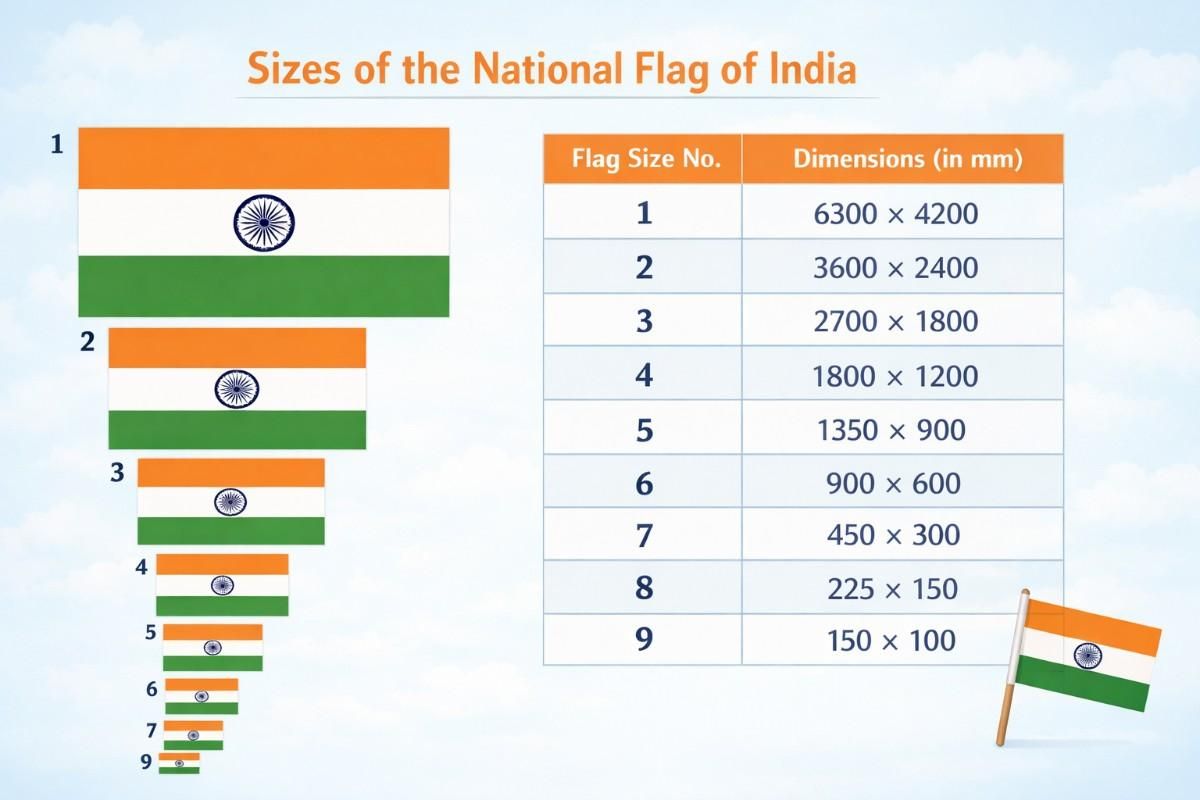
Indian Flag Dimensions
The National Flag shall be rectangular in shape. The Flag can be of any size, but the ratio of the length to the height (width) of the Flag shall be 3:2.
Standard Sizes (as per Flag Code): There are 9 standard sizes prescribed for the flag:
Importance of Ashoka Chakra in the Flag of India
The Ashoka Chakra is the navy-blue wheel placed at the centre of the white band in India’s National Flag. It represents Dharma (law), justice, and the continuous progress of the nation.
- Number of Spokes: The wheel has 24 spokes, symbolising constant movement, progress, and the 24 hours.
- Historical Origin: It is inspired by the Lion Capital of Emperor Ashoka at Sarnath, a Mauryan-era symbol of governance and morality.
- Replacement of Charkha: The Ashoka Chakra replaced the spinning wheel (Charkha) to give the flag a more universal and constitutional meaning.
- Symbolic Meaning: It represents the Rule of Law, reminding citizens and rulers that authority must be guided by justice and righteousness.
Also read: Judicial Review in India: Meaning, Scope & Provisions [UPSC]
Display of the National Flag with Other Flags
The display of the Indian National Flag along with flags of other nations and international organisations is governed by specific rules to ensure dignity, equality, and proper protocol.
- When flags are displayed in a straight line, the Indian National Flag should be on the extreme right (from the flag’s own point of view).
- Flags of other countries should be placed in alphabetical order (English names).
- The Indian Flag may be placed at the start, end, or in its alphabetical position.
- The Indian Flag is hoisted first and lowered last.
- In a semi-circle or arc, follow the same rule as a straight line.
- In a full circle, the Indian Flag marks the start of the circle, and other flags are placed clockwise in alphabetical order. No extra Indian Flag is needed.
- When crossed on a wall with another flag, the Indian Flag is on the right, and its staff is placed in front.
- When flown with the UN Flag, it may be on either side, but generally, the Indian Flag is kept on the extreme right.
- All flagpoles must be of equal height.
- No country’s flag should be flown higher than another in peacetime.
- The Indian Flag must not share the same flagpole with any other flag. Separate poles are required.
UPSC Prelims PYQ on Flag Code of India 2002
QUESTION 1
Consider the following statements in respect of the National Flag of India according to the Flag Code of India, 2002 :
Statement-I :One of the standard sizes of the National Flag of India is 600 mm x 400 mm. Statement-II :The ratio of the length to the height (width) of the Flag shall be 3:2.
Which one of the following is correct in respect of the above statements?
Dos and Don’ts of the National Flag of India
To prevent insult to the national honour, the Flag Code and the Prevention of Insults to National Honour Act, 1971 lay down strict guidelines.
Do's:
✅Position of Honour: The flag should always occupy a position of honour and be distinctly placed.
✅Hoisting Style: It should be hoisted briskly and lowered slowly.
✅Privilege: It can be flown on the cars of only specific dignitaries (President, Vice-President, Governors, CJI, etc.).
Don'ts:
❌No Inversion: The flag must never be displayed with the saffron band down.
❌No Damage: A damaged or dishevelled flag shall not be displayed.
❌No Drapery: It cannot be used as a drapery, costume, or uniform. It cannot be embroidered on cushions, handkerchiefs, or undergarments.
❌No Lettering: There shall be no lettering of any kind on the flag.
❌No Dipping: The flag shall not be dipped in salute to any person or thing.
❌No Objects Above: No other flag or bunting can be placed higher than or above, or side-by-side with the National Flag.
❌Commercial Use: It cannot be used for commercial purposes or as a receptacle for receiving, delivering, or holding things.
Important: Any violation of the Flag Code or acts that insult the National Flag are punishable under the Prevention of Insults to National Honour Act, 1971, with imprisonment up to three years, a fine, or both.
UPSC Mains Practice Question
What is the Flag Code of India, 2002? Discuss its salient features and explain how the 2002, 2021 and 2022 changes have altered the relationship between citizens and the National Flag.
Evaluate Your Answer Now!Conclusion
The Indian National Flag is more than a symbol. It reflects our freedom struggle, unity, and values. Each colour and the Ashoka Chakra carry a deep meaning. Respecting the Tiranga and following the Flag Code is both a duty and a sign of patriotism.
For UPSC aspirants, understanding these rules is important for exams and for appreciating India’s constitutional ideals.
Let us uphold the honour of the Tiranga in letter and spirit. Jai Hind!
Toppers trust discipline, and SuperKalam makes it easy with daily goals, instant mains answer evaluation & unlimited NCERT & MCQ practice. Join now!
Crack UPSC with your Personal AI Mentor
An AI-powered ecosystem to learn, practice, and evaluate with discipline
Download the SuperKalam App Now