What do you mean by Digital Rupee? In this context, explain the working and progress of India's Central Bank Digital Currency (CBDC).
What do you mean by Digital Rupee? In this context, explain the working and progress of India's Central Bank Digital Currency (CBDC).
The Reserve Bank of India (RBI) launched the Digital Rupee (e₹) under the RBI Act, 1934, as a programmable legal tender designed to modernize payment systems and enhance monetary transparency across the domestic financial ecosystem.
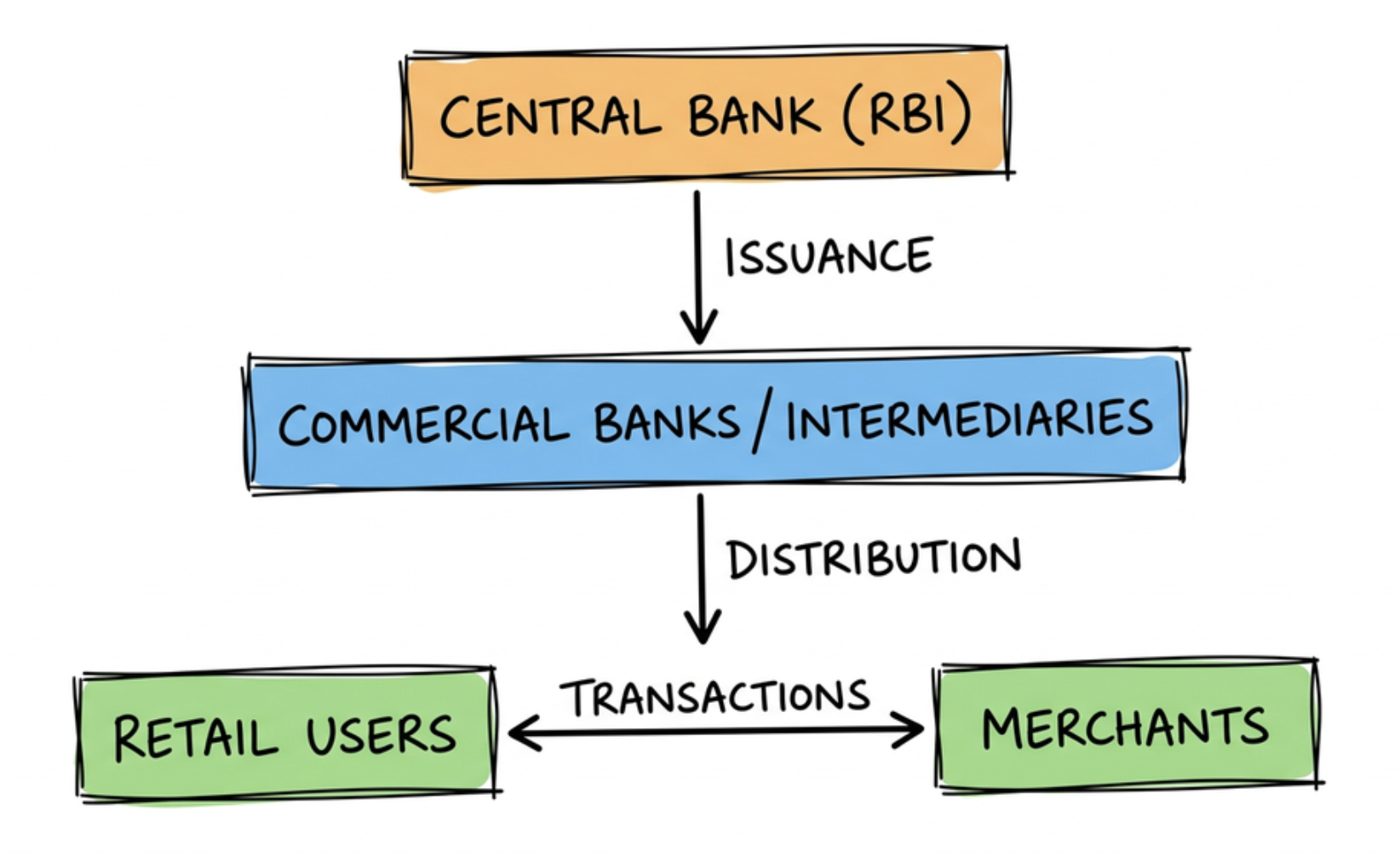
Two-Tier Architecture of Central Bank Digital Currency (CBDC)
Working Mechanism of the Digital Rupee
-
Two-Tier Model: The RBI issues tokens to commercial banks for distribution to users.
- Eg: 19 banks in the retail pilot by October 2025.
-
Token-Based System: Holders prove ownership of specific digital tokens to complete transactions.
- Eg: CBDC wallets from banks or Non-Bank Payment System Operators.
-
Programmable Functionality: Funds are hardcoded for specific purposes to ensure intended outcomes.
- Eg: CBDC-based Public Distribution System in Gujarat, February 2026.
-
Finality of Settlement: Transactions achieve instant settlement without interbank clearinghouse processes.
-
Offline Capabilities: The system facilitates transactions via Near Field Communication (NFC) without internet.
Progress of India's CBDC Pilot
-
Scale of Adoption: The retail pilot reached 7 million users by October 2025.
-
Circulation Dynamics: The RBI Annual Report 2025-26 recorded CBDC-Retail at Rs 771.66 crore on March 31, 2026.
-
Cross-Border Integration: India signed a pact with Singapore and explores projects with the United Arab Emirates.
-
Direct Benefit Transfer: Pilots in Puducherry and Chandigarh utilized e-rupee for welfare payments during 2025-26.
-
Technological Expansion: Future rollouts allow PhonePe and Google Pay to offer digital wallets.
By leveraging the G20 Roadmap for cross-border payments and the National Strategy on Blockchain, India aims to modernize its monetary architecture. This aligns with the Digital India mission to enhance financial stability and inclusion.
Answer Length
Model answers may exceed the word limit for better clarity and depth. Use them as a guide, but always frame your final answer within the exam’s prescribed limit.
Evaluate this PYQ now
Write your answer & evaluate in just 60 seconds




500+ students evaluated
Model Answers from
- 2026Economy15 MarksView Answer
Discuss the different types of subsidies and support provided by the Government of India to the agricultural sector. Examine the related issues pertaining to the Agreement on Agriculture of the World Trade Organisation (WTO).
- 2026Economy15 MarksView Answer
How has Indian agriculture been transformed from food scarcity to food surplus level? Explain the various government policies implemented for diversification of Indian agriculture.
- 2026Economy15 MarksView Answer
How are startups in India promoting entrepreneurship, innovation and employment? Discuss the global and domestic challenges in their working and suggest suitable measures to overcome these challenges.
- 2026Economy15 MarksView Answer
Explain the key challenges for India's energy security. What measures do you suggest for ensuring energy security along with economic growth and sustainability?
- 2026Economy10 MarksView Answer
Explain the factors responsible for inefficiency of agri-produce marketing. How does e-commerce help to reduce inefficiency of agri-produce marketing? Explain.
- 2026Economy10 MarksView Answer
Describe the various Technology Missions initiated in Indian agriculture and examine their role in food security.
Model Answers by Subject


Crack UPSC with your
Personal AI Mentor
An AI-powered ecosystem to learn, practice, and evaluate with discipline



