Discuss the different types of subsidies and support provided by the Government of India to the agricultural sector. Examine the related issues pertaining to the Agreement on Agriculture of the World Trade Organisation (WTO).
Discuss the different types of subsidies and support provided by the Government of India to the agricultural sector. Examine the related issues pertaining to the Agreement on Agriculture of the World Trade Organisation (WTO).
As per the Union Budget 2026-2027, India continues its robust support for the agrarian economy, allocating 1.70 lakh crore for fertiliser subsidies and 63,500 crore for the PM-KISAN scheme to ensure national food security and farmer welfare.
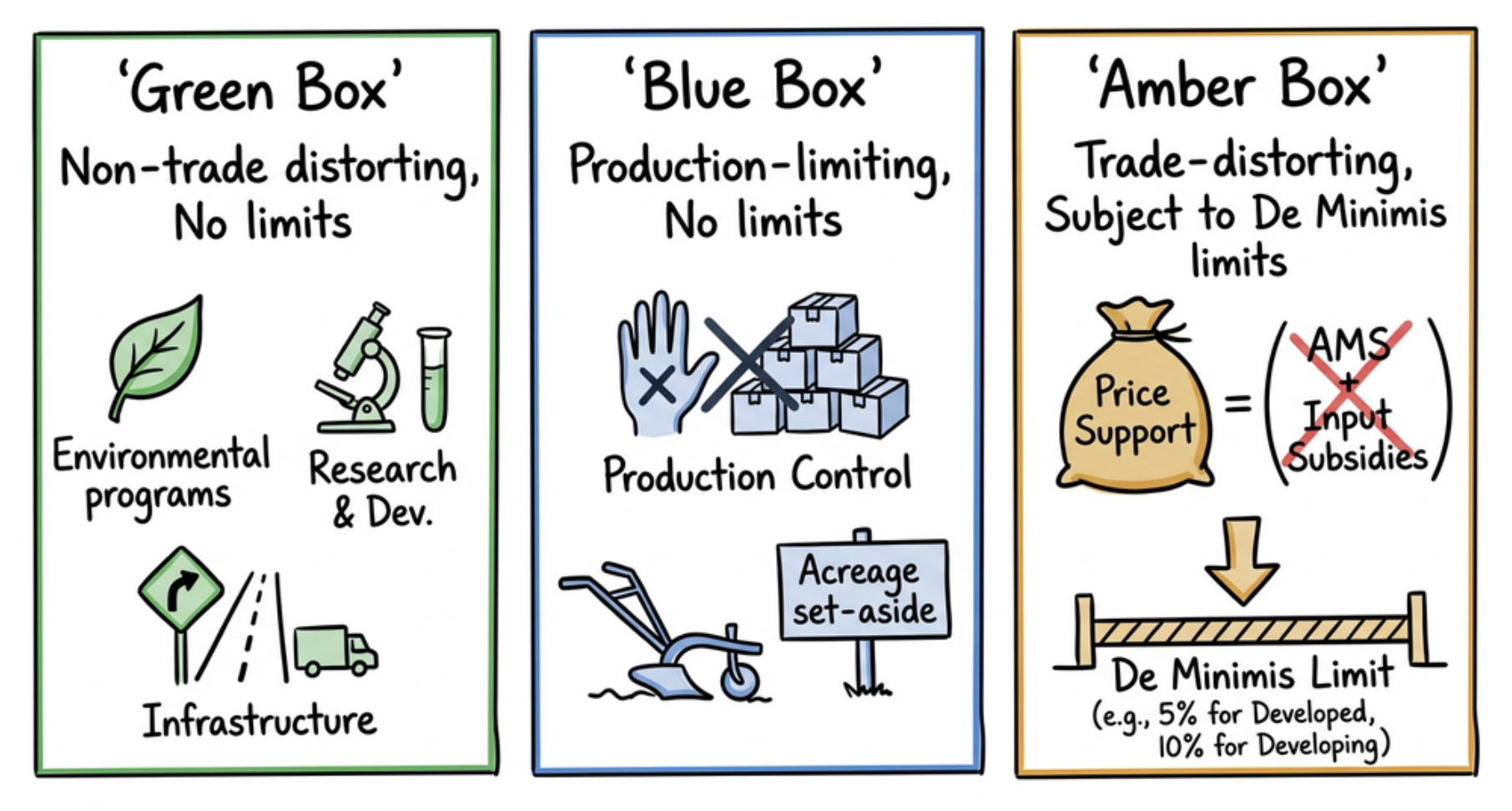
WTO Agreement on Agriculture: Classification of Agricultural Subsidies
Types of Subsidies and Support Provided to Agriculture
-
Input Subsidies: State provides fertilisers, seeds, and power below market rates.
- Eg: Fertiliser Subsidy outlay of 1.70 lakh crore for 2026-2027.
-
Direct Income Support: Fixed cash transfers reach farmer households directly.
- Eg: PM-KISAN provides 6,000 annually, 2026 guidelines.
-
Price Support Mechanism: State guarantees minimum prices against market volatility.
- Eg: PM-AASHA with 7,200 crore 2026 allocation for oilseeds and pulses.
-
Irrigation and Infrastructure Subsidies: Aid covers micro-irrigation and cold chain systems.
- Eg: PMKSY provides 60 percent micro-irrigation subsidies.
-
Credit and Interest Subvention: Institutional credit utilizes interest waivers and guarantees.
- Eg: KCC Scheme and Agriculture Infrastructure Fund (AIF) provide 3 percent subvention.
-
Mechanization Support: Grants promote modern machinery use to improve efficiency.
- Eg: Sub-Mission on Agricultural Mechanization (SMAM) provides 40-50 percent subsidies.
-
Risk Mitigation Support: Insurance covers crop failures from disasters or pests.
- Eg: PMFBY provides comprehensive risk coverage and low premiums.
-
Horticulture and Niche Sectors: Financial aid promotes high-value crop diversification.
- Eg: MIDH provides 50 percent subsidies, August 2026.
Issues Pertaining to the WTO Agreement on Agriculture
-
De Minimis Ceiling Breaches: India exceeds the 10 percent trade-distorting support limit.
- Eg: Peace Clause invoked May 2026 for seventh year for rice.
-
Public Stockholding (PSH) Conflict: Developing nations demand permanent food security solutions.
- Eg: MC14, March 2026: India retained existing PSH programs.
-
Calculation Methodology Disputes: US and EU challenge the 1986-88 base year.
- Eg: US notification, March 2026: India rice support at 86 percent.
-
Export Subsidy Allegations: Domestic schemes face challenges as trade-distorting subsidies.
- Eg: Sugar subsidies disputes: Brazil and Australia at WTO.
-
Amber Box Restrictions: Agreement on Agriculture (AoA) limits production-influencing subsidies.
-
Dispute Settlement Paralysis: Non-functioning WTO Appellate Body stalls Indian appeals.
-
Special Safeguard Mechanism (SSM): India advocates protecting farmers from import surges.
- Eg: Special and Differential Treatment (S&DT) at MC14 negotiations, 2026.
India must balance its WTO obligations with the National Food Security Act 2013 by diversifying into Green Box subsidies and securing a permanent solution for Public Stockholding to safeguard its 80 crore beneficiaries.
Answer Length
Model answers may exceed the word limit for better clarity and depth. Use them as a guide, but always frame your final answer within the exam’s prescribed limit.
Evaluate this PYQ now
Write your answer & evaluate in just 60 seconds




500+ students evaluated
Model Answers from
- 2026Economy15 MarksView Answer
How has Indian agriculture been transformed from food scarcity to food surplus level? Explain the various government policies implemented for diversification of Indian agriculture.
- 2026Economy15 MarksView Answer
How are startups in India promoting entrepreneurship, innovation and employment? Discuss the global and domestic challenges in their working and suggest suitable measures to overcome these challenges.
- 2026Economy15 MarksView Answer
Explain the key challenges for India's energy security. What measures do you suggest for ensuring energy security along with economic growth and sustainability?
- 2026Economy10 MarksView Answer
Explain the factors responsible for inefficiency of agri-produce marketing. How does e-commerce help to reduce inefficiency of agri-produce marketing? Explain.
- 2026Economy10 MarksView Answer
Describe the various Technology Missions initiated in Indian agriculture and examine their role in food security.
- 2026Economy10 MarksView Answer
Examine the view that financial inclusion is an integral part of social and economic inclusion in a country like India. Also throw light on the usefulness of the R.B.I.'s Financial Inclusion Index.
Model Answers by Subject


Crack UPSC with your
Personal AI Mentor
An AI-powered ecosystem to learn, practice, and evaluate with discipline



