How has Indian agriculture been transformed from food scarcity to food surplus level? Explain the various government policies implemented for diversification of Indian agriculture.
How has Indian agriculture been transformed from food scarcity to food surplus level? Explain the various government policies implemented for diversification of Indian agriculture.
India leveraged the Indian Council of Agricultural Research to transition from scarcity to producing 376 million tonnes of grains, yet current policies under Rashtriya Krishi Vikas Yojana and the Digital Agriculture Mission focus on essential sectoral diversification.
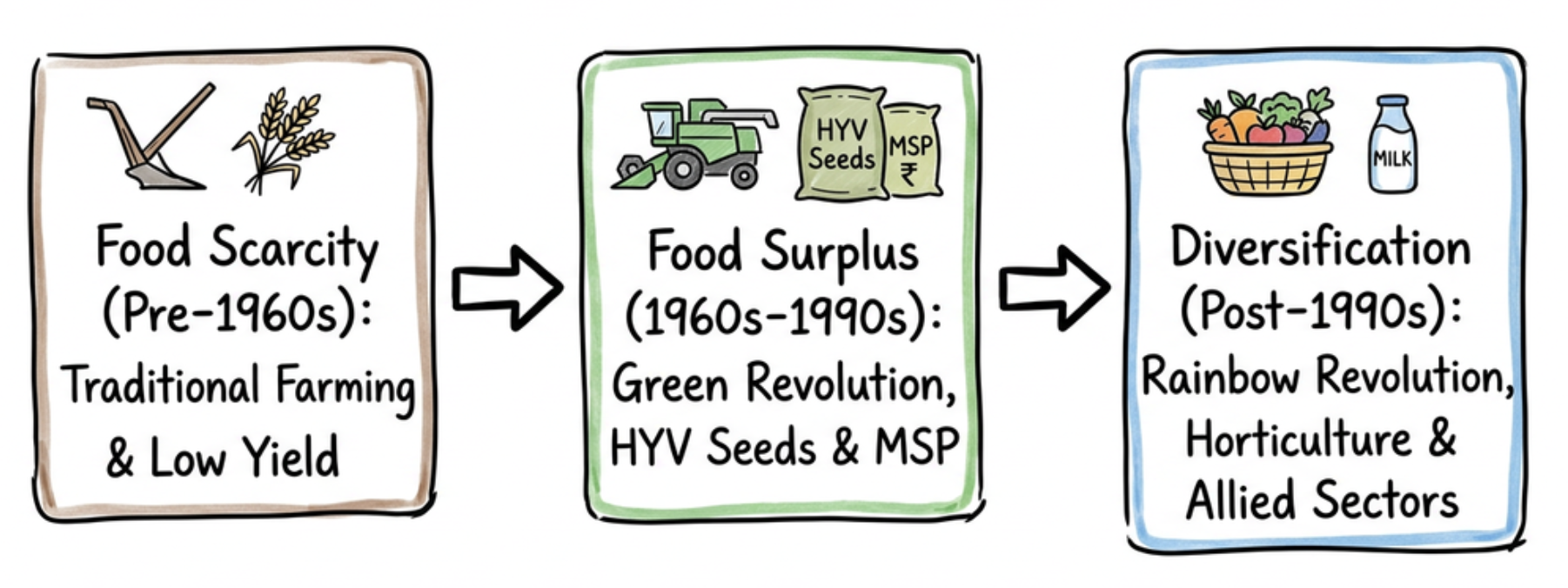
Evolution of Indian Agriculture from Food Scarcity to Diversification
Factors Transforming India from Food Scarcity to Food Surplus
-
High Yielding Varieties: Adoption of intensive farming using seeds developed by Indian Council of Agricultural Research increased productivity.
- Eg: Wheat production grew significantly following the introduction of Mexican dwarf varieties in 1966.
-
Technological Infrastructure: Expansion of canal networks and energized tube wells under Pradhan Mantri Krishi Sinchayee Yojana reduced monsoon dependence.
-
Price Support Mechanism: Implementation of Minimum Support Price by the Commission for Agricultural Costs and Prices incentivized surplus production.
-
Institutional Credit Access: Scaling of Kisan Credit Cards and Priority Sector Lending targets allowed farmers to purchase modern inputs.
-
Buffer Stock Management: Creation of robust storage by Food Corporation of India prevented post-harvest losses and stabilized prices.
- Eg: Central buffer stock in May 2026 stood at four times the prescribed norm.
-
Fertilizer Subsidy Regime: Provision of affordable nutrients through the Nutrient Based Subsidy policy ensured soil fertility for high output.
-
Research and Extension: Dissemination of modern practices through Krishi Vigyan Kendras bridged the lab to the land gap for smallholders.
Government Policies for Agricultural Diversification
-
Crop Diversification Programme: Promotion of shifting from water intensive paddy to pulses and oilseeds under PM-RKVY framework.
- Eg: Farmers in Punjab and Haryana shifted to maize and vegetables by October 2025.
-
Oilseed Self Reliance: Launch of Mission for Aatmanirbharta in Pulses with 11,440 crore rupees to reduce import bills.
-
High Value Horticulture: Focus on spices, cashew, and sandalwood under Union Budget 2026-27 to enhance rural incomes.
-
Allied Sector Incentives: Support for livestock and fisheries which recorded 7.1 percent and 8.8 percent growth respectively in 2025.
-
Natural Farming Transition: Implementation of National Mission on Natural Farming 2024 to encourage chemical free diverse cropping systems.
-
Agri Business Support: Provision of financial assistance for value addition projects through the Rashtriya Krishi Vikas Yojana umbrella.
-
Alternative Pricing Strategies: Utilization of ethanol pricing and PM-AASHA to make non-cereal crops financially attractive to growers.
-
Digital Integration: Deployment of the Digital Agriculture Mission to provide real time market data for diverse produce.
The Economic Survey 2025-26 emphasizes that while surplus is achieved, shifting toward horticulture and the Blue Revolution is vital. Strengthening the e-NAM platform and Agriculture Infrastructure Fund will ensure sustainable farm prosperity.
Answer Length
Model answers may exceed the word limit for better clarity and depth. Use them as a guide, but always frame your final answer within the exam’s prescribed limit.
Evaluate this PYQ now
Write your answer & evaluate in just 60 seconds




500+ students evaluated
Model Answers from
- 2026Economy15 MarksView Answer
Discuss the different types of subsidies and support provided by the Government of India to the agricultural sector. Examine the related issues pertaining to the Agreement on Agriculture of the World Trade Organisation (WTO).
- 2026Economy15 MarksView Answer
How are startups in India promoting entrepreneurship, innovation and employment? Discuss the global and domestic challenges in their working and suggest suitable measures to overcome these challenges.
- 2026Economy15 MarksView Answer
Explain the key challenges for India's energy security. What measures do you suggest for ensuring energy security along with economic growth and sustainability?
- 2026Economy10 MarksView Answer
Explain the factors responsible for inefficiency of agri-produce marketing. How does e-commerce help to reduce inefficiency of agri-produce marketing? Explain.
- 2026Economy10 MarksView Answer
Describe the various Technology Missions initiated in Indian agriculture and examine their role in food security.
- 2026Economy10 MarksView Answer
Examine the view that financial inclusion is an integral part of social and economic inclusion in a country like India. Also throw light on the usefulness of the R.B.I.'s Financial Inclusion Index.
Model Answers by Subject


Crack UPSC with your
Personal AI Mentor
An AI-powered ecosystem to learn, practice, and evaluate with discipline



