How are startups in India promoting entrepreneurship, innovation and employment? Discuss the global and domestic challenges in their working and suggest suitable measures to overcome these challenges.
How are startups in India promoting entrepreneurship, innovation and employment? Discuss the global and domestic challenges in their working and suggest suitable measures to overcome these challenges.
As per the DPIIT, India’s startup ecosystem has generated over 23.36 lakh direct jobs as of 2026, leveraging the Startup India Seed Fund Scheme to catalyze domestic innovation. However, persistent regulatory and funding hurdles complicate this growth trajectory.
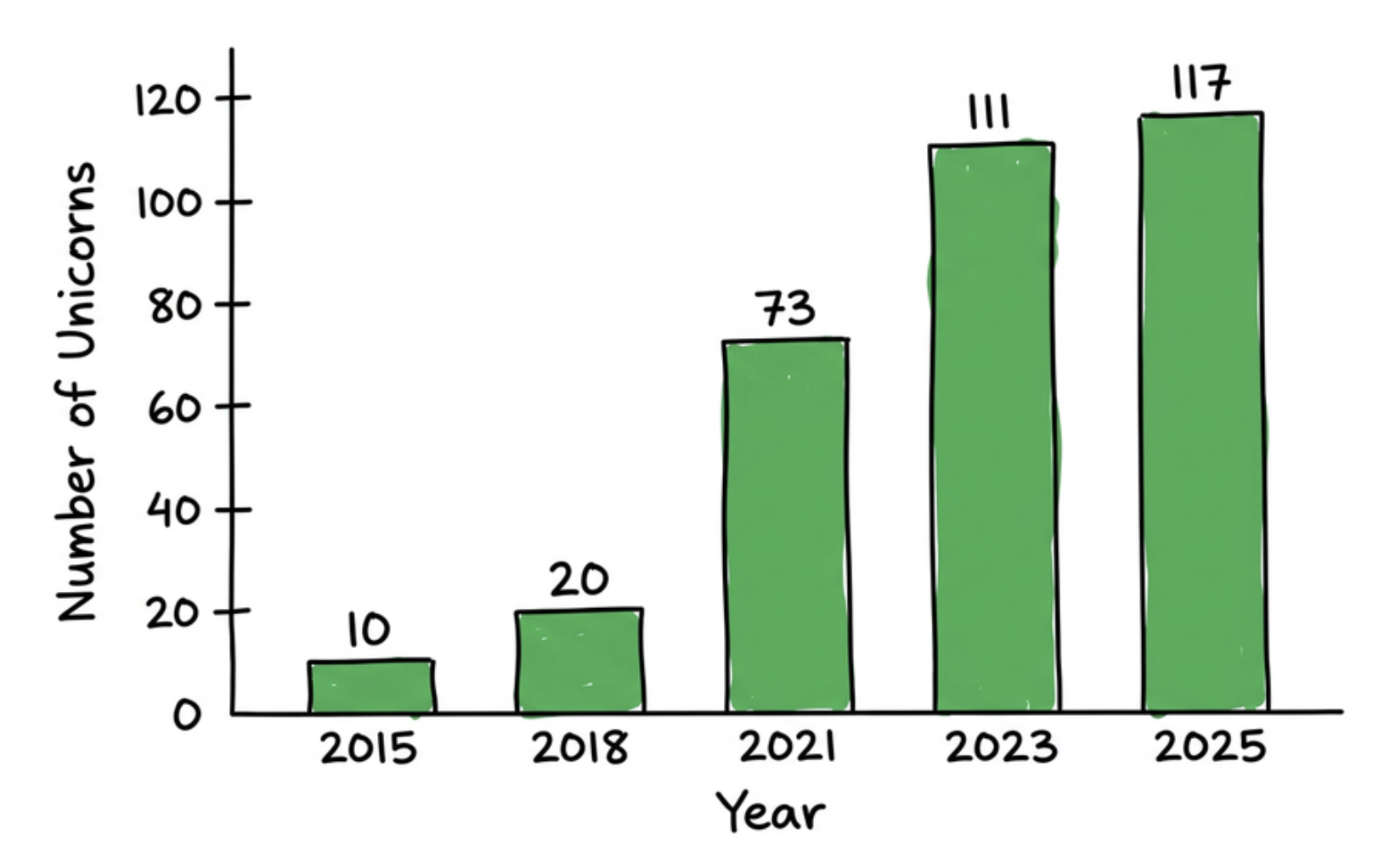
Growth of Unicorns in India, 2015, 2025
Role of Startups in Entrepreneurship, Innovation, and Employment
-
Democratizing Entrepreneurship: Decentralizing ecosystems beyond Tier-1 cities.
- Eg: Stand-Up India Scheme loans up to Rs 1 crore for women and SC/ST, 2026.
-
Accelerating Technological Innovation: Solving social problems via high-frontier technology.
- Eg: IndiaAI Mission Rs 10,372 crore for AI models and robotics, 2026.
-
Massive Job Creation: Absorbing technical and non-technical workforces.
- Eg: 23.36 lakh direct jobs generated by March 2026.
-
DeepTech Advancement: Moving research to industrial prototypes.
- Eg: NIDHI-PRAYAS 2.0 Rs 40 lakh at Advance PRAYAS Centres, August 2026.
-
Sectoral Diversification: Expanding into Space Tech, Semiconductors, and CleanTech.
- Eg: EV infrastructure and Defencetech funding rounds, 2026.
Global and Domestic Challenges in the Startup Ecosystem
-
Funding Structural Imbalance: Friction in securing long-term capital for extended gestations.
- Eg: NASSCOM 2026 report on limited growth-stage capital for DeepTech.
-
Commercialization Hurdles: Struggles in securing early customer bases.
- Eg: Zinnov-nasscom 2026 report on technical success failing to scale.
-
Global Macroeconomic Volatility: Interest rates and geopolitical tensions affecting venture capital.
- Eg: Global Confluence 2026 on capital alignment criticality.
-
Regulatory Complexity: Navigating ministerial departments for compliance.
- Eg: June 2026 DPIIT Playbook consolidating departmental information.
-
Talent Mismatch: Skill gaps in emerging generative AI technologies.
- Eg: Semiconductor design and Industrial Automation expert shortages.
Suggested Measures to Overcome Challenges
-
Enhancing Debt Financing: Providing credit through robust guarantees.
- Eg: Credit Guarantee Scheme for Startups (CGSS) limit raised to Rs 20 crore, 2026.
-
Boosting Early-Stage Grants: Reducing mortality through non-dilutive funding.
- Eg: Startup India Seed Fund Scheme (SISFS) grants up to Rs 20 lakh.
-
Promoting Industry-Academia Linkages: Strengthening incubators to bridge innovation and utility.
- Eg: TIDE 2.0 prototype funding up to Rs 7 lakh, 2026.
-
Simplifying Regulatory Frameworks: Raising recognition thresholds to enable scaling.
- Eg: February 2026 turnover ceiling increase to Rs 200 crore.
-
Targeted Sectoral Support: Ensuring balanced growth via specialized grants.
- Eg: BIRAC BIG Grant updated May 2026 for biotech ventures, Rs 50 lakh.
Scaling the Startup India Action Plan and aligning with NITI Aayog frameworks will ensure long-term stability. Adopting global best practices from the Global Innovation Index will further solidify India's economic sovereignty.
Answer Length
Model answers may exceed the word limit for better clarity and depth. Use them as a guide, but always frame your final answer within the exam’s prescribed limit.
Evaluate this PYQ now
Write your answer & evaluate in just 60 seconds




500+ students evaluated
Model Answers from
- 2026Economy15 MarksView Answer
Discuss the different types of subsidies and support provided by the Government of India to the agricultural sector. Examine the related issues pertaining to the Agreement on Agriculture of the World Trade Organisation (WTO).
- 2026Economy15 MarksView Answer
How has Indian agriculture been transformed from food scarcity to food surplus level? Explain the various government policies implemented for diversification of Indian agriculture.
- 2026Economy15 MarksView Answer
Explain the key challenges for India's energy security. What measures do you suggest for ensuring energy security along with economic growth and sustainability?
- 2026Economy10 MarksView Answer
Explain the factors responsible for inefficiency of agri-produce marketing. How does e-commerce help to reduce inefficiency of agri-produce marketing? Explain.
- 2026Economy10 MarksView Answer
Describe the various Technology Missions initiated in Indian agriculture and examine their role in food security.
- 2026Economy10 MarksView Answer
Examine the view that financial inclusion is an integral part of social and economic inclusion in a country like India. Also throw light on the usefulness of the R.B.I.'s Financial Inclusion Index.
Model Answers by Subject


Crack UPSC with your
Personal AI Mentor
An AI-powered ecosystem to learn, practice, and evaluate with discipline