Explain the key challenges for India's energy security. What measures do you suggest for ensuring energy security along with economic growth and sustainability?
Explain the key challenges for India's energy security. What measures do you suggest for ensuring energy security along with economic growth and sustainability?
While the National Green Hydrogen Mission aims to decarbonize heavy industries, India remains constrained by a 90 percent crude oil import dependency and a power grid currently relying on 70 percent fossil fuel generation.
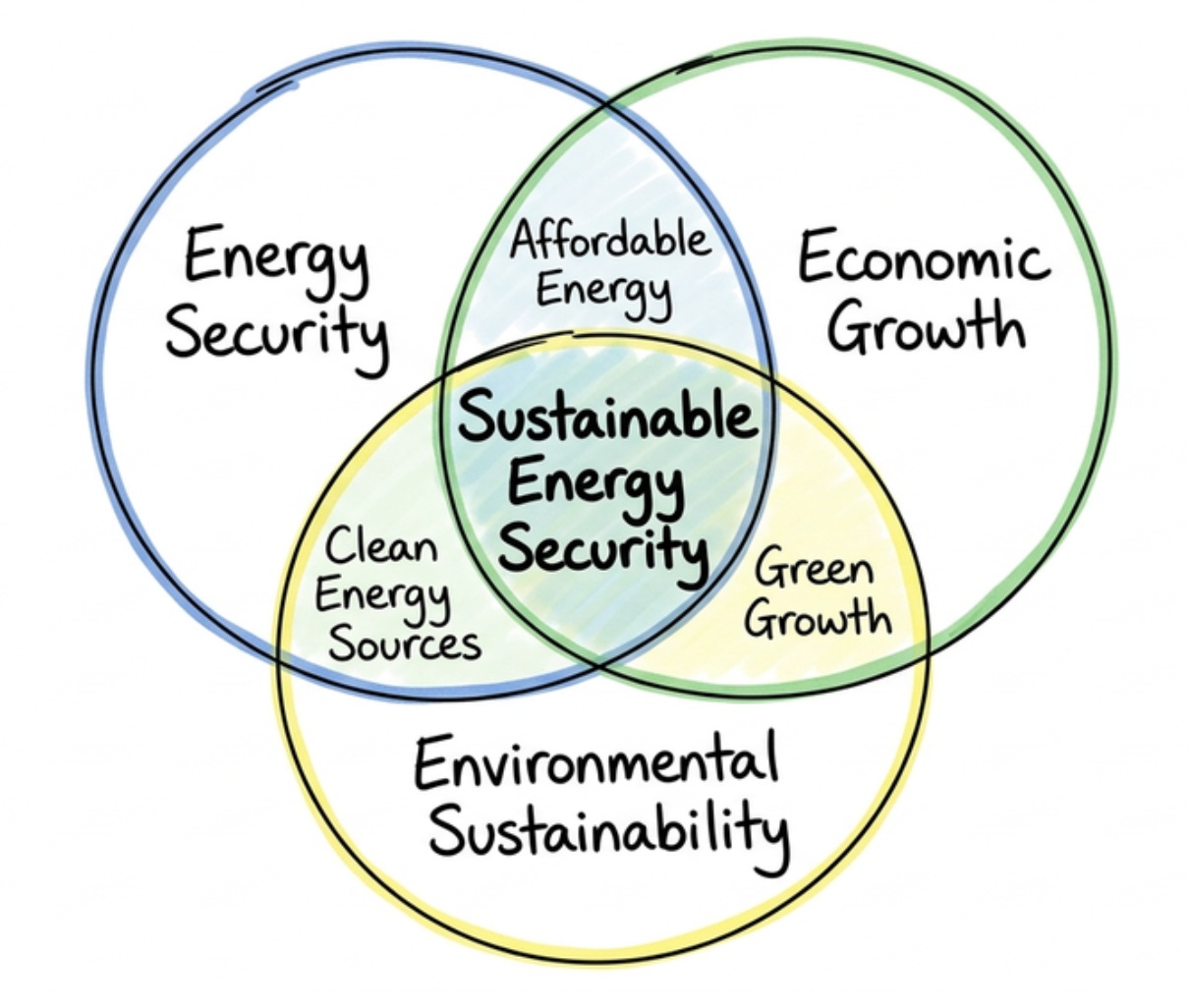
Sustainable Energy Security through Energy, Economic and Environmental Balance
Key Challenges for India's Energy Security
-
High Hydrocarbon Import Dependency: India imports 90% crude oil and 50% natural gas.
- Eg: 122 billion dollar import bill, 2025-26 trade data.
-
Coal Dominance in Power Generation: Fossil fuels provide 70% electricity with coal at 68% in early 2026.
- Eg: Coal reliance versus renewable sector growth.
-
Critical Mineral Supply Chains: Energy transition requires lithium and cobalt.
- Eg: Union Budget 2026 domestic mining push.
-
Grid Stability and Integration: Intermittent renewables challenge national transmission.
- Eg: Investment requirements for Battery Energy Storage Systems.
-
Financial Health of Discoms: Debt and losses hinder infrastructure modernization.
- Eg: Billing and collection strain on state utilities.
-
Geopolitical Volatility and Price Shocks: Global conflicts disrupt energy supplies.
- Eg: West Asian instability and LNG costs.
-
Infrastructure Bottlenecks in Clean Energy: Manufacturing shortages slow the green transition.
- Eg: Production Linked Incentive renewable manufacturing schemes.
Suggested Measures for Growth and Sustainability
-
Accelerated Solar Rooftop Adoption: Implement the PM Surya Ghar Muft Bijli Yojana.
- Eg: 20,000 crore allocation, 2025-26 budget.
-
Diversification through Nuclear Power: Expand capacity for carbon-free baseload.
- Eg: Shanti Act of 2025 private participation.
-
Scaling the Green Hydrogen Ecosystem: Fund the National Green Hydrogen Mission.
- Eg: 600 crore allocation, 2025-26 budget.
-
Enhanced Battery Storage Infrastructure: Utilize Viability Gap Funding for Battery Energy Storage Systems.
- Eg: 30 GWh storage capacity target.
-
Promotion of Electric Mobility: Expand the PM E-Drive scheme.
- Eg: 9,570 crore outlay for commercial electrification.
-
Carbon Capture and Storage Deployment: Integrate Carbon Capture, Utilisation and Storage technologies.
- Eg: 2.2 billion dollar Union Budget 2026 earmark.
-
Modernizing the National Electricity Policy: Align the Draft National Electricity Policy 2026 with targets.
- Eg: 60 percent non-fossil capacity target, 2035.
-
Strengthening Strategic Petroleum Reserves: Expand storage in Padur and Chandikhol.
- Eg: Reserve expansion for national resilience.
Synthesizing the National Green Hydrogen Mission with the Energy Conservation Act mandates will facilitate reaching Net Zero 2070, ensuring that India achieves economic resilience through sustainable energy leadership.
Answer Length
Model answers may exceed the word limit for better clarity and depth. Use them as a guide, but always frame your final answer within the exam’s prescribed limit.
Evaluate this PYQ now
Write your answer & evaluate in just 60 seconds




500+ students evaluated
Model Answers from
- 2026Economy15 MarksView Answer
Discuss the different types of subsidies and support provided by the Government of India to the agricultural sector. Examine the related issues pertaining to the Agreement on Agriculture of the World Trade Organisation (WTO).
- 2026Economy15 MarksView Answer
How has Indian agriculture been transformed from food scarcity to food surplus level? Explain the various government policies implemented for diversification of Indian agriculture.
- 2026Economy15 MarksView Answer
How are startups in India promoting entrepreneurship, innovation and employment? Discuss the global and domestic challenges in their working and suggest suitable measures to overcome these challenges.
- 2026Economy10 MarksView Answer
Explain the factors responsible for inefficiency of agri-produce marketing. How does e-commerce help to reduce inefficiency of agri-produce marketing? Explain.
- 2026Economy10 MarksView Answer
Describe the various Technology Missions initiated in Indian agriculture and examine their role in food security.
- 2026Economy10 MarksView Answer
Examine the view that financial inclusion is an integral part of social and economic inclusion in a country like India. Also throw light on the usefulness of the R.B.I.'s Financial Inclusion Index.
Model Answers by Subject


Crack UPSC with your
Personal AI Mentor
An AI-powered ecosystem to learn, practice, and evaluate with discipline



